
Most B2B marketers treat newsletters like a quarterly obligation, something to check off before moving on to paid ads or social media. That's a costly mistake. Only half of B2B marketers use newsletters despite their proven ability to build trust, nurture leads, and drive long-term revenue. This guide breaks down exactly why newsletters deserve a front-row seat in your marketing strategy, how to build ones that actually perform, how to measure what matters, and how to connect them to every stage of your sales funnel. If you've been sleeping on newsletters, this is your wake-up call.
Table of Contents
- Why newsletters matter in the B2B customer journey
- Best practices for creating high-performance B2B newsletters
- driving results: measuring newsletter impact beyond open rates
- From strategy to action: integrating newsletters with your B2B marketing funnel
- Why most B2B newsletters fail (and what actually works)
- harness B2B newsletters for your business growth
- frequently asked questions
Key Takeaways
| Point | Details |
|---|---|
| Newsletters nurture leads | Valuable content in B2B newsletters builds trust and advances buyers along their journey. |
| Best practices matter | Consistent cadence, personal sender, and engaging formats multiply newsletter effectiveness. |
| Measure what counts | Track pipeline influence and long-term value, not just opens and clicks. |
| Target the right audience | Careful behavioral segmentation maximizes engagement and return on investment. |
| Integrate for growth | Embedding newsletters into a coordinated B2B marketing funnel accelerates results. |
Why newsletters matter in the B2B customer journey
There's a common mix-up between newsletters and promotional emails. A promotional email says, "Buy this now." A newsletter says, "Here's something useful for your business." That distinction is everything in B2B, where buying cycles are long and trust is earned slowly.
B2B newsletters prioritize value over promotion and guide leads through each stage of the customer journey. Think of it this way: a prospect who reads your newsletter for three months before ever booking a call already trusts you. That's not an accident. That's a strategy.
Here's how newsletters touch each stage of the B2B buying process:
- awareness: Your newsletter introduces your brand's perspective and expertise to cold or warm leads who aren't ready to buy yet.
- consideration: Regular, informative content keeps your brand top-of-mind while prospects evaluate their options.
- decision: A well-timed case study or success story in your newsletter can tip the scale in your favor.
- retention and loyalty: Post-sale newsletters reinforce value, reduce churn, and open doors for upsells.
"The best B2B newsletters don't feel like marketing. They feel like a trusted colleague sharing something genuinely useful."
Most small businesses skip this entirely. They send a newsletter once, get modest results, and abandon the channel. What they miss is that educational B2B newsletters build compounding authority over time. Each issue adds another layer of credibility. Our B2B marketing blog covers this in more depth, but the core idea is simple: newsletters are a relationship tool, not a sales tool. Use them that way.

Best practices for creating high-performance B2B newsletters
Knowing why newsletters work is step one. Building ones that actually perform is step two. The difference between a newsletter people open and one they ignore comes down to a handful of decisions made before you hit send.
Here's a proven framework for high-performance B2B newsletters:
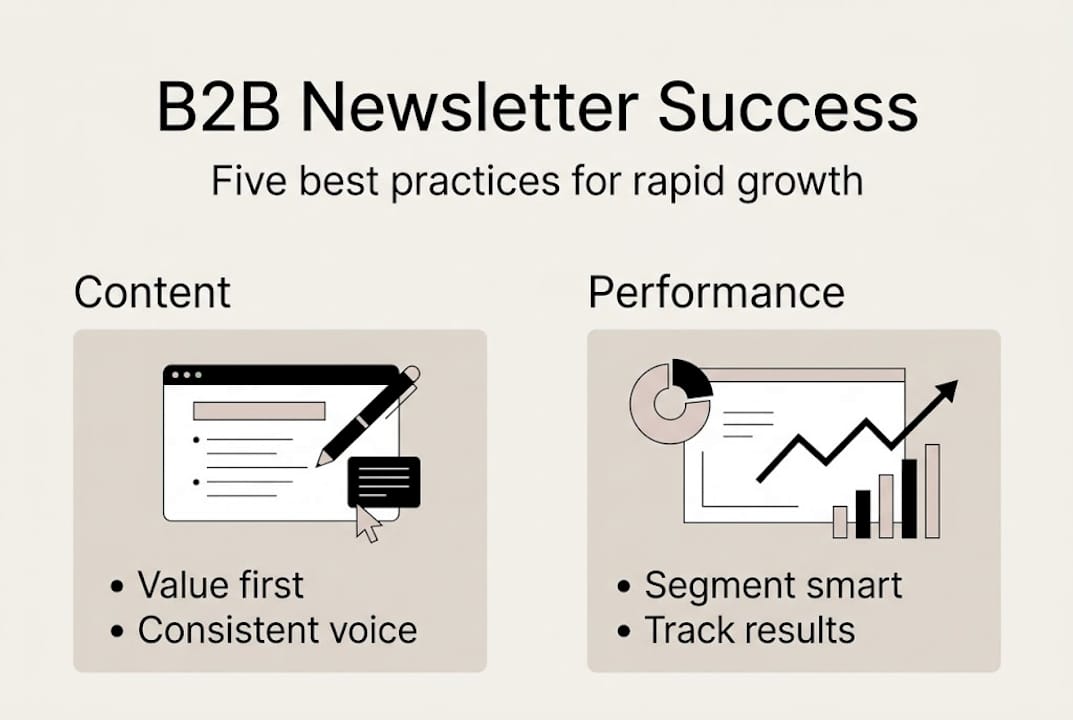
- Use a consistent, personal sender name. "Sarah from GrowthCo" outperforms "GrowthCo Marketing" every time. People open emails from people, not brands.
- Write skimmable content. Use short paragraphs, bold key phrases, and clear section headers. Your readers are busy. Make it easy to extract value fast.
- Send on the right day and time. Best open rates for B2B newsletters cluster around Tuesday through Thursday mornings, between 8 a.m. and 10 a.m. in the recipient's time zone.
- Mix your media. Don't just write articles. Include a short video clip, a quick data point, or a curated industry link. A varied format keeps readers engaged issue after issue.
- End with a PS. A conversational postscript with a single call to action consistently drives clicks. It feels personal, not pushy.
Pro tip: Your PS is prime real estate. Use it to pitch one thing only, whether that's booking a call, downloading a resource, or checking out a new service page. One ask beats three every time.
Here's a quick look at how different newsletter formats stack up:
| Newsletter type | Primary goal | Best for | Key metric to watch |
|---|---|---|---|
| Educational roundup | Build authority | Cold and warm leads | Click-through rate |
| Case study spotlight | Drive consideration | Mid-funnel prospects | Reply rate |
| Product or service update | Drive conversions | Active customers | Pipeline influence |
| Industry news digest | Stay top-of-mind | All segments | Open rate |
| Mixed format | Full-funnel nurture | All segments | LTV and engagement |
Your marketing services strategy should dictate which format you lead with. If your audience is mostly cold leads, lean educational. If you're nurturing existing customers, spotlight results. And always keep web design best practices in mind when building your email template. A clean, mobile-friendly layout isn't optional in 2026.
driving results: measuring newsletter impact beyond open rates
Open rates feel good. They're easy to track and easy to report. But in B2B, a 30% open rate means nothing if it doesn't connect to revenue. The real question is: what did your newsletter actually influence?
Wrong newsletter subscribers quietly kill B2B ROI by inflating vanity metrics while dragging down deliverability and engagement scores. A list of 10,000 unqualified subscribers is worse than a list of 1,000 engaged buyers. Clean your list regularly.
Here are the metrics that actually matter for B2B newsletters:
- influenced pipeline: Track how many deals in your CRM touched a newsletter before closing.
- customer lifetime value (LTV): Do newsletter subscribers spend more over time? They usually do.
- net promoter score (NPS): Survey your newsletter audience. High NPS correlates with referral growth.
- reply rate: Are people responding to your emails? That's a signal of genuine engagement.
- unsubscribe and spam rate: Rising numbers here mean your content or list quality needs attention.
| Impact metric | What it measures | Why it matters |
|---|---|---|
| Pipeline influence | Revenue touched by newsletter | Shows direct business impact |
| LTV by segment | Long-term customer value | Links content to retention |
| NPS from subscribers | Reader satisfaction and loyalty | Early signal of referral potential |
| Reply rate | Active two-way engagement | High trust indicator |
| List health score | Quality of your subscriber base | Poor health tanks deliverability |
Pro tip: Use behavioral targeting, not just demographic data, to segment your list. Someone who clicked your pricing page three times is a hotter lead than someone who fits your ideal customer profile on paper but never engages. Your SEO performance tracking tools can feed behavioral signals directly into your email segmentation.
From strategy to action: integrating newsletters with your B2B marketing funnel
A newsletter sitting in isolation is a missed opportunity. The real power comes when you connect it to everything else you're doing, from social media to retargeting to your sales team's outreach.
behavioral targeting and educational content consistently outperform demographic segmentation for newsletter-fueled B2B engagement. That means building your integration around what people do, not just who they are.
Here's a step-by-step workflow for multi-channel newsletter integration:
- Map content to funnel stages. Write awareness content for new subscribers, consideration content for mid-funnel readers, and decision content for prospects who've visited your pricing or services pages.
- Share newsletter content on LinkedIn. Turn each newsletter into a LinkedIn post or article. This extends reach and drives new subscribers from your social audience.
- Use newsletter clicks to trigger retargeting. If someone clicks your case study link, add them to a Facebook ads retargeting audience. That's a warm lead worth pursuing.
- Alert your sales team. When a prospect opens three newsletters in a row or clicks a pricing link, that's a buying signal. Set up automated alerts so your team can follow up at the right moment.
- Loop back with loyalty content. Post-sale, send newsletters that help customers get more value from your product or service. This reduces churn and opens natural upsell conversations.
For businesses exploring B2B sourcing strategies, newsletters can also serve as a supplier communication channel, keeping partners informed and aligned without the noise of social media. The funnel doesn't end at the sale. Your newsletter can be the thread that holds the entire customer relationship together.
Why most B2B newsletters fail (and what actually works)
Here's the uncomfortable truth: most B2B newsletters fail not because of bad writing or poor design, but because of bad habits. The three biggest killers are poor list hygiene, generic content, and "batch and blast" sending, where you send the same message to everyone regardless of where they are in the buying journey.
Wrong subscribers quietly kill ROI for B2B newsletters by dragging down your sender reputation and distorting your data. You can't make smart decisions from dirty data.
The real differentiator is behavioral segmentation. Not "who is this person" but "what has this person done." Did they click a specific article? Did they visit your website after reading? Did they forward your email to a colleague? Those actions tell you far more than a job title ever will.
Over-selling is another trust killer. The moment your newsletter starts feeling like a sales pitch, readers disengage. Building a loyal newsletter audience is a long game. It takes months of consistent, genuine value before you see compounding returns. Our experience with B2B-to-B2C launch clients confirms this: the businesses that stay patient and stay educational always outperform those chasing quick wins.
harness B2B newsletters for your business growth
You now have the framework. You understand why newsletters matter, how to build them, what to measure, and how to connect them to your full marketing funnel. The next step is execution, and that's where most businesses get stuck.
At sourcesnova, we help small and mid-size businesses turn strategy into results without the bloated retainers or jargon. Whether you need help building a newsletter program from scratch, cleaning up your list, or connecting email to your broader digital strategy, our B2B sourcing solutions and full-service approach have you covered. Visit sourcesnova to explore how we can support your growth goals and turn your newsletter into one of your most valuable marketing assets.
frequently asked questions
What makes a B2B newsletter different from a regular promotional email?
B2B newsletters emphasize valuable, educational content over direct selling to build long-term relationships. newsletters focus on value and nurturing leads rather than pushing immediate purchases.
How often should B2B newsletters be sent for best results?
Monthly or bi-monthly sending delivers strong engagement without overwhelming subscribers. A consistent monthly cadence is the most widely recommended approach for B2B audiences.
What metrics should B2B marketers track for newsletter success?
Key metrics include influenced sales pipeline, subscriber engagement, and customer lifetime value. Track pipeline influence and LTV for a true picture of newsletter impact.
Does segmentation really matter for B2B newsletters?
Yes, segmenting by behavior and interests drives significantly better engagement than demographic targeting alone. behavioral segmentation is more effective for B2B newsletter engagement than sorting by industry or company size.
Is it important to include a call to action in every B2B newsletter?
Yes, clear calls to action, even in a subtle PS, boost click-through rates and drive next steps. Adding a PS for the pitch is a proven tactic for increasing newsletter-driven revenue.