
Aluminum is a viable, market-ready material for the U.S. coffee-maker market when specified and finished correctly. Moka pots, stovetop percolators, outdoor camping pots, and premium filter housings all have established U.S. buyer segments. Your immediate priorities are confirming FDA food-contact compliance, selecting a finish (anodized vs. painted), addressing induction compatibility in your product specs and labeling, and securing third-party testing before you approach any U.S. retailer or distributor.
- Confirm FDA food-contact compliance and obtain third-party test reports before any U.S. buyer conversation.
- Define your finish — anodized (Type II or III) protects against corrosion and supports premium pricing; painted or raw finishes require more explicit care instructions.
- Label induction compatibility accurately — traditional aluminum pots require a separate induction adapter plate; this must appear on packaging.
- Plan third-party testing and product liability insurance in parallel with product development, not after.
Pro Tip: Sourcesnova works with Asian manufacturers at every stage of U.S. market entry, from compliance consulting and RFQ-ready website builds to B2B lead generation and DTC launch packages. Starting with a market-entry audit saves months of trial and error.
Table of Contents
- What makes aluminum a strong choice for coffee makers?
- Which aluminum coffee-maker formats sell in the U.S.?
- What alloy specs and finishes do U.S. buyers expect?
- What compliance steps are required before selling in the U.S.?
- How do U.S. distribution channels affect your product specs?
- How do Asian manufacturers win U.S. customers digitally?
- What does your U.S. launch checklist look like operationally?
- Five-step U.S. launch roadmap
- Key Takeaways
- What most manufacturers get wrong about the U.S. aluminum coffee-maker market
- How Sourcesnova helps you enter the U.S. aluminum coffee-maker market
- Useful sources
What makes aluminum a strong choice for coffee makers?
Aluminum's thermal conductivity is its most commercially relevant property for coffee makers. It heats quickly and distributes heat evenly across the base and walls of a pot, which shortens brew times and supports consistent extraction. That speed matters most in stovetop formats like moka pots and percolators, where fast, even heat distribution directly affects cup quality.
Weight is the second advantage. Aluminum is significantly lighter than stainless steel, which makes it the default material for camping percolators and portable stovetop pots. For outdoor enthusiasts, that weight difference is a purchase driver, not just a spec detail.
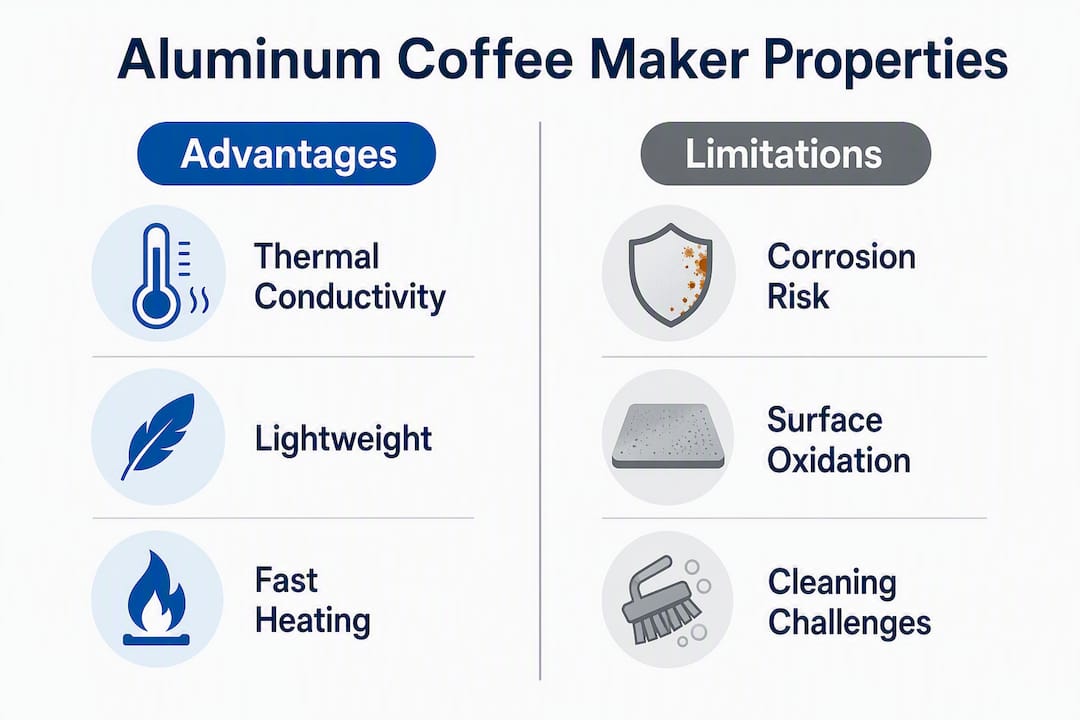
The limitation is corrosion. Untreated aluminum oxidizes when exposed to water, acidic coffee oils, and detergents. Washing aluminum in dishwashers or with aggressive detergents causes surface oxidation and permanent damage that alters flavor. This is why finish selection is a product decision, not just an aesthetic one.
| Property | Aluminum | Stainless Steel |
|---|---|---|
| Thermal conductivity | High — fast, even heating | Lower — slower heat-up |
| Weight | Light — ideal for portable formats | Heavier |
| Corrosion resistance (untreated) | Moderate — oxidizes without finish | High |
| Induction compatibility | No (requires adapter) | Yes (ferritic grades) |
| Dishwasher safety | No — damages surface and flavor | Generally yes |
| Premium finish options | Anodized, brushed, matt | Brushed, polished |
When commercial kitchens or induction-native designs are the target, stainless steel is the more practical choice. For stovetop, camping, and design-forward DTC formats, aluminum wins on weight and aesthetics.
Which aluminum coffee-maker formats sell in the U.S.?
Moka and stovetop pots are the highest-profile aluminum coffee-maker category in the U.S. Bialetti's Moka Express — made from 100% recyclable aluminum with a patented safety valve — is the category reference point. U.S. buyers in this segment skew toward heritage and ritual positioning. They expect hand-wash-only guidance, a visible safety valve, and an octagonal or classic silhouette. DTC and specialty retail are the natural channels.

Camping and outdoor percolators serve a distinct buyer: outdoor enthusiasts who prioritize rust resistance and portability. Capacities range from 9-cup home-style percolators to 2.5-gallon commercial units. These products sell through outdoor retail chains, Amazon, and wholesale distributors. Marketing copy emphasizes durability, easy cleanup, and group capacity.
Premium automated filter machines use brushed or matt aluminum as a design signal. The Wilfa Zense Alux, with its brushed aluminum construction and 5-year guarantee, demonstrates how finish quality supports premium DTC pricing. Nordic/minimal aesthetics translate well to U.S. specialty retail and design-conscious DTC buyers.
Value and cultural-market stovetop pots occupy a separate segment. IMUSA's 12-cup cast aluminum stovetop coffeemaker targets Latin American and multicultural households with even heat distribution, a cool-touch handle, and a flip-top spout. This segment suits mass retail and wholesale distribution.
| Format | Target channel | Key buyer motivation | Price positioning |
|---|---|---|---|
| Moka/stovetop pot | DTC, specialty retail | Heritage, ritual | Mid to premium |
| Camping percolator | Outdoor retail, Amazon | Portability, durability | Budget to mid |
| Premium filter machine | DTC, specialty retail | Design, performance | Premium |
| Value stovetop pot | Mass retail, wholesale | Affordability, cultural fit | Budget |
What alloy specs and finishes do U.S. buyers expect?
Alloy selection affects both food safety and mechanical performance. Aluminum alloys used in cookware and consumer appliances are typically chosen for corrosion resistance, machinability, and food-contact suitability. Confirm your alloy's food-contact status with your testing lab before finalizing specs.
Finish options and their trade-offs:
- Type II anodizing — standard for consumer cookware; improves corrosion resistance and scratch resistance; supports a clean, matte appearance.
- Type III (hard anodizing) — thicker oxide layer; used for premium or commercial-grade products; higher cost but stronger durability claims.
- Pulse anodizing — an advanced process that improves surface durability and allows tighter control over finish consistency; relevant for premium DTC positioning.
- Painted/powder-coated exteriors — lower cost; require explicit care instructions since chips expose raw aluminum.
- Food-safe interior coatings — used in some drip and percolator designs; require separate food-contact testing.
Critical mechanical parts for moka pots specifically: the safety valve must be easy to inspect and clean, as Bialetti's patented valve design demonstrates. Gasket materials must be food-safe and heat-resistant. Handles must meet heat-resistance standards to prevent burn injuries.
Pro Tip: Build lot traceability into your production from day one. U.S. retailers and Amazon require country-of-origin disclosure and lot codes on packaging. Retrofitting this after your first shipment is expensive and delays re-orders.
What compliance steps are required before selling in the U.S.?
FDA food-contact requirements apply to any aluminum component that contacts food or beverage. The FDA's food-contact materials guidance covers both the base material and any coatings or gaskets. Third-party test reports from an accredited U.S. lab are what buyers and retailers actually ask for — not self-declarations.
Required and strongly recommended steps:
- FDA food-contact documentation — obtain third-party extractables and leachables test reports for all food-contact surfaces (aluminum body, gaskets, coatings).
- Pressure and valve safety testing — for moka pots, verify that the safety valve releases at the correct pressure threshold under worst-case use conditions.
- Induction compatibility labeling — state clearly on packaging whether the product requires an adapter plate. Omitting this generates returns and negative reviews.
- Dishwasher incompatibility warning — include explicit "hand wash only" labeling. Aluminum moka pots are not dishwasher safe; detergents cause oxidation and flavor changes that drive negative reviews.
- California Proposition 65 — IMUSA's product page discloses aluminum alloy constituents including nickel and manganese compounds. If your alloy contains listed chemicals above threshold levels, a Prop 65 warning is required for California sales.
- Product liability insurance — U.S. distributors and major retailers typically require proof of product liability coverage before signing a purchase order.
- Instruction manual — include clear guidance on overfilling risks for moka pots. Overfilling or tamping the funnel increases pressure beyond the valve's design range, causing safety issues and warranty claims.
This article is general information, not legal or regulatory advice. Confirm current FDA requirements and Prop 65 thresholds with a qualified compliance professional for your specific product.
How do U.S. distribution channels affect your product specs?
Channel choice changes what your product needs to look like before it ships.
- DTC/e-commerce — premium packaging, detailed product photography, and a brand story. Minimum order quantities are low; lead times are tight. Your product page must address induction compatibility, dishwasher safety, and finish care directly.
- Amazon — requires UPCs, Brand Registry enrollment, and A+ content. Customer review risk is high for products with unclear care instructions. Prep your packaging for FBA requirements before your first shipment.
- Specialty retail and wholesale — buyers expect certifications, demo-ready packaging, and distributor terms with net-30 or net-60 payment. Third-party test reports are often a listing prerequisite.
- Trade shows and B2B outreach — RFQ flows, sample policies, and localized sales materials matter. U.S. buyers at trade shows expect a one-page spec sheet, a sample, and a clear MOQ/pricing structure.
- Confirm channel requirements before finalizing packaging dimensions and materials.
- Build a channel-specific price sheet: DTC MSRP, wholesale price, and Amazon-landed cost are three different numbers.
- Prepare a sample kit with production-identical parts, test reports, and a COO declaration before any buyer meeting.
Pro Tip: For Amazon specifically, invest in A+ content that includes a care instructions module. Products with clear hand-wash-only and induction-adapter guidance consistently generate fewer returns and better reviews.
How do Asian manufacturers win U.S. customers digitally?
The manufacturers who gain traction fastest in the U.S. are not the ones with the lowest price. They are the ones whose product pages answer every buyer question before it gets asked — FDA testing status, finish durability, induction compatibility, and care instructions, all visible above the fold.
Product content and SEO drive organic wholesale and DTC traffic. Pages targeting buyer-intent keywords ("aluminum stovetop coffee pot wholesale," "anodized moka pot manufacturer") convert better when they lead with test documentation, finish specs, and MOQ details rather than generic brand copy.
- B2B RFQ pages — build a dedicated landing page with product specs, certifications, MOQ, and a short RFQ form. LinkedIn outreach to U.S. specialty retail buyers and distributors should link directly to this page.
- DTC paid social — creative that emphasizes finish quality and ritual (for moka pots) or portability and performance (for camping percolators) outperforms generic product shots. Pack-sample offers for micro-influencers in the coffee and outdoor niches build review velocity before a full launch.
- Email funnels — a post-purchase sequence covering care instructions, induction adapter guidance, and recipe suggestions reduces returns and increases repeat purchase rates.
What does your U.S. launch checklist look like operationally?
- Finalize alloy and finish spec; produce pilot samples — send production-identical samples with COO documentation, packing lists, and preliminary test reports.
- Third-party testing — budget 4–8 weeks for extractables/leachables, valve pressure, and any Prop 65 screening.
- Packaging, UPCs, and digital catalog — finalize retail-ready packaging with all required labeling; build your RFQ landing page and B2B materials.
- Pilot DTC listing via U.S. 3PL — small-batch warehousing through a U.S. third-party logistics provider reduces Amazon FBA prep complexity and gives you a domestic return address for DTC orders.
- Scale to wholesale and marketplace — once pilot reviews and return rates are acceptable, approach distributors and expand to Amazon with replenishment rules in place.
- Use aluminum sheet components for lightweight portable parts in camping-focused designs.
- Prepaid return labels for Amazon reduce negative feedback from customers who receive damaged or incorrect items.
- Price your DTC MSRP at a level that supports both a wholesale margin and an Amazon-landed cost without going below your floor.
Pro Tip: Ship samples to at least three U.S. buyers or reviewers before your official launch date. Real feedback on packaging, care instructions, and finish quality is worth more than any internal review.
Five-step U.S. launch roadmap
- Weeks 0–4: Finalize alloy and finish spec; produce pilot samples with full lot traceability.
- Weeks 4–8: Submit to accredited third-party lab for food-contact, valve pressure, and Prop 65 screening.
- Weeks 6–10: Finalize packaging, UPCs, and digital product catalog; prepare RFQ landing page and B2B sales materials.
- Weeks 10–14: Launch pilot DTC listing via U.S. 3PL; run targeted paid social to build review velocity.
- Week 14+: Scale to wholesale and Amazon with distributor agreements and inventory replenishment rules.
Manufacturers who run compliance testing and digital setup in parallel — not sequentially — consistently reach their first U.S. sale faster than those who treat them as separate phases.
Key Takeaways
Aluminum is a proven, market-ready material for U.S. coffee makers when anodizing and food-contact verification are treated as non-negotiable launch requirements, not optional upgrades.
| Point | Details |
|---|---|
| Finish determines viability | Anodized (Type II/III) aluminum passes food-contact scrutiny and supports premium pricing; raw or painted finishes require stricter care labeling. |
| Induction and dishwasher labeling | Both must appear on packaging; omitting either generates returns, negative reviews, and potential retailer chargebacks. |
| Channel shapes the product | Camping formats need portability and rust resistance; DTC premium needs finish quality; moka/stovetop needs a certified safety valve and gasket. |
| Compliance runs in parallel | Third-party testing, Prop 65 screening, and product liability insurance must start during product development, not after samples are approved. |
| Sourcesnova accelerates entry | Sourcesnova provides market-entry audits, RFQ-ready website builds, B2B lead generation, and DTC launch packages for Asian manufacturers entering the U.S. |
What most manufacturers get wrong about the U.S. aluminum coffee-maker market
The conventional wisdom says compliance is the hard part. It is not. The hard part is positioning. Most Asian manufacturers arrive with a technically sound product — correct alloy, proper anodizing, a working safety valve — and then lose six months because their product pages read like a factory spec sheet translated by software. U.S. buyers, whether they are a specialty retailer in Portland or a consumer on Amazon, make decisions based on trust signals: does this brand understand how I use this product? Does the page tell me whether it works on my induction cooktop before I have to ask?
The finish-to-channel mismatch is the second recurring problem. A brushed matt aluminum filter machine belongs in DTC and specialty retail with a story about Nordic design and precision brewing. The same product listed on a wholesale marketplace at a commodity price point destroys the margin and the brand simultaneously. Choosing the channel before finalizing the finish is the correct sequence, not the reverse.
The manufacturers who move fastest are the ones who treat digital setup — product content, RFQ flows, paid social creative — as part of the product launch, not a follow-on activity. Compliance and content in parallel, not in sequence.
How Sourcesnova helps you enter the U.S. aluminum coffee-maker market
Asian manufacturers launching aluminum coffee makers in the U.S. face a specific combination of challenges: compliance documentation, channel-fit decisions, and digital presence that converts wholesale buyers and DTC consumers alike. Sourcesnova addresses all three in a single engagement.
A typical engagement starts with a market-entry audit covering your product specs, target channels, and compliance gaps. From there, Sourcesnova builds the digital infrastructure: an RFQ-ready website with product catalogs and food-contact documentation, North American SEO targeting wholesale buyer intent, and paid social campaigns for DTC launch. Fulfillment strategy and 3PL coordination are included for manufacturers who need a U.S. warehousing solution from day one.
Request a market-entry audit from Sourcesnova to get a clear picture of what your aluminum coffee-maker line needs before your first U.S. buyer conversation.
Useful sources
Third-party testing, anodizing guidance, and product reference examples to start your compliance and sourcing work:
- Bialetti Moka Express product page — reference for safety valve design, aluminum construction, and care instructions.
- Bialetti on induction compatibility — official guidance on adapter plate requirements for aluminum moka pots.
- Bialetti on the moka valve — explains safe operation, overfilling risks, and valve maintenance.
- IMUSA 12-cup cast aluminum stovetop coffeemaker — value-segment product reference with Prop 65 chemical disclosure example.
- Wilfa Zense Alux product page — premium brushed/matt aluminum filter machine with ECBC certification and 5-year guarantee.
- ION Rectifiers pulse anodizing services — technical resource for Type II/III and pulse anodizing processes.
- Coghlan's aluminum camping percolator at Lowe's — outdoor segment reference with capacity and retail positioning data.
Third-party test reports and lot-level traceability are the two documents U.S. retailers ask for first. Prepare both before your initial buyer outreach, not after.
| Resource type | What it covers | Starting point |
|---|---|---|
| Food-contact testing | Extractables, leachables, Prop 65 screening | Accredited U.S. lab (SGS, Intertek, Bureau Veritas) |
| Anodizing specs | Type II/III and pulse anodizing for consumer appliances | ION Rectifiers guidance |
| Product reference (moka) | Safety valve, aluminum construction, care labeling | Bialetti Moka Express page |
| Product reference (camping) | Capacity, rust resistance, outdoor positioning | Coghlan's at Lowe's |
| Product reference (premium filter) | Brushed/matt finish, ECBC certification, DTC pricing | Wilfa Zense Alux page |