
For the U.S. market, produce two core SKUs: a finely woven 100% nylon or mesh wearing cap in four or more skin-tone shades, and a separate professional-grade construction mesh dome sold by the unit or by the meter. These two products address distinct buyer needs and should never be combined into a single listing.
Recommended SKUs at a glance:
- Consumer wearing cap: A finished, open-top mesh liner worn directly against the scalp to contain natural hair and create a smooth base under any wig. U.S. buyers expect breathability, color options (nude, brown, black, blonde), and an elastic band that holds its shape through repeated wear.
- Professional construction cap: A sew-and-glue-ready mesh dome used by stylists and wig makers to build or alter custom units. Buyers in this segment prioritize mesh uniformity, adhesive compatibility, and structural durability over softness.
The rationale is straightforward. U.S. consumers cite breathability and band durability as their top comfort concerns. Stylists and salon buyers need a construction-grade base that accepts knotting needles and adhesive without distorting. Serving both with one product means serving neither well.
Table of Contents
- What types of wig nets do U.S. buyers actually want?
- What specs belong on your production drawings and tech packs?
- How do you run quality control on wig nets before shipment?
- What U.S. labeling and import rules apply to wig nets?
- How should you structure SKUs, pricing, and channels for the U.S. market?
- How do you market wig nets effectively to U.S. buyers online?
- Key Takeaways
- What Asian manufacturers often get wrong about the U.S. wig net market
- Sourcesnova can help you launch wig nets in the U.S. market
- Useful sources and your first 90-day action plan
What types of wig nets do U.S. buyers actually want?
The industry distinguishes two fundamentally different products that share a name. Wearing caps are finished consumer liners. Construction caps are raw building materials for custom wig work. Communicating that distinction clearly prevents product confusion and returns.

| Feature | Mesh wearing cap | Nylon wearing cap | Construction mesh dome |
|---|---|---|---|
| Primary fiber | Nylon or terylene mesh | Smooth nylon | Nylon mesh or terylene net |
| Breathability | High | Moderate | Varies by weave density |
| Visibility under lace-front | Low (fine weave) | Low (smooth) | Not applicable |
| Typical failure mode | Elastic creep after months of wear | Elastic creep; heat retention | Seam separation under tension |
| Price tier | Mid to premium | Entry to mid | Professional/trade |
| Sold as | Finished cap | Finished cap | Unit or by the meter |
Mesh wins on breathability. Product specialists confirm that consumers choose mesh over nylon primarily because mesh prevents heat buildup during long wear, making it the preferred premium option. Nylon caps still sell, particularly at lower price points, but the breathability gap is real and U.S. reviewers mention it consistently.
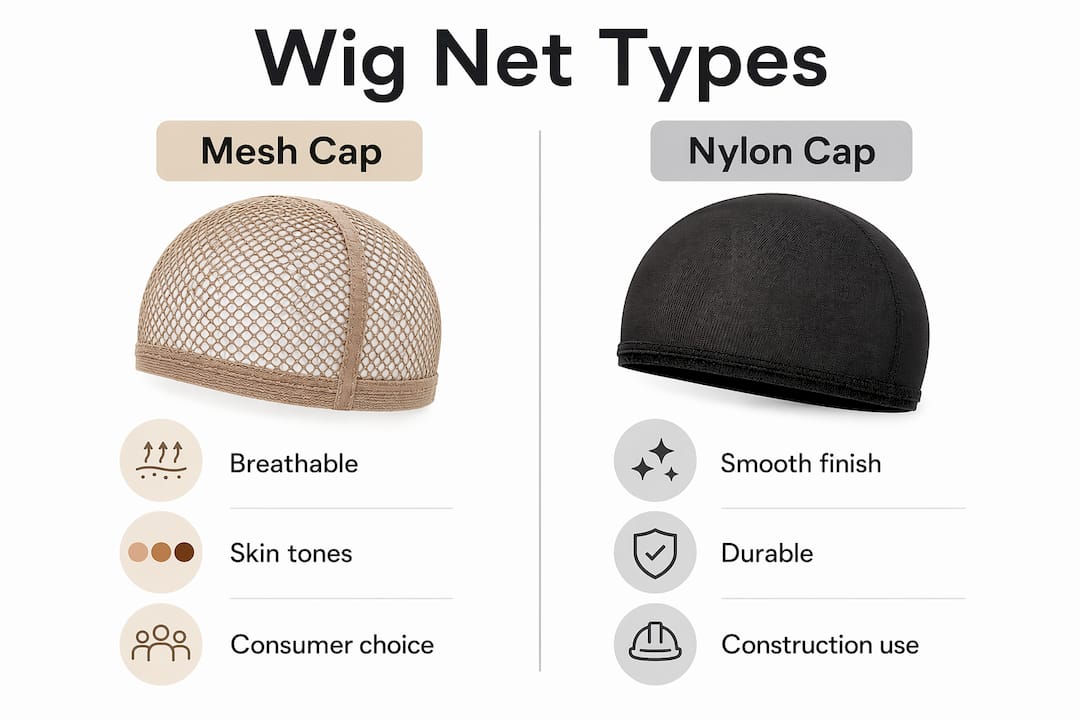
Color matching matters more than most manufacturers expect. Matching the cap to the wearer's skin tone rather than the wig color reduces visible hairline demarcation under lace-front units. Multiple shade SKUs and clear fit photos lower return rates measurably.
For construction use, terylene toupee net is the professional standard. It is typically sold by the meter as a raw material rather than a finished cap, which means your production and QC workflows for this SKU differ significantly from consumer cap production.
Pro Tip: Offer a two-cap combo pack pairing a fishnet cap with a smooth nylon cap. Experienced wearers use the fishnet and nylon combination to manage hair bulk while maintaining a flat base. Bundling both in one SKU gives you a higher average order value and a product that experienced buyers actively search for.
What specs belong on your production drawings and tech packs?
U.S. wholesale buyers and private-label retailers expect a complete spec sheet before they place a trial order. Vague descriptions get ignored. Concrete dimensions and material calls get approved.
| Spec field | Consumer wearing cap | Construction mesh dome |
|---|---|---|
| Top opening | Open top (standard) or closed top (optional SKU) | Closed top standard |
| Fiber / denier | 70D–100D nylon or terylene | 70D terylene or nylon |
| Adjuster type | Sewn elastic loop or hook-and-loop tab | Hook-and-loop or none |
| Seam finish | Flatlock or bound edge to prevent fraying | Bound edge; reinforced at stress points |
Sizing charts are not optional. Retail listings that include head-circumference guides consistently receive better reviews and fewer returns than one-size-fits-most listings with no measurement reference. Include a simple two-column chart (head circumference in inches and centimeters) on every product page and in every buyer packet.
Pro Tip: Flag the elastic composition on your spec sheet. Buyers increasingly ask whether the band contains latex, particularly for medical and sensitive-skin channels. A latex-free call-out on the label and spec sheet removes a common barrier to retail approval.
How do you run quality control on wig nets before shipment?
In-house QC does not require a lab. A structured protocol run on production samples catches the failures that generate returns and damage reorder rates.
| Test | Method | Pass threshold |
|---|---|---|
| Wash-and-dry test | Hand wash in 30°C water; air dry; measure cap dimensions | Circumference shrinkage under 5% |
| Seam tensile test | Apply 5 lbs. pull force to seam junction for 30 seconds | No seam separation or thread pull |
| Mesh uniformity check | Visual inspection under magnification | No broken threads, no density gaps larger than 2mm |
| Band adhesion check | Tug elastic-to-cap join at four points | No delamination or thread pop |
Customer reviews consistently flag elastic band failure as the primary reason for replacement, with reviewers describing stretched elastic that no longer holds the cap in place after a few months of regular wear. Specifying elastic composition and expected lifecycle on the product page directly addresses this concern and reduces returns.
When shipping samples to U.S. buyers, include: a photo set showing the cap flat, stretched, and on a mannequin head; a measurement sheet with actual dimensions from the production run; a material certificate confirming fiber content; and your QC report with test results filled in. Buyers who receive complete sample packets approve faster and order larger.
What U.S. labeling and import rules apply to wig nets?
The Federal Trade Commission's Textile Fiber Products Identification Act requires that every wig net sold in the United States carry a label disclosing fiber content by percentage, country of origin, and the manufacturer's or importer's name or registered number. These fields must appear on the product itself or its packaging, not only on the outer carton.
- Fiber content: List all fibers by generic name and percentage (e.g., "100% Nylon" or "70% Nylon, 30% Polyester"). No trade names without the generic name alongside.
- Country of origin: "Made in China" or the applicable country, in English, on the label.
- Care instructions: The FTC Care Labeling Rule requires permanent care labels on textile products. For wig nets, "Hand Wash Cold, Do Not Bleach, Lay Flat to Dry" covers most constructions.
- HTS classification: Wig nets and hair nets typically fall under HTS Chapter 65 (headgear) or Chapter 56 (wadding, felt, nonwovens). Work with a licensed U.S. customs broker to confirm the correct subheading before your first shipment. Classification errors trigger delays and potential reclassification penalties.
- Flammability: Wig nets are not subject to the CPSC's flammability standards that apply to children's sleepwear, but if your cap contains chemical finishes or flame-retardant treatments, disclose them on the safety data sheet and confirm they comply with California Proposition 65 limits if you plan to sell in California.
Pro Tip: Prepare a one-page compliance summary for each SKU: fiber content, HTS code, country of origin, and care instructions. Attach it to every sample packet. Retail buyers and import brokers both appreciate having this on one page rather than hunting through a product catalog.
How should you structure SKUs, pricing, and channels for the U.S. market?
| SKU type | Pack count | Suggested wholesale price | Suggested retail / MAP | Primary channel |
|---|---|---|---|---|
| Consumer mesh wearing cap (single) | 1 | — | — | Amazon, DTC, beauty supply |
| Consumer mesh wearing cap (6-pack) | 6 | — | — | Amazon, club/value retail |
| Two-cap combo (fishnet + nylon) | 2 | — | — | Amazon, DTC, salon supply |
| Professional construction dome | 1 | $3–$6 | — | Salon supply, B2B wholesale |
| Terylene construction net (by meter) | 1m or 5m roll | $4–$8/m | Not typically retail | Trade, wig-making suppliers |
For Amazon and digital-first retailers, MOQs of 500–1,000 units per SKU per color are workable for initial purchase orders. Brick-and-mortar distributors typically require 2,000–5,000 units per SKU and expect 60–90 day lead times from order confirmation to warehouse receipt. Build that lead time into your production calendar before you pitch distributors.
Packaging for retail shelves needs a hang tag or header card with a UPC/GTIN barcode, the FTC-required label fields, and a product image showing the cap on a model. Polybag packaging with a printed insert works for e-commerce. For trade shows and buyer outreach, a three-SKU sample pack (consumer mesh, nylon, and construction dome) in a branded box positions you as a full-range supplier rather than a single-product vendor.
How do you market wig nets effectively to U.S. buyers online?
- Write titles that match buyer search behavior. A strong Amazon or Shopify title follows this pattern: [Material] Wig Cap Net for [Use Case] [Color/Count] [Key Feature]. Example: "Nylon Mesh Wig Cap Net for Lace Front Wigs, Nude/Brown/Black, 6-Pack, Open Top."
- Lead bullet points with benefits, not specs. "Stays breathable through 8+ hours of wear" outperforms "100% nylon mesh construction" as the first bullet. Move specs to the third or fourth bullet.
- Use three required image types: a flat-lay showing the cap's construction detail; an on-model shot showing hairline fit and color match; and a close-up of the elastic band and seam finish. These three images address the questions that generate the most pre-purchase questions and post-purchase returns.
- For B2B outreach, keep the RFQ email short. Include your company name, the SKU you are proposing, MOQ, lead time, sample availability, and a link to your product page or catalog. Attach the one-page compliance summary. Buyers who receive a clean, complete first email respond faster.
- Use sample packs to open distribution conversations. A three-cap sample set with a short printed insert explaining the two-cap method and the construction dome's adhesive compatibility gives a buyer everything they need to test and approve without a call.
Pro Tip: Include a small printed instruction card in every sample pack showing the two-cap wearing method. Buyers who understand how to use the product sell it more confidently, and confident buyers reorder.
Key Takeaways
Producing two distinct SKUs, a consumer mesh wearing cap and a professional construction dome, is the single most important decision for entering the U.S. wig net market successfully.
| Point | Details |
|---|---|
| Two-SKU strategy | Produce a consumer mesh wearing cap and a professional construction dome as separate, clearly labeled SKUs. |
| Color and sizing | Offer at least four skin-tone shades and include a head-circumference chart to reduce returns. |
| QC before shipment | Run elasticity cycle, wash-and-dry, and seam tensile tests; document results and include them in buyer sample packets. |
| FTC compliance | Every unit needs fiber content, country of origin, and care labels before it enters U.S. retail or wholesale channels. |
| Sourcesnova support | Sourcesnova provides compliance consulting, localized product pages, and B2B lead generation to speed U.S. market entry for wig net manufacturers. |
What Asian manufacturers often get wrong about the U.S. wig net market
The most common mistake is treating the U.S. wig net category as a commodity race to the lowest price. It is not. The buyers who drive repeat volume in this market, salon owners, wig retailers, and Amazon private-label brands, are making a quality and reliability bet on their supplier. They are not shopping for the cheapest cap; they are shopping for the supplier who will not embarrass them with a return spike six months after launch.
The elastic band issue is the clearest example. Manufacturers know elastic degrades. Buyers know it too. What separates a reorder from a chargeback is whether the manufacturer documented the expected lifecycle, specified the elastic composition, and gave the buyer something to tell their customer. That one-page spec sheet is not paperwork. It is the difference between a trial order and a long-term account.
The second thing manufacturers underestimate is the power of the two-cap combo as a marketing asset. Experienced wig wearers already know this technique. Positioning your brand as the one that teaches it, through a simple insert card or a product page video, builds credibility that a lower price cannot replicate.
Sourcesnova can help you launch wig nets in the U.S. market
Asian manufacturers entering the U.S. wig net category face a specific set of barriers: FTC labeling requirements, HTS classification, buyer-ready product pages, and B2B outreach to salon distributors and Amazon wholesale accounts. Sourcesnova addresses all of them in a single engagement, without the overhead of a traditional agency.
Sourcesnova's market entry packages for manufacturers include U.S. compliance consulting, localized Shopify or WooCommerce product pages with RFQ flows, North American SEO targeting wholesale buyer intent, and paid social lead generation for both direct-to-consumer and B2B channels. The process runs from a product-market audit through a sample-order pilot to a scaled distribution push, with clear deliverables at each stage.
If you are ready to move from production to U.S. sales, request a market entry consultation with Sourcesnova to get a scoped audit of your wig net SKUs and a channel strategy built for North American buyers.
Useful sources and your first 90-day action plan
| Resource | What it covers | When to use it |
|---|---|---|
| FTC Textile Fiber Products Identification Act | Fiber content, country of origin, and labeling rules | Before finalizing packaging artwork |
| U.S. International Trade Commission HTS database | Tariff classification for wig nets and hair nets | Before first import shipment |
| Atelier Bassi wig making materials | Professional construction net specs and tools | When developing construction dome SKU |
| Amid Beauty wig making supplies | U.S. retail reference for wig-making supply buyers | When researching trade buyer expectations |
| DreamHair wig net product page | Consumer-facing language and feature framing | When writing product page copy |
30 days: Finalize two SKUs (consumer mesh cap and construction dome), run elasticity and wash tests, and prepare FTC-compliant label artwork.
60 days: Build three-cap sample packs, create product pages with sizing charts and on-model photos, and begin B2B outreach to salon distributors and Amazon wholesale buyers.
90 days: Place a pilot production run, confirm HTS classification with a licensed customs broker, and launch paid search targeting wholesale buyer keywords in the U.S.