
You're spending money on marketing, posting on social media, maybe running ads, and still not seeing the growth you expected. Sound familiar? Most small business owners hit this wall not because their marketing is bad, but because they never defined what success actually looks like. Without a clear target, every dollar you spend is a guess. This guide walks you through the exact process to build marketing goals that are concrete, measurable, and built for the real constraints of a small business. From prep work to the proven [Specific, Measurable, Achievable, Relevant, Time-bound] (also known as the SMART framework), you'll leave with a practical system you can use this week.
Table of Contents
- Why clear marketing goals matter
- preparing to set effective goals: What you need first
- How to use the SMART framework for your marketing goals
- Examples and common mistakes: Real-world SMART goals for small businesses
- What most guides miss about goal-setting for small businesses
- Get tailored support to set and achieve your marketing goals
- frequently asked questions
Key Takeaways
| Point | Details |
|---|---|
| Clarity is essential | Crystal-clear marketing goals help you track success and avoid wasted effort. |
| SMART framework works | Use SMART criteria to make your goals specific, measurable, achievable, relevant, and time-bound. |
| Start with research | A quick analysis of your current numbers and resources sets you up for realistic goals. |
| Review and adjust | Check progress regularly and adjust goals to stay on track for growth. |
Why clear marketing goals matter
Marketing without goals is like driving without a destination. You'll burn fuel, cover ground, and still end up nowhere useful. For small businesses, that wasted motion is especially costly because resources are tight and every decision counts.
When your goals are vague, like "get more customers" or "grow our social media," you have no way to know if your efforts are working. You can't optimize what you can't measure. Clear, written goals give you a benchmark. They tell you when to double down on a tactic and when to cut it.
Here's what well-defined marketing goals actually do for your business:
- Create accountability. When a goal has a number and a deadline, it's either hit or it isn't. That clarity keeps you and your team honest.
- Guide budget decisions. You stop spending on channels that feel right and start investing in what the data supports.
- Enable real ROI tracking. You can calculate what you spent versus what you gained, which is the only way to know if marketing is working.
- Keep your team aligned. Everyone knows what they're working toward, which reduces wasted effort and miscommunication.
- Support faster pivots. When results fall short, a specific goal tells you exactly where the gap is so you can adjust quickly.
The urgency here is real. 68% of SMBs plan to increase their marketing budgets in 2026, with most prioritizing digital channels for local growth. That means competition is increasing. If your competitors are spending more and you're both operating without clear goals, you're both gambling. But if you have a structured approach and they don't, you win by default.
Goal clarity isn't a nice-to-have. It's the foundation that makes everything else in your marketing strategy actually work.
preparing to set effective goals: What you need first
Now that you see why goal clarity is essential, it's time to get the right foundation in place before you define outcomes.
Setting goals before you understand your current situation is like writing a map before you know where you are. The prep work takes maybe a few hours, but it dramatically increases the chance your goals will be realistic and worth chasing.

Start with a quick **S**WOT analysis (strengths, weaknesses, opportunities, threats). This helps you spot where your business has an edge and where you're exposed. It also reveals which marketing opportunities are actually within reach versus which ones sound exciting but don't match your situation.
Next, pull your current numbers. You need a baseline before you can set a target. Key metrics to know:
| metric | why it matters | where to find it |
|---|---|---|
| Website traffic | Shows your current reach | Google Analytics |
| conversion rate | % of visitors who take action | Analytics or CRM |
| Customer acquisition cost (CAC) | What you pay to win each customer | Ad platform + revenue data |
| Email open and click rates | Email channel health | Your email platform |
| Social engagement rate | Content resonance | Platform insights |
Once you have your numbers, list your available resources: budget, team hours per week, platforms you're already using, and tools you have access to. A solo owner with five hours a week has very different goal parameters than a team of three with a $3,000 monthly ad budget.
Also take time to revisit your customer personas. Who is your actual buyer? What problem are they solving? Where do they spend time online? If you're investing in SEO strategies or Facebook advertising, understanding your buyer's journey will determine which channels deserve your attention.
Pro tip: Don't skip the persona step even if you think you know your customer. Markets shift. A quick review of who's actually buying from you right now often reveals surprises that change your goal priorities.
How to use the SMART framework for your marketing goals
With your groundwork established, now let's walk through the proven method to set goals that actually stick.
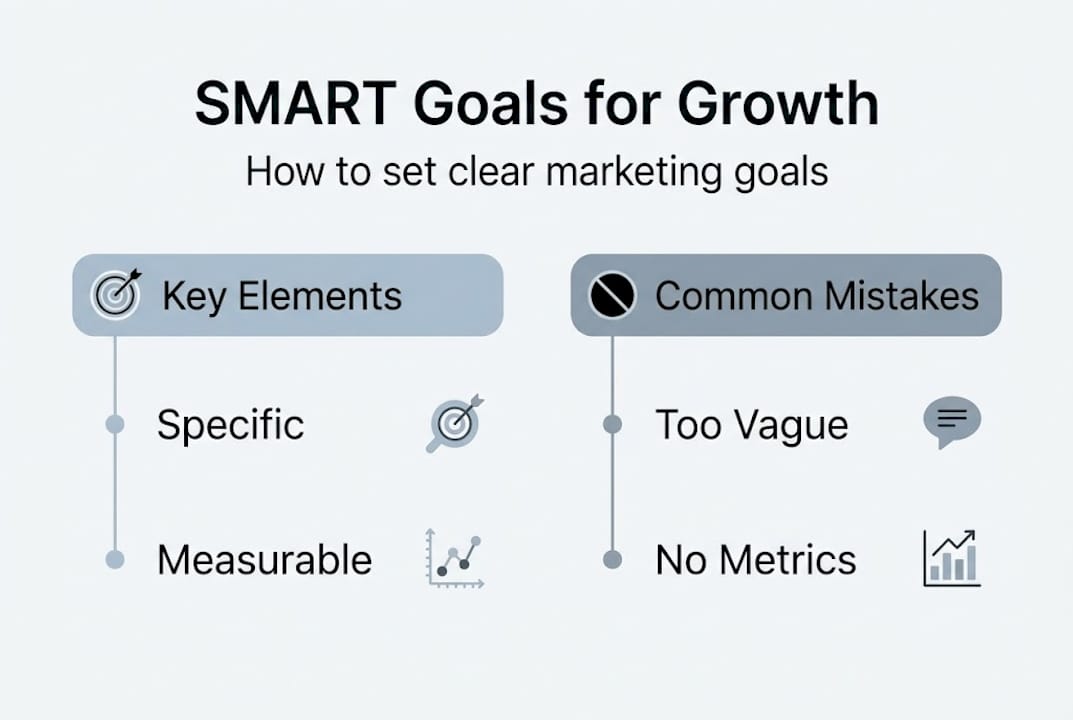
The SMART framework gives you a five-part test for every goal you write. If your goal passes all five criteria, it's ready to execute. If it fails even one, revise it before you commit resources.
Here's how to apply each element:
- Specific: Name exactly what you want to achieve, in which area, and by how much. "Get more website traffic" fails this test. "Get 500 more monthly visitors to our service pages" passes.
- Measurable: Define the metric you'll track. If you can't put a number on it, you can't manage it. Use KPIs like total leads, conversion rate percentage, or email subscribers added.
- Achievable: Check your baseline and resources. If you currently get 300 monthly visitors and have a modest SEO budget, targeting 10,000 visitors in 60 days isn't achievable. A 25% increase over 90 days might be.
- Relevant: Connect the goal to a real business outcome. Growing your Instagram following by 500 people is only relevant if those followers are likely buyers, not just numbers.
- Time-bound: Set a hard deadline. Open-ended goals get deprioritized. "By the end of Q2 2026" creates urgency and a clear review point.
Here's a quick comparison of a weak goal versus a SMART goal:
| weak goal | SMART goal** | |
|---|---|---|
| specificity | "Get more leads" | "Generate 30 new leads from Google each month" |
| measurement | Not trackable | Track via Google Analytics conversions |
| achievability | Unknown | Based on current traffic and 3% conversion rate |
| relevance | Maybe | Each lead = potential $800 client |
| timeline | None | By June 30, 2026 |
If you're planning a new product or service launch, this structure is especially critical. B2C launch planning works best when every campaign goal is pre-defined before spend begins.
Pro tip: Write your goals down and post them somewhere visible. Teams that document goals are significantly more likely to hit them than those who keep goals informal.
Examples and common mistakes: Real-world SMART goals for small businesses
To connect the method to daily reality, let's see what SMART goals look like in practice, and what to avoid.
Here are four concrete SMART goal examples tailored for small businesses:
- Email list growth: "Add 200 new subscribers to our email list by May 31, 2026, using a lead magnet on our homepage."
- Website traffic: "increase organic traffic to our blog by 30% in 90 days through weekly SEO-optimized posts."
- Customer acquisition: "Convert 15 new paying customers from Facebook ads in Q2 2026 at a CAC under $40."
- Social media engagement: "Double our average post engagement rate on Instagram from 2% to 4% by July 2026 by posting 4 times per week."
Notice what makes each one SMART: a specific number, a clear metric, a realistic target based on current performance, a connection to business growth, and a firm deadline.
Now, the mistakes. These are the ones we see most often:
"We want to grow our brand awareness and reach more people online this year."
This is not a goal. It's a wish. There's no number, no channel, no deadline, and no way to know if you achieved it. Every goal you write should make this kind of statement feel uncomfortable by comparison.
Other common pitfalls:
- Setting too many goals at once and spreading resources thin across five priorities instead of focusing on two.
- Writing goals based on what sounds impressive rather than what your data supports.
- Never reviewing progress. A goal with no check-in is just a forgotten intention.
- Using web design improvements or new tools as a substitute for goal clarity. Tools support goals; they don't replace them.
A note on frameworks: some businesses try to layer in OKRs (objectives and key results) on top of SMART goals. For small teams, that often creates more overhead than value. OKR vs SMART comparisons show that hybrid approaches can work, but only if you have the team capacity to manage the added structure. For most small businesses, clean SMART goals are enough. You can find more practical guidance on the SoursesNova blog.
What most guides miss about goal-setting for small businesses
Here's the part most how-to articles skip: the SMART framework is a tool, not a rulebook. And treating it like a rulebook is one of the most common ways small business owners actually slow themselves down.
We've seen businesses spend so much time perfecting the structure of a goal that they never start executing. The framework should take you 20 minutes, not two weeks.
The deeper truth is that the best marketing results often come from setting a reasonable goal, launching quickly, reviewing results within 30 days, and adjusting. That cycle of rapid iteration beats rigid adherence to a plan that was written before you had real market feedback.
SMART goals excel for small business practicality, while OKRs suit larger teams chasing ambitious alignment. But for a local business with a lean team, the most valuable skill isn't perfect goal architecture. It's the willingness to review, learn, and adapt fast. If a goal isn't working at the 30-day mark, change it. The market doesn't care about your original plan. If you want expert guidance on building a flexible, results-driven approach, that's exactly where we focus.
Get tailored support to set and achieve your marketing goals
Understanding the framework is step one. Actually turning it into consistent revenue growth is where most small businesses need a hand.
At SoursesNova, we work with local and small-to-mid-size businesses to build marketing strategies that are grounded in real data, not guesswork. Whether you need help with a B2C product launch, want to drive leads through Facebook advertising, or need someone to translate these frameworks into an actual growth plan, we handle the strategy and the execution. No jargon, no bloated retainers. Just clear goals and the work to hit them.
frequently asked questions
How many marketing goals should a small business set?
Aim for 2-3 priority goals per quarter. Review goals quarterly and adjust based on what the data shows, rather than chasing too many targets at once.
What's the difference between SMART goals and OKRs?
SMART goals are practical and easy to track for small teams. OKRs suit organization-wide alignment and longer-term strategic vision, which can overwhelm lean operations.
How do I measure progress on my marketing goals?
Track KPIs like website traffic, conversion rates, and customer acquisition cost. KPIs and quarterly reviews are the most reliable way to stay on top of what's working.
What if my small team can't hit ambitious goals?
Goals should match resources and be adjusted when reality shifts. SMART is built on realism, so if a goal is out of reach, revise it rather than abandon the process entirely.