
Running a small business means wearing every hat at once, and marketing is often the one that fits worst. You're posting on social media, sending occasional emails, maybe running a Google ad or two, but nothing connects. Leads trickle in randomly, you can't tell what's working, and every dollar spent feels like a guess. That scattered approach is exactly what kills marketing ROI before it ever has a chance to grow. This guide walks you through building a repeatable digital marketing workflow that ties your channels together, cuts wasted spend, and turns online visitors into paying customers.
Table of Contents
- What is a digital marketing workflow and why does it matter?
- Essential elements of an effective digital marketing workflow
- Step-by-step digital marketing workflow for small businesses
- Common mistakes and how to avoid them
- Measuring and improving your workflow's ROI
- Why most digital marketing workflows fail (and what actually works)
- Put your workflow into action with expert help
- Frequently asked questions
Key Takeaways
| Point | Details |
|---|---|
| Workflow clarity saves time | A clear digital marketing workflow reduces confusion and wasted resources. |
| Email is high-ROI retention | Retention through email automation is much cheaper and more effective than constant acquisition efforts. |
| Measure and optimize regularly | Track every step of your process to improve results and lower customer acquisition costs. |
| Start small, automate what works | Begin with the basics and layer on automation once your core process is proven to work. |
What is a digital marketing workflow and why does it matter?
A digital marketing workflow is a defined, step-by-step process that connects your marketing channels, tasks, and tools into one repeatable system. Instead of reacting to whatever feels urgent that day, you follow a sequence: attract the right audience, engage them with relevant content, convert them into leads, and keep them coming back. Think of it like a production line for customer acquisition.
Without that structure, every campaign becomes a one-off effort. You spend time and money, get inconsistent results, and have no real way to improve because nothing is documented or measured. That's how businesses end up with a high customer acquisition cost (CAC), which is the total amount you spend to win one new customer.
CAC benchmarks vary widely by industry: e-commerce businesses typically see CAC between $80 and $100, B2B SaaS companies average $270 to $300, and legal services can exceed $900 per new client. The gold standard most growth-focused businesses aim for is a lifetime value to CAC ratio of 3:1, meaning every dollar you spend acquiring a customer should return three dollars in revenue over time.
A well-built workflow directly improves that ratio. It reduces redundant work, keeps messaging consistent across channels, and makes sure no lead falls through the cracks. Good marketing process optimization is not about doing more. It's about doing the right things in the right order, every time.
"The biggest marketing mistake small businesses make is treating every campaign like a fresh start. A workflow turns your past efforts into a foundation, not a sunk cost."
Benefits of a structured workflow at a glance:
- Reduces time spent on repetitive tasks by up to 30%
- Keeps brand messaging consistent across email, social, and ads
- Makes it easier to spot what's working and cut what isn't
- Lowers CAC over time through better targeting and follow-up
- Gives your team (even if that's just you) clear next steps
Pro Tip: Before building your workflow, check the small business marketing planning resources from the SBA. Their framework for setting measurable goals is a solid starting point before you touch any tool or platform.
Essential elements of an effective digital marketing workflow
With the importance established, let's break down what parts make up a digital marketing workflow. Every high-performing workflow moves through four stages: awareness, engagement, conversion, and retention. Each stage needs the right tools, the right content, and someone accountable for execution.
Core tools you need:
- A fast, mobile-friendly high-converting website that captures leads
- A CRM (customer relationship manager) to track contacts and follow-ups
- An email marketing platform like Mailchimp or Klaviyo
- Analytics tools, starting with Google Analytics 4
- Basic automation software to handle repetitive follow-up tasks
People matter just as much as tools. Even in a small operation, someone needs to own each area: one person managing content, someone handling design or development updates, and someone reviewing analytics monthly. If that's all you, block dedicated time for each role rather than switching between them randomly throughout the week.

One thing that often gets overlooked is the omnichannel approach. This means your customer gets a consistent experience whether they find you through Google search, a Facebook ad, or a friend's referral. CAC benchmarks consistently show that businesses using multiple coordinated channels outperform single-channel strategies in cost efficiency. According to HubSpot's small business marketing research, retention through email is 5 to 25 times cheaper than acquiring a new customer, which makes your email list one of the most valuable assets in your workflow.
Manual vs. automated digital marketing workflows:
| Element | Manual workflow | Automated workflow |
|---|---|---|
| Lead follow-up | Sent individually, often delayed | Triggered instantly via email sequence |
| Content scheduling | Posted in real time, inconsistent | Queued weeks in advance |
| Analytics review | Done occasionally, no pattern | Dashboard updated automatically |
| Lead scoring | Guesswork based on memory | Scored by behavior and engagement |
| Customer segmentation | Broad, one-size-fits-all | Segmented by purchase history or interest |
The difference is not just efficiency. Automation removes the human error that causes leads to go cold. A prospect who fills out your contact form at 11 PM on a Friday should get a response before your competitor opens Monday morning.
Pro Tip: Start your SEO workflow essentials early. SEO takes time to compound, so building it into your workflow from day one means you'll see organic traffic gains while your paid campaigns run.
Step-by-step digital marketing workflow for small businesses
Now that you know the pieces, here's exactly how to put them together in your business. This sequence works whether you're a solo operator or managing a small team.
1. Define your audience and set measurable goals. Before picking any channel, get specific about who you're targeting and what success looks like. A goal like "get more customers" is useless. "Generate 20 new leads per month from Google search at a CAC under $90" is actionable. The SBA's planning framework consistently emphasizes goal-setting and ROI measurement over jumping straight into tactics.
2. Choose your primary channels based on intent. High-intent channels like SEO and pay-per-click (PPC) ads reach people who are already searching for what you offer. Social media is better for awareness and remarketing. Start with one or two channels, master them, then expand. Spreading thin across five platforms before you've dialed in one is a common and costly mistake.
3. Build a content calendar. Map out what content you'll create, when it publishes, and on which channel. A simple spreadsheet works fine. The goal is consistency, not volume. Two well-crafted blog posts per month beat eight rushed ones every time.
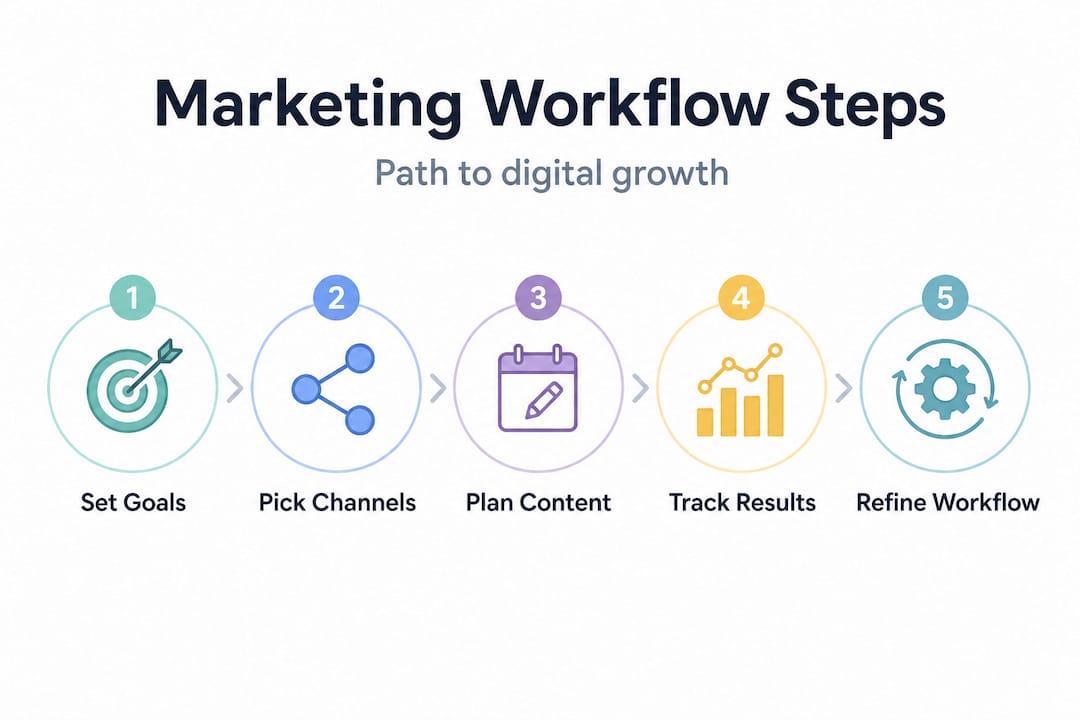
4. Set up conversion tracking. Install Google Analytics 4, connect it to your website, and define conversion events: form submissions, phone calls, purchases. Without this, you're flying blind. Visit your digital channel integration resources to understand how to connect your platforms properly.
5. Automate your follow-up sequences. Every lead that enters your system should trigger an automated email sequence. A basic three-email nurture series, sent over seven days, can dramatically improve your close rate without adding hours to your week.
6. Run paid ads to accelerate results. Once your organic foundation is in place, layer in paid ads campaign setup to drive faster traffic. A retail store, for example, might run Google Shopping ads for immediate purchase intent while building SEO content to capture long-tail search traffic over time. Email campaigns then re-engage past buyers with new arrivals or promotions.
"Organic channels build long-term compounding value. Paid channels buy you speed. The businesses that win use both, with email holding the customer relationship together for the long haul."
Organic-first vs. paid-first workflow comparison:
| Scenario | Organic-first | Paid-first |
|---|---|---|
| Best for | Established businesses with 6+ months runway | New businesses needing fast lead flow |
| Cost over time | Decreases as content compounds | Stays constant or rises |
| Time to results | 3 to 6 months | Days to weeks |
| Risk | Low, slow burn | Higher spend risk if not optimized |
| Best channels | SEO, content, email | PPC, Facebook Ads, Instagram Ads |
Common mistakes and how to avoid them
Even with a solid plan, many businesses struggle from repeating common mistakes. Knowing them in advance saves you real money.
The most damaging workflow mistakes:
- Running campaigns without conversion tracking in place
- Manually sending every follow-up email instead of automating sequences
- Treating social media as your only retention channel while ignoring email
- Building a workflow once and never reviewing or updating it
- Copying competitor tactics without tying them to your specific goals
The email mistake deserves extra attention. Many small business owners focus all their energy on acquiring new customers while ignoring the ones they already have. Retaining customers via email costs 5 to 25 times less than acquiring new ones. A simple monthly newsletter, a post-purchase follow-up, or a reactivation email to lapsed customers can generate revenue with almost no ad spend.
"The most expensive marketing is the kind you can't measure. If you don't know your CAC, you don't know if your marketing is working or just burning cash."
Automation mistakes are just as costly. Businesses that set up automated sequences and never revisit them end up sending outdated offers, broken links, or messaging that no longer matches their brand. Automation is not a set-and-forget solution. Schedule a monthly review of every active sequence to make sure it still reflects your current offers and tone.
Pro Tip: Review your multichannel approach pitfalls before scaling. Jumping to five channels before mastering two is one of the fastest ways to inflate your average CAC without improving results.
Measuring and improving your workflow's ROI
Once your workflow is running, here's how you make sure it's delivering and how to fine-tune it for maximum return. Measurement is not optional. It's the only way to know whether your workflow is an asset or a money pit.
Start simple. You don't need an enterprise dashboard on day one. A spreadsheet tracking leads by source, conversions, and spend per channel tells you more than most small businesses ever act on.
Key metrics to track monthly:
- Total leads generated by channel
- Conversion rate from lead to customer
- Customer acquisition cost by channel
- Email open rate and click-through rate
- Revenue attributed to each campaign
Once you have two to three months of data, start A/B testing. Test one variable at a time: a different subject line, a new landing page headline, or a revised call-to-action button. Small improvements compound quickly. A 10% better conversion rate on your main landing page can cut your CAC significantly over a year.
CAC benchmarks by industry (2026):
| Industry | Average CAC | LTV:CAC target |
|---|---|---|
| E-commerce | $80 to $100 | 3:1 |
| B2B SaaS | $270 to $300 | 3:1 |
| Legal services | $900+ | 3:1 |
| Local services | $50 to $150 | 3:1 |
Referencing these CAC benchmarks helps you understand whether your spending is competitive or out of control. If your e-commerce CAC is $250, your workflow has a serious leak somewhere. Use your data to find it.
Revisit your SEO measurement tips quarterly. Organic traffic takes time to build, but once it's moving, it's one of the most cost-effective drivers in your entire workflow.
Why most digital marketing workflows fail (and what actually works)
Here's the uncomfortable truth we've seen play out with dozens of small business clients: most workflow failures have nothing to do with the tools. They come from copying tactics without connecting them to a clear goal, and then never measuring whether those tactics actually moved the needle.
Businesses see a competitor running Facebook ads and assume that's the answer. They set up an automation sequence from a template and assume it's working because it's running. They post three times a week because someone said consistency matters, without ever checking whether those posts are driving traffic or just filling a feed.
The "set-and-forget" trap is especially dangerous. We've seen businesses spend six months running an email nurture sequence that was sending people to a landing page that no longer existed. Automation is only as good as the human oversight behind it.
What actually works is simpler than most marketing agencies want you to believe. Clear goals. Two or three well-chosen channels. Consistent follow-up. Monthly review of what the numbers say. The businesses that grow are not the ones with the most sophisticated tech stack. They're the ones who actually respond to leads within an hour, follow up twice when someone doesn't reply, and know their CAC well enough to make smart decisions about where to spend next.
Human touchpoints still win deals. A personal email from the business owner, a quick phone call after a quote request, or a thank-you note after a first purchase builds the kind of trust that no automation sequence can replicate. The best workflows leave room for those moments instead of replacing them entirely.
Explore real-world workflow strategies to see how businesses in different industries have built systems that balance automation with genuine connection.
Put your workflow into action with expert help
Building a workflow that actually drives customers takes more than reading a guide. It takes the right setup, the right tools configured correctly, and someone watching the numbers.
At SourcesNova, we help small businesses build and run digital marketing workflows that generate real results, not just activity. Whether you need a digital workflow for product launches, a fully managed ads campaign management system, or a complete growth strategy from the ground up, we bring the strategy and the hands-on execution. No jargon, no bloated retainers. Just a clear plan built around your goals. Visit SourcesNova to talk through where your workflow stands today and what it would take to make it work harder for your business.
Frequently asked questions
What is the most important step in a digital marketing workflow?
Setting clear, measurable goals before choosing any channel or tool is the foundation everything else builds on. The SBA emphasizes planning and ROI measurement as the starting point for any effective marketing effort.
How can I lower my customer acquisition cost (CAC)?
Focus on high-intent channels like SEO and PPC, automate your follow-up sequences, and invest in email for retention since email retention costs 5 to 25 times less than acquiring a new customer.
Are email campaigns still effective for small businesses?
Absolutely. Email consistently delivers the highest ROI for retention and costs far less to maintain than outbound or paid acquisition campaigns, making it one of the smartest tools in any small business workflow.
What tools do I need to build a simple marketing workflow?
Start with a solid website, a CRM to track contacts, an email marketing platform, Google Analytics 4 for tracking, and a basic automation tool to handle follow-up sequences without manual effort.
How do I know if my new workflow is working?
Track leads, conversions, and CAC by channel every month and compare against industry benchmarks: e-commerce targets $80 to $100 CAC, while most businesses should aim for a 3:1 lifetime value to CAC ratio.