
Most small business owners think digital marketing means running a few Facebook ads and hoping for the best. That's a costly misunderstanding. Digital marketing covers a wide range of channels and strategies, many of which cost little to nothing up front, and some of which consistently outperform paid ads in long-term value. Owned channels like SEO, email, and your website often deliver stronger returns than paid campaigns for businesses working with tight budgets. This guide breaks down exactly what digital marketing is, which channels matter most for small businesses, and how to start building a strategy that drives real, measurable growth.
Table of Contents
- Defining digital marketing for small businesses
- The core channels: Owned, earned, and paid media explained
- Digital marketing's impact on growth and retention
- Budgeting and execution: What works for SMBs
- Why authentic connection beats fancy tools in digital marketing
- Ready to elevate your business with proven digital strategies?
- Frequently asked questions
Key Takeaways
| Point | Details |
|---|---|
| Digital marketing definition | It means using online channels to grow your customer base, revenue, and reach. |
| Owned channels first | SMBs see the best results by focusing on websites, SEO, and email before jumping into paid ads. |
| Prioritize retention | It’s five times cheaper to keep a customer than to get a new one, making retention tactics crucial. |
| Test, then scale | Start with small marketing experiments, analyze what works, and increase your investment in proven channels. |
Defining digital marketing for small businesses
Digital marketing is simply using online channels to reach people who are already looking for what you sell, or who need to discover you for the first time. It's not one single thing. It's a collection of strategies, tools, and platforms that work together to help your business get found, build trust, and turn visitors into paying customers.
For small businesses, that matters because the playing field online is fundamentally different from traditional advertising. A local nail salon can compete for Google search visibility with a national chain if they know what they're doing. A single-person service business can build an email list that generates consistent revenue without spending a dollar on ads. That kind of leverage is what makes digital marketing so valuable for small and medium-sized businesses.
Here's a quick breakdown of the major components:
- Search engine optimization (SEO): Getting your website to rank in Google search results when people look for what you offer
- Content marketing: Creating blog posts, videos, or guides that attract and educate your target audience
- Email marketing: Sending targeted messages to people who have opted in to hear from your business
- Social media marketing: Building presence and engagement on platforms like Instagram, Facebook, or LinkedIn
- Pay-per-click advertising (PPC): Running paid ads on Google or social platforms and paying only when someone clicks
- Local marketing: Optimizing your Google Business Profile and earning local citations so nearby customers can find you
What ties all of these together is intent: you're meeting customers where they already spend their time online, and giving them a reason to choose you.
Why it matters: Research shows a strong link between digital adoption and SME growth in sales, market expansion, and customer retention. But that growth is moderated by two key factors: digital competence and available budget. Translation: you don't need a massive budget, but you do need a clear strategy and the skills or support to execute it.
Small businesses that treat digital marketing as an afterthought grow slower than those that build it into their core operations. The good news is that starting smart doesn't require a massive investment. It requires understanding which channels to prioritize first.
The core channels: Owned, earned, and paid media explained
One of the most useful frameworks for thinking about digital marketing is the owned, earned, and paid media model. It separates your channels into three buckets based on how you control them and what they cost.
| Channel type | Examples | Control level | Cost |
|---|---|---|---|
| Owned media | Website, blog, email list | Full control | Low ongoing cost |
| Earned media | Reviews, shares, press mentions | No direct control | Free (but takes effort) |
| Paid media | Google Ads, Facebook Ads, sponsored posts | Full control | Direct spend required |
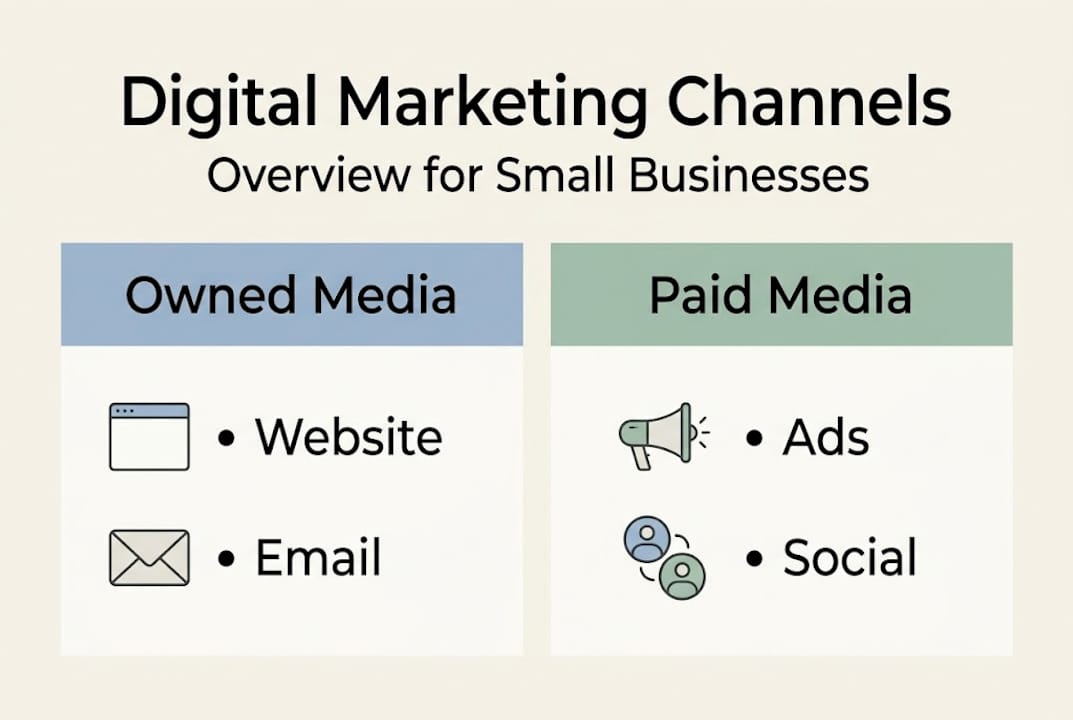
Owned media is the foundation. Your website, your blog, your email list. These assets belong to you entirely. No algorithm change can take them away. No platform can decide to stop showing your content to followers. When you invest time and money into building owned media, you're building something that compounds over time.
Earned media is what other people say about you. Customer reviews on Google or Yelp, social media shares, mentions in local press or industry blogs. You can't buy authentic earned media, but you can create the conditions for it. Great customer experience, a consistent follow-up process, and an active request for reviews all increase earned media over time.
Paid media is where most small businesses start, and often where they overspend before they're ready. Paid ads work best when you already have a solid owned media foundation. If your website doesn't convert visitors into leads, buying traffic is like pouring water into a leaking bucket.
For cost-effective digital channels, the Bank of America small business resource team recommends a clear sequencing strategy: start with owned channels first, invest in earned media next, and test paid strategically with small monthly budgets in the $300 to $500 range before scaling.
Here's what that looks like in practice for a local service business:
- Build or update your website so it clearly explains what you do and how to contact you
- Optimize your Google Business Profile so local searches show your listing
- Start collecting email addresses from every customer and inquiry
- Ask every satisfied customer for a Google review
- Once those are in place, test a small Google Ads or Facebook Ads campaign to fill gaps in lead volume
Pro Tip: Don't try to be on every platform at once. Pick one or two channels and do them well before expanding. Spreading thin across six platforms with mediocre effort beats having a strong presence nowhere.
Digital marketing's impact on growth and retention
After knowing the channel types, it's important to see why digital marketing investments matter for your bottom line. The numbers tell a compelling story, and they're especially relevant for small businesses trying to grow without burning through capital.

Let's start with the growth side. Research confirms a strong positive correlation between digital marketing adoption and measurable SME growth across three key areas: sales volume, market expansion, and customer retention. Businesses that actively use digital channels don't just get more customers. They grow into new markets and keep existing customers longer.
Now consider the retention side. Here's a fact that should change how you think about your marketing priorities:
It costs five times more to acquire a new customer than to retain an existing one. Yet most small business marketing budgets focus almost entirely on acquisition.
That's a significant gap. If your digital strategy is 100% focused on getting new customers and 0% on keeping the ones you have, you're working much harder than you need to. Shifting even 20% of your effort toward retention can dramatically improve your profitability.
| Strategy type | Focus | Relative cost | Timeframe |
|---|---|---|---|
| Paid acquisition | New customers | High | Immediate |
| SEO | New customers | Medium (time investment) | Long-term |
| Email nurture | Existing customers | Very low | Ongoing |
| Retargeting ads | Warm leads | Low to medium | Short to medium |
| Loyalty programs | Existing customers | Low | Long-term |
Here's a practical sequence for building a retention-focused digital strategy:
- Set up an email automation sequence for new customers. A welcome email, a follow-up with helpful tips, and a check-in after 30 days costs you almost nothing and keeps your business top of mind.
- Create a simple loyalty program using a platform like Mailchimp or even a punch card system tied to email sign-ups. Repeat customers spend more per transaction and refer others at higher rates.
- Run retargeting ads to people who visited your website but didn't convert. These audiences are already warm, and the ad spend required is a fraction of cold audience campaigns.
- Ask for feedback actively. A short email survey or a direct message after a purchase shows customers you care about their experience. It also gives you data you can act on.
Retention marketing isn't just cheaper. It's more personal, and personal connection is where small businesses naturally have an advantage over larger competitors.
Budgeting and execution: What works for SMBs
Knowing the impact, let's get into how much to spend and how to execute a digital strategy that actually works for SMBs.
The most commonly cited benchmark comes from the Bank of America small business resources team: allocate 7 to 12% of your total revenue to marketing, with more than half of that directed toward digital channels. For a business generating $300,000 a year in revenue, that means a digital marketing budget of roughly $10,500 to $18,000 annually, or $875 to $1,500 per month.
That might sound like a lot if you're just starting out. The good news is the same guidance emphasizes a "test small, scale winners" philosophy. You don't need to spend your full budget from day one. You need to run small experiments, measure what works, and put more money behind the tactics that show results.
Here's a practical execution plan for SMBs working with a modest budget:
- Month 1 to 2: Focus entirely on owned media. Update your website, claim and optimize your Google Business Profile, and set up a simple email sign-up form. These cost little to nothing.
- Month 3: Start collecting email addresses actively. Offer a discount, a free resource, or simply ask at checkout. Begin sending a monthly newsletter.
- Month 4: Test a small paid campaign. Allocate $300 to $500 to either Google Ads or Facebook Ads targeting a specific local audience. Run it for 30 days and measure leads and cost per lead.
- Month 5 to 6: Review your results. Double down on what's working. Kill what isn't. This is how professional agencies think about budget allocation.
AI tools can speed up certain parts of this process significantly. Tools like ChatGPT can help you draft email sequences, brainstorm blog topics, or write ad copy faster. Canva can produce professional-looking graphics without a designer. Scheduling tools like Buffer or Later can automate your social media posting.
Pro Tip: AI is a productivity multiplier, not a replacement for knowing your audience. Use it to execute faster, but make sure the voice, offers, and messaging still reflect your actual brand and real customer relationships. Automation that sounds robotic will cost you trust faster than it saves you time.
The businesses that see the best results from digital marketing treat it like any other business investment: deliberate, measured, and continuously improved.
Why authentic connection beats fancy tools in digital marketing
Here's a perspective that challenges what most digital marketing advice actually teaches: the fanciest tools and the biggest ad budgets rarely win. The businesses we've seen grow the most consistently are the ones that communicate honestly and show up regularly for their audience.
There's a pattern we see constantly. A business invests in an elaborate marketing stack, automates everything, and ends up sending emails that feel like they were written by a robot and running ads that don't reflect who they actually are. The metrics look okay. The growth is flat.
Then there's the salon owner who sends a simple, personal email to her customer list every two weeks about what's new, what's on sale, and what she's been thinking about. No fancy design. No automation platform. Real words. Her email open rates are double the industry average, and her repeat customer rate is the highest we've seen in her category.
The tools matter, but only after the message matters. Your customers choose you because of how you make them feel, not because you have a sophisticated CRM. Consistency, honesty, and genuine customer focus will outperform any trendy tactic. Chasing every new platform or algorithm update is a distraction from the one thing that actually builds long-term business value: a trusted relationship with the people who buy from you.
Ready to elevate your business with proven digital strategies?
When you're ready to put these strategies into practice, you don't have to do it alone.
At SourcesNova, we work specifically with small and medium-sized businesses that want real growth, not vanity metrics or confusing agency reports. Whether you're launching your first digital presence through our B2C launch services or ready to run high-converting campaigns through Facebook ads management, we build strategies around your budget and goals.
We've helped salons, retailers, service businesses, and e-commerce stores go from invisible online to consistently generating leads and sales. Our team handles the strategy and execution while you focus on running your business. Explore the full range of our digital marketing solutions and find the right starting point for where your business is today.
Frequently asked questions
What is the most cost-effective digital marketing channel for SMBs?
Owned channels like your website, SEO, and email typically deliver the highest ROI for SMBs starting out, since they build long-term value without requiring ongoing ad spend.
How much should my small business budget for digital marketing?
Experts recommend allocating 7 to 12% of your revenue to marketing overall, with more than half directed toward digital channels for maximum reach and measurability.
Does digital marketing really help grow small businesses?
Yes. Research confirms a strong link between digital marketing and measurable growth in sales, customer retention, and market expansion for SMBs across industries.
Can digital marketing help with customer retention?
Absolutely. Digital strategies focused on retention, like email nurture and retargeting, are five times more affordable than running campaigns to attract brand-new customers.