
Most business owners assume digital growth simply means more website traffic. Get more visitors, get more sales, done. But that thinking leaves serious money on the table. Digital growth is a full-spectrum strategy that touches every corner of your online presence, from how customers find you to how you keep them coming back. It combines marketing, technology, data, and customer experience into one connected engine. In this guide, you'll get a clear picture of what digital growth actually means, why it matters more than ever in 2026, and exactly how to start applying it to your business right now.
Table of Contents
- Defining digital growth and why it matters
- Core components of digital growth strategies
- How digital growth impacts business performance
- Applying digital growth: A simple blueprint for your business
- Why most digital growth advice misses the real challenge
- How SourcesNova can accelerate your digital growth
- Frequently asked questions
Key Takeaways
| Point | Details |
|---|---|
| Digital growth is holistic | It goes beyond marketing to include all facets of online business expansion and transformation. |
| Strategy trumps tactics | Lasting digital growth comes from a comprehensive plan, not quick-fix campaigns. |
| Actionable steps matter | Assess, plan, execute, and refine your digital strategies for consistent results. |
| Continuous learning wins | Ongoing experimentation and adaptation are crucial to staying competitive. |
Defining digital growth and why it matters
Digital growth is not a campaign. It is not a tactic. It is the ongoing process of expanding your business's reach, revenue, and customer relationships through digital channels and technologies. Think of it as the entire operating system behind your online business success, not just one app running on it.
Here is where many business owners get tripped up. They hire someone to run Google ads or post on social media, see a spike in traffic, and call it digital growth. But when the ad budget stops, so does the traffic. Real digital growth builds momentum that compounds over time. It creates systems that bring in customers, nurture them, convert them, and bring them back, without starting from zero every quarter.
The scope of digital growth includes:
- Search engine optimization (SEO) to get found organically by the right audience
- Paid advertising for faster, targeted customer acquisition
- Email and content marketing to build long-term audience relationships
- Website and mobile experience to convert visitors into buyers
- Data analytics to understand what works and cut what does not
- Process automation to save time and reduce human error
- Digital transformation projects that modernize how your business operates internally
A common misconception is that digital growth only benefits large corporations with big budgets. That is simply not true. Small and mid-sized businesses often have an advantage because they can move faster, test ideas quickly, and build personal connections that larger brands struggle to replicate at scale.
"Digital transformation is no longer optional for businesses that want to remain competitive. Companies that prioritize digital investment consistently outperform peers in revenue growth, customer retention, and operational efficiency." — McKinsey & Company Global Survey on Digital Transformation
The payoff is real. Businesses that invest in a connected digital strategy see improvements across customer reach, engagement quality, and the depth of insight they have into what their customers actually want. That last point is critical. Data-driven decisions beat gut feelings almost every single time.
Core components of digital growth strategies
Understanding digital growth as a concept is one thing. Knowing which building blocks to put in place is where things get practical. Here are the core pillars you need to build a complete digital growth strategy for your business.
| Component | What it does | Why it matters |
|---|---|---|
| SEO and organic search | Drives free, long-term traffic | Builds authority and reduces ad spend over time |
| Paid ads (Google, Meta) | Delivers fast, targeted traffic | Fills the pipeline while SEO builds momentum |
| Email marketing | Nurtures and retains customers | Highest ROI channel in digital marketing |
| Website optimization | Converts visitors into leads or buyers | A slow or confusing site kills every other effort |
| Data and analytics | Tracks what works | Removes guesswork from decision-making |
| Process automation | Streamlines operations | Saves time and reduces costly mistakes |
Each of these components works better when they are connected. Your SEO strategy should inform your content. Your analytics should shape your ad targeting. Your email marketing should reflect what your website visitors care about most. Isolation kills results. Integration creates growth.
Here is a simple order of operations for building your digital growth engine:
- Build a strong foundation. Your website needs to be fast, mobile-friendly, and easy to navigate. Without this, every dollar you spend driving traffic is wasted.
- Get found by the right people. Use SEO and targeted ads together to attract buyers, not just browsers.
- Create a customer journey. Map out every step from first click to final purchase and make each step as smooth as possible.
- Capture and nurture leads. Use email sequences and retargeting ads to stay in front of people who showed interest but did not buy yet.
- Automate repetitive tasks. Tools like CRM systems and email automations free you up to focus on higher-value work.
- Measure everything and adjust. Set up dashboards that show you weekly and monthly performance across all channels.
The Industry 4.0 evolution shows how businesses across sectors are integrating digital tools not just for marketing but for operational transformation. These practical digital projects prove that even small businesses can compete when they adopt the right systems intentionally.
Pro Tip: Do not try to do everything at once. Pick the one area where you are losing the most ground, whether that is poor SEO rankings, a clunky checkout process, or no email follow-up, and fix that first. One meaningful improvement beats five half-finished initiatives every time.
How digital growth impacts business performance
Strategy is only valuable if it delivers results. So let's look at what actually happens when businesses commit to a real digital growth approach, and where the numbers land.

The evidence is hard to ignore. Businesses that invest in digital channels consistently outgrow those that rely on traditional methods alone. Digital channels like SEO, email, and paid social generate trackable, scalable revenue that traditional advertising like print or radio simply cannot match in precision or cost efficiency.
| Metric | Digital channels | Traditional channels |
|---|---|---|
| Cost per lead | Lower and decreasing over time | Higher and rising |
| Targeting precision | Extremely granular | Broad and imprecise |
| Measurability | Real-time data | Delayed and limited |
| Scalability | High with low marginal cost | Limited and expensive to scale |
| Customer engagement | Interactive and two-way | One-directional |
Process automation is one of the most underrated elements of digital growth for small businesses. When you automate your appointment reminders, follow-up emails, invoice generation, or inventory alerts, you eliminate manual labor and human error. That efficiency translates directly into cost savings and faster service for your customers.
Customer engagement is where digital growth really separates itself from old-school marketing. Loyal customers spend significantly more over their lifetime and refer others. When you use personalized email campaigns, loyalty programs, and targeted retargeting ads, you turn one-time buyers into repeat customers. That is pure bottom-line impact without spending an extra cent on acquisition.
Looking at the manufacturing sector as an example, 3D printing trends reveal how rapidly digital technologies are reshaping production, supply chains, and customer fulfillment timelines. The data on key 3D printing trends shaping manufacturing in 2026 shows businesses using digital supply chain tools cutting fulfillment time by up to 40%, a dramatic competitive advantage. You can explore similar smart manufacturing case studies that apply these lessons to businesses of every size.
The big picture statistic: Companies that have fully embraced digital transformation report profit margins up to 26% higher than industry peers who have not made the shift yet. That is not a marginal difference. That is a business-defining gap.
The takeaway here is direct. Digital growth does not just make your marketing look better. It makes your entire business more profitable, more efficient, and far more resilient when markets shift.
Applying digital growth: A simple blueprint for your business
Equipped with this data, let's walk through an actionable plan to apply digital growth to your business starting today. You do not need a massive budget or a team of experts. You need a clear sequence and the discipline to follow it.
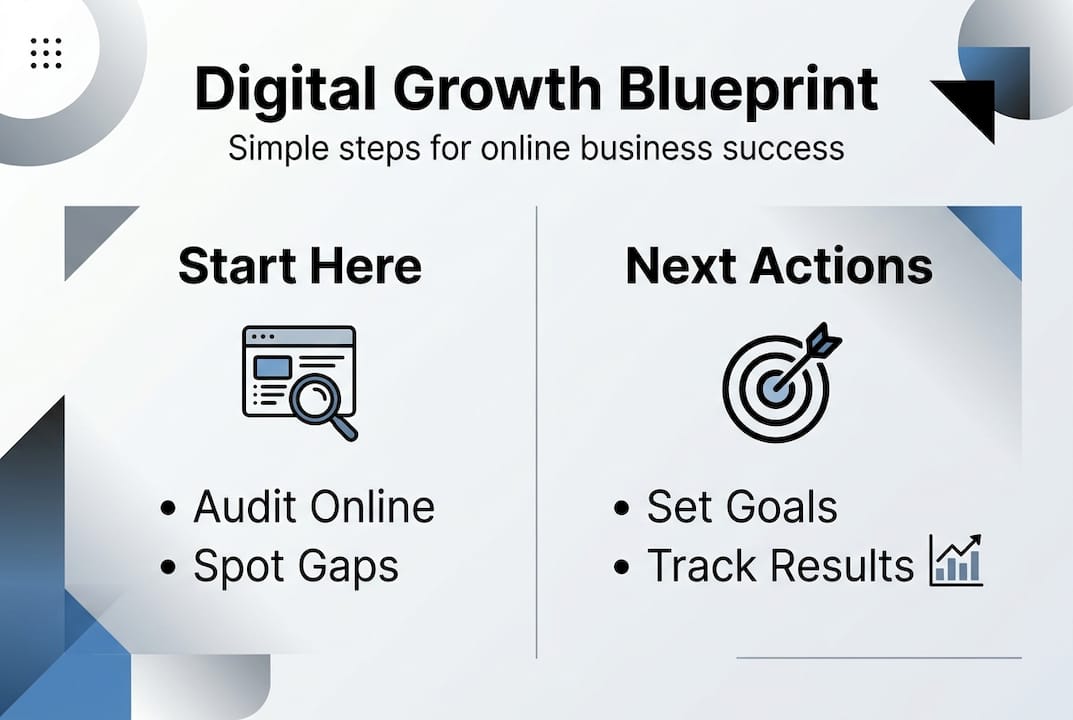
Step 1: Audit your current digital presence. Before you change anything, understand where you stand. Google your own business name and your main services. What shows up? Check your website load speed using Google PageSpeed Insights (a free tool). Look at your Google Business Profile and confirm all information is accurate and up to date. Review your social media profiles and assess how active and consistent they are.
Step 2: Identify your biggest gaps. Are potential customers finding you at all? Is your website turning visitors away because it loads too slowly or looks outdated? Are you capturing leads and following up, or letting interested people slip through the cracks? Write down your top three gaps. These are your priorities.
Step 3: Set specific, measurable goals. Vague goals produce vague results. Instead of "get more traffic," set a goal like "increase organic website visitors by 25% in 90 days." Instead of "grow our email list," aim for "add 150 new subscribers this month through a lead magnet." Specific goals give you a clear target and make it obvious when you are off track.
Step 4: Choose your tools and tactics. Based on your gaps and goals, select the right combination of tools. For acquisition, focus on SEO and paid ads. For engagement, use email marketing and social media consistency. For retention, build a loyalty offer or automated follow-up sequence. Do not add tools just because they look impressive. Every tool should serve a specific goal.
Step 5: Track your progress weekly. Set up a simple reporting dashboard. Free tools like Google Analytics 4 and Google Search Console give you most of what you need. Check your key metrics every week and adjust fast when something is not working. The businesses that grow fastest are not the ones that pick the perfect strategy upfront. They are the ones that adjust the fastest.
Step 6: Scale what works. Once you find a channel or campaign that consistently delivers results, invest more into it. This is where digital growth compounds. When integrated Industry 4.0 systems are applied in manufacturing, they connect processes that previously operated in silos, creating efficiency that multiplies across the whole operation. The same principle applies to your digital strategy. Connecting your winning tactics creates results far greater than any single effort alone. Explore digital project success stories to see how businesses like yours have made this work.
Pro Tip: Start with your highest-impact, lowest-effort opportunity. For most small businesses, that is claiming and fully optimizing their Google Business Profile. It is free, takes a few hours, and directly impacts local search visibility, which is often where the fastest wins live.
Why most digital growth advice misses the real challenge
Here is the uncomfortable truth most marketing content skips over. Most digital growth advice focuses on tactics: post more, run ads, optimize your SEO. And yes, those things matter. But the businesses that actually achieve lasting digital growth are not the ones that found the best hack. They are the ones that built a system for continuous improvement.
The real challenge is not knowing what to do. It is sustaining the discipline to test, measure, and adapt month after month. A viral post or a single strong campaign feels great. It does not build a business. What builds a business is the boring, consistent work of getting slightly better at every piece of the digital puzzle every single quarter.
We have seen this firsthand across the clients we work with at SourcesNova. The businesses that stall are usually the ones waiting for one big breakthrough. The businesses that grow are treating every result, including the disappointing ones, as information. Failures tell you exactly where to improve. The digital growth insights we share regularly reflect this mindset, because sustainable growth is a system, not a moment.
Stop looking for a silver bullet. Build a learning machine instead.
How SourcesNova can accelerate your digital growth
Ready to stop guessing and start building a digital growth system that actually works for your business?
At SourcesNova, we built our agency around one promise: no fluff, just results. Whether you are launching into a new market with our B2C launch solutions or driving targeted traffic through targeted Facebook ads, every service we offer is designed to move the needle on your real business goals. We handle the strategy, the execution, and the ongoing optimization so you can focus on running your business. If you are ready to grow with clarity and confidence, explore what digital growth guidance from SourcesNova looks like in practice.
Frequently asked questions
What is the difference between digital growth and digital marketing?
Digital marketing focuses on promoting products online, while digital growth covers the entire business strategy for expansion and engagement in the digital space, including operations, customer experience, and data systems.
Can digital growth help small businesses compete with larger ones?
Yes, digital growth can level the playing field by enabling small businesses to reach and engage more customers efficiently, often outmaneuvering larger competitors through speed and personalization.
What are the first steps to kick-start digital growth?
Start by evaluating your online presence, set clear and measurable goals, choose the tools that match your gaps, and track your progress weekly for ongoing improvement.
How can digital transformation projects boost business growth?
Digital transformation projects automate processes and provide actionable data that drive better decisions and stronger customer engagement. Connecting Industry 4.0 technologies with business operations, as shown through integrated Industry 4.0 systems, highlights how manufacturers are using digital integration to unlock significant efficiency and revenue gains.
Are there risks involved with digital growth strategies?
Every business change carries some risk, but careful planning, clear goal-setting, and a commitment to continuous learning dramatically reduce the common pitfalls that trip up digital growth initiatives.