
Most small business owners assume direct sourcing is something only Fortune 500 companies can pull off. The reality? 50% cost reduction is achievable for small businesses that make the switch. Direct sourcing, the practice of buying goods or talent directly from manufacturers or service providers without middlemen, is one of the most powerful levers a growing business can pull. This article breaks down exactly how it works, what results you can expect, and how to avoid the pitfalls that trip up most first-timers.
Table of Contents
- What is direct sourcing? Defining the approach
- Key benefits of direct sourcing for SMBs
- Risks, challenges, and pitfalls to avoid
- Real-world examples: Direct sourcing in action
- Our perspective: Why direct sourcing drives growth beyond just savings
- Ready to transform your sourcing and growth?
- Frequently asked questions
Key Takeaways
| Point | Details |
|---|---|
| Huge cost savings | Direct sourcing helps SMBs cut costs by as much as 50 percent through bypassing middlemen. |
| Better product quality | Working directly with suppliers allows for improved quality control and faster time-to-market. |
| Growth enabler | Savings from direct sourcing free up budget for marketing, customer acquisition, and innovation. |
| Manageable risks | Taking steps to vet suppliers and build the right partnerships keeps the process safe and scalable. |
What is direct sourcing? Defining the approach
Direct sourcing means going straight to the source. Instead of working through a distributor, broker, or intermediary, you buy products, materials, or services directly from the manufacturer or provider. That single shift changes everything about how you manage quality, price, and supply chain flexibility.
Traditional procurement typically involves multiple layers. A business places an order, a distributor or broker finds a supplier, marks up the cost, and passes the goods along. Every layer adds time, cost, and potential for miscommunication. Direct sourcing cuts that chain short, giving you a direct line to the people who actually make what you sell.
Here is a side-by-side comparison of the two models:
| Factor | Traditional procurement | Direct sourcing |
|---|---|---|
| Cost structure | Higher due to middlemen | Lower, better margins |
| Quality control | Limited, filtered through layers | Direct, real-time feedback |
| Customization | Often restricted | Fully negotiable |
| Supplier visibility | Minimal | Full transparency |
| Speed | Slower due to handoffs | Faster order cycles |
| Relationship | Transactional | Partnership-based |
The misconception that stops most small businesses is the idea that direct sourcing is complex, expensive to set up, or reserved for companies with large procurement departments. That is simply not accurate. Today, direct vs indirect sourcing comparisons show that SMBs gain greater control over quality, customization, inventory, and supply chain transparency when they choose the direct path.
Here is what makes direct sourcing accessible for smaller businesses right now:
- Digital platforms connect buyers to verified global manufacturers with lower minimum order quantities
- Pilot programs let you test one product or supplier before committing at scale
- Consultants and sourcing agencies handle the legwork without requiring a full internal team
- Online supplier directories reduce the time it takes to find and vet credible partners
You do not need a massive operation to benefit. If you sell a physical product, source talent for a service, or depend on materials to deliver your work, direct sourcing is already relevant to you. For more on how different direct sourcing models apply to real businesses, we go deeper in our blog.
Key benefits of direct sourcing for SMBs
Now that direct sourcing is defined, let us look at why so many smaller businesses are embracing it. The advantages go well beyond a lower price tag.
Cost savings are the headline benefit, and the numbers back it up. According to the 2025 CPO Survey Report, executives reported that working with small suppliers delivers a 50% cost reduction, 53% improvement in supply chain resilience, 56% improvement in quality, and 44% faster time-to-market. Those are not marginal gains. Those are business-changing results.

Here is what those figures look like in practice:
| Benefit area | Executive-reported improvement |
|---|---|
| Cost reduction | 50% |
| Supply chain resilience | 53% |
| Product quality | 56% |
| Time-to-market | 44% |
Beyond raw cost savings, the benefits compound in ways that matter to growth-stage businesses:
-
Better product quality. When you communicate directly with a manufacturer, you can set exact specifications, require samples, and build in quality checks. No more hoping a distributor passed your feedback along correctly.
-
Customization on your terms. Want your packaging to match your brand? Need a modified version of a standard component? Direct relationships make this possible in ways that traditional procurement rarely allows.
-
Faster inventory cycles. Cutting out middlemen means fewer handoffs, fewer delays, and shorter lead times. If you have ever lost a sale because stock arrived two weeks late, you already understand how valuable this is.
-
Supply chain resilience. When disruptions hit, businesses with direct supplier relationships adapt faster. You can communicate in real time, shift orders, and problem-solve without waiting for a broker to relay messages.
Pro Tip: Start with one pilot product and one direct supplier. Track your cost per unit, lead time, and defect rate over 90 days. Compare those numbers against your current supplier. That data makes the case for expanding your direct sourcing program internally and proves ROI before you scale.
You can also explore manufacturing cost-savings tips if you want a detailed breakdown of how operational changes compound with direct sourcing to drive even greater efficiency. When you combine leaner procurement with smarter operations, you are no longer just cutting costs. You are building margin that funds growth. Investing in B2B sourcing support early in this process can prevent costly missteps and accelerate your results.
Risks, challenges, and pitfalls to avoid
While the benefits are significant, direct sourcing is not without risks. Going direct gives you more control, but it also puts more responsibility on your shoulders. Knowing where businesses commonly go wrong helps you avoid the same mistakes.
The biggest risk is poor supplier vetting. 41% of enterprises experience significant losses due to inadequate supplier vetting. For a small business with tighter cash flow, a single bad supplier relationship can be devastating. Late deliveries, substandard materials, or sudden production shutdowns can all trace back to a supplier you did not properly evaluate before signing a contract.
Common pitfalls SMBs run into when starting direct sourcing include:
- Relying on a single supplier without a backup, which creates major risk if they face production issues
- Underestimating hidden costs like international shipping fees, import duties, currency fluctuations, and quality control inspections
- Skipping legal and compliance checks, especially when sourcing from overseas manufacturers
- Moving too fast and committing to large orders before a supplier has proven themselves
- Neglecting communication by assuming a supplier will proactively flag problems rather than building regular check-ins
"The most expensive sourcing mistake is not the wrong price. It is the wrong supplier. You can negotiate a better deal, but you cannot negotiate your way out of a failed product launch or a broken supply chain."
How do you mitigate these risks? The answer is structured, repeatable processes. Start with thorough background checks on potential suppliers, request references, and always run a sample order before committing to volume. Using data for supplier vetting is increasingly standard practice, and even small businesses can access supplier rating tools and third-party audit services.
Building a resilient direct sourcing program means:
- Maintaining relationships with at least two approved suppliers for each product category
- Setting clear performance benchmarks in your supplier contracts, including delivery timelines and defect thresholds
- Creating an internal policy for how and when you escalate supplier issues
- Reviewing supplier performance quarterly, not just when a problem arises
Pro Tip: Lean on third-party sourcing platforms or consultants, especially in the early stages. The cost of expert guidance is almost always lower than the cost of a sourcing failure. Our full services list includes sourcing support designed specifically for SMBs navigating this transition.
Real-world examples: Direct sourcing in action
The best way to understand direct sourcing is through businesses that have already done it. The numbers are real, and the lessons translate directly to your own situation.
Case one: $276,000 in annual savings for a global manufacturer. According to a documented case study, a manufacturer restructured its sourcing by cutting out distributor layers and building direct relationships with suppliers. The result was $276,000 in savings in a single year. The key moves were standardizing supplier evaluation, negotiating directly on pricing and terms, and introducing data-driven spend analysis. This is not a strategy that requires a massive procurement department. It requires discipline and the right framework.
Case two: $20,600 first-year ROI for an SMB using direct talent sourcing. This case involves a small business that stopped relying on staffing agencies and instead built a direct recruiting pipeline using niche platforms. By eliminating recruiter fees and building a direct applicant pool, they generated a first-year return of over $20,000. Talent sourcing works by the same principles as product sourcing: remove the middleman, build the relationship, control the outcome.
Here is a step-by-step approach to launching your own direct sourcing pilot:
- Identify your highest-cost product or material category. This is where direct sourcing will generate the fastest ROI.
- Research and shortlist three to five potential suppliers. Use directories, trade shows, or sourcing platforms to build your list.
- Run a background check and request samples. Evaluate quality, lead times, and communication responsiveness before committing.
- Place a pilot order. Start small. Set clear performance benchmarks and document every metric.
- Track results over 90 days. Measure cost per unit, lead time, defect rate, and total spend versus your previous model.
- Use the data to scale. Once the pilot proves ROI, expand to additional product lines or supplier partnerships.
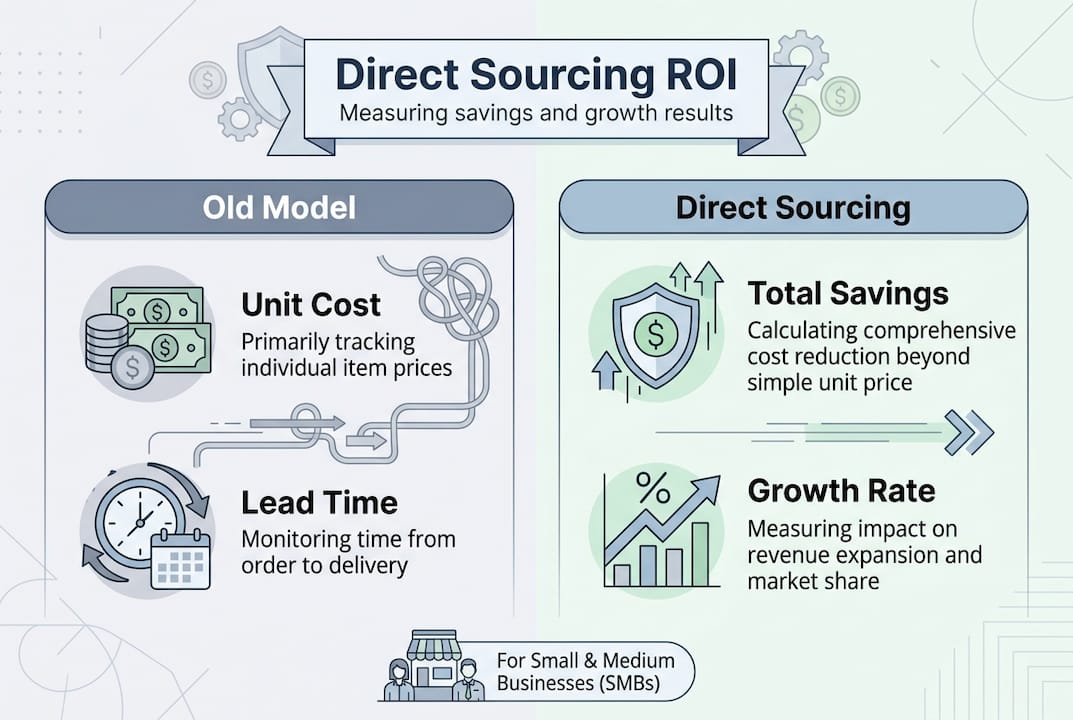
Measuring ROI from direct sourcing is straightforward: compare your total cost of goods under the old model (including distributor markup, delays, and quality costs) against your total cost under the direct model. Factor in any upfront investment in vetting or sample orders. For businesses exploring market entry alongside sourcing, our B2C launch services are designed to help you move fast without expensive mistakes. You can also explore cost reduction strategies that pair well with direct sourcing to drive even stronger margins from day one.
Our perspective: Why direct sourcing drives growth beyond just savings
Here is something most articles on direct sourcing miss entirely: cost savings are just the beginning. The real strategic value of direct sourcing is what you do with the money you free up.
We have worked with small businesses across retail, e-commerce, and service industries, and the pattern is consistent. The businesses that grow fastest are not necessarily the ones with the best product. They are the ones who figured out how to fund their marketing before their competitors did. When lowering acquisition costs for goods and talent frees up meaningful budget, that money does not just sit in a bank account. It gets reinvested into digital marketing, customer acquisition, and brand building. That is where the real growth engine starts.
The businesses that struggle with direct sourcing are often the ones who treat it as a purely operational exercise. They save 20% on a product category and route that savings back into the same overhead it came from. Nothing changes. The smarter move is to treat direct sourcing as a growth strategy, not just a procurement upgrade. Every dollar saved on goods is a dollar available for SourcesNova supported marketing that brings in new customers.
Small businesses can genuinely act like larger companies in this area. The tools, platforms, and partners exist. What most SMBs lack is not access. It is the decision to stop outsourcing their strategic thinking to whoever is cheapest and start building sourcing models that are designed to fund growth.
Ready to transform your sourcing and growth?
Direct sourcing is one of the clearest paths small and mid-sized businesses have to reduce costs, improve quality, and put real money back into growth. The case is proven, the tools are available, and the results speak for themselves.
At SourcesNova, we help SMBs move from expensive, opaque procurement to lean, strategic direct sourcing. Whether you are looking to cut product costs through B2B sourcing services or need help planning a direct-to-consumer market entry with B2C launch support, we bring hands-on execution without the bloated agency fees. Visit SourcesNova to learn how we can help you build a sourcing model that actually funds your growth.
Frequently asked questions
What is the main difference between direct and indirect sourcing?
Direct sourcing means buying straight from manufacturers or service providers, which gives you full control over pricing, quality, and customization. Indirect sourcing routes purchases through distributors or middlemen, adding cost and reducing supply chain transparency.
Can direct sourcing really save SMBs money?
Yes, and the data is compelling. Executive surveys show SMBs that switch to direct sourcing report 50% cost reduction along with major gains in quality and speed.
What are common risks when starting with direct sourcing?
The biggest risk is skipping proper supplier vetting, which causes significant financial losses for 41% of businesses that experience it. Careful vetting, backup suppliers, and scalable partnerships are the best defenses.
How quickly can SMBs see ROI from direct sourcing?
Some SMBs see first-year returns exceeding $20,000 in ROI through direct sourcing and talent acquisition improvements, with manufacturers reporting even larger savings within the same timeframe.