
The customer acquisition process is the end-to-end system that moves an anonymous prospect through every stage — from first touch to paid customer to activated account. For Asian manufacturers and consumer brands entering the U.S. B2B market, three actions come first:
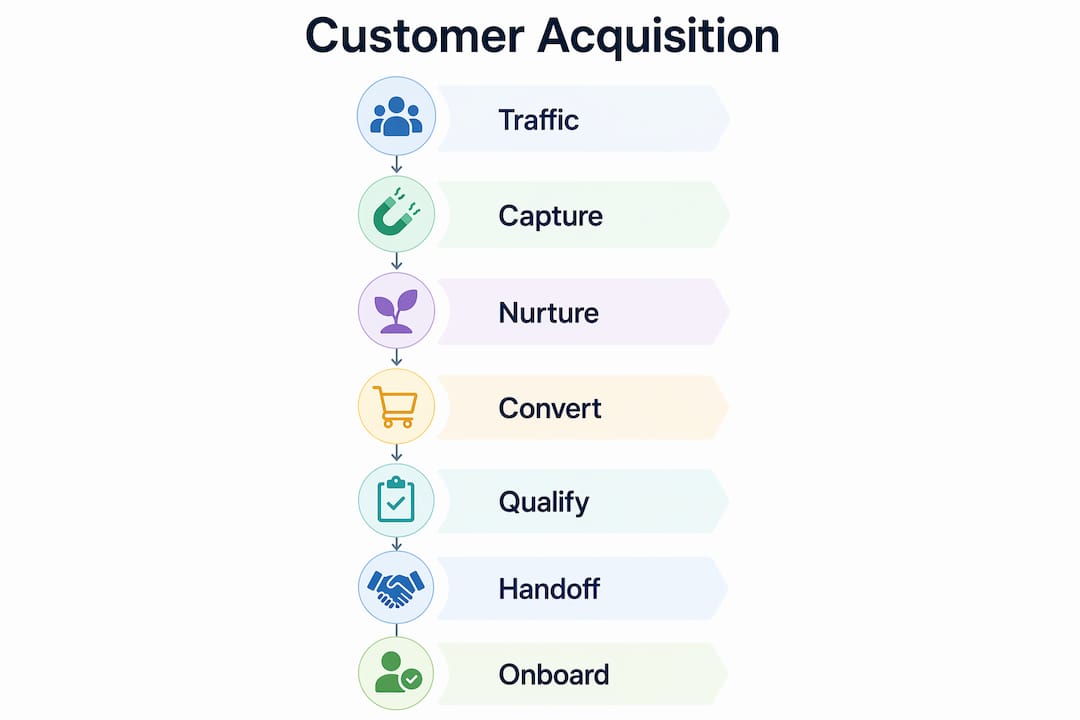
- Map your funnel across all seven stages: Traffic → Capture → Nurture → Qualify → Handoff → Convert → Onboard.
- Agree a written marketing-to-sales handoff SLA that defines response times, ownership, and lead-score thresholds before a single lead is passed.
- Build one owned-contact capture asset — an RFQ flow, gated spec sheet, or industry whitepaper — so you are not entirely dependent on paid traffic.
One distinction worth locking in early: lead generation is a tactical subset of acquisition focused on capturing contact information. Acquisition covers everything after capture — nurture, qualification, sales engagement, and onboarding. Conflating the two is how brands stall at the top of the funnel and wonder why revenue does not follow.
Table of Contents
- What does the customer acquisition process look like stage by stage?
- How do you calculate CAC, LTV, and payback period?
- How do you align marketing and sales with a handoff SLA?
- Which acquisition tactics work best for U.S. B2B market entry?
- How do you lower CAC and improve payback period?
- What does a 90-day starter plan look like?
- Key Takeaways
- What Sourcesnova sees working for Asian brands in the U.S.
- Sourcesnova's market entry services for U.S. customer acquisition
- Useful sources and further reading
What does the customer acquisition process look like stage by stage?
Mapping acquisition in four-plus phases — Traffic, Capture, Nurture, Convert — and extending through Qualify, Handoff, and Onboard gives every lead a routed path with a clear owner at each gate.

| Stage | Job to Be Done | Owner | Core KPI |
|---|---|---|---|
| Traffic | Drive qualified visitors via SEO, paid social, trade shows | Marketing | Sessions, cost per click |
| Capture | Convert visitors to known contacts via RFQ, lead magnet | Marketing | Opt-in rate |
| Nurture | Build trust via email sequences, case studies, spec content | Marketing | Email open/click rate |
| Qualify | Score leads against ICP criteria; triage intent | Sales Development | Lead-to-qualified rate |
| Handoff | Pass scored leads to sales rep with full engagement history | SDR → Sales Rep | Response time (SLA) |
| Convert | Run discovery, proposal, negotiation, close | Sales Rep | Conversion rate, deal size |
| Onboard | Deliver first shipment, validate compliance, activate account | Ops / Customer Success | Time-to-first-shipment |
Owned audiences sit at the center of this map. An email list or newsletter subscriber is a contact you can reach without paying for traffic again. Rented audiences — paid ads, marketplace listings, trade show badge scans — disappear the moment you stop paying. Building owned contacts at the Capture stage is what makes the rest of the funnel sustainable. Gated content and newsletters materially lower long-term nurture costs compared with pure paid acquisition.
Multi-touch journeys are the norm in U.S. B2B commerce. A procurement manager may find you through a Google search, download a spec sheet, attend a trade show, and then respond to a LinkedIn ad before requesting a quote. No single channel closes the deal alone.
How do you calculate CAC, LTV, and payback period?
Customer Acquisition Cost (CAC) is total acquisition spend divided by new customers in the same period. The numerator must include ad spend, creative production, tooling, agency fees, and the fully loaded labor cost of everyone in marketing and sales.
Worked example — U.S. wholesale buyer:
- Monthly spend: $12,000 (ads $6,000 + agency $4,000 + tooling/labor $2,000)
- New wholesale accounts signed: 4
- CAC = $12,000 ÷ 4 = $3,000 per account
- Average first-year contract value: $18,000
- Gross margin: 40% → gross profit per account = $7,200
- Payback period = $3,000 ÷ ($7,200 ÷ 12) = ~5 months
Prioritize customers with the highest Lifetime Value (LTV) and shortest payback, not the lowest CAC alone. A $500 CAC on a buyer who churns after one order is worse than a $3,000 CAC on a distributor who reorders quarterly for three years.
Treating the first 60–90 days post-conversion as part of acquisition is critical. If a new account does not reach expected outcomes — such as first shipment delivery, compliance documentation validation, or reorder initiation — churn risk increases and your CAC payback calculation becomes inaccurate.
Dashboard fields to track in your CRM:
- Lead source and first-touch channel
- Opt-in asset downloaded
- Lead score at handoff
- Call-booked timestamp
- Contract signed date
- First shipment delivered date
How do you align marketing and sales with a handoff SLA?
Misaligned handoffs are the single most common failure point in B2B acquisition. Marketing passes a contact; sales ignores it because the lead is not ready. Or sales calls too late, and the buyer has already chosen a competitor. A written SLA eliminates the ambiguity.
Sample SLA checklist — fields required before handoff:
- Company name, size (employees and annual revenue), and U.S. state
- Buyer role and purchasing authority (decision-maker, influencer, or evaluator)
- Estimated annual order volume and budget range
- RFQ specifications: product category, MOQ, lead-time requirements
- Intent signals: pages visited, assets downloaded, emails opened, demo requested
- Lead score: minimum threshold of 40 points before handoff (see scoring below)
Sample lead-scoring model for U.S. wholesale buyers:
- Downloaded spec sheet or RFQ template: +15 points
- Visited pricing or MOQ page twice or more: +10 points
- Opened 3+ nurture emails: +8 points
- Company revenue over $5M: +10 points
- Buyer role is procurement manager or category director: +12 points
- Responded to a qualification form: +15 points
Sales needs visibility into the same engagement data as marketing — content consumed, pages visited, assets downloaded — before the first call. Shared CRM dashboards and full contact histories materially improve sales conversations and win rates. The SLA should also specify a maximum response time of four business hours for a Marketing Qualified Lead and 24 hours for a lower-scored contact, with an escalation path if the rep does not respond.
Which acquisition tactics work best for U.S. B2B market entry?
Asian manufacturers entering the U.S. face a specific trust gap: procurement managers have no prior relationship, no reference accounts, and often limited familiarity with the brand. Tactics that build credibility and reduce friction close that gap faster than volume-based outreach.
Owned-audience plays:
- Gated RFQ templates and downloadable spec sheets capture buyer contact details at the moment of highest intent
- A B2B newsletter targeting procurement managers and category buyers builds familiarity before a sales conversation
- Industry whitepapers on compliance, lead times, or material standards position the brand as a knowledgeable supplier
Channel execution notes:
- Localized SEO: target buyer-intent queries ("wholesale [product] supplier USA," "[product] RFQ manufacturer") with product pages that include MOQ, lead time, and compliance certifications
- LinkedIn paid social: target by job title (procurement manager, category buyer, VP of sourcing) and company size; use case studies and spec content as ad creative
- Trade shows: MAGIC, Cosmoprof North America, and industry-specific expos give direct access to retail buyers and distributors; follow up within 48 hours with a personalized RFQ link
- Distributor outreach: distributor matching accelerates trust because a known intermediary vouches for the brand
- Marketplace and wholesale listings: Faire, RangeMe, and Alibaba.com's U.S.-facing storefronts reach buyers already in procurement mode
For manufacturers, website architecture must support RFQ flows and detailed product catalogs. A standard retail Add-to-Cart layout signals a consumer brand, not a wholesale supplier. Procurement managers expect clear MOQ fields, downloadable spec sheets, compliance documentation, and a direct RFQ submission form.
How do you lower CAC and improve payback period?
Prioritized levers, roughly in order of impact:
- Improve capture conversion. A landing page with a specific offer (RFQ template, compliance checklist) consistently outperforms a generic homepage form. Test headline, form length, and social proof.
- Fix RFQ and spec-sheet UX. If buyers cannot find MOQ, lead time, or compliance docs within two clicks, they leave. Fixing navigation and page structure raises conversion without additional ad spend.
- Retarget high-intent visitors. Visitors who viewed a product page or started an RFQ but did not submit are your warmest audience. Retargeting campaigns for this segment typically cost a fraction of cold acquisition.
- Increase average order value via bundling. Higher AOV on the first order shortens payback period without reducing CAC.
- Shift budget toward owned-audience channels. Every email subscriber you nurture to a sale costs less than the equivalent paid-traffic conversion.
Pro Tip: Add a short qualification form (four to six fields) before routing a lead to a full sales call. This single triage step protects sales time, filters out low-intent contacts, and raises close rates for markets entering the U.S. B2B channel.
What does a 90-day starter plan look like?
| Weeks | Milestone | Owner | Acceptance Criteria |
|---|---|---|---|
| 1–2 | Funnel audit and ICP definition | Marketing Lead | Documented funnel map, buyer persona, and gap list |
| 3–4 | Build RFQ flow and one gated capture asset | Marketing + Web | Live RFQ page with MOQ/spec fields; lead magnet live |
| 5–6 | Set up CRM tracking and SLA | Sales Lead + Ops | All 6 SLA fields mapped in CRM; scoring model live |
| 7–8 | Launch SEO content and LinkedIn campaign | Marketing + Agency | 3 buyer-intent pages published; LinkedIn campaign active |
| 9–10 | Run qualification gate and first triage calls | Sales Development | Triage form live; first 10 qualified leads scored |
| 12 | Optimize top channel; scale budget | Marketing Lead | CAC trend down; opt-in rate above baseline |
Weekly metric checklist:
- Opt-in rate on capture assets
- Lead-to-qualified rate (leads scored above threshold ÷ total leads)
- Call-booking rate from qualified leads
- CAC trend week over week
- Time-to-first-shipment for any closed accounts
Key Takeaways
A structured customer acquisition process — from funnel mapping through onboarding — is the foundation for sustainable U.S. B2B growth for Asian manufacturers and consumer brands.
| Point | Details |
|---|---|
| Map all seven stages | Assign a clear owner and KPI to each stage from Traffic through Onboard. |
| Capture owned contacts first | Build an RFQ flow or gated asset before scaling paid traffic. |
| Write a handoff SLA | Define lead-score thresholds, required fields, and a four-hour response time before passing leads to sales. |
| Measure CAC and payback together | A low CAC on a short-LTV buyer is worse than a higher CAC on a long-term distributor relationship. |
| Sourcesnova accelerates entry | Sourcesnova delivers funnel mapping, RFQ-ready website builds, and B2B lead generation for Asian brands entering North America. |
What Sourcesnova sees working for Asian brands in the U.S.
The pattern that separates brands gaining traction from those stalling is straightforward: the ones winning own their audience before they scale their ad spend. Every brand that skips the capture step and runs straight to paid traffic ends up rebuilding from scratch every quarter when budgets shift.
The second recurring fix is the RFQ flow. Procurement managers in the U.S. make decisions on spec, compliance, and lead time — not brand story. A site that buries MOQ in a PDF and has no RFQ submission form signals operational immaturity to a buyer who processes dozens of supplier evaluations a month. Adding a structured RFQ page with clear fields for product category, quantity, and delivery timeline consistently shortens the sales cycle.
Distributor matching accelerates trust in a way that direct outreach rarely does at the start. A known U.S. distributor vouching for a new supplier removes the relationship risk that procurement managers are paid to avoid.
The brands that close accounts in the first 90 days are the ones that treated onboarding as part of acquisition, not a post-sale afterthought. First shipment delivered on time, compliance docs in order, and a follow-up call at day 30 — those three steps determine whether a trial order becomes a recurring account.
Sourcesnova's market entry services for U.S. customer acquisition
Asian manufacturers and consumer brands entering North America need more than a marketing plan — they need a system built for U.S. wholesale buyers from day one. Sourcesnova delivers exactly that: market-entry audits, RFQ-ready website builds, B2B lead generation, distributor matching, and retained paid-media management, all executed by a team with direct cross-border experience.
A typical engagement starts with a funnel audit and ICP definition in weeks one and two, followed by a live RFQ flow, capture assets, and CRM setup by week six. From there, Sourcesnova manages channel testing, qualification gates, and ongoing optimization so your internal team can focus on closing and fulfilling orders.
To get a funnel map and 90-day acquisition plan built for your product category and U.S. entry goals, contact Sourcesnova for a consultation.
Useful sources and further reading
- What Is Customer Acquisition? Strategies, Process & Benefits | Vtiger — Covers the distinction between lead generation and full acquisition, and the role of owned-audience building. Supports the BLUF, process overview, and efficiency levers sections.
- Ecommerce Customer Acquisition: Channels & Formula | Shopify — Defines CAC with included cost categories, explains multi-touch journeys, and addresses RFQ/wholesale UX requirements. Supports the measurement and tactics sections.
- Customer Acquisition Process Map: How to Build One | Catalyst Outsourcing — Foundational guide to mapping acquisition stages with triggers, decision points, and completion criteria. Supports the process overview and 90-day plan.
- What Is Customer Acquisition? 9 Strategies | Zendesk — Details the value of shared engagement data and CRM alignment between marketing and sales. Supports the governance and handoff section.
- B2B Lead Generation Strategies | Sourcesnova — Practical standards for defining and qualifying leads in a manufacturing context; useful alongside the SLA checklist.
- Examples of Lead Magnets That Grow Your Email List | Sourcesnova — Covers gated content formats for industrial brands building owned audiences; supports the capture asset recommendations.