
Price negotiation is only a small part of what separates thriving supply chains from struggling ones. Most small and mid-sized businesses focus almost entirely on unit cost, overlooking the broader system of identifying, evaluating, and engaging suppliers that actually drives sustainable savings and resilience. B2B sourcing is that system: a disciplined process focused on total cost of ownership, quality, and supplier reliability. This guide breaks it all down, from definitions to real-world application, so your business can use sourcing as a strategic lever rather than a reactive scramble.
Table of Contents
- B2B sourcing explained: What it is (and isn't))
- Types of B2B sourcing: Strategic, tactical, and essential models
- The B2B sourcing process step-by-step
- Benefits and risks of B2B sourcing for SMBs
- Best practices for sourcing success in small and mid-sized businesses
- A fresh perspective: What most SMBs get wrong about B2B sourcing
- Take your B2B sourcing to the next level
- Frequently asked questions
Key Takeaways
| Point | Details |
|---|---|
| Strategic sourcing matters | Looking beyond price to value and risk can save SMBs up to 30% and build supply chain resilience. |
| Process drives results | A structured, step-by-step approach to sourcing consistently yields better supplier deals and fewer headaches. |
| Right model for the need | Strategic sourcing fits big-impact buys; tactical is for urgent, low-value needs—knowing when to use each saves time and money. |
| Avoid common pitfalls | Single sourcing and ‘price-only’ thinking often backfire; always factor in reliability, quality, and adaptability. |
| Digital tools boost efficiency | Modern e-procurement and analytics give SMBs an edge to make sourcing faster, smarter, and more reliable. |
B2B sourcing explained: What it is (and isn't)
B2B sourcing is often confused with purchasing or procurement, but there are meaningful differences worth understanding before building a strategy.
At its core, B2B sourcing is the process by which one business identifies, evaluates, and engages suppliers to acquire goods or services needed for operations. It is not just placing an order. It is the upstream work that determines who you buy from, under what terms, and with what expectations for quality and delivery.
Here is how sourcing differs from procurement:
- Sourcing asks: "Who should we buy from, and why?"
- Procurement asks: "How do we execute the purchase from this supplier?"
As sourcing precedes procurement, it focuses on identifying and selecting suppliers, while procurement handles the transactional side: purchase orders, invoicing, and logistics.
Another common misconception is that the lowest price always wins. In practice, a supplier charging 15% more but delivering on time with consistent quality can cost far less over a 12-month period than a cheaper vendor with frequent delays and defects. This is the concept of total cost of ownership (TCO): the full financial impact of a supplier relationship, including shipping, inspection, returns, and operational disruption.
"Sourcing without a TCO lens is just shopping. Real B2B sourcing is an investment in operational resilience."
For SMBs exploring direct sourcing for cost savings, the distinction between price and value is often the difference between marginal gains and transformational results.
Key misconceptions to avoid:
- "It's just purchasing" — sourcing is strategic, purchasing is transactional
- "Lowest price wins" — TCO, reliability, and relationship quality matter far more
- "Only large companies do this" — SMBs benefit equally, and often more proportionally
- "One-time activity" — effective sourcing is a continuous process
Types of B2B sourcing: Strategic, tactical, and essential models
With a clear definition in mind, the next step is to understand the different types and approaches to B2B sourcing.
Not every sourcing situation is the same. A business buying office supplies on short notice has different needs than one locking in a two-year contract for custom manufactured components. Choosing the wrong model wastes time and money.
Strategic vs. tactical sourcing
Strategic sourcing is proactive and long-term. It focuses on TCO, risk reduction, supplier relationships, and market analysis. Tactical sourcing, on the other hand, is reactive and short-term, prioritizing speed and price for immediate needs.
| Criteria | Strategic sourcing | Tactical sourcing |
|---|---|---|
| Time horizon | Long-term (months to years) | Short-term (days to weeks) |
| Primary focus | TCO, risk, relationships | Price, speed, availability |
| Best for | High-value or recurring categories | Urgent or low-value one-time buys |
| Supplier interaction | Deep partnership development | Transactional engagement |
| Process depth | Full RFx, analysis, contracting | Spot buying or quick quotes |
Other sourcing models SMBs should know
There are four primary models beyond the strategic/tactical split:
- Single sourcing: One supplier for a specific category. This maximizes leverage and simplifies management but creates dependency risk.
- Global sourcing: Sourcing internationally for cost advantage, access to technology, or specialized manufacturing capacity.
- Insourcing: Handling a service or production internally rather than through a third party.
- Outsourcing: Delegating a function or supply need to a specialized external provider.
For SMBs, a practical starting point often involves combining single sourcing for 2 to 3 high-volume categories with tactical sourcing for lower-priority needs. This approach balances manageability with impact.
Pro Tip: If you are new to strategic sourcing, start by mapping your top 5 spend categories. Identify which ones repeat monthly and carry high dollar value. Those are your priority targets for a strategic model.
Thinking about building supplier relationships as a long-term investment, rather than a transactional interaction, is what separates tactical buyers from strategic sourcing leaders.

The B2B sourcing process step-by-step
Having compared sourcing models, it is time to see how a best-practice process actually unfolds.
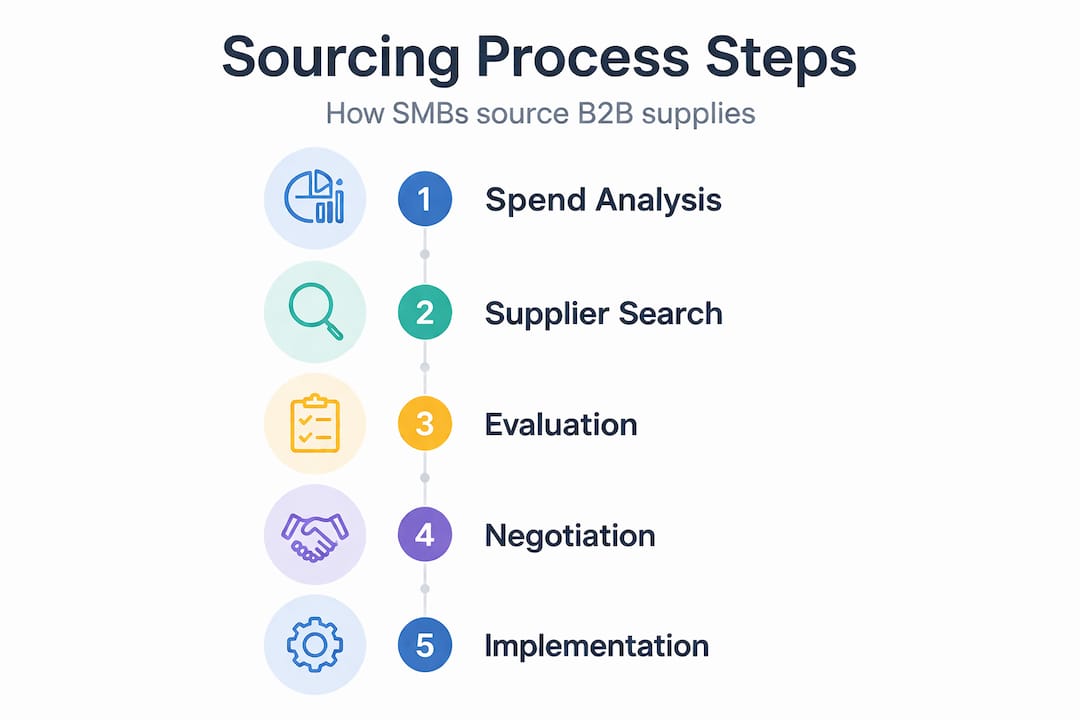
The strategic sourcing process follows six core steps, each designed to reduce risk and increase value at every stage.
-
Spend analysis and category profiling: Before contacting a single supplier, analyze what you are buying, how much, how often, and from whom. This reveals duplication, maverick spending, and consolidation opportunities.
-
Market research and supplier mapping: Research available suppliers in your category. Identify who serves your market, what certifications they hold, and what their reputation looks like. Online directories, trade publications, and industry referrals are valuable here.
-
Strategy development (RFx): Decide on your approach. Will you issue a Request for Information (RFI), a Request for Proposal (RFP), or a Request for Quote (RFQ)? The right tool depends on category complexity and supplier market structure.
-
Supplier evaluation and selection: Score suppliers against weighted criteria: price, lead times, quality certifications, financial stability, and references. Do not rely on a single metric. A scorecard approach keeps evaluation objective and defensible.
-
Negotiation and contracting: Negotiate terms covering price, payment, delivery, performance benchmarks, and exit clauses. A signed contract is your protection against quality fade, price creep, and delivery inconsistency.
-
Implementation and performance monitoring: Launch the relationship with clear onboarding. Then track supplier performance quarterly using agreed KPIs such as on-time delivery rate, defect rate, and responsiveness to issues.
| Step | Key action | Primary output |
|---|---|---|
| Spend analysis | Categorize and quantify spending | Category spend profile |
| Market research | Map potential suppliers | Supplier shortlist |
| Strategy development | Design RFx process | RFP or RFQ document |
| Supplier evaluation | Score against criteria | Supplier scorecard |
| Negotiation | Agree on terms | Signed contract |
| Monitoring | Track KPIs | Performance report |
A real-world example: an SMB spending $600,000 annually on office supplies starts by profiling the category. They find spending spread across seven vendors with no volume leverage. After market research, they issue an RFQ to three qualified suppliers. By consolidating to one primary vendor, they negotiate better pricing, free delivery, and a 30-day payment term. The result: a 20% cost reduction, saving $120,000 in year one.
Pro Tip: Use B2B communication best practices when engaging suppliers during the RFx process. Clear, professional communication builds credibility and often results in more competitive responses.
Benefits and risks of B2B sourcing for SMBs
Understanding the steps is essential, but results matter most. Here is what effective sourcing delivers, and where it can backfire.
The tangible benefits
Cost savings are real and measurable. Strategic sourcing typically yields 15% to 30% cost reductions in mature categories. A global manufacturer applying this approach saved $276,000, which is 20% of $790,000 in indirect spend, by consolidating suppliers and renegotiating contracts.
For smaller businesses, the results are equally compelling. A $12 million distributor saved $140,000 through vendor consolidation despite operating on razor-thin 1.2% margins. A mid-sized firm cut office supply costs by 20%, saving $120,000 on $600,000 in spend. These are not outlier results. They reflect what happens when SMBs treat sourcing as a system rather than an afterthought.
Key benefits include:
- Cost savings: 15% to 30% reductions are achievable with structured category management
- Supply chain resilience: Vetted suppliers reduce the risk of disruption during demand spikes or logistics disruptions
- Quality consistency: Contractual quality standards and performance monitoring reduce defects and returns
- Better payment terms: Volume commitments and long-term relationships often unlock net-30 or net-60 terms
- Operational efficiency: Fewer suppliers to manage means less administrative overhead
"Strategic sourcing is not just about spending less. It is about spending better, with suppliers who are invested in your success."
The risks you cannot ignore
Single sourcing creates concentration risk. If your one supplier experiences a production halt, a port delay, or a quality failure, your operations stop too. Supplier relationship management (SRM) and dual-sourcing strategies help mitigate this.
Quality fade is another real concern in global sourcing. A supplier that delivers excellent quality in year one may cut corners to protect their margins in year two. Regular audits and contractual performance standards are your primary defense.
Urgent, low-value purchases often do not justify a full strategic process. For those situations, tactical sourcing is the right tool. Over-engineering small decisions wastes resources without meaningful payoff.
Best practices for sourcing success in small and mid-sized businesses
To maximize results and avoid common traps, these proven best practices can guide your B2B sourcing journey.
Strategic sourcing best practices consistently point to the same core principles. Alignment, data, and continuous monitoring separate high-performing sourcing programs from those that stall after initial savings.
Core best practices for SMBs
-
Align sourcing strategy with business goals. If your business is scaling into new markets, your supplier base needs to scale with you. Sourcing decisions should support growth objectives, not just cost targets.
-
Prioritize high-impact categories first. Not all spend is equal. Focus your sourcing effort on the categories that represent the largest share of cost or the greatest operational risk.
-
Use data and spend analysis as your foundation. Decisions based on gut instinct rarely outperform decisions grounded in spending data, supplier performance records, and market benchmarking.
-
Build cross-functional teams. Sourcing affects operations, finance, and sales. Including these stakeholders in sourcing decisions improves buy-in and surfaces requirements that procurement alone would miss.
-
Adopt digital tools for efficiency. Digital tools such as e-procurement platforms and AI-powered spend analytics significantly enhance efficiency for SMBs, reducing manual workload and improving visibility across the supplier base.
-
Avoid reverse auctions for complex needs. Reverse auctions drive price down fast, but they can damage supplier relationships and result in quality trade-offs when used for nuanced or relationship-dependent categories.
Additional best practices:
- Conduct annual or bi-annual market checks even with established suppliers
- Document sourcing decisions for accountability and future reference
- Build risk assessment into every new supplier relationship from day one
- Use SRM processes to maintain consistent communication with key suppliers
For SMBs looking to leverage direct sourcing for SMBs, these practices create a scalable foundation that compounds in value over time.
Pro Tip: Before investing in a new sourcing tool or platform, map your current process manually. Identifying where time is lost and where decisions break down tells you exactly what to prioritize when evaluating solutions.
A fresh perspective: What most SMBs get wrong about B2B sourcing
Before wrapping up, here is an insight most SMBs overlook when launching or optimizing their sourcing efforts.
The single biggest mistake is treating sourcing as a one-time cost-cutting exercise rather than an ongoing operational capability. Business owners launch a sourcing project, achieve some savings, and then return to the old habits: fragmented vendor lists, reactive purchasing, and no performance tracking. Within 18 months, costs creep back up and the gains disappear.
The second mistake is obsessing over price to the exclusion of everything else. It feels rational. Lower price equals lower cost. But that logic breaks down quickly when you factor in late deliveries, replacement orders, customer complaints, and the internal time spent managing unreliable suppliers. One bad supplier relationship can cost far more than the savings it appeared to deliver.
The smarter approach is to pick one high-impact category and run the full strategic sourcing process from spend analysis to contract. Research shows that SMBs who start with a single focused category often see 10% to 20% savings quickly, and those results build organizational confidence to scale the process further.
The businesses that get the most from sourcing treat supplier relationships as a form of partnership. They communicate clearly, pay on time, provide demand forecasts when possible, and invest in understanding their suppliers' constraints. In volatile markets, those suppliers prioritize their best partners. That access to priority production and reliable inventory is worth far more than a 2% price discount.
Adaptability matters too. The best sourcing programs are not rigid. They evolve with market conditions, business growth, and supplier development. The SMBs that learn from direct sourcing early build a competitive advantage that is genuinely hard for competitors to replicate.
Take your B2B sourcing to the next level
You now have a clear framework for understanding, structuring, and executing B2B sourcing in a way that creates lasting value for your business. The knowledge is the starting point. Implementation is where results are earned.
SourcesNova helps small and mid-sized businesses move from reactive purchasing to strategic sourcing, backed by clear processes and hands-on execution. No jargon. No bloated retainers. Just practical guidance and real results. Whether you are mapping your first category for strategic review or looking to optimize an existing supplier base, explore what B2B sourcing solutions can do for your business today. The next step is simpler than you think.
Frequently asked questions
What's the difference between B2B sourcing and procurement?
Sourcing selects and vets suppliers based on strategy and total cost of ownership, while procurement handles the transactional execution of purchases with those selected suppliers. Think of sourcing as the "who" and procurement as the "how."
How much can B2B sourcing save a small business?
Strategic sourcing typically delivers 15% to 30% cost reductions in mature spend categories, with some businesses saving significantly more through vendor consolidation and better contract terms.
What are the main risks of single sourcing?
Single sourcing creates supply disruption risk if that supplier experiences problems. Strong supplier relationship management and backup options help reduce that exposure.
When should an SMB use tactical vs. strategic sourcing?
Tactical sourcing fits urgent, low-value buys where speed matters most. Strategic sourcing is better for high-value, recurring, or operationally critical categories where relationship quality and TCO have significant long-term impact.
How do digital tools help SMBs with B2B sourcing?
E-procurement platforms and AI analytics automate supplier comparison, track spending in real time, and flag performance issues early, helping small teams manage sourcing programs that would otherwise require much larger resources.