
Most small business owners treat service marketing the same way they market products. They focus on features, list prices, and run ads. Then they wonder why the phone stays quiet. The truth is that services operate by entirely different rules. You can't photograph a haircut before it happens or let a customer test-drive a bookkeeping consultation. Trust, experience, and reputation carry the weight that packaging and product demos handle in product marketing. Understanding this distinction is the first step toward building a service marketing approach that consistently generates leads, builds loyalty, and drives visible online growth.
Table of Contents
- Service marketing explained: Key concepts and definitions
- The 7Ps of service marketing: Framework for growth
- Why trust, experience, and proof matter most in service marketing
- Addressing challenges: Perishability, variability, and scaling for SMBs
- A fresh perspective: Why "proof before promotion" beats old marketing habits
- Drive your service business growth with expert strategies
- Frequently asked questions
Key Takeaways
| Point | Details |
|---|---|
| Service marketing is unique | Selling services requires a focus on trust and relationships, not just features. |
| The 7Ps drive SMB success | Aligning all seven elements of the marketing mix fuels sustainable growth and visibility. |
| Trust is your greatest asset | Building reputation and proof is more effective than jumping to paid promotions. |
| Solve perishability and variability | Practical steps like process standardization and resource management help scale your business. |
Service marketing explained: Key concepts and definitions
Now that we've set the stage for why service marketing demands a unique approach, let's break down exactly what it is and why it's different from marketing physical goods.
Service marketing is the application of marketing principles to promote intangible services rather than physical products, focusing on building trust, customer experiences, and value delivery to increase awareness and sales. That definition carries more weight than it appears to at first glance. The word "intangible" changes everything about how you need to communicate, build credibility, and convert prospects into paying customers.
Services share four core characteristics that set them apart from goods. These are not abstract academic ideas. They are practical realities that affect every marketing decision you make.
According to established marketing research, services have four core characteristics: intangibility (cannot be touched or stored), inseparability (produced and consumed simultaneously), heterogeneity (variable quality), and perishability (cannot be inventoried). Here is what each one means for your business:
- Intangibility: A customer cannot examine your service before buying it. This creates uncertainty and requires you to build trust before a transaction occurs.
- Inseparability: The service is delivered and consumed at the same time, which means your team's performance is the product. A bad interaction cannot be recalled like a defective widget.
- Heterogeneity: Service quality varies between employees, locations, and even days of the week. Consistency is a marketing challenge, not just an operational one.
- Perishability: An unsold appointment slot disappears forever. Unlike inventory, you cannot stock services and sell them later.
"The biggest marketing mistake service businesses make is assuming that more promotion solves a trust problem. Intangibility means customers are buying a promise. Your entire marketing presence needs to make that promise believable."
These characteristics create distinct challenges. But they also create opportunities. When you understand what makes your service different, you can shape your marketing strategies for SMB growth around what customers actually need to feel confident enough to book.
The 7Ps of service marketing: Framework for growth
Understanding what makes services unique, the next step is mastering the extended marketing mix that sets successful service marketing apart: the 7Ps framework.
The original marketing mix had four elements. Services required an expansion. The extended 7Ps marketing mix adds People, Process, and Physical Evidence to the traditional four, creating a complete system for how service businesses position and deliver value.

Here is a look at all seven elements and how they apply to real SMB scenarios:
| P Element | What it means | SMB example |
|---|---|---|
| Product (service) | The core offering and its quality | A nail salon's signature treatment menu |
| Price | Value-based pricing, not just cost-plus | A consultant charging by outcomes, not hours |
| Place | How and where the service is accessed | Online booking plus a physical storefront |
| Promotion | Trust-building communication | Before-and-after client stories on social media |
| People | Staff as brand representatives | Trained technicians who reinforce your brand values |
| Process | How the service is delivered, step by step | A defined onboarding workflow for new clients |
| Physical evidence | Tangible cues that confirm quality | A clean, well-branded reception area or polished website |
Each element influences how customers perceive your business before, during, and after a service interaction. The seven elements work together. A premium price promise falls apart if your physical evidence (your website, your space, your uniforms) signals low quality. A strong promotion strategy loses credibility if your people fail to deliver a consistent experience.
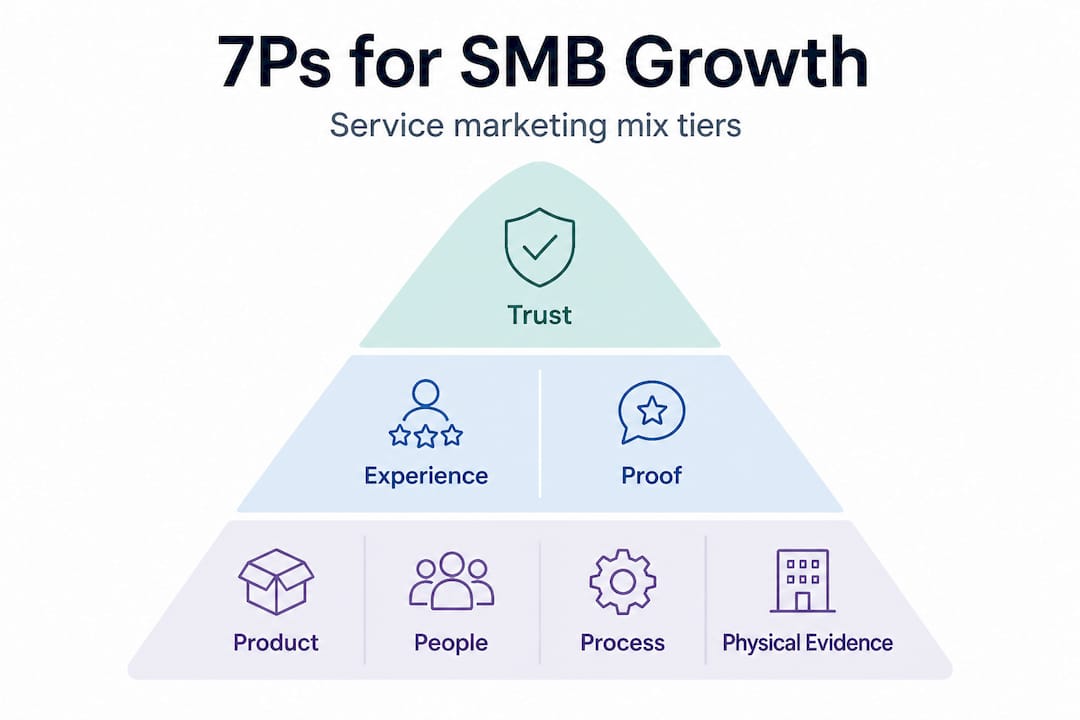
Pro Tip: Audit your 7Ps at least once a quarter. Walk through each element and ask honestly whether it supports or undermines your brand promise. Many SMBs find that their weakest link is either "Process" or "Physical Evidence," both of which are fixable without a large budget.
Numbered steps for a basic 7Ps audit:
- List your current service offering and define what makes it valuable to customers.
- Review your pricing model against competitor positioning and perceived value.
- Assess how easy it is for a new customer to find and book your service.
- Evaluate every promotional channel for consistency of message and tone.
- Gather recent feedback about staff interactions and identify training gaps.
- Map your service delivery from first contact to follow-up, and identify friction points.
- Review all physical touchpoints including your website, signage, and any printed materials.
Connecting these seven elements to your content types for brand visibility ensures that your marketing output reflects the actual quality and consistency of your service delivery. That alignment is what builds lasting credibility.
Why trust, experience, and proof matter most in service marketing
With the 7Ps in mind, let's zero in on the strategies that matter most for SMBs: how to establish trust, demonstrate value, and make your service a first choice online.
Because potential customers cannot evaluate a service before purchasing it, they rely heavily on signals. Reviews, testimonials, case studies, referrals, and the overall look and feel of your online presence all act as substitutes for that missing pre-purchase evaluation.
For SMBs, key strategies include local SEO and Google Business Profile optimization, content marketing for trust through case studies and testimonials, referrals and partnerships, and trust-first execution before paid ads. This sequencing matters. Investing in paid advertising before you have a strong foundation of reviews and visible proof typically results in wasted spend and weak conversion rates.
Here is what a trust-first marketing approach looks like in practice:
- Optimize your Google Business Profile with accurate hours, services, photos, and a steady stream of genuine reviews. This is often the first impression a local customer gets.
- Collect and display testimonials prominently on your website and social media. Video testimonials carry the most weight because they feel more authentic than text alone.
- Build a referral system that rewards existing customers for recommending your business. Word of mouth is still one of the highest-converting channels for service businesses.
- Create case studies that walk potential clients through a real problem you solved. Specifics build credibility. Vague claims do not.
- Ensure your website UX reflects your service quality. A slow, confusing, or visually outdated site tells visitors that attention to detail may not be a priority for your business.
"Digital physical evidence, meaning your website experience, online reviews, and published results, has become as important as your physical premises for building confidence in a service business."
Pro Tip: Leverage customer stories in two formats. A short-form version works well for social media, and a longer case study version works on your website. Both versions strengthen trust with different segments of your audience. Pair this with consistent Google Business activity to reinforce credibility through multiple channels.
Consistency across these touchpoints is what separates businesses that attract steady clients from those that struggle month to month. Following proven SMB marketing strategies means prioritizing this credibility layer before scaling any paid acquisition efforts.
Addressing challenges: Perishability, variability, and scaling for SMBs
While building trust attracts customers, every SMB also faces real-world obstacles. Let's tackle the often-overlooked operational challenges that shape service marketing outcomes.
Two characteristics create the biggest operational headaches for service business owners: perishability and heterogeneity (variable quality). Both affect not just operations but also your ability to market confidently and scale.
High perishability demands dynamic pricing and capacity management, as seen in industries like airlines; heterogeneity requires employee training to standardize variability. For an SMB owner, this translates into practical decisions made every week.
Consider a mid-size spa with twelve appointment slots per therapist each day. An unfilled slot cannot be recovered. That's lost revenue with no remedy unless the business has a system in place to reduce no-shows, manage waitlists, and price strategically during off-peak hours.
| Challenge | Marketing impact | Practical response |
|---|---|---|
| Perishability | Unsold time cannot be recovered | Dynamic pricing, waitlists, off-peak promotions |
| Heterogeneity | Inconsistent quality damages reputation | Staff training, process documentation, quality checks |
| Inseparability | Staff behavior directly affects brand | Culture investment, hiring criteria, client feedback loops |
| Intangibility | Hard to justify pricing without proof | Testimonials, case studies, visible certifications |
Here are numbered steps to build scalable systems that address these challenges:
- Standardize your core process with written procedures for every major service interaction, from intake to delivery to follow-up.
- Train staff regularly with role-specific guidelines that define what good service looks and feels like for your customers.
- Use scheduling software to track capacity, manage waitlists, and send automated reminders that reduce no-shows.
- Apply off-peak pricing or promotional incentives to redistribute demand and minimize empty time slots.
- Collect structured feedback after every service interaction and use it to identify patterns in quality variation.
- Document your quality benchmarks so new hires can reach your standard faster and existing staff stay aligned.
Addressing these challenges gives you the operational confidence to market aggressively. When your delivery is consistent, every new customer you attract through marketing becomes a reliable source of reviews, referrals, and repeat business. Explore more SMB insights and trends to stay ahead of evolving challenges in your industry.
A fresh perspective: Why "proof before promotion" beats old marketing habits
Most guides tell SMB owners to study what big brands do and replicate it at a smaller scale. That advice sounds reasonable. In practice, it leads service businesses to spend money they cannot afford on ads that promote a reputation they have not yet built.
The uncomfortable reality is this: advertising for a service business is not a growth strategy on its own. It is an amplification tool. If there is nothing credible to amplify, the ad spend produces low-quality leads at high cost. Research on SMB marketing strategies consistently shows that service businesses with strong organic credibility convert paid traffic at dramatically higher rates than those without it.
Some marketers argue that proof-first approaches are too slow and that combining product-style tactics with service-specific ones creates faster results. There is some truth in hybrid approaches for certain industries. But for most local and small service businesses, skipping the trust-building phase in favor of paid reach simply burns through budget.
The smarter sequence is clear. Start with your Google Business Profile and referral systems, both of which cost almost nothing and generate compounding returns. Layer in SEO and content that answers the questions your ideal customers are already asking. Then, once you have proof (reviews, case studies, conversion data), use paid ads to scale what is already working. For SMB growth and online visibility, starting with free and high-ROI channels like Google profiles and referrals, then layering SEO and content, and using paid only after proof can bring cost-per-lead figures as low as $6 to $8 with strong lifetime value.
The businesses that grow sustainably are not the ones with the biggest ad budgets. They are the ones with the most credible proof, the most consistent delivery, and the clearest connection between what they promise and what customers actually experience. Build that foundation first. Then promote it with confidence.
Drive your service business growth with expert strategies
Armed with a new perspective and actionable strategies, you don't have to navigate service marketing alone. Here's how to move forward with confidence.
Knowing the 7Ps and the principles of trust-first marketing is valuable. But applying them consistently while running your business is a different challenge. That's where the right partner makes a measurable difference.
SourcesNova helps local and small-to-mid-size service businesses build the credibility, visibility, and systems that turn strategy into real growth. From optimizing your online presence to building content that converts, the team at SourcesNova focuses on execution that produces results you can measure. Explore the full range of service marketing resources and find out how a clear strategy and hands-on support can move your business from invisible to in-demand. No jargon. No bloated retainers. Just growth built on proof.
Frequently asked questions
What makes service marketing different from product marketing?
Service marketing emphasizes trust, experience, and value delivery rather than physical features, due to the unique characteristics of services like intangibility and inseparability.
Why do SMBs need to focus on customer reviews and testimonials?
Because services are intangible, reviews and testimonials build the trust and visible proof potential customers need to choose your business over a competitor they have never met in person.
What are the most important elements of the 7Ps for service businesses?
Trust-building promotion, people as brand ambassadors, and digital physical evidence like a polished online presence are most critical for service businesses seeking to build credibility and convert new customers.
How can an SMB manage the challenge of variable service quality?
Regular employee training and process standardization help ensure consistent service quality, as heterogeneity requires structured management to minimize variation across team members and service interactions.
When should I invest in paid ads for my service business?
Only after your business has built trust and proof through reputation, referrals, and free channels should you consider paid ads, since starting with high-ROI channels and proving your conversion foundation first produces far better results from any ad spend.