
Most marketing budgets are spent on gut instinct dressed up as strategy. A brand runs the same campaign format it used three years ago, a sales team reports leads that never convert, and leadership wonders why growth stalls. The answer, in most cases, is a near-complete absence of data-driven marketing. This approach uses measurable customer data, behavioral signals, and analytics to make decisions grounded in evidence rather than assumptions. The benefits extend beyond better campaigns. They reach into revenue alignment, operational efficiency, and the kind of C-suite trust that protects and grows marketing budgets.
Table of Contents
- Key Takeaways
- Why data driven marketing is a strategic necessity
- Business outcomes tied to data-driven marketing
- Closing the C-suite accountability gap
- How to implement data driven marketing strategies
- My honest take on data-driven marketing
- Build a marketing engine that proves its value
- FAQ
Key Takeaways
| Point | Details |
|---|---|
| Data replaces guesswork | Data-driven marketing uses behavioral, transactional, and demographic data to guide decisions with evidence. |
| Customer acquisition improves dramatically | Organizations using data are 23 times more likely to acquire customers than those that do not. |
| C-suite alignment requires shared metrics | Bridging the CEO-CMO accountability gap depends on consistent revenue-focused measurement frameworks. |
| Closed-loop reporting connects activity to revenue | Linking marketing analytics to CRM outcomes proves ROI and shifts focus from leads to actual customers. |
| Implementation requires culture, not just tools | Building data-driven capability means investing in people and processes alongside technology. |
Why data driven marketing is a strategic necessity
What is data-driven marketing, at its core? It is the practice of using customer data — behavioral patterns, transaction history, and demographic or firmographic attributes — to inform every marketing decision, from channel selection to message timing and budget allocation. According to the foundational definition, common inputs include first-party behavioral data, transaction records, and audience segmentation data that together support continuous optimization and measurement.
This is a meaningful departure from traditional marketing, which typically relies on creative instinct, historical precedent, and broad demographic assumptions. Traditional approaches produce output. Data-driven approaches produce learning.
The data types most relevant to marketing professionals include:
- Behavioral data: website visits, email opens, content consumption patterns, and product interactions
- Transactional data: purchase history, average order value, frequency, and customer lifetime value
- Demographic and firmographic data: age, geography, company size, industry, and job function
- First-party intent signals: form submissions, chat logs, and sales call recordings
First-party data has become especially significant as privacy regulations tighten and third-party cookies disappear. Organizations that build direct data relationships with their customers hold a structural advantage. Every consent-based interaction becomes an asset.
Pro Tip: Before purchasing a customer data platform or analytics tool, audit what first-party data you already collect and whether it is clean, deduplicated, and accessible across teams. Bad data infrastructure produces confident wrong decisions.
Unified customer profiles, where behavioral, transactional, and demographic data merge into a single view of the customer, are what separate organizations that personalize well from those that spray and pray.
Business outcomes tied to data-driven marketing
The case for why data driven marketing matters is not theoretical. Organizations that adopt it are 23 times more likely to acquire customers and 6 times more likely to retain them compared to competitors still relying on traditional methods. Those are not marginal improvements. That is a structural competitive gap.
Here is where the benefits of data driven marketing become concrete across key business functions:
- Customer acquisition: Paid media campaigns optimized with behavioral data consistently outperform demographic-only targeting because the signals reflect actual purchase intent, not assumed interest.
- Retention and lifetime value: Personalized post-purchase journeys and predictive churn models help marketing teams intervene before a customer disengages.
- Personalization at scale: Rich customer data enables messaging that reflects where a buyer actually is in their decision process, not where marketing assumes they are.
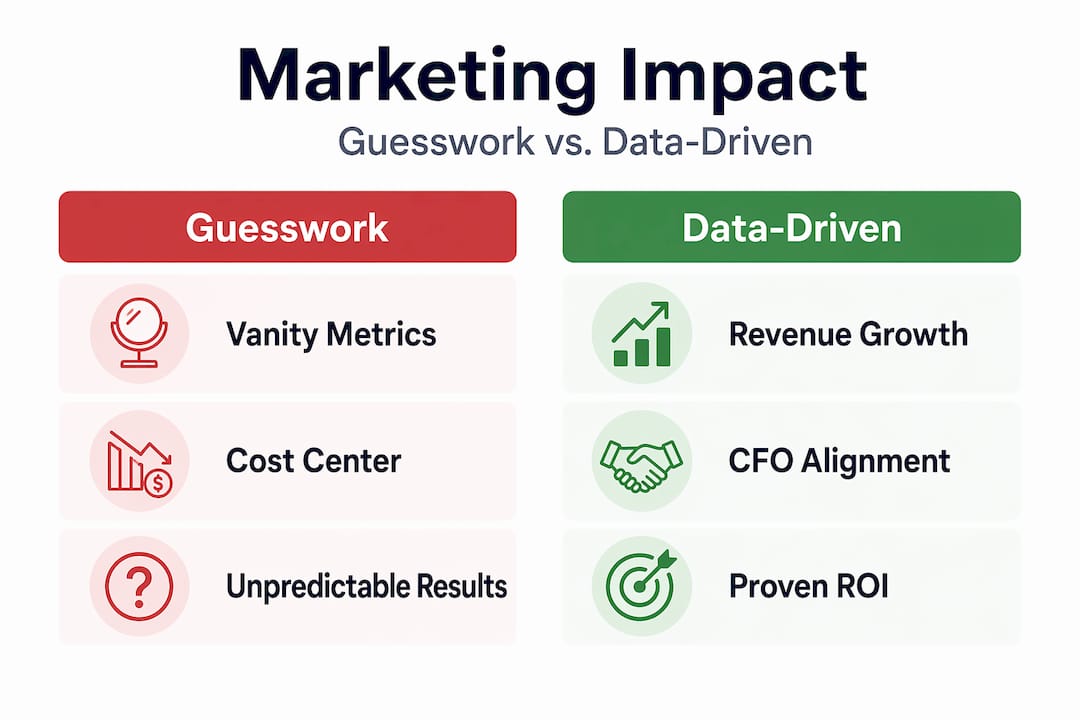
- Real ROI measurement: Replacing vanity metrics like impressions and clicks with revenue-linked outcomes changes what marketing reports and what leadership trusts.
- Operational efficiency: Real-time dashboards and automated reporting reduce the hours marketing teams spend building spreadsheets and increase the hours spent acting on signals.
Combining quantitative and qualitative data in decision-making minimizes risk, strengthens customer insight, and drives cost savings through enhanced operational efficiency. The qualitative layer matters because it provides context that numbers alone cannot. A spike in churn rate is a data point. Understanding that customers leave after a specific onboarding step is an insight that drives action.
Marketing's role shifts when it operates this way. It moves from a cost center requesting budget to a revenue driver presenting evidence. That shift directly affects how CFOs and CEOs evaluate marketing's contribution to the business.

Closing the C-suite accountability gap
One of the clearest structural problems in marketing today is the disconnect between what CMOs measure and what CEOs care about. 70% of CEOs cite revenue and margin as their top accountability metrics. Only 35% of CMOs do. That gap is not a communication problem. It is a measurement problem, and data-driven marketing measurement frameworks are what close it.
Here is a practical framework for aligning marketing measurement with C-suite priorities:
- Identify the metrics leadership cares about most. Revenue, margin, customer acquisition cost, and lifetime value are the measures that earn budget authority.
- Partner with the CFO early. Consistent measurement frameworks built with finance input carry far more credibility than marketing-only reports.
- Run holdout tests. Holdout tests that turn off marketing activities in controlled markets demonstrate causality. They show that revenue dropped when marketing stopped, which is far more persuasive than correlation-based attribution.
- Report incremental impact, not total impact. Incremental ROI shows what marketing actually caused. Total impact inflates performance by attributing outcomes marketing did not drive.
- Remove black-box measurement. If your attribution model cannot be explained to a CFO in under two minutes, it will not be trusted.
Pro Tip: Set up a quarterly marketing measurement review with your CFO or finance lead. Present one or two incremental ROI results alongside standard KPIs. Over time, this builds the kind of trust that protects budget during economic uncertainty.
The table below illustrates the difference between common vanity metrics and the revenue-aligned metrics that data-driven marketing reporting should prioritize:
| Vanity metric | Revenue-aligned equivalent |
|---|---|
| Impressions | Reach among in-market buyers |
| Clicks | Qualified leads by source |
| Email open rate | Revenue influenced by email sequence |
| Social engagement | Pipeline generated from social channels |
| Cost per lead | Customer acquisition cost by channel |
Attribution credibility depends on robust holdout tests and consistent metric frameworks to demonstrate incremental impact. Without that rigor, marketing remains a black box to leadership. With it, marketing becomes one of the most accountable functions in the organization.
How to implement data driven marketing strategies
Building data-driven marketing capability requires more than buying a new platform. Technology is the enabler. People and processes are what make it work. Here is how to build it systematically:
- Build closed-loop reporting first. Closed-loop reporting connects marketing analytics with CRM sales outcomes, so every lead source can be traced to an actual closed customer. This is the single most important infrastructure investment for proving marketing ROI.
- Establish a customer data platform (CDP). A CDP resolves identity across channels and creates unified customer profiles that support real-time personalization and AI-driven engagement, shifting the CMO's function from campaign manager to data architect.
- Run A/B and multivariate tests consistently. Testing is not a one-time project. It is the mechanism by which closed-loop reporting feedback informs what to optimize next. Teams that test continuously compound their advantages over teams that test once a quarter.
- Leverage AI for segmentation and personalization. Machine learning models that score leads, predict churn, and surface next-best actions are accessible even to mid-market teams through modern CRM and CDP tools.
- Build a data-curious culture. Tools without skilled, curious operators produce dashboards that no one reads. Hiring for analytical thinking, training existing team members on data literacy, and celebrating insights from failed experiments all matter.
For marketing professionals exploring B2B growth fundamentals, closed-loop reporting is where most organizations should start. It creates a feedback loop where sales outcomes directly influence which marketing channels and messages receive future investment. The practical result is that budget decisions are based on actual customers and revenue, not surface metrics that look good in slide decks.
Pro Tip: If you are just starting with data-driven marketing, do not try to build everything at once. Pick one channel, set up closed-loop reporting for it, and run two tests per month. In six months, you will have more actionable learning than most teams accumulate in two years.
Understanding how data flows through a marketing funnel from first touch to closed customer is also foundational. Without that map, even the best analytics tools produce noise instead of signal.
My honest take on data-driven marketing
I have seen a consistent pattern working with marketing teams at companies of every size. They have data. They have dashboards. They have annual platform subscriptions that cost more than their first hire. And yet they still make major budget decisions based on what worked two years ago or what a senior leader remembered seeing at a conference.
The problem is almost never a lack of data. It is a lack of agreement on what the data should answer. When marketing and leadership cannot agree on the one or two metrics that define success, every report becomes a negotiation. Data-driven marketing collapses into data-selective marketing, where teams cherry-pick the numbers that support decisions already made.
What I have found actually works is starting with the question, not the data. Ask leadership: "If marketing doubled its impact next year, how would you know?" That answer defines your measurement framework. Everything else is plumbing.
I have also seen organizations dismiss data-driven approaches because they ran one poorly designed test and drew the wrong conclusions. Holdout tests done right, with clean control groups and sufficient time, are genuinely persuasive. I have watched CFOs shift from skeptics to advocates of marketing spend after seeing a single well-constructed incremental ROI test.
The organizations winning with data are not necessarily the ones with the most sophisticated tools. They are the ones where marketing and finance share a common definition of success, and where someone is willing to run an experiment that might prove their assumptions wrong.
— Tran
Build a marketing engine that proves its value
Sourcesnova works with small and mid-size businesses that are done guessing. If your marketing spend is not connected to revenue outcomes, or if your leadership team treats marketing as a cost rather than a growth driver, that is the gap worth addressing first.
From closing the loop between your marketing activity and actual sales to building the reporting frameworks your CFO will trust, Sourcesnova brings clear strategy and hands-on execution to clients across retail, e-commerce, and service industries. Explore proven SMB growth strategies on the Sourcesnova blog, or visit Sourcesnova.com to learn how the team can help you build a marketing operation grounded in evidence, not assumptions.
FAQ
What is data-driven marketing?
Data-driven marketing is the practice of using customer data, including behavioral, transactional, and demographic information, to guide marketing decisions based on evidence rather than intuition. It supports continuous optimization across channels and customer segments.
Why does data-driven marketing produce better results?
Organizations using data-driven marketing are 23 times more likely to acquire customers and 6 times more likely to retain them. Evidence-based decisions consistently outperform assumptions because they reflect actual customer behavior.
How do you align marketing metrics with CEO priorities?
70% of CEOs prioritize revenue and margin as accountability metrics, so CMOs must adopt the same language. Partnering with the CFO to build consistent, revenue-linked measurement frameworks is the most direct path to C-suite alignment.
What is closed-loop reporting and why does it matter?
Closed-loop reporting connects marketing activity to CRM sales data, allowing teams to trace every lead source to a closed customer. It shifts reporting from surface metrics to revenue outcomes, which is what justifies and grows marketing budgets.
How should a business start implementing data-driven marketing?
Start with one channel and build closed-loop reporting for it. Run two tests per month, use findings to adjust investment, and expand from there. The advantage compounds when learning is systematic rather than occasional.