
For most Asian manufacturers and consumer brands entering the U.S., a hybrid DTC-first approach is the right move. Start with a limited DTC pilot alongside existing or planned wholesale relationships, not as a replacement. If your gross margin after landed cost exceeds 50% and you have at least one SKU with repeat-purchase potential, begin the pilot now. If margins are thinner or operations are not yet U.S.-ready, build wholesale distribution first and layer in DTC within 12 months.
U.S. DTC e-commerce sales exceeded one hundred billion dollars in 2021, and the channel continues to grow. The direct-to-consumer (DTC) model means selling your products straight to U.S. buyers through your own channels, bypassing retailers and wholesalers. Sourcesnova works with Asian manufacturers at exactly this crossroads, helping brands structure entry so neither channel undermines the other.

Table of Contents
- Why the direct consumer model matters for your U.S. entry
- When DTC is the right move and when to wait
- How to run DTC and wholesale together without conflict
- U.S. go-to-market checklist: legal, logistics, tech, and costs
- Customer acquisition channels and realistic cost expectations
- Key metrics every DTC manufacturer should track
- Common risks and how to prevent them
- How Sourcesnova supports your DTC and hybrid U.S. launch
- Key Takeaways
- What most brands get wrong about going direct
- Sourcesnova's U.S. market entry pilot for Asian manufacturers
- Useful sources and where to get U.S. legal help
Why the direct consumer model matters for your U.S. entry
Three business outcomes make DTC worth the investment for manufacturers.
- Higher per-unit margin: Removing retailer and wholesaler markups means more revenue per sale stays with you. That margin buffer funds customer acquisition and operations.
- First-party data ownership: Owning customer data is the primary commercial advantage of DTC. You control purchase history, preferences, and behavioral signals that no retailer will share with you.
- Faster product-market fit: Direct feedback loops let you adjust pricing, packaging, and features in weeks, not quarters.
- Inventory reduction via sell-design-make: McKinsey identifies the sell-design-make supply chain as a core DTC advantage. Producing to real demand rather than forecasted wholesale orders cuts working capital needs.
U.S. DTC e-commerce sales in 2021 were reported to be very large, per Wikipedia's DTC market data. The channel has grown every year since.
Companies with DTC offerings have outperformed peers on share-price growth and return on invested capital, according to McKinsey cross-industry analysis. That is not a coincidence. Direct customer relationships compound over time through retention, referrals, and richer targeting.
When DTC is the right move and when to wait
Use this scorecard to grade your readiness before committing capital.
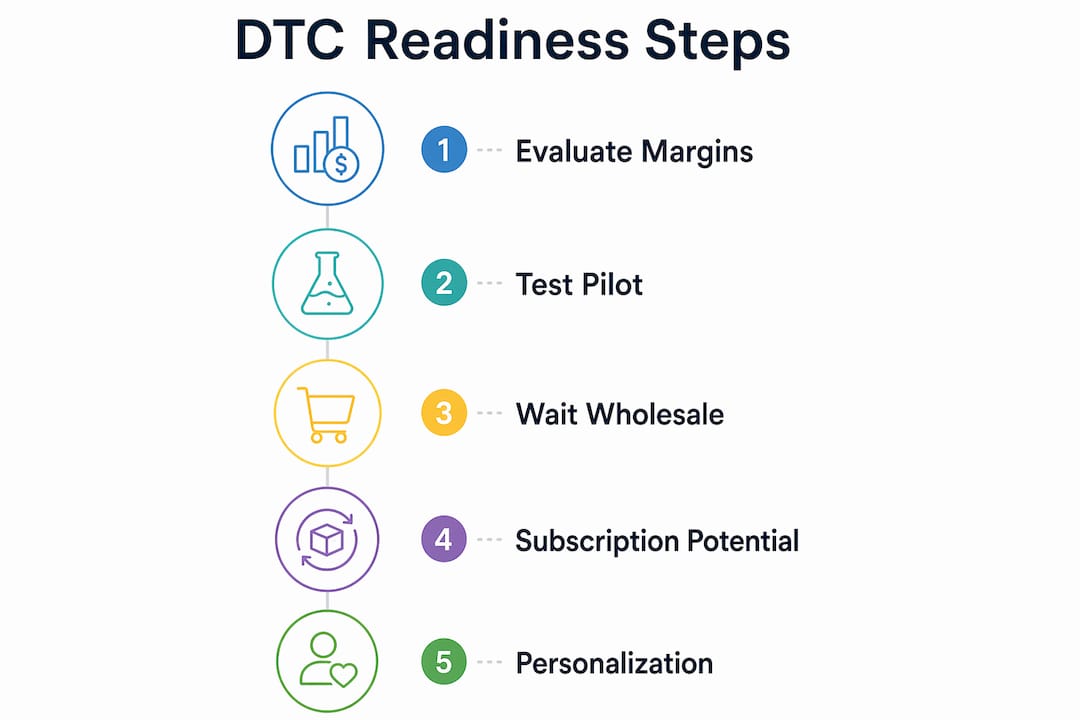
| Readiness Dimension | Go Now | Pilot First | Wait / Wholesale First |
|---|---|---|---|
| Gross margin (post-landed cost) | Above 50% | 45% or higher | Below 45% |
| SKU repeat-purchase potential | High (consumables, refills) | Medium | Low (one-time purchase) |
| U.S. fulfillment partner identified | Yes | In progress | No |
| Returns handling process | Defined | Partial | None |
| Localized English content | Ready | Partial | Not started |
| Customer service capacity | Staffed | Outsourceable | Not available |
SKUs with subscription or refill mechanics, differentiated packaging, or personalization potential are the strongest DTC candidates. Commodity products with thin margins and no repeat-purchase cycle are better served through wholesale distribution first, with DTC added later once the brand has U.S. recognition.
How to run DTC and wholesale together without conflict
The biggest misconception about DTC is that it requires abandoning retail partners. BCG research is direct on this: hybrid models reduce channel conflict and preserve the retail reach that manufacturers need for volume. The risk to avoid is the "DTC paradox," where going direct alienates the dealers who still drive most of your revenue.
Practical tactics to prevent that:
- Exclusive online SKUs: Sell configurations, bundles, or colorways online that are not available in retail. Partners have no reason to object to sales they were never going to make.
- MAP enforcement: Set and enforce a minimum advertised price policy across all channels. Price parity protects retail partners and your brand positioning simultaneously.
- Transparent data sharing: Share aggregated DTC insights with key retail partners. Showing them which products are trending online helps them stock better, which strengthens the relationship.
- Traffic routing rules: Use your DTC site for discovery and education; route bulk or B2B inquiries to your wholesale sourcing channel. Each channel has a defined job.
- Phased geographic pilots: Launch DTC in one or two U.S. regions first. This limits exposure and gives you data before a national rollout that could disrupt existing retail accounts.
Academic research published in ScienceDirect confirms that integrating dealers into DTC strategy across customer journey phases improves long-term outcomes for both parties.
Pro Tip: Share a monthly DTC insights brief with your top three retail partners. Show them search trends, top-performing SKUs, and customer questions. Partners who feel informed become advocates, not adversaries.
U.S. go-to-market checklist: legal, logistics, tech, and costs
Legal and compliance
- Product labeling must meet FTC and CPSC requirements (country of origin, material disclosures, safety warnings by category).
- Sales tax nexus: once you have economic nexus in a state (typically $100,000 in sales or 200 transactions), you must collect and remit that state's sales tax. Use TaxJar or Avalara to automate this.
- Import: work with a licensed U.S. customs broker to classify HTS codes correctly and calculate duties before pricing. Bonded warehousing can defer duty payment on unsold inventory.
This checklist is general information, not legal advice. Confirm current requirements with licensed U.S. counsel and a customs broker for your specific product category.
Technology stack
Shopify and WooCommerce are the standard platforms for localized DTC storefronts. Shopify is faster to launch; WooCommerce offers more flexibility for complex catalogs. Pair either with Google Analytics 4, a CRM (Klaviyo for email), and a first-party data layer to own customer records from day one. Sourcesnova builds localized e-commerce sites on both platforms for manufacturers entering North America.
Fulfillment options
| Option | Best For | Trade-off |
|---|---|---|
| ShipBob (3PL) | Brands shipping 100 or more orders/month | Monthly fees; setup time |
| Amazon FBA | High-volume, commodity-adjacent SKUs | Amazon owns the customer relationship |
| Regional 3PL | Custom packaging, fragile goods | Requires vetting and SLA negotiation |
| Self-fulfillment | Very early pilot (under 50 orders/month) | Not scalable |
Cost and timeline estimates
| Phase | Timeline | Estimated Setup Cost | Key Milestone |
|---|---|---|---|
| Foundation | Up to 3 months | — | Site live, fulfillment partner onboarded |
| Growth | 3 months or more | — | First orders, CAC baseline set |
| Scale | 24 to 36 months | Variable (ad spend scales with revenue) | Breakeven; repeat purchase rate positive |
BCG notes that DTC breakeven commonly falls between 24 and 36 months. Plan capital accordingly.
Customer acquisition channels and realistic cost expectations
- Paid social (Meta/Instagram): Best for visual products and brand awareness. U.S. CAC for consumer goods typically runs $30–$80 for a first purchase, higher in competitive categories. Expect the first 90 days to be expensive while the algorithm learns.
- Google paid search: High intent, higher cost-per-click. Works well for products with clear search demand. Less effective for categories where U.S. consumers do not yet know your brand name.
- Organic SEO: Lower ongoing cost but 6–12 months to meaningful traffic. Treat your website as a media asset, not a catalog. Data-driven content and localized SEO compound over time and reduce CAC structurally.
- Amazon marketplace: High volume, low brand control. Useful for testing price sensitivity and generating reviews, but Amazon owns the customer data.
- Influencer and affiliate: Effective for lifestyle and beauty categories. Commission-based structures keep CAC variable until you find what converts.
The most common manufacturer mistake is underestimating U.S. CAC. Removing the retailer margin does not automatically improve profitability if marketing spend replaces it. BCG is explicit: marketing investment tends to consume early margin gains if CAC is not planned for from the start.
Key metrics every DTC manufacturer should track
| KPI | Formula | Why It Matters |
|---|---|---|
| CAC | Total marketing spend ÷ new customers acquired | Sets your breakeven threshold |
| LTV | Avg. order value × purchase frequency × customer lifespan | Determines how much CAC you can afford |
| ROAS | Revenue from ads ÷ ad spend | Measures channel efficiency |
| Repeat purchase rate | Repeat buyers ÷ total customers (period) | Signals product-market fit and retention |
| Churn rate | Lost customers ÷ total customers (period) | Early warning for retention problems |
| Gross margin after returns | (Revenue – COGS – returns cost) ÷ revenue | True profitability signal |
Worked example: If CAC is $50 and average order value is $40, you lose money on the first purchase. But if repeat purchase rate is 40% and customers buy three times per year, LTV reaches $120. Breakeven happens on the second order, and the third order is pure margin.
At early stage, prioritize CAC and gross margin after returns. At scaling stage, shift focus to repeat purchase rate and LTV. At maturity, contribution margin per channel tells you where to allocate budget.
Common risks and how to prevent them
| Risk | Probability | Impact | Mitigation |
|---|---|---|---|
| Channel conflict with retail partners | High | High | Exclusive online SKUs, MAP policy, data sharing |
| CAC exceeds margin | High | High | Set a CAC cap before launch; test with appropriate ad budget |
| Inventory overstock | Medium | Medium | Limit SKUs in pilot; use 3PL to avoid warehouse commitments |
| Returns and fraud | Medium | Medium | Clear returns policy, Signifyd or NoFraud for payment protection |
| Regulatory/labeling non-compliance | Low | High | Pre-launch compliance review; use licensed U.S. counsel |
Key operational checkpoints:
- Negotiate SLAs with your 3PL before launch (order processing time, returns handling, damage rates).
- Test the returns flow yourself before going live. A broken returns experience destroys repeat purchase rates.
- Build inventory in stages. Start with 60–90 days of projected demand, not a full production run.
How Sourcesnova supports your DTC and hybrid U.S. launch
| GTM Requirement | Sourcesnova Service |
|---|---|
| Localized Shopify or WooCommerce storefront | E-commerce builds with RFQ flows and product catalogs |
| Paid social customer acquisition | Facebook and Instagram ads management for DTC and wholesale |
| North American SEO | Wholesale and buyer-intent keyword targeting |
| Distributor and 3PL matching | B2B lead generation and partner identification |
| Compliance and import guidance | Compliance consulting as part of market-entry packages |
| Market entry sequencing | Structured market-entry process from discovery through scale |
Sourcesnova's approach is to start with a defined pilot: limited SKUs, a set CAC cap, and a 90-day measurement window. That structure protects capital and generates the data needed to make the next decision with confidence.
Most manufacturers who come to Sourcesnova have strong products and real U.S. demand potential. What they need is a sequenced plan that does not require betting the entire operation on a single channel decision.
Key Takeaways
A hybrid DTC-plus-wholesale approach is the most capital-efficient path for Asian manufacturers entering the U.S., provided gross margin exceeds 45% and at least one SKU has repeat-purchase potential.
| Point | Details |
|---|---|
| Start hybrid, not DTC-only | Run DTC alongside wholesale to preserve retail revenue while building direct customer data. |
| Plan for breakeven after a few years; BCG data shows DTC breakeven commonly takes several years; budget capital for the full runway. | |
| CAC is the critical variable | U.S. paid social CAC often runs $30–$80; set a hard cap before launch to protect margins. |
| Exclusive SKUs prevent channel conflict | Online-only bundles and MAP enforcement keep retail partners aligned with your DTC growth. |
| Sourcesnova pilots reduce upfront risk | A structured 90-day pilot with defined SKU limits and a CAC cap shortens time-to-insight. |
What most brands get wrong about going direct
The conventional wisdom treats DTC as a technology decision: pick Shopify, run some ads, and the margin improvement follows. That framing misses the real challenge. The organizational shift, specifically aligning incentives, data flows, and partner relationships, is harder than the tech stack and more consequential.
Manufacturers who succeed with U.S. DTC entry treat the website as a media asset from day one. They invest in localized content, SEO, and retention flows continuously, not just at launch. The brands that struggle are the ones who build a site, run one paid campaign, and then wonder why CAC is unsustainable. The website is not a catalog. It is a customer acquisition and retention engine that requires ongoing investment to perform.
The hybrid model is not a compromise. It is the correct strategic structure for most manufacturers. Retail gives you volume and market presence. DTC gives you data, margin, and the feedback loop that makes your products better. Neither channel alone gives you both.
Sourcesnova's U.S. market entry pilot for Asian manufacturers
Asian manufacturers entering the U.S. face a specific problem: the market is large, CAC is high, and the cost of a wrong channel decision compounds quickly. Sourcesnova's market-entry pilot is built around that reality. For a defined scope and timeline, Sourcesnova delivers a market scan, a localized Shopify or WooCommerce storefront, an initial paid social test with a hard CAC cap, and a fulfillment partner recommendation. You get real U.S. market data within 90 days, not a 40-page strategy deck.
No long-term commitment is required to start. The pilot is structured to generate the data you need to decide whether to scale DTC, expand wholesale, or run both in parallel. Visit sourcesnova.com to request a scope and pricing conversation for your product category.
Useful sources and where to get U.S. legal help
- McKinsey: DTC e-commerce — how consumer brands can get it right — Strategy frameworks for sell-design-make supply chains and DTC channel design.
- McKinsey: The direct-to-customer edge — Cross-industry analysis on shareholder value and first-party data advantages.
- BCG: Even big brands need a DTC strategy — Covers hybrid models, the DTC paradox, CAC realities, and breakeven timelines.
- ScienceDirect: Unlocking DTC benefits without alienating dealers — Academic framework for integrating dealers across the customer journey.
- Shopify: What is direct to consumer? — Practical operator guidance on platform selection, fulfillment, and channel design.
- Wikipedia: Direct-to-consumer — Market size data and definitional context for the DTC channel.
For U.S. legal and tax compliance: Consult a licensed U.S. attorney for product liability, labeling, and consumer protection requirements specific to your category. For import duties and HTS classification, engage a licensed U.S. customs broker before your first shipment. For sales tax nexus, TaxJar and Avalara both offer automated compliance tools.
For market-entry services, visit sourcesnova.com.