
Yes, aluminum moka pots are safe for everyday coffee brewing under normal use conditions. Peer-reviewed lab studies consistently show that aluminum migration into brewed coffee stays well below the Tolerable Weekly Intake (TWI) established by European food safety authorities, even in worst-case scenarios. For a typical U.S. coffee drinker, the exposure from a well-maintained aluminum moka pot represents a small fraction of the weekly threshold regulators consider acceptable.
Three steps you can take right now:
- Season your new pot first. Run 2–3 full brew cycles and discard that coffee before drinking from it.
- Hand-wash only. Never put an aluminum moka pot in the dishwasher.
- Don't store coffee or acidic liquids in the pot. Brew, pour, and rinse.
Table of Contents
- How much aluminum actually gets into your coffee
- What health authorities say about aluminum cookware
- What increases aluminum leaching and how to keep it negligible
- Aluminum vs. stainless steel moka pots: which should you choose?
- Does aluminum cause Alzheimer's or cancer?
- A plain-English risk estimate for a U.S. coffee drinker
- Key Takeaways
- The evidence is clear, but the maintenance habits are what actually matter
- Primary sources and further reading
How much aluminum actually gets into your coffee
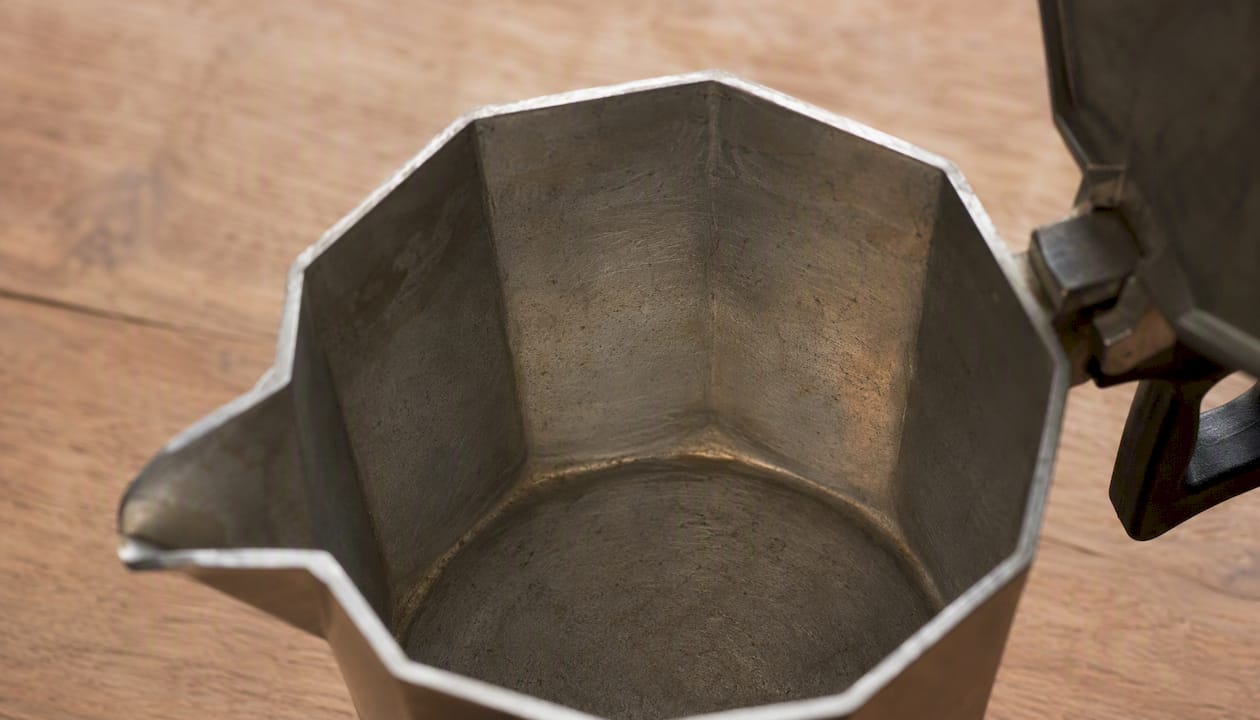
The most rigorous published data comes from a 2017 laboratory study in Environmental Sciences Europe (Stahl et al.), which measured aluminum migration from moka pots across repeated brew cycles, including a worst-case dishwasher scenario. The researchers found that migration was highest on the first few uses and dropped substantially as the pot seasoned. After dishwasher exposure, migration increased again because alkaline detergents strip the protective aluminum oxide layer from the pot's inner surface.
A companion analysis of the same study's methodology confirmed that even under the worst-case conditions tested, aluminum contribution from a moka pot reached approximately 4% of the TWI for an adult consuming coffee at high daily volumes. Under typical seasoned-pot conditions, the figure is considerably lower.
A separate PMC study on aluminum in coffee added an important nuance: coffee grounds themselves bind some of the aluminum that dissolves into the brewing water. The finished beverage consistently showed lower aluminum concentrations than the brewing water alone. The pressure dynamics of moka pot brewing do push more aluminum into solution compared with slower methods like drip or French press, but the grounds' chelating effect partially offsets that.
| Condition | Al Migration Trend | Notes |
|---|---|---|
| New, unseasoned pot | Highest | First 1–3 brews release the most aluminum |
| Seasoned pot (repeated use) | Substantially lower | Protective oxide layer stabilizes migration |
| After dishwasher cycle | Elevated again | Alkaline detergents strip the oxide layer |
| Stainless steel pot (comparison) | Lower Al; higher Cr/Ni | Different metals, similar safety margins |
| Finished beverage vs. brewing water | Lower in beverage | Coffee grounds bind some dissolved aluminum |
Key figure: The worst-case aluminum exposure from a moka pot in the Stahl et al. study reached approximately 4% of the TWI for a high-consumption adult scenario.
What health authorities say about aluminum cookware
The TWI for aluminum, set by the European Food Safety Authority (EFSA), is 1 mg per kilogram of body weight per week. For a 154-pound (70 kg) adult, that equals 70 mg of aluminum per week from all dietary sources combined. The U.S. Agency for Toxic Substances and Disease Registry (ATSDR) similarly establishes a minimal risk level for chronic oral aluminum exposure, and the FDA considers aluminum cookware generally recognized as safe under normal conditions of use.
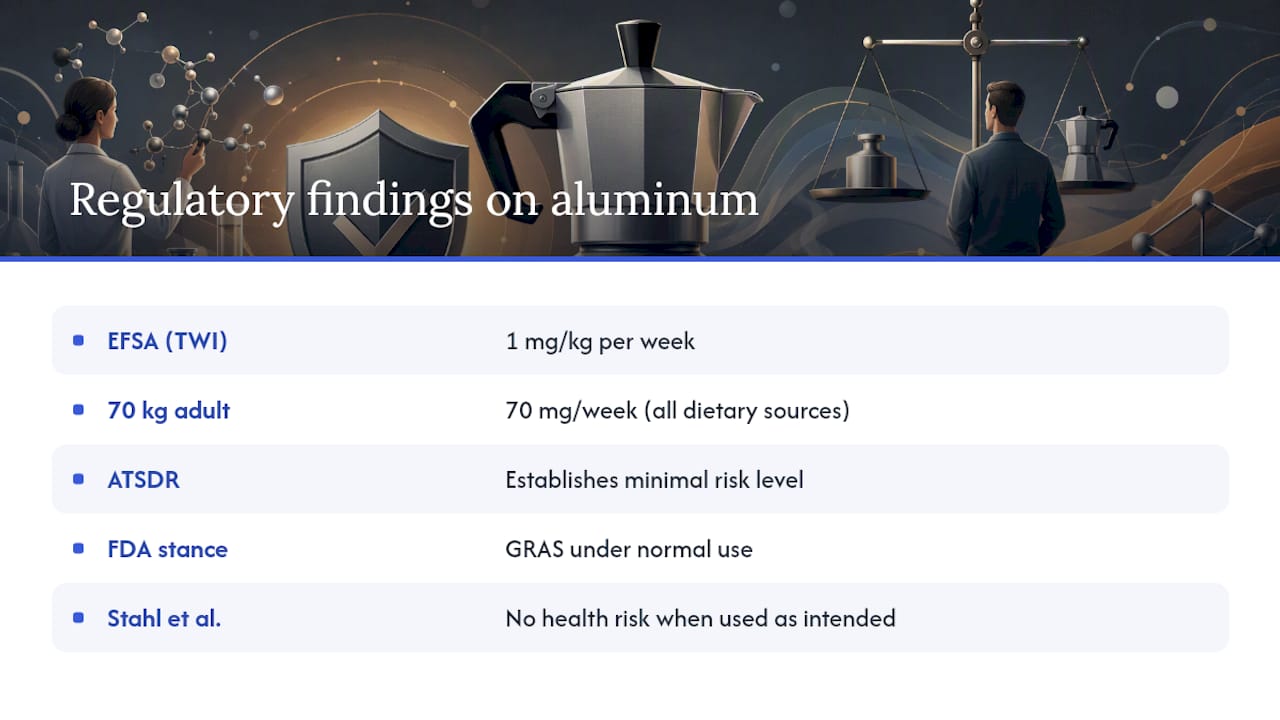
Both European and U.S. regulatory frameworks evaluate total dietary aluminum exposure, not just cookware. Most dietary aluminum comes from food additives, grains, vegetables, and drinking water. Cookware, including moka pots, contributes a minor share of that total. The Stahl et al. risk assessment concluded that aluminum cookware used as intended does not pose a health risk to the general population, a position consistent with BfR (Germany's Federal Institute for Risk Assessment) and EFSA evaluations.
A 2024 comparative risk assessment measuring aluminum, chromium, and nickel in coffee brewed in both aluminum and stainless steel moka pots reached the same conclusion: calculated exposures for all three metals did not exceed permissible doses. The hazard-quotient methodology used in that study is the standard approach regulators use to determine whether a measured exposure crosses a threshold of concern.
What increases aluminum leaching and how to keep it negligible
Migration is not uniform across all conditions. Several specific factors drive it up, and each one is within your control.
Primary risk factors:
- A brand-new, unseasoned pot (highest migration on first uses)
- Dishwasher cleaning with alkaline detergents
- Abrasive scrubbing pads that scratch the interior surface
- Storing brewed coffee or other acidic liquids in the pot after brewing
- Visible pitting, deep scratches, or corrosion on the interior
Checklist for new pot owners:
- Fill the pot with water, brew a full cycle, and discard the coffee. Repeat 2–3 times.
- After seasoning brews, rinse with warm water only. No soap, no scrubbing pads.
- Dry the pot thoroughly before storing to prevent moisture-driven corrosion.
- Never fill the boiler above the pressure valve.
Daily cleaning checklist:
- Rinse all parts under warm running water immediately after use.
- Use a soft cloth or sponge if needed. No steel wool, no abrasive cleaners.
- Air-dry completely before reassembling.
- Replace the rubber gasket when it shows cracking or stiffness, typically every 1–2 years.
Pro Tip: If the interior of your moka pot shows white chalky deposits, pitting, or dark corrosion that won't rinse away, replace the pot. A degraded surface leaches more aluminum and is harder to clean effectively. Bialetti and similar manufacturers sell replacement gaskets and filter plates, but a heavily pitted boiler warrants a new pot entirely.
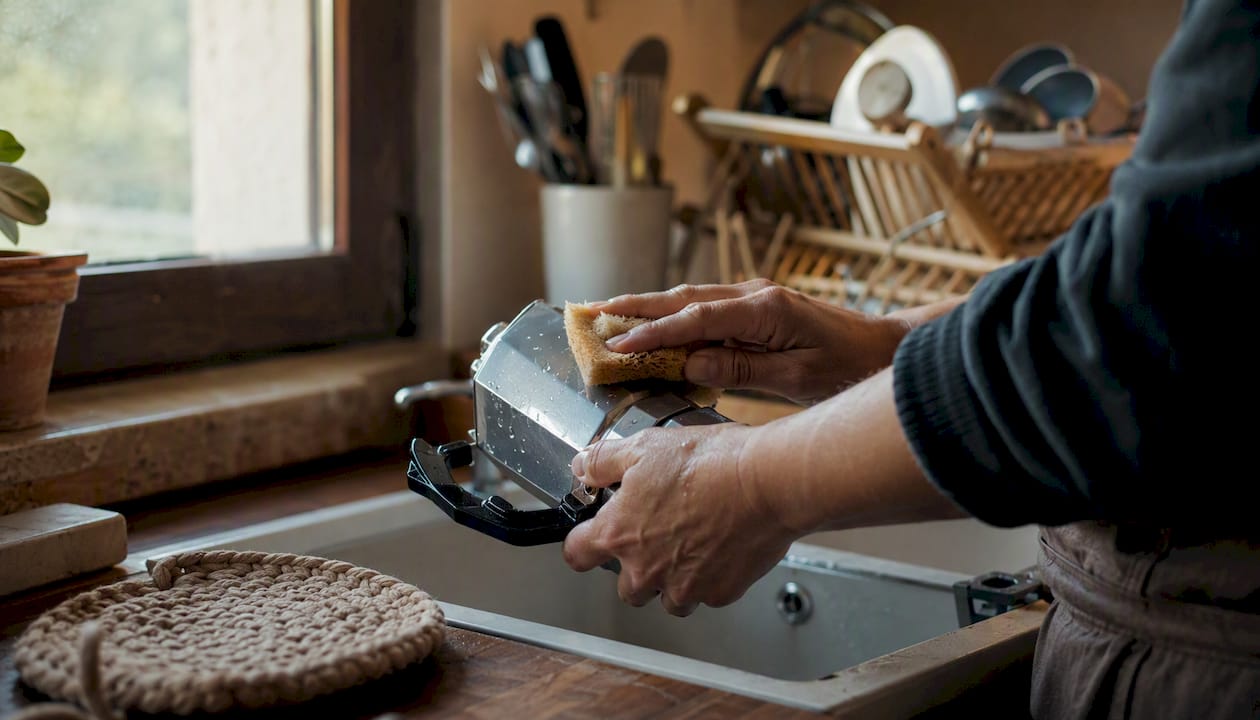
Practical consumer guidance consistently reinforces these same points: hand-washing and avoiding abrasive cleaners are the two most impactful daily habits for keeping aluminum exposure negligible.
Aluminum vs. stainless steel moka pots: which should you choose?
The safety question is often framed as aluminum versus stainless steel, but the evidence shows both materials are safe when used correctly. The difference is in which metals migrate and in practical performance factors.
Migration profiles compared:
- Aluminum pots yield higher aluminum in brewed coffee; stainless steel pots yield higher chromium and nickel.
- The 2024 risk assessment found that exposures from both materials fell below permissible doses, making neither material a clear health winner over the other.
- People with confirmed nickel sensitivity may have reason to prefer aluminum; those with no known sensitivities face no meaningful risk from either.
Practical trade-offs:
- Induction compatibility: Stainless steel works on induction stovetops; most aluminum pots do not. If you have an induction range, stainless steel is the practical choice.
- Dishwasher tolerance: Stainless steel handles dishwashers better, though hand-washing is still preferable for longevity. Aluminum must never go in the dishwasher.
- Cost: Aluminum moka pots, including the widely available Bialetti Moka Express, are typically less expensive than comparable stainless steel models.
- Weight and heat distribution: Aluminum heats faster and more evenly on gas and electric stovetops, which many experienced moka pot users prefer for flavor control.
- Durability: Stainless steel resists scratching and corrosion better over years of use.
Choose stainless steel if you have an induction stovetop, prefer dishwasher convenience, or want a pot that tolerates less careful handling. Aluminum is a sound choice for gas or electric stovetops when you follow the hand-washing and seasoning steps above.
Does aluminum cause Alzheimer's or cancer?
The short answer: no established causal link exists between aluminum from household cookware and either Alzheimer's disease or cancer.
The Alzheimer's claim originated from 1960s and 1970s research that found elevated aluminum in brain tissue of some Alzheimer's patients. Subsequent decades of research have not confirmed a causal relationship. Major health organizations, including the Alzheimer's Association, do not list aluminum cookware as a risk factor. The BfR and EFSA have both reviewed the evidence and found no basis for concluding that normal dietary aluminum exposure from cookware causes neurological disease.
Consumer-facing analyses that synthesize the scientific consensus reach the same conclusion: the evidence does not support avoiding aluminum cookware on the basis of Alzheimer's or cancer risk. The concern persists in popular media largely because the original correlation was widely reported and the corrections received less attention.
A few additional points worth knowing:
- Aluminum is the third most abundant element in the Earth's crust. Humans ingest it daily through food, water, and some medications (antacids contain substantial amounts).
- The body absorbs only a small fraction of ingested aluminum, and healthy kidneys excrete it efficiently.
- Rare aluminum hypersensitivity exists but is not the same as toxicity. If you have a documented aluminum allergy or compromised kidney function, consult your physician before using aluminum cookware regularly.
A plain-English risk estimate for a U.S. coffee drinker
Here is how the numbers work for a realistic scenario. Assume a 154-pound (70 kg) adult drinking two cups of moka pot coffee per day, seven days a week, from a seasoned aluminum pot. The TWI for that person is 70 mg of aluminum per week.
The Stahl et al. study's worst-case figure, approximately 4% of TWI, applied to a high-consumption scenario with dishwasher-cleaned pots. Under normal seasoned-pot conditions, the contribution is lower. Even at 4% of TWI, the moka pot contributes a small fraction of the aluminum intake against the weekly threshold, before accounting for the grounds' binding effect, which reduces the actual beverage concentration further.
Scale that to three cups per day and the proportion rises, but remains a small fraction of the TWI. The assumptions that matter most are pot condition (seasoned vs. new), cleaning method (hand-wash vs. dishwasher), and whether you store coffee in the pot. A new pot run through the dishwasher and used to store coffee overnight represents the worst-case combination. A seasoned pot hand-washed and emptied immediately after brewing represents the best case, and the gap between those two scenarios is significant.
Limitations worth noting: most published studies used European water chemistry and specific coffee blends. Water hardness and coffee acidity both affect aluminum solubility, so U.S. results could differ modestly. The available data is sufficient to frame the risk, but not to produce a precise milligram figure for every household.
Key Takeaways
Aluminum moka pots are safe for everyday use when seasoned properly and hand-washed, with measured exposure reaching at most a small fraction of the regulatory Tolerable Weekly Intake.
| Point | Details |
|---|---|
| Safety verdict | Lab studies confirm aluminum migration stays well below the TWI under normal use conditions. |
| Season your new pot | Discard the first 2–3 brews to reduce initial aluminum migration before drinking. |
| Never use a dishwasher | Alkaline detergents strip the protective oxide layer and markedly increase migration. |
| Don't store liquids in the pot | Pour coffee immediately after brewing; acidic liquids accelerate leaching. |
| Replace a degraded pot | Visible pitting or corrosion signals it is time for a new pot, not just a cleaning. |
The evidence is clear, but the maintenance habits are what actually matter
The scientific record on aluminum moka pots is more settled than most online discussions suggest. Peer-reviewed migration studies, European risk assessments, and comparative analyses of aluminum versus stainless steel all point to the same conclusion: the exposure from a well-maintained aluminum moka pot is small relative to established safety thresholds. The Alzheimer's link, which drives much of the anxiety around this topic, has not held up under decades of scrutiny.
What the research also makes clear is that maintenance is not optional. The difference between a seasoned, hand-washed pot and a dishwasher-cleaned, unseasoned one is measurable in the lab. The good news is that the required habits are simple: season the pot, hand-wash it, empty it after brewing, and replace it when the interior shows real wear. Those four steps are what separate a safe daily ritual from a preventable source of unnecessary exposure.
Sourcesnova's approach to research like this mirrors the same principle that applies to market entry and digital growth: the data tells you what is possible, but the execution determines the actual outcome. Understanding the migration numbers is useful; acting on the maintenance guidance is what makes the difference in practice. For readers who want to go deeper on the manufacturing and market considerations behind aluminum coffee equipment, the coffee maker aluminum market entry analysis on the Sourcesnova blog covers the technical and commercial dimensions in detail.
Primary sources and further reading
-
Stahl et al. (2017), Environmental Sciences Europe — The most-cited peer-reviewed study measuring aluminum migration from moka pots across repeated brew cycles and a dishwasher worst-case. Reports the ~4% TWI figure under high-consumption assumptions. Read the full article
-
Stahl et al. (2017) — Full PDF — Companion access to the same study's methodology and experimental detail, useful for reviewing the dishwasher-cycle protocol and migration measurement approach. Access the PDF
-
Aluminum in Coffee — PMC — Documents aluminum concentrations by brewing method, explains the pressure-driven extraction mechanism in moka pots, and reports the grounds-binding effect that reduces final beverage aluminum. Read on PubMed Central
-
Risk assessment of Al, Cr, and Ni in aluminum and steel moka pots (2024) — Comparative hazard-quotient analysis showing that measured exposures from both pot materials fell below permissible doses. Read the study
-
The Best Coffee Machine Blog — Aluminum coffee maker safety — Consumer-oriented synthesis covering hand-washing, abrasive cleaner avoidance, and seasoning guidance. Read the guide
-
KitchenSurfers — Debunking aluminum coffee myths — Accessible summary of the scientific consensus on aluminum cookware, Alzheimer's claims, and practical maintenance advice. Read the article
This article provides general informational guidance based on published research. It is not medical advice. Readers with kidney disease, confirmed aluminum sensitivity, or other relevant health conditions should consult a qualified healthcare professional before making changes to their diet or cookware.