
Even the best products and services can go completely unnoticed without a clear social media growth strategy. Right now, your competitors who are more active online are capturing the customers you should be reaching. For local and small-to-mid-size businesses, this gap is widening every year. The good news is that growing your presence does not require a massive budget or a full marketing team. It requires the right approach, executed consistently, and measured honestly. This guide walks through exactly that, from assessing where you stand today to refining what works.
Table of Contents
- Assess where your business stands online
- Gather your growth toolkit
- Execute your step-by-step growth plan
- Measure, verify, and refine your results
- What most experts overlook about growing small business audiences
- Take your social media growth further with expert support
- Frequently asked questions
Key Takeaways
| Point | Details |
|---|---|
| Benchmark your engagement | Knowing your platform-specific engagement rates helps you set realistic growth targets and track progress. |
| Choose the right tools | Selecting proper content and ad tools makes daily management easier and more effective. |
| Small audiences can win | Accounts with just 1,000 followers can outpace larger ones in engagement and local impact. |
| Consistency wins growth | A simple, repeatable posting and ad cycle will steadily build your online presence and drive customers. |
| Adjust and improve | Regularly compare your results to industry benchmarks and refine your approach for the best results. |
Assess where your business stands online
Now that you are ready to build your presence, start by measuring where you are today. Most businesses skip this step entirely, jumping straight to posting more content without understanding what is already working. That approach wastes time and money. Before executing any marketing strategies for SMB growth, you need a clear picture of your current baseline.
Start by listing every platform where your business has a profile. For each one, record your current follower count, your average engagement rate, and the date of your last post. Engagement rate is calculated by dividing total interactions (likes, comments, shares) by your total followers, then multiplying by 100. A profile with 500 followers and 50 interactions per post has a 10% engagement rate, which is outstanding compared to a profile with 10,000 followers getting 50 interactions (a 0.5% rate).
Why does this matter? The 2026 engagement benchmarks show that TikTok averages 4.25% overall, Instagram sits at a 1.25% median, LinkedIn reaches 2.94%, and Twitter/X comes in at 1.11%. Nano accounts with 1,000 to 10,000 followers consistently outperform larger accounts, with TikTok nano accounts hitting 7.84% and Instagram nano accounts reaching 3.42%. Understanding digital growth explained in these terms changes how you evaluate your progress.
Use this simple tracking table to collect your data:
| Platform | Followers | Avg. Interactions/Post | Engagement Rate | Last Post Date |
|---|---|---|---|---|
| TikTok | ||||
Pro Tip: Do not spread effort across every platform at once. Identify which platform already has your most engaged audience and prioritize it first. Winning on one channel builds momentum and confidence before expanding.
Common mistakes local businesses make when evaluating their social presence:
- Focusing only on follower count instead of engagement rate
- Assuming low follower numbers mean the strategy is failing
- Posting inconsistently and then measuring incomplete data
- Ignoring which content types actually generated real interactions
- Comparing to national brands instead of local competitors with similar audiences
Gather your growth toolkit
With a clear idea of your baseline, the next step is ensuring you have the right tools and formats to drive growth. Trying to grow on social media without basic tools is like trying to run a retail store without a point-of-sale system. You can do it, but not efficiently.
Here are the four core tool categories worth investing in:
Scheduling tools like Buffer, Later, or Meta Business Suite let you plan and auto-publish content in advance. This removes the daily pressure of posting in real time and ensures consistency, which algorithms favor. Design tools like Canva give non-designers the ability to create polished graphics and branded visuals quickly. Video tools like CapCut (free and mobile-friendly) make short-form video editing accessible for businesses with no production experience. Analytics tools like native platform insights or Google Analytics 4 track what is converting and what is being ignored.

Beyond tools, your content format choices matter enormously. Different formats perform differently depending on the platform and your audience. Review this comparison before deciding where to invest your content creation time:
| Format | Best Platform | Engagement Potential | Effort Level |
|---|---|---|---|
| Short video (Reels/TikTok) | Instagram, TikTok | Very High | Medium |
| Carousel posts | Instagram, LinkedIn | High | Medium |
| Static image | Facebook, Instagram | Moderate | Low |
| Stories | Instagram, Facebook | Moderate | Low |
| Long-form video | YouTube, Facebook | High | High |
For paid reach, Meta ads best practices recommend using Advantage+ campaigns with cost-based optimization across 3 to 5 ad sets, starting with lowest-cost bidding, implementing pixel and CAPI tracking, and targeting a local geographic radius. Even a $10 to $20 per day budget can generate meaningful reach for a local business when the targeting is precise and the creative is relevant to the community.
The content types that build visibility most consistently for local businesses share these characteristics:
- Timeliness: Tied to local events, seasons, or trending topics in your area
- Local relevance: References to your neighborhood, city, or community
- Clear call to action: Every post invites a specific response (comment, share, visit, book)
- Authentic storytelling: Behind-the-scenes content, team introductions, real customer stories
- Visual consistency: A recognizable style that builds brand recall over time
Execute your step-by-step growth plan
Gathered and organized, you are ready to put those plans into action with a proven process. Execution is where most strategies fall apart. The steps below are intentionally simple, repeatable, and low cost, designed specifically for local businesses without dedicated marketing staff.
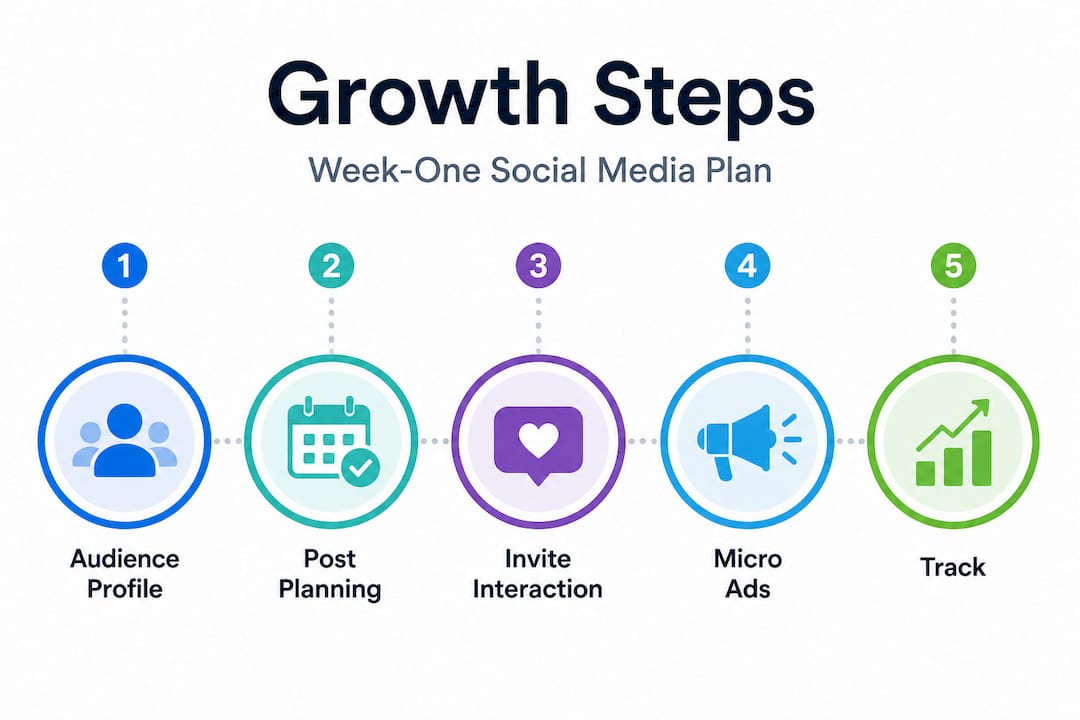
Step 1: Define your target audience and local radius. Before writing a single caption, describe your ideal customer in specific terms. What is their age range? What problems do they have that your business solves? What neighborhoods, zip codes, or cities do they live in? This detail shapes every content and ad decision that follows. Vague targeting produces vague results.
Step 2: Plan one week of posts using high-engagement formats. Based on your toolkit and your strongest platform, map out seven days of content. Prioritize short video and carousel formats, which consistently outperform static images. Mix educational posts (tips related to your product or service), social proof posts (customer stories or reviews), and behind-the-scenes content. Variety sustains audience interest over time.
Step 3: Ensure every post invites interaction. A post that ends with a question, a poll, or a direct request for a comment generates significantly more engagement than one that does not. Simple examples: "Which of these would you choose?" or "Tag someone who needs to see this" or "Drop your answer below." These prompts do not feel forced when they match the context of the post.
Step 4: Launch a micro ad campaign. Take your best-performing organic post from the previous week and put $10 per day behind it using local radius targeting. This amplifies content that has already proven it resonates with your existing audience, which reduces risk and improves return on ad spend. Running ads on posts that already perform well consistently outperforms boosting posts that have seen little organic traction.
Step 5: Track engagement after seven days. Pull your engagement rate for the week and compare it to your baseline. Note which specific posts drove the most interactions, what format they used, and what time they were published. Use this data to inform the next week's content plan.
Pro Tip: Do not dismiss a small following. Nano accounts with 1,000 to 10,000 followers consistently deliver the highest engagement rates across TikTok and Instagram. A tight, locally relevant audience almost always outperforms a large, diffuse one when the goal is converting followers into actual paying customers.
Refer to the best practices for growth when building your week-one content calendar. Getting the fundamentals right in the first two to four weeks creates a compounding effect that becomes easier to sustain over time.
Measure, verify, and refine your results
After executing your plan, it is critical to objectively check what is working and where to improve. Without measurement, you are guessing. With it, you are making informed decisions that reduce waste and accelerate growth.
Start by pulling your week-over-week engagement rate for each active platform. Compare your actual results against the 2026 benchmarks: TikTok sits at 4.25% overall, while Instagram nano accounts average 3.42%. Use the table below as your tracking template:
| Platform | Your Engagement Rate | 2026 Benchmark | Gap/Surplus | Action Needed |
|---|---|---|---|---|
| TikTok | 4.25% overall | |||
| 3.42% (nano) | ||||
| 2.94% | ||||
| Track manually |
Signs that your strategy is gaining real momentum include:
- More comments from local users, especially those mentioning your area or store
- Direct messages from potential customers asking about services or products
- Increased shares and saves, which indicate content your audience finds genuinely valuable
- Growth in local followers who match your target customer profile
- Repeat interactions from the same users, indicating a building relationship
When you consistently hit or exceed platform benchmarks for two consecutive weeks, that is a signal to scale. Increase your ad budget incrementally, expand your content calendar, or test a second platform.
Review your engagement benchmarks every month. What performs in January may lose traction by March as audience behaviors shift, platform algorithms update, and seasonal relevance changes. Monthly reviews keep your strategy connected to real results rather than outdated assumptions.
Use what the data tells you to make small, targeted updates. If video posts outperform static images consistently, shift more production time toward video. If posts published at 7pm receive more engagement than those published at noon, adjust your scheduling. If your ad targeting a five-mile radius is generating clicks but not conversions, tighten the audience parameters or refine the landing page. Each adjustment should be based on specific data, not instinct alone.
The growth and engagement strategies that drive sustained results are not dramatic pivots. They are consistent, small refinements applied every week based on what the numbers show. That process, repeated reliably, is what separates businesses that grow online from those that plateau.
What most experts overlook about growing small business audiences
The loudest voices in social media marketing tend to focus on scale: more followers, more reach, more impressions. For large brands with national audiences, that logic makes some sense. For local and small businesses, it often leads to chasing numbers that do not connect to real revenue.
The data tells a different story than most gurus want to acknowledge. Nano accounts on TikTok and Instagram consistently outperform accounts with hundreds of thousands of followers on engagement rate. A local nail salon with 2,000 engaged followers who live within five miles of the store is more valuable, in pure business terms, than a brand account with 50,000 followers scattered across the country.
Understanding digital growth success for a local business means redefining what success actually looks like. It is not the number on your follower counter. It is the ratio of people who interact with your content relative to those who follow you. It is the percentage of your followers who live in your service area. It is the number of direct messages that turn into booked appointments or in-store visits.
There is also a practical advantage that rarely gets discussed. It is significantly easier and less expensive to influence a small, locally concentrated audience than a large, diffuse one. Your posts are more likely to be seen by people who already know your neighborhood, your street, or your business by name. That familiarity builds trust faster than any polished brand campaign.
The shift in mindset that actually moves the needle for small businesses is this: stop trying to grow at all costs and start growing what works for your specific goals and your specific community. A strategy built around 200 genuine local followers who share your content and refer their friends will outperform a strategy that gains 2,000 followers who never buy anything. Every time.
Take your social media growth further with expert support
Implementing a consistent social media growth strategy takes time, discipline, and ongoing refinement. Many local businesses see early wins and then stall because the day-to-day demands of running the business pull attention away from marketing. That is where expert guidance makes a measurable difference.
SourcesNova helps local and small-to-mid-size businesses build social media strategies that translate into real customer growth, not just better-looking profiles. Whether you are just establishing your online presence or ready to scale what is already working, the team at SourcesNova provides hands-on execution, clear reporting, and strategies tailored to your specific market and goals. No jargon, no inflated retainers, and no vanity metrics that fail to connect to revenue. Just focused work on what actually grows your business.
Frequently asked questions
What is a good engagement rate for small business social media in 2026?
Nano accounts with 1,000 to 10,000 followers on TikTok and Instagram should aim for engagement rates above 3%, with strong TikTok nano accounts reaching 7.84% and Instagram nano accounts averaging 3.42%.
How much should a local business budget for social media ads in 2026?
Starting with $10 to $20 per day using precise local radius targeting is a realistic and effective entry point for most local businesses running Meta ads.
Which social media platforms deliver the best engagement for small businesses?
TikTok and Instagram nano accounts lead all platforms on engagement rate in 2026, with TikTok nano accounts averaging 7.84% and Instagram nano accounts averaging 3.42%, making both strong priorities for local SMBs.
How do I know which type of content to post for growth?
Test short video, carousels, and interactive story posts during your first two weeks, then track which format generates the most engagement and direct messages, and allocate more of your content creation time to that format going forward.