
Selling Chinese products is the process of sourcing goods from Chinese manufacturers and marketing them to U.S. customers through e-commerce channels, wholesale, or direct retail. Knowing how to sell Chinese products profitably requires more than finding a cheap supplier. You need to understand HS Tariff codes, import duties, Section 301 tariffs, and the full landed cost before you price a single unit. The sellers who fail are not the ones who pick bad products. They are the ones who underestimate what it costs to get those products to a U.S. customer's door.
How to sell Chinese products: sourcing platforms and tools
The right sourcing platform determines your cost, risk, and communication burden from day one. Alibaba is the most accessible starting point for U.S. entrepreneurs. It offers English-language listings, Trade Assurance payment protection, and verified supplier badges. Domestic Chinese platforms like 1688 offer 20%–40% lower prices than Alibaba. That price gap sounds attractive, but 1688 operates entirely in Mandarin and targets Chinese buyers, so browser translation alone is not enough to avoid costly miscommunications.
Sourcing agents fill the gap when you work with platforms like 1688 or need deeper supplier vetting. Agents charge 5%–10% of the order value and handle supplier verification, negotiation, quality inspections, and shipment consolidation. That fee often pays for itself by preventing a single bad shipment. When evaluating suppliers directly, look for certifications like ISO 9001 or BSCI audits. These are internationally recognized quality and ethical compliance standards, not marketing labels.
| Sourcing method | Cost level | Communication risk | Best for |
|---|---|---|---|
| Alibaba | Medium | Low | Beginners, small orders |
| 1688 | Low | High | Experienced buyers with agents |
| Sourcing agent | Medium + fee | Low | Complex orders, quality control |
| Trade shows (Canton Fair) | Travel cost | Very low | Relationship building, new categories |
Pro Tip: Always activate Trade Assurance on Alibaba orders. It protects your payment if a supplier fails to ship on time or delivers goods that do not match the agreed specifications.
How do import tariffs and customs work for Chinese goods?
Import costs are the single most misunderstood part of selling products from China. The U.S. applies two layers of tariffs to most Chinese goods. Most Favored Nation (MFN) rates are the standard duties applied to all trading partners. Section 301 tariffs are an additional layer imposed specifically on Chinese goods, and duty rates range from 0% to 25% or more depending on the product category. A product with a 7.5% MFN rate could carry an additional 25% Section 301 tariff, pushing your total duty burden above 30%.
Every product entering the U.S. is classified by an HS Tariff code, a standardized numeric system used by U.S. Customs and Border Protection to determine the applicable duty rate. Getting the classification wrong leads to underpayment of duties, which triggers penalties, or overpayment, which erodes your margin. Shipments valued at $2,500 or more require a formal customs entry, a licensed customs broker, and in many cases a Surety bond. Skipping the customs broker to save money is one of the most expensive mistakes new importers make.
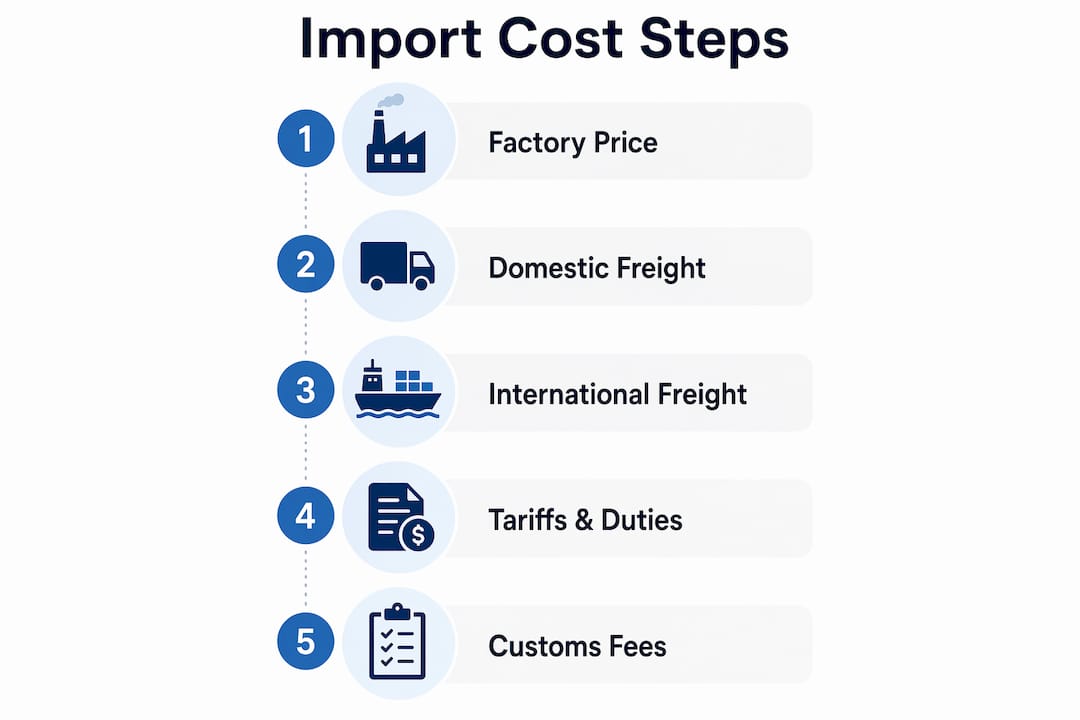
Landed cost is the true profitability metric. It includes the factory price, domestic freight in China, international ocean or air freight, import duties, customs brokerage fees, and last-mile delivery in the U.S. Landed cost often doubles the factory quote. A product that costs $5 at the factory gate may land in your warehouse at $10 or more.
| Cost component | Typical range |
|---|---|
| Factory price | Baseline |
| China domestic freight | $0.10–$0.50 per unit |
| Ocean freight (LCL) | $1–$4 per unit |
| Import duties (MFN + Section 301) | 0%–30%+ of product value |
| Customs brokerage | $150–$400 per shipment |
| Last-mile delivery (U.S.) | $0.50–$2 per unit |
Incoterms like EXW (Ex Works), FOB (Free on Board), and CIF (Cost, Insurance, and Freight) define who pays for which portion of the shipping journey. FOB is the most common choice for U.S. importers because it transfers risk to you at the port of origin, giving you control over freight and insurance costs.
What are the best practices for negotiating with Chinese suppliers?
Negotiating with Chinese suppliers follows a specific sequence that most new importers get backwards. Negotiate product specifications first, then discuss price. A supplier who agrees to a low price before specs are locked will cut corners on materials or labor to protect their margin. One bad customer review from a quality failure can wipe out the savings from a cheaper unit cost.

Once specs are agreed, use volume consistency to drive price down. Beginners can negotiate 10%–25% discounts and lower minimum order quantities by demonstrating a reliable order schedule. Suppliers value predictability. A buyer who orders every 60 days is worth more to them than a one-time buyer placing a large order.
Key negotiation priorities for U.S. entrepreneurs:
- Lock specifications in writing before any price discussion begins.
- Request samples before placing a production order. Never skip this step.
- Negotiate minimum order quantities (MOQs) by showing a long-term order plan.
- Agree on lead times in writing and include penalties for late delivery.
- Confirm payment terms that protect you, such as 30% deposit and 70% after inspection.
Pro Tip: Hire a third-party inspection service to check goods before final payment. Skipping pre-shipment inspections means you lose all leverage once products arrive in the U.S., since returning defective goods to China is rarely economically viable.
How to market and sell Chinese products in U.S. e-commerce
The U.S. e-commerce market offers multiple channels for selling imports, and each has distinct requirements. Amazon FBA is the highest-volume channel but also the most demanding. Amazon requires strict labeling, packaging, and carton preparation, and shipments that fail prep standards get rejected or charged prep fees that destroy your margin. Using a third-party prep center, either in China before shipping or in the U.S. after arrival, reduces this risk significantly.
Shopify gives you more control over branding and customer relationships. It works best when paired with paid traffic or strong SEO. eBay suits sellers testing new product categories with lower upfront investment. Wholesale to U.S. retailers is a fourth option that removes the complexity of consumer marketing but requires larger order volumes and longer payment cycles.
Dropshipping from Chinese platforms like 1688 or Taobao is a lower-risk entry point, but it requires import workflows, professional translation, and agent cooperation to function reliably. One-click fulfillment tools do not handle the compliance and communication complexity of these platforms. Set realistic shipping expectations with customers. Chinese dropshipping typically adds 10–20 days to delivery times compared to domestic fulfillment.
For product listing optimization, write titles and bullet points that match U.S. consumer search behavior, not Chinese product naming conventions. Use keyword research tools to identify how American buyers describe the product. Invest in professional product photography. Listings with high-quality images consistently outperform those with factory photos.
Sourcesnova's SEO services help entrepreneurs improve product visibility across search engines and marketplace platforms, which directly affects conversion rates and organic traffic.
What common mistakes do sellers make when importing from China?
The most damaging mistake is calculating profit based on the factory price alone. Landed cost, not factory price, determines whether a product is profitable. Sellers who skip a full landed cost calculation before placing an order frequently discover their margin is negative after duties and freight are added.
Poor supplier due diligence is the second most common failure. Verifying a supplier only through their Alibaba profile is not enough. Request business licenses, audit reports, and references from other buyers. A supplier who cannot provide these documents is a risk you should not take.
Compliance failures are silent margin killers. A shipment held at customs for incorrect labeling or missing documentation costs you storage fees, delays, and potential fines. An Amazon rejection for non-compliant packaging costs you prep fees and lost sales velocity. Neither shows up in your initial cost model, but both show up in your profit and loss statement.
Language barriers cause more problems than most sellers anticipate. Misunderstood specifications, incorrect shipping addresses, and wrong product configurations all trace back to communication gaps. Use written confirmations for every agreement. If you work directly with Chinese factories, consider a professional sourcing agent who manages communication in Mandarin and confirms details in English.
Unrealistic shipping promises to customers are a reputation risk. Ocean freight from China takes 25–40 days. Air freight is faster but costs three to five times more. Build your customer communication around accurate timelines, not optimistic ones.
Key Takeaways
Selling Chinese products profitably in the U.S. requires accurate landed cost calculation, verified suppliers, and channel-specific compliance from the first order.
| Point | Details |
|---|---|
| Calculate landed cost first | Factory price alone never reflects true cost; include duties, freight, and brokerage fees. |
| Verify suppliers before ordering | Request ISO 9001 or BSCI certifications and references before placing any production order. |
| Negotiate specs before price | Lock product specifications in writing before discussing unit price to protect quality. |
| Use pre-shipment inspections | Inspect goods before final payment to retain leverage over defects and avoid costly returns. |
| Match channel to your model | Amazon FBA, Shopify, and dropshipping each require different compliance and fulfillment setups. |
What I've learned from watching sellers get this wrong
I've seen entrepreneurs spend months researching products and minutes researching their landed cost. That imbalance is the root cause of most failed import businesses. The product research is exciting. The duty calculation is not. But the duty calculation is what determines whether you make money.
The sellers who build durable businesses treat sourcing and selling as two separate disciplines. Sourcing requires supplier relationships, quality control systems, and logistics knowledge. Selling requires marketing, customer service, and channel compliance. Most people are naturally stronger in one area. Recognizing which area is your weakness and hiring for it, whether through a sourcing agent or a marketing partner, is the fastest path to profitability.
One more thing that rarely gets discussed: the value of a long-term supplier relationship. Suppliers give their best pricing, fastest lead times, and most flexible MOQs to buyers they trust. That trust is built through consistent orders, clear communication, and paying on time. Aggressive one-time negotiation tactics that squeeze a supplier on margin will cost you that relationship the moment a better buyer comes along.
The entrepreneurs who scale successfully are not the ones who found the cheapest factory. They are the ones who found a reliable factory and built a system around it.
— Tran
Sourcesnova helps entrepreneurs source and sell with confidence
Sourcing from China involves supplier vetting, tariff calculations, quality inspections, and channel compliance. Each step carries real financial risk if handled without experience.
Sourcesnova works with U.S. entrepreneurs and small business owners to reduce that risk. From B2B sourcing support and supplier matching to digital marketing and product visibility, Sourcesnova provides hands-on execution without the bloated retainer model. The team understands cross-border sourcing and U.S. market entry, which means you get guidance grounded in real import and e-commerce experience. Contact Sourcesnova to discuss your sourcing goals and build a plan that protects your margins from the first order.
FAQ
What is landed cost and why does it matter?
Landed cost is the total cost of getting a product from a Chinese factory to your U.S. warehouse, including duties, freight, and brokerage fees. It often doubles the factory quote and is the only accurate basis for pricing decisions.
How do I find reliable Chinese suppliers?
Use Alibaba with Trade Assurance enabled, or work with a sourcing agent who verifies suppliers through certifications like ISO 9001 or BSCI audits. Always request samples and references before placing a production order.
What tariffs apply to Chinese products in 2026?
Most Chinese goods face both MFN duties and Section 301 tariffs, with combined rates ranging from 0% to 25% or higher depending on the product's HS Tariff code classification.
Is dropshipping from China a viable business model?
Dropshipping from platforms like 1688 or Taobao works, but requires professional sourcing agents, import workflows, and realistic shipping timelines. Browser translation and one-click tools are not sufficient for reliable fulfillment.
Do I need a customs broker to import from China?
Yes, for shipments valued at $2,500 or more, U.S. law requires a formal customs entry filed by a licensed customs broker, and a Surety bond may also be required.