
Many small business owners assume product sourcing is straightforward: find the cheapest supplier, place an order, and move on. That assumption costs businesses more than they realize. Sourcing decisions directly shape your profit margins, your ability to fulfill orders reliably, and your long-term reputation with customers. Done poorly, sourcing creates stockouts, quality complaints, and cash flow problems. Done strategically, it becomes one of the most powerful levers for sustainable growth. This guide breaks down what product sourcing actually means, how the process works, what risks to avoid, and how to build a sourcing strategy that supports your business goals.
Table of Contents
- What is product sourcing?
- Key steps in the product sourcing process
- Risks and challenges in product sourcing
- Local vs. global product sourcing
- Building an effective product sourcing strategy
- The smart sourcing mindset most entrepreneurs miss
- Boost your sourcing strategy with expert help
- Frequently asked questions
Key Takeaways
| Point | Details |
|---|---|
| Sourcing is strategic | Effective product sourcing involves long-term planning, not just buying from the cheapest supplier. |
| Understand key steps | A structured process—needs, negotiation, quality control, logistics—reduces risk and enhances results. |
| Mitigate risks early | Diversifying suppliers and verifying compliance helps avoid costly disruptions and protect your brand. |
| Blend local and global | Combining domestic and international suppliers increases flexibility and resilience. |
| Strategy beats price-chasing | Align your sourcing decisions with your business goals for sustained growth and reliability. |
What is product sourcing?
Product sourcing is not simply shopping around for goods. It is a structured business process with real strategic weight. As defined by sourcing professionals, product sourcing is "the process of finding, evaluating, and purchasing (or arranging to obtain) the products and materials your business needs from suppliers or manufacturers so you can sell or use them." That definition covers a lot of ground. It includes everything from identifying what you need to negotiating payment terms and confirming delivery timelines.
One distinction worth understanding early is the difference between sourcing and procurement. They are related, but not the same thing. Sourcing vs. procurement is a common point of confusion: sourcing is mainly about choosing what to buy and from whom (strategy), while procurement is about the ongoing buying process once suppliers and requirements are established. Think of sourcing as the planning and selection phase, and procurement as the operational execution that follows.
Here is a quick reference to clarify the two:
| Concept | Focus | Key activities |
|---|---|---|
| Product sourcing | Strategy and selection | Supplier research, evaluation, negotiation, sampling |
| Procurement | Ongoing operations | Purchase orders, payments, delivery management |
"Effective product sourcing is not just about price. It is about identifying suppliers that align with your quality standards, delivery requirements, and long-term business goals."
For small businesses especially, sourcing decisions have an outsized impact. A single unreliable supplier can derail an entire season's sales. A better-negotiated deal can add meaningful points to your gross margin. The sourcing insights blog at SourcesNova regularly covers how these decisions play out for businesses across retail, e-commerce, and service industries.
Key steps in the product sourcing process
Understanding the definition is one thing. Knowing how to execute it is another. The product sourcing process typically follows a sequence of interconnected stages, each with its own decision points and risk exposure.
Product sourcing typically covers identifying product needs, locating suppliers, negotiating pricing, terms, and quantities such as minimum order quantities (MOQs), ordering samples, managing production and quality control, and coordinating logistics and shipping. That is a significant operational scope for any small business team to manage.
Here is how those stages break down in practice:
- Identify your product needs. Define what you need, including specifications, volume estimates, target price range, and delivery requirements. Vague requirements lead to mismatched supplier proposals.
- Research and locate suppliers. Use trade directories, industry contacts, trade shows, and digital platforms to build a list of candidates. Aim for at least three to five options before narrowing down.
- Request quotes and negotiate terms. Compare pricing, MOQs, payment terms, lead times, and warranty or return policies. Negotiation is expected at this stage; do not accept the first proposal.
- Assess samples and validate quality. Request physical samples before committing to a bulk order. Evaluate against your product specifications and quality standards.
- Manage production and logistics. Once an order is placed, track production milestones and confirm shipping arrangements, import documentation, and delivery timelines.
- Conduct quality assurance checks. Inspect goods on arrival or during production, depending on order size and risk level. Document any discrepancies immediately.
Pro Tip: Even if you have sourced from a supplier before, always request a sample for new product lines or when production volumes increase significantly. Quality can shift as suppliers scale.
To illustrate how these steps matter in practice, consider two competing suppliers for a retail product. Supplier A offers a unit price 15% lower but has a minimum order of 500 units and a 10-week lead time. Supplier B charges more per unit, accepts orders as low as 100 units, and ships within four weeks. For a small business testing a new product, Supplier B may be the smarter choice despite the higher unit cost. The lower financial risk and faster market entry can outweigh the savings on paper.

| Factor | Supplier A | Supplier B |
|---|---|---|
| Unit price | Lower | Higher |
| Minimum order quantity | 500 units | 100 units |
| Lead time | 10 weeks | 4 weeks |
| Best for | Established demand | New product testing |
Risks and challenges in product sourcing
Even businesses with solid sourcing processes run into problems. Knowing what to watch for makes mitigation far more practical.
Common risks in product sourcing include supplier reliability and lead-time failures, quality problems that create returns and reputation damage, regulatory and non-compliance issues, and dependency on a single supplier. Each of these can disrupt operations significantly, and some compound each other. A quality failure, for example, often cascades into customer complaints, returns processing costs, and potential regulatory scrutiny if products do not meet safety standards.
The most frequently underestimated risk is single-source dependency. Many small businesses find a supplier that works and stick with them exclusively. That feels efficient until a factory closure, natural disaster, or political disruption halts supply entirely. Rebuilding a sourcing relationship under pressure takes far longer than maintaining a backup option in calmer times.
Key risks to monitor and address:
- Supplier reliability failures. Late deliveries or capacity shortages can leave you unable to fulfill customer orders.
- Quality inconsistency. A supplier that passes initial sampling may cut corners on bulk production.
- Regulatory non-compliance. Products must meet applicable safety, labeling, and import standards for your market.
- Single-supplier dependency. No backup means no flexibility when disruptions occur.
- Inventory cost mismanagement. Over-ordering ties up cash; under-ordering creates stockouts.
"Supply chain resilience is not a luxury for large enterprises. It is a necessity for any business that relies on consistent product availability to serve customers and generate revenue."
SafetyCulture notes that mitigation strategies include diversifying suppliers and using inventory planning approaches such as safety stock alongside just-in-time or just-in-case inventory methods. For small businesses, even holding a modest buffer of high-velocity products can prevent lost sales during supplier delays.
Pro Tip: Schedule a formal supplier review at least twice per year. Evaluate delivery performance, quality consistency, and pricing competitiveness. Maintaining more than one qualified supplier gives you negotiating leverage and operational flexibility.
Connecting with B2B sourcing support from experienced partners can also help you set up supplier evaluation frameworks that fit your specific business model and risk tolerance.
Local vs. global product sourcing
One of the most consequential sourcing decisions a small business makes is whether to source domestically, internationally, or through a combination of both. Each approach has legitimate advantages and real trade-offs.
Diversifying sourcing locations, such as blending local or nearshore suppliers with offshore options, is a proven strategy to improve supply chain resilience when demand shifts or disruptions occur. That is not just advice for large corporations. Small businesses increasingly use geographic diversification as a risk management tool.
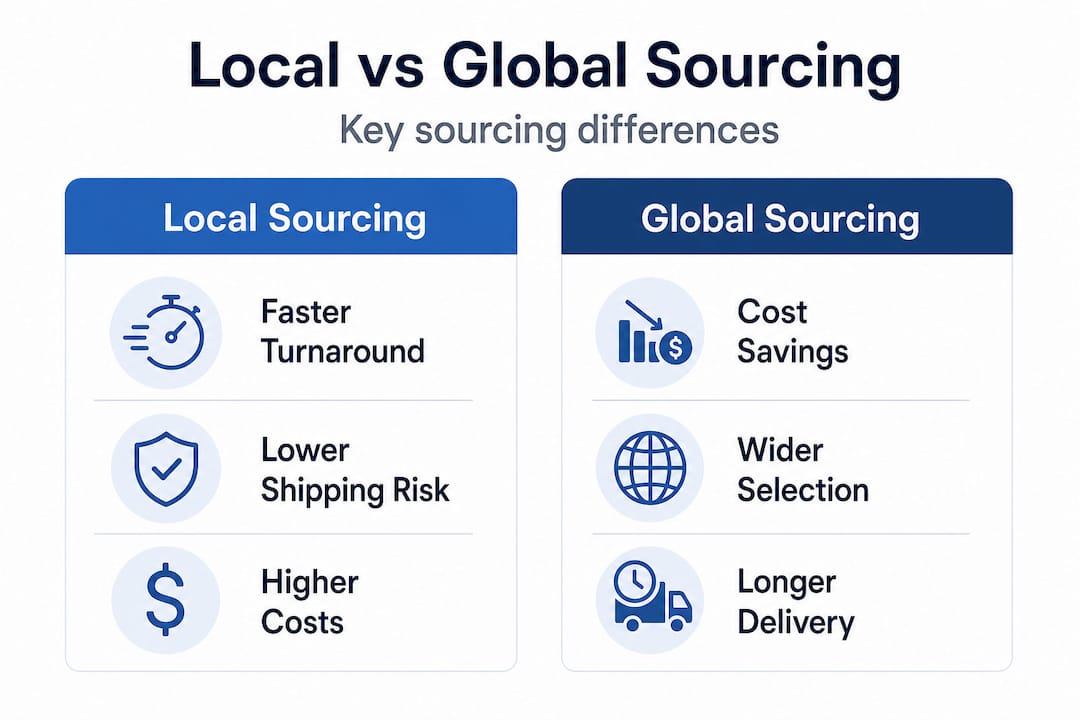
| Factor | Local sourcing | Global sourcing |
|---|---|---|
| Unit cost | Generally higher | Generally lower |
| Lead times | Shorter | Longer |
| Communication | Easier | More complex |
| Regulatory compliance | Simpler | Requires more oversight |
| Supply chain flexibility | High | Lower |
| Minimum order quantities | Often more flexible | Typically larger |
When to consider local sourcing:
- Your product requires rapid restocking to meet fluctuating demand.
- Quality control requires regular in-person inspection.
- Regulatory compliance for your market is complex or highly specific.
- You want to promote a "made in USA" positioning for marketing purposes.
- Lead time is a stronger competitive factor than unit cost.
When to consider global sourcing:
- You have established, predictable demand that justifies larger order volumes.
- Significant cost savings are available that improve margin sustainability.
- Product specifications are standardized and quality can be verified remotely.
- You have logistics support to manage import documentation and customs.
For businesses local sourcing in Texas or other regional markets, domestic suppliers can offer faster turnaround and simpler compliance. But a blended model, where high-volume staple products come from offshore suppliers and fast-moving or seasonal products are sourced locally, often delivers the best overall performance.
Building an effective product sourcing strategy
Moving from ad-hoc purchasing to a structured sourcing strategy is one of the most meaningful operational upgrades a small business can make. It does not require complex systems, but it does require intentional planning.
Recognized frameworks in procurement treat sourcing as aligning supplier selection and management with business goals related to cost, risk, compliance, and resilience, rather than simply chasing the lowest unit price. That shift in perspective changes how you evaluate suppliers, negotiate contracts, and plan inventory.
Small-business research indicates that many leaders are reshaping sourcing strategies due to tariffs and global trade shifts, and that supplier reliability and online sourcing channels are increasingly critical. Entrepreneurs who rely on informal, ad-hoc sourcing are more exposed to these shifts than those with structured, repeatable processes.
Here is a practical framework for building your sourcing strategy:
- Define your sourcing objectives. Clarify whether your primary drivers are cost reduction, speed to market, product quality, or supply chain resilience. Most businesses balance all four, but knowing your priorities helps when trade-offs arise.
- Map your current supplier landscape. Document every active supplier, what you buy from them, their performance history, and their risk level. Gaps and concentrations become visible quickly.
- Segment your product categories. Not all products need the same sourcing approach. High-margin items may justify premium local suppliers. High-volume commodities may warrant global sourcing for cost efficiency.
- Build supplier tiers. Identify primary, secondary, and contingency suppliers for critical product categories. This prevents single-source dependency without requiring you to manage dozens of relationships simultaneously.
- Establish evaluation criteria. Use consistent metrics such as on-time delivery rate, defect rate, pricing competitiveness, and responsiveness when assessing suppliers.
- Review and update regularly. Markets, tariffs, and supplier capabilities shift. Treat your sourcing strategy as a living document, not a one-time plan.
Pro Tip: Use digital sourcing tools and market data to benchmark your current supplier pricing at least annually. If a supplier's pricing has drifted significantly above market, use that data as the basis for renegotiation or transition planning.
For businesses planning a B2C launch sourcing strategy, aligning sourcing timelines with product launch windows and marketing campaigns is especially critical. A delay in product availability can undermine a marketing investment made months earlier.
The smart sourcing mindset most entrepreneurs miss
Most conversations about product sourcing focus on tactics: which platforms to use, how to find suppliers, what to negotiate. Those tactics matter. But the deeper issue is mindset.
Many entrepreneurs treat sourcing as a cost center, something to minimize and manage rather than invest in. That framing leads to decisions that prioritize the lowest invoice price while ignoring total cost. Delayed shipments, quality failures, emergency restocking from expensive alternative sources, and customer refunds all carry costs that rarely appear in a unit price comparison.
The businesses that source well think about supplier relationships as a form of capital. A supplier who knows your business, understands your standards, and prioritizes your orders during high-demand periods is genuinely valuable. That relationship is built through consistent communication, fair negotiation, timely payments, and treating suppliers as partners rather than just vendors.
Short-term cost-cutting through aggressive price pressure often destroys exactly the relationships that protect you when supply chains tighten. The factories and distributors with reliable quality and delivery capacity have options. They choose which clients to prioritize. Being a preferred client requires behaving like one.
Structured sourcing, using the frameworks and evaluation criteria described throughout this guide, also functions as a competitive advantage. When your supply chain is predictable, you can make better inventory decisions, plan promotions with confidence, and scale product lines without the operational anxiety that comes from fragile supplier relationships.
Reviewing sourcing best practices regularly and treating that knowledge as a strategic asset, rather than background noise, is what separates growing businesses from those stuck in reactive mode.
Boost your sourcing strategy with expert help
Building a reliable, cost-effective sourcing strategy takes time, research, and the right support structure. For small business owners managing operations across multiple functions, having a knowledgeable partner can make the difference between guesswork and growth.
SourcesNova works with local and small-to-mid-size businesses to strengthen operations and support growth, including the sourcing and digital infrastructure decisions that affect long-term profitability. Whether you are refining an existing sourcing process overview or starting from scratch, the right guidance helps you avoid costly mistakes and move faster with confidence. Explore how expert sourcing support can help your business source smarter, reduce risk, and build the supplier relationships that fuel sustainable growth.
Frequently asked questions
How do I choose between local and global suppliers?
Consider cost, lead time, risk, and regulatory requirements together. As sourcing strategy research confirms, diversifying across both local and global suppliers is a proven way to improve resilience when demand shifts or disruptions occur.
What is the difference between product sourcing and procurement?
Sourcing is the strategic process of selecting what to buy and which supplier to use, while procurement manages the ongoing buying process, payments, and supplier relationships after those decisions are made. Sourcing and procurement serve distinct but complementary roles in supply chain management.
What if my supplier fails to deliver on time or on quality?
Diversify your supplier base and hold safety stock for critical products. Supplier risk mitigation through diversification and inventory planning is one of the most effective ways to buffer against reliability failures and quality issues.
How do small businesses keep product sourcing costs down?
Balance domestic and global sourcing options, negotiate payment and delivery terms, and compare multiple suppliers before committing. Local vs. global trade-offs are not just about unit price but about total cost including lead time, risk, and logistics.