
Reaching US consumers requires a structured approach that combines a precise Ideal Customer Profile (ICP), culturally calibrated messaging, the right digital channels, and logistics infrastructure built for American expectations. This guide covers every critical layer of USA customer acquisition strategies, from primary research methods and platform selection to fulfillment speed and common market entry mistakes. Whether you are a manufacturer, an e-commerce brand, or a service business, the frameworks here apply directly to how you plan, spend, and scale in the US market.
How to target USA customers: define your ICP first
The foundation of any successful US market entry is a precisely defined Ideal Customer Profile built specifically for American buyers, not adapted from your home market. US consumers differ from other markets in their purchase motivations, language, and expectations. A profile that works in Europe or Southeast Asia will miss the mark in Chicago or Dallas.
Primary qualitative research outperforms secondary data for understanding what actually drives US purchase decisions. Surveys tell you what people say. Structured interviews and ethnographic observation tell you what people mean. Those are two different things.
Build your ICP using these inputs:
- Demographic data: Age, income bracket, geography, household type
- Behavioral data: Purchase frequency, brand loyalty patterns, preferred channels
- Psychographic data: Values, lifestyle priorities, attitudes toward price versus quality
- Competitive mapping: Price points and positioning gaps that reveal where your offer fits
Conduct at least five structured interviews with US customers or industry contacts before finalizing your strategy. This is not optional. Those conversations surface the exact language buyers use, the objections they carry, and the emotional triggers that move them to purchase.
Pro Tip: Use projective interview techniques, such as asking buyers to describe your product category as a person or a place. Projective methods uncover emotional drivers that direct questions consistently miss.
The US is not one market. Seattle and Houston consumers respond differently to the same message. Build your ICP with regional variation in mind, and test your assumptions across at least two distinct submarkets before committing budget.
Which marketing channels work best for US buyers?
Channel selection is where most international businesses waste their first US marketing budget. The right channel depends on your audience segment, your offer type, and your current brand awareness level in the US.
Paid digital advertising
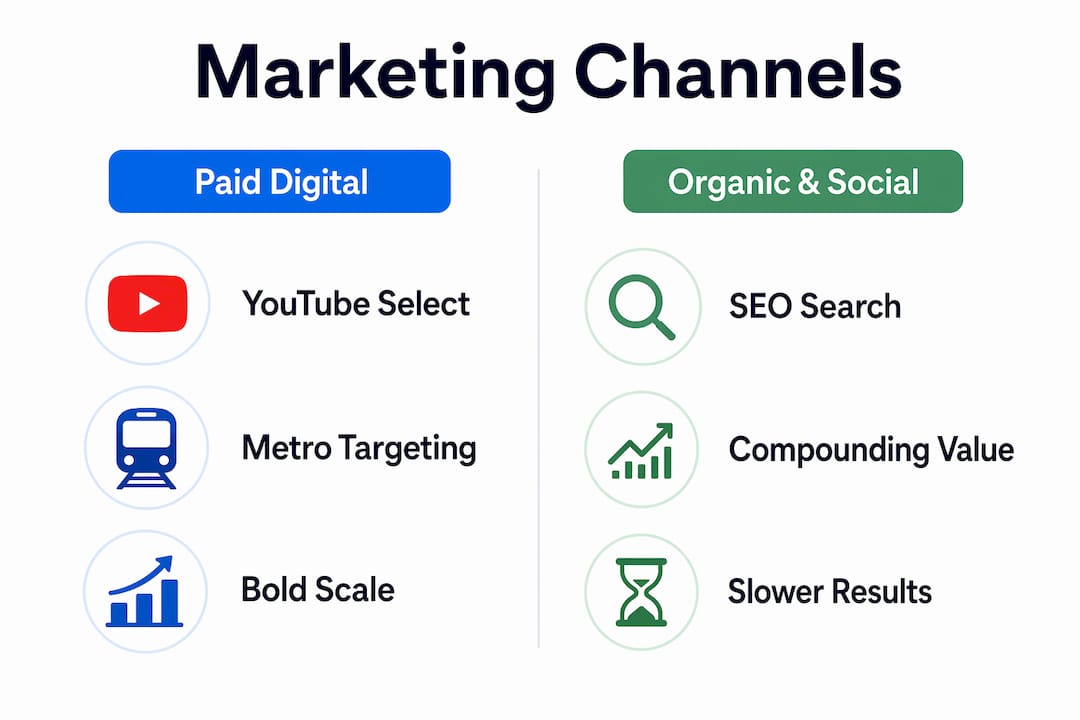
Digital advertising in the US rewards boldness and scale. YouTube Select ads generate 90% of impressions on connected TVs, making them a high-impact format for brand awareness campaigns. Connected TV reach is growing faster than traditional broadcast, and non-skippable formats force full message delivery. For businesses entering the US market with limited brand recognition, this format builds awareness efficiently.
A data-driven metro-level approach to city selection improves campaign performance. Targeting New York, Los Angeles, and Chicago simultaneously spreads budget thin. Matching search volume data with cultural relevance scores lets you identify two or three cities where your offer has the strongest natural fit, then scale from there.

Organic and social channels
| Channel | Best For | Key Consideration |
|---|---|---|
| Google Search (SEO) | High-intent buyers researching solutions | Requires 6–12 months to build authority |
| TikTok | Under-35 consumer audiences | Content must feel native, not produced |
| Lifestyle, beauty, retail, food brands | Visual consistency drives follower trust | |
| B2B and professional services | Decision-maker targeting is precise | |
| YouTube (organic) | Product education and reviews | Long-form content builds purchase confidence |
Organic channels build compounding value over time. Paid channels deliver faster results but stop the moment you stop spending. The most effective US digital marketing strategies combine both: paid to generate early traction, organic to reduce cost per acquisition over 12–24 months.
Influencer partnerships
Influencer marketing in the US works when the creator's audience matches your ICP precisely. Micro-influencers with 10,000–100,000 followers in a specific niche consistently outperform celebrity partnerships on conversion rates. The reason is trust. A fitness influencer recommending a supplement to 40,000 dedicated followers carries more purchase authority than a broad celebrity post to 2 million passive ones.
- Prioritize engagement rate over follower count
- Require content approval rights before publishing
- Track affiliate codes or UTM links to measure actual sales impact
Does your messaging match american expectations?
US marketing norms prioritize directness, boldness, and clarity. Overly polite or hedged language reads as indecision to American buyers. This is one of the most common and costly mistakes international businesses make when entering the US market.
American consumers want to know immediately: what does this do for me? Your headline, your ad copy, and your product description all need to answer that question in the first sentence. "Clinically tested formula reduces breakouts in 14 days" outperforms "Our carefully developed skincare solution may help with various skin concerns" every time.
Localization is an operational discipline, not a translation task. It means adapting your product assortment, your retail experience, and your merchandising to regional cultural expectations. A product line that sells well in California may need different sizing, different packaging language, or different retail placement to succeed in the Southeast.
Pro Tip: Run your US copy through a native American English speaker who is also your target buyer type. Grammar tools like Grammarly catch errors. They do not catch cultural tone mismatches.
Key messaging principles for the US market:
- Lead with the benefit, not the feature. "Saves you 3 hours a week" beats "Advanced automation technology."
- Use specific numbers. Vague claims lose credibility. Specific claims build it.
- Match regional vocabulary. "Soda" versus "pop" versus "Coke" signals whether you understand a local market.
- Avoid corporate hedging. Words like "may," "could," and "potentially" weaken every claim they touch.
Are your operations ready for US customer demands?
Marketing drives traffic. Operations determine whether that traffic converts to loyal customers or one-time buyers who never return. US consumers expect fast, reliable delivery, and that expectation has only grown since Amazon normalized two-day shipping.
Here is how to build an operational foundation that supports your US marketing investment:
-
Select a 3PL with a nationwide network. Experienced 3PL partners reduce fulfillment risk and provide the geographic coverage needed to meet delivery expectations across all 50 states. A single warehouse in New Jersey cannot serve California customers at competitive shipping speeds.
-
Plan for peak season demand spikes. Labor Day, back-to-school, Black Friday, Cyber Monday, and the December holiday cycle all create sudden volume surges. US consumers expect next-day or same-day delivery even during these peaks. Brands that cannot fulfill during peak seasons lose customers permanently.
-
Implement real-time order tracking. US buyers expect tracking updates from purchase confirmation through delivery. Gaps in communication create support tickets and negative reviews.
-
Build a frictionless returns process. Free or low-cost returns are now a baseline expectation in most US product categories. A complicated returns process is a direct conversion barrier.
-
Staff customer service for US time zones. Response times beyond 24 hours are considered poor service by US standards. If you cannot staff US hours internally, outsource to a US-based customer service provider.
Your logistics setup is part of your brand experience. A strong product with weak fulfillment will generate negative reviews that undermine every dollar you spend on marketing.
What are the most common mistakes when targeting US customers?
Most market entry failures in the US trace back to a small set of repeatable mistakes. Recognizing them early saves significant time and budget.
- Assuming the US is one homogeneous market. Regional differences in culture, climate, income, and values require tailored approaches. What resonates in Miami will not automatically work in Minneapolis.
- Skipping primary research. Relying on home market assumptions or secondary data alone produces a strategy built on guesswork. The 90-day entry roadmap used by experienced international founders dedicates the first month entirely to validating the opportunity before spending on marketing.
- Underestimating channel partner timelines. US distributors and retailers have onboarding processes that can take 3–6 months. Building those relationships into your go-to-market timeline prevents launch delays.
- Measuring vanity metrics. Impressions and follower counts do not pay invoices. Track cost per acquisition, customer lifetime value, and return on ad spend from day one.
- Ignoring logistics until it is too late. Logistics decisions made after launch are always more expensive than logistics decisions made before it.
"The businesses that succeed in the US market are not always the ones with the best product. They are the ones that understood the market before they entered it."
Fixing these mistakes mid-campaign is possible but costly. Building the right foundation before launch is always the better investment.
Key takeaways
Targeting US customers successfully requires validated research, culturally direct messaging, channel discipline, and logistics infrastructure that matches American delivery expectations.
| Point | Details |
|---|---|
| Build a US-specific ICP | Conduct at least five structured interviews with US buyers before finalizing your strategy. |
| Select channels by audience fit | Match paid and organic channels to your buyer segment rather than defaulting to the most popular platforms. |
| Lead with direct messaging | US buyers respond to clear, benefit-first language. Remove hedging from all copy. |
| Prepare logistics before launch | Partner with a 3PL that has nationwide coverage and peak season capacity. |
| Validate before scaling | Use a 90-day roadmap to test assumptions and reduce costly mistakes before committing full budget. |
What i have learned about entering the US market
The US market rewards preparation more than any other market I have worked in. Businesses that skip the research phase and go straight to advertising almost always spend their first $20,000 learning lessons they could have learned for free in five customer interviews.
The cultural directness requirement surprises most international teams. They interpret bold messaging as aggressive. US buyers interpret it as confidence. That reframe alone changes how you write every headline, every email subject line, and every product description.
Regional variation is the other factor that consistently catches businesses off guard. The US is geographically and culturally enormous. A metro-level targeting strategy, starting with two or three cities where your offer has the strongest fit, outperforms a national launch almost every time. It concentrates your resources, generates cleaner data, and builds a proof of concept you can use to justify scaling.
Operational readiness is not a logistics problem. It is a marketing problem. Every fulfillment failure is a marketing failure. Every slow delivery is a brand message. The businesses that treat operations as a core part of their US growth strategy consistently outperform those that treat it as a back-office function.
— Tran
How Sourcesnova helps businesses reach US customers
Sourcesnova works with manufacturers and small-to-mid-size businesses that need more than generic marketing advice. The team brings hands-on experience in US market entry, distributor matching, and digital channel execution.
For businesses ready to build a real US customer acquisition strategy, Sourcesnova provides customized research, channel planning, and logistics guidance tailored to your product category and target region. No bloated retainers. No vanity reports. If you are planning your US market entry and want a team that treats your business like their own, start here and connect with the Sourcesnova team directly.
FAQ
What is an ideal customer profile for the US market?
An Ideal Customer Profile (ICP) is a detailed description of the buyer most likely to purchase your product in a specific market. For the US, it combines demographic, behavioral, and psychographic data validated through primary research with actual American buyers.
How many marketing channels should i use to reach US buyers?
Start with two or three channels that match your audience segment and budget. Spreading across too many channels too early dilutes your data and your spend. Validate performance on a focused set before expanding.
Why does messaging need to change for american customers?
US marketing norms favor direct, benefit-first language. Subtle or hedged messaging is perceived as a lack of confidence by American buyers, which reduces conversion rates regardless of product quality.
How fast do US customers expect delivery?
US consumers expect next-day or same-day delivery during peak seasons and two-day delivery as a standard baseline. Brands that cannot meet these expectations consistently lose customers to competitors who can.
How long does it take to enter the US market properly?
A structured 90-day roadmap covers opportunity validation, ICP definition, and channel model testing before significant budget is committed. Full market traction typically requires 6–12 months of consistent execution.