
Most small business owners launch their first digital ad expecting immediate results, only to find their budget gone and little to show for it. Digital advertising is not a plug-and-play solution. It demands strategic channel selection, audience targeting, creative discipline, and a working knowledge of legal compliance that many SMB owners overlook entirely. This guide cuts through the noise to give you a clear, practical roadmap for running digital ads that build real visibility, drive genuine engagement, and keep your business on the right side of U.S. consumer-protection standards.
Table of Contents
- Why digital advertising matters for SMBs
- Understanding digital advertising compliance
- Core digital advertising strategies for SMBs
- Measuring success: Analytics and optimization
- What most SMBs miss about digital advertising
- Ready to elevate your SMB's digital advertising?
- Frequently asked questions
Key Takeaways
| Point | Details |
|---|---|
| Compliance is essential | Consumer protection laws shape every online ad and can't be ignored by SMBs. |
| Strategy drives results | Effective channel selection and campaign structure maximize advertising ROI. |
| Measure and optimize | Track key metrics regularly to refine your approach and grow your business. |
| Legal standards apply online | Truth-in-advertising rules are enforced for all digital campaigns in the USA. |
Why digital advertising matters for SMBs
Digital advertising has fundamentally changed what is possible for small and mid-sized businesses. A local salon, a regional lighting distributor, or a niche e-commerce shop can now place their message in front of precisely defined audiences, competing for attention alongside national brands with multimillion-dollar budgets.
The core advantage for SMBs is targeting precision. Unlike print flyers or radio spots, digital ads let you control who sees your message, when they see it, and on what device. That level of control means a modest budget can generate outsized results when deployed correctly. Understanding digital marketing for SMBs is the foundation that makes every other tactic more effective.
Here is what effective digital advertising can do for your business:
- Increase brand visibility among local, regional, or national audiences depending on your goals
- Drive qualified traffic to your website or physical location through intent-based targeting
- Generate leads and sales through retargeting users who have already shown interest in your products
- Build engagement across social platforms where your customers already spend time
- Provide measurable ROI through real-time analytics that print or broadcast media cannot match
Beyond the opportunity, there is a critical responsibility that comes with running ads online. The Federal Trade Commission (FTC) makes clear that FTC guidance on online advertising emphasizes that online advertising standards still apply, just as they do in print or broadcast. Misleading claims, deceptive pricing, or hidden terms are violations whether they appear in a newspaper or a Facebook ad.
"Digital advertising gives SMBs access to precision targeting tools that were once reserved for large corporations. That access comes with legal and ethical responsibilities that cannot be ignored."
Exploring proven marketing strategies for SMB growth alongside your ad efforts multiplies your results and reduces wasted spend from the start.
Understanding digital advertising compliance
While audience reach is crucial, staying compliant is just as important for long-term business success. Many SMB owners assume that following an ad platform's rules is sufficient. It is not. The FTC operates independently of Google, Meta, or any other platform. Its standards apply to every U.S. business regardless of where the ad appears.
Key compliance areas for U.S. SMBs
| Compliance Area | What It Means for Your Ads | Common Mistake |
|---|---|---|
| Truth in advertising | All claims must be accurate and verifiable | Exaggerating results or benefits |
| Clear disclosures | Sponsored content must be labeled | Hiding that a post is a paid ad |
| Endorsements | Paid endorsers must disclose the relationship | Posting fake reviews or paid testimonials without disclosure |
| Data privacy | You must handle customer data lawfully | Running retargeting without proper consent notices |
| Pricing transparency | Advertised prices must be real and available | Displaying a sale price that is not actually available |
Truth-in-advertising standards apply in digital channels without exception. Legal compliance is non-negotiable for SMBs competing in any online market. Reviewing the FTC's specific guidelines for digital ads through resources like FTC guidelines for digital ads helps you identify gaps in your current practices before they become violations.
Understanding compliance also connects directly to the concept of unlocking business digital growth. Businesses that build trust through transparent advertising convert better and retain customers longer.
Common compliance pitfalls to avoid
Four mistakes appear repeatedly among SMBs entering digital advertising for the first time:
- Using superlatives without evidence. Claims like "best in the city" or "guaranteed results" require proof. If you cannot document the claim, do not make it.
- Forgetting sponsored content disclosures. If you pay an influencer, partner, or affiliate, every piece of content they create must clearly indicate the paid relationship.
- Ignoring state-specific regulations. California's CCPA, for example, adds data-privacy obligations on top of FTC rules. Know which states your ads reach.
- Assuming platform approval means FTC approval. A platform may approve your ad while the underlying claim still violates FTC standards.
Pro Tip: Before launching any campaign, run your ad copy through a simple self-audit. Ask yourself: Can I substantiate every claim with documented evidence? Is every disclosure visible and readable? If the answer to either question is no, revise before publishing.
Core digital advertising strategies for SMBs
Once compliance is addressed, you can focus on maximizing your digital ad results through proven strategies. Effective digital advertising is not about running one great ad. It is about building a system that attracts, engages, and converts the right customers consistently.

Choosing the right advertising channels
Different channels serve different purposes. Selecting the wrong one wastes budget quickly.
| Channel | Best For | Average Cost Model | Strength |
|---|---|---|---|
| Search ads (Google) | High-intent buyers ready to purchase | Cost per click (CPC) | Captures demand at the moment of search |
| Social media ads | Awareness and community building | Cost per impression (CPM) or CPC | Precise demographic and interest targeting |
| Display ads | Retargeting and brand awareness | CPM | Visual reach across millions of websites |
| Email marketing | Nurturing existing leads and customers | Fixed or per-send cost | Highest average ROI across digital channels |
Building a strong email marketing for SMB sales program alongside your paid ads creates a full-funnel system that maximizes every dollar you spend on acquisition.
Steps to build a results-driven digital ad campaign
- Define your goal. Choose one primary objective per campaign: awareness, lead generation, or direct sales. Trying to achieve all three at once dilutes your results.
- Identify your audience. Use demographic data (age, location, income level), behavioral signals (purchase history, browsing habits), and interest categories to narrow your targeting.
- Select your channels. Match channel strengths to your goal. Use search ads for ready buyers, social ads for awareness, and email for retention.
- Develop your creative. Write a clear headline, one specific benefit, and a direct call to action. Use visuals that reflect your brand and resonate with your audience.
- Set your budget. Start with a test budget (typically $500 to $1,500 per month for most SMBs) to gather data before scaling.
- Launch and monitor. Run your campaign for at least two weeks before drawing conclusions. Watch click-through rates, conversion rates, and cost per acquisition daily.
- Optimize continuously. Pause underperforming ads, increase budget for top performers, and test new creative regularly.
A well-designed social media growth strategy anchors your social ad efforts within a broader content plan that keeps engagement high between paid campaigns.
Creative best practices that improve ad performance
Your creative is what the audience actually sees and reacts to. Weak creative wastes targeting precision. Strong creative multiplies it.
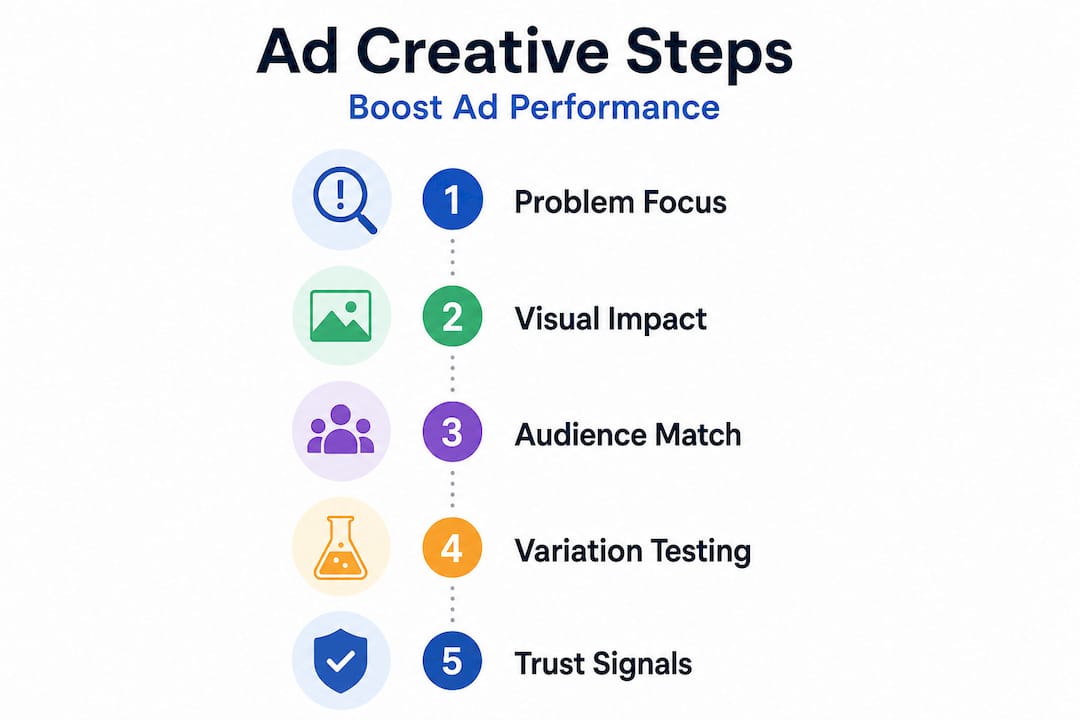
Write headlines that address a specific problem your customer faces, not generic claims about your business being great. Use images or video that feature real people and real outcomes rather than stock photography that audiences have seen thousands of times. Every ad should have one clear call to action: "Book a free consultation," "Shop the collection," or "Get your free quote today."
Streamlining your overall digital marketing workflow tips ensures your creative production, approvals, and scheduling processes do not become bottlenecks that slow down your campaigns.
Consumer-protection standards help both consumers and businesses online by creating a fair, trustworthy environment for commerce. Ads that follow these standards earn more consumer trust and convert at higher rates than ads that push legal boundaries.
Pro Tip: Run at least two creative variations for every ad group. Small differences in headline wording, image choice, or call-to-action phrasing can produce 20 to 40 percent differences in click-through rate. Always test before committing your full budget to a single version.
Measuring success: Analytics and optimization
You have launched your campaigns. Now it is time to analyze what works and optimize for growth. Running digital ads without measuring results is the single most expensive mistake SMBs make. Many business owners check how much they spent but never calculate what they earned from that spend.
Key metrics every SMB should track
- Impressions: How many times your ad was shown. A leading indicator of reach and brand awareness.
- Click-through rate (CTR): The percentage of people who clicked after seeing your ad. Industry average CTRs vary from 0.5 percent on display to 3 to 5 percent on search.
- Conversion rate: The percentage of clicks that resulted in a desired action (purchase, form fill, phone call).
- Cost per click (CPC): How much you pay for each click. Lower is better when quality stays high.
- Cost per acquisition (CPA): The total cost to acquire one customer or lead. This is the most important metric for profitability.
- Return on ad spend (ROAS): Revenue generated for every dollar spent on ads. A ROAS of 3x or higher is a common benchmark for healthy SMB campaigns.
- Bounce rate: The percentage of ad-driven visitors who leave your site immediately. High bounce rates signal a disconnect between your ad promise and your landing page.
FTC guidelines note that rules and guidelines help businesses measure and maintain trustworthy advertising. Transparent, accurate reporting is as important internally as it is legally.
Tools that make measurement manageable
Google Analytics 4 (GA4) is free and connects directly to Google Ads, giving you a clear view of how paid traffic behaves on your site. Meta Ads Manager provides campaign-level and ad-level performance data for Facebook and Instagram campaigns. Most email platforms include open rate, click rate, and conversion tracking built in.
For SMBs managing multiple channels, a simple spreadsheet dashboard that consolidates weekly data from each platform is often more actionable than expensive third-party tools. The goal is to identify patterns, not to collect data for its own sake.
Producing B2B content for brand visibility alongside your paid campaigns creates organic visibility that supports ad performance over time and reduces your dependence on paid traffic alone.
What most SMBs miss about digital advertising
Working with small and mid-sized businesses across industries reveals a pattern that most digital advertising guides never address directly. The businesses that succeed with digital ads are not necessarily the ones with the biggest budgets or the most sophisticated tools. They are the ones that treat advertising as a learning process rather than a one-time purchase.
Most SMBs approach digital ads transactionally. They run a campaign, it underperforms, and they conclude that "digital advertising doesn't work for us." What actually failed was the process, not the channel. Campaigns without clear objectives, without audience research, and without measurement cannot succeed regardless of budget size.
The compliance dimension is equally misunderstood. Many business owners view FTC guidance as a bureaucratic formality. In practice, FTC standards imply that you must meet truth-in-advertising and consumer-protection expectations at every level of your digital presence. This shapes not only your legal exposure but your brand credibility. Ads that make inflated or vague claims generate lower trust, lower conversion rates, and higher refund rates.
Creative adaptation is another area where SMBs consistently underinvest. An ad that performed well six months ago will fatigue your audience. Consumers see thousands of ads per day. Repetition creates invisibility, not memorability. Updating your creative monthly, or even bi-weekly for active campaigns, keeps performance from eroding.
Finally, many SMBs rely too heavily on ad platform recommendations. Platforms optimize for their own revenue. Their automated recommendations often increase your spend more than they improve your results. Maintaining manual oversight of your campaigns, especially targeting parameters and budget allocation, keeps you in control of your outcomes. Integrating regular newsletter strategies for growth into your broader marketing mix reduces over-reliance on paid channels and builds a direct audience you own.
Ready to elevate your SMB's digital advertising?
Building a digital advertising program that consistently drives visibility, engagement, and revenue takes more than a good ad. It takes a clear strategy, ongoing optimization, and expert guidance tailored to your industry and audience.
SourcesNova works directly with small and mid-sized businesses to build digital advertising programs that deliver measurable results. No jargon, no vanity metrics, no overpromising. If you want a clear-eyed assessment of where your digital advertising stands and what it would take to improve it, our team is ready to help. Explore digital advertising resources on our website and connect with a team that treats your business growth as seriously as you do.
Frequently asked questions
How can SMBs avoid legal pitfalls in digital advertising?
Follow FTC guidance consistently by using only truthful claims, clearly labeling sponsored content, and reviewing all ad copy for potentially misleading statements before publication.
Which digital advertising channels are best for small businesses?
Search ads, social media ads, email marketing, and display ads are all effective for SMBs. The best choice depends on your target audience, your budget, and whether your goal is awareness, lead generation, or direct sales.
What metrics should I track to measure ad success?
Prioritize impressions, click-through rate, conversion rate, and cost per acquisition because these metrics together reveal both reach and profitability, giving you the clearest picture of campaign performance.
Does FTC guidance override ad platform policies?
Yes. FTC consumer-protection standards apply independently of individual ad platform policies for all U.S.-based SMBs. Platform approval of your ad does not equal FTC compliance.