
Most service business owners are great at what they do. Marketing it is a different skill entirely. Whether you run a cleaning company, a landscaping crew, a consulting practice, or a home repair service, you already know the frustration: you spend money on ads or a website, and the phone stays quiet. A solid service business marketing guide does not just show you which channels to use. It shows you how to build the full system, from attracting the right prospects to closing them before a competitor does. That is exactly what this guide covers.
Table of Contents
- Key takeaways
- Service business marketing guide: building your foundation
- Digital marketing essentials for service businesses
- Lead response: the operational side of marketing
- Validating and adjusting your marketing offers
- My take on what actually moves the needle
- How Sourcesnova can help you grow
- FAQ
Key takeaways
| Point | Details |
|---|---|
| Build the plan first | Define your audience, value proposition, and goals before spending a dollar on any channel. |
| Optimize local visibility | A complete Google Business Profile is one of the fastest ways to generate service leads at low cost. |
| Speed converts leads | Responding within five minutes makes a lead 21x more likely to qualify than waiting 30 minutes. |
| Validate before scaling | Test your offer with a small audience before committing significant budget to any campaign. |
| Measure revenue metrics | Track cost per booked meeting and conversion rates, not just clicks and impressions. |
Service business marketing guide: building your foundation
The formal term for what most small business owners need is a marketing strategy, which is a structured plan covering audience targeting, positioning, channel selection, and performance measurement. A service business marketing guide without that foundation is just a list of tactics with no direction.
The SBA recommends that every marketing plan cover six core elements: target market demographics, competitive advantage, sales process steps, goals for the year ahead, channel selection, and budget with ROI benchmarks. Most small service businesses skip at least three of these and wonder why results are inconsistent.
Here is how to build each element properly:
- Define your audience with precision. "Homeowners" is not a target market. "Homeowners aged 35 to 55 in suburban zip codes who own properties built before 2000 and are actively searching for HVAC maintenance" is a target market. The more specific your buyer persona, the more focused your messaging and channel choices will be.
- Clarify your unique value proposition. What do you do that a competitor does not, will not, or cannot? Price is rarely the right answer. Think about speed, specialization, guarantees, or local expertise.
- Set goals that connect to revenue. "Get more leads" is not a goal. "Generate 40 qualified service inquiries per month at a cost below $35 per lead" is a goal you can track, report on, and improve.
- Map your sales process. Marketing creates interest. Sales closes it. If you do not have a defined process from inquiry to signed contract, your marketing spend leaks at every step.
- Choose channels strategically. Not every channel fits every service business. A wedding photographer benefits from Instagram. A commercial HVAC contractor benefits from LinkedIn and local SEO. Fit the channel to the buyer.
Pro Tip: Before selecting any marketing channel, write down where your last five best clients came from. That data is often worth more than any industry benchmark.
Salesforce's 2026 marketing strategy framework recommends using the STP model (segmentation, targeting, positioning) as the backbone of any plan before committing to tactics or channels. This applies directly to service businesses because your audience is typically local and specific, which means precise targeting produces significantly better returns than broad awareness campaigns.
| Marketing plan element | Common mistake | Better approach |
|---|---|---|
| Target audience | "Anyone who needs our service" | Define age, location, need, and buying trigger |
| Value proposition | Competing on price alone | Lead with a specific outcome or guarantee |
| Goals | Track website traffic only | Set cost per lead and cost per booked job targets |
| Channel selection | Running every platform at once | Choose two channels, master them, then expand |
Digital marketing essentials for service businesses
Digital marketing for service businesses is not about having the most polished brand. It is about being found at the moment someone needs what you offer, and then making it easy for them to contact you.
Optimizing your Google Business Profile is the single highest-leverage starting point for most local service businesses. Claim the profile, complete every field, select accurate service categories, add photos, manage reviews, and list your service areas. A fully optimized profile puts you in front of buyers who are actively searching right now, not passively browsing.
Beyond local search, here are the core digital marketing channels that consistently deliver results for service businesses:
- Search engine optimization (SEO). Write content that answers the specific questions your buyers ask. A plumber who publishes a page on "how to stop a running toilet in [city name]" attracts homeowners at the exact moment they have a problem worth paying to solve.
- Social media. Pick one or two platforms where your buyers actually spend time. For B2C service businesses, Facebook and Instagram remain strong. For B2B services, LinkedIn drives better-quality conversations. Post consistently and respond to every comment and message.
- Email marketing. A monthly newsletter to past clients keeps your name in front of people who have already trusted you. This is often the most underused channel in small service businesses, and one of the highest-ROI options available.
- Pay-per-click (PPC) advertising. Google Search ads work well when your target buyers are actively searching. Start with a tight geographic radius and a small daily budget. Track cost per lead, not cost per click.
Pro Tip: Set up call tracking for every digital channel. Knowing which ad or page drove a phone call is the difference between scaling what works and guessing what works.
For lead capture, every marketing channel should funnel prospects to a single clear action: call, fill out a form, or book an appointment. Generating leads consistently requires aligning your digital presence with a follow-up system that responds fast. That follow-up system is the next piece most service businesses are missing entirely.
Lead response: the operational side of marketing
Here is a fact most marketing guides leave out. You can run a perfect ad campaign and still lose the lead. How? By responding too slowly.

MIT and Harvard Business Review research shows that responding to a lead within five minutes makes it 21 times more likely to qualify compared to waiting 30 minutes. Lead qualification probability drops roughly 80 percent between the five-minute and ten-minute response windows. Those are not incremental differences. They are the difference between a booked job and a lost one.
Here is how to build a lead response system that works:
- Use real-time notifications. Every lead form, website chat, or ad lead should trigger an immediate text or email alert to the person responsible for follow-up. No checking the inbox once a day.
- Set a response time standard. Define it clearly: all new leads receive a call or text within five minutes during business hours, and a text or automated acknowledgment immediately after hours.
- Route leads by service type. If you offer multiple services, route leads directly to the technician or salesperson with relevant expertise. Every hand-off that slows response time costs you conversions.
- Use automation for after-hours coverage. An automated text that says "We received your request and will call you first thing in the morning" dramatically reduces lead drop-off compared to silence.
- Track show rates. If prospects are not showing up to scheduled calls or appointments, your follow-up process needs work before you spend more on advertising.
"Designing your marketing funnel so leads immediately reach appointment setting is the highest-ROI configuration available to service businesses." This is the practitioner standard for service businesses that convert marketing spend into actual booked revenue.
Pro Tip: Test your own lead response by submitting a contact form on your website and timing how long it takes to hear back. Most business owners are surprised by what they find.
Effective service marketing techniques are not just about creative campaigns. They depend on the operational infrastructure that handles what marketing creates. Aligning marketing with sales workflows is what separates businesses that grow from those that stay stuck on the ad-spend treadmill.
Validating and adjusting your marketing offers
Before putting serious budget behind any campaign, test whether your offer actually resonates. This is where many small service businesses waste the most money: marketing a service that is either too vague, priced incorrectly, or solving a problem prospects do not prioritize.
Early-stage offer validation means clarifying the specific problem you solve, for whom, and at what price point, then testing that message with a small group of real prospective buyers before scaling. This does not require a large budget. It requires a clear offer and five to ten honest conversations.
Use these criteria when validating a service offer:
- The problem is specific. "I help residential landlords reduce tenant turnover in properties with deferred maintenance" is testable. "I help people with their properties" is not.
- The buyer is identifiable. You should be able to name where this person searches, what they read, and what objections they raise.
- The deliverable is concrete. Vague service descriptions kill conversions. A defined scope, timeline, and outcome makes pricing easier and objections smaller.
- Early feedback is honest. Run a small ad, send a cold email, or post in a relevant group. If people engage, ask questions, or request a quote, the offer has legs. If it generates nothing, adjust before scaling.
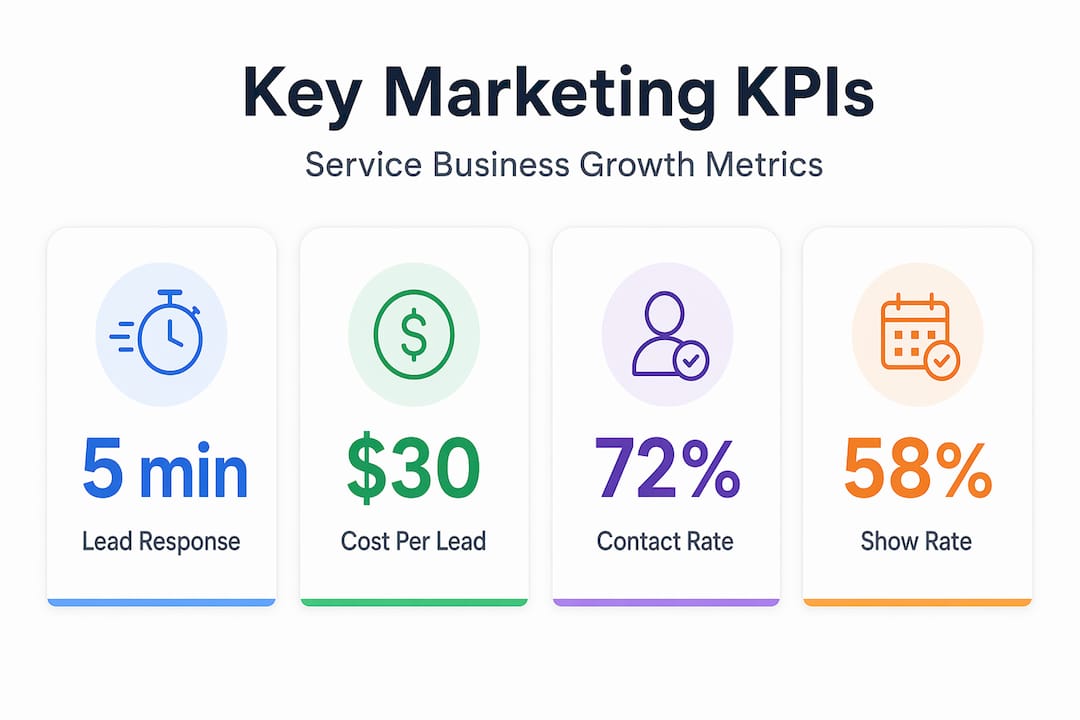
Once you have validated the offer, shift to measuring the right metrics. KPIs for lead generation should center on contact-to-meeting rate, show rate, and cost per booked meeting. Tracking impressions and clicks without tying them to booked revenue produces what practitioners call vanity metrics: numbers that look good and mean nothing.
| Metric | What it measures | Why it matters |
|---|---|---|
| Cost per lead | Ad spend divided by leads generated | Indicates channel efficiency |
| Contact-to-meeting rate | Leads who schedule a call or appointment | Reflects offer clarity and follow-up quality |
| Show rate | Scheduled appointments that actually occur | Reveals friction in the nurture process |
| Cost per booked job | Total marketing spend divided by closed deals | The only metric that directly measures ROI |
For broader SMB growth strategies that go beyond single campaigns, the consistent pattern among high-performing service businesses is disciplined measurement combined with a willingness to change what is not producing revenue-level results, not just engagement.
My take on what actually moves the needle
I have worked with service business owners across a wide range of industries, from cleaning and landscaping to consulting and home services. The most common pattern I see is spending money on the visible parts of marketing (ads, website, social) while completely ignoring the operational parts that determine whether that spending pays off.
In my experience, the single biggest missed opportunity is treating marketing and lead handling as two separate departments. They are one system. A beautifully designed Facebook ad campaign that drives prospects to a form nobody checks for 48 hours is not a marketing failure. It is an operations failure that the marketing budget gets blamed for.
What I have also learned is that most service businesses do not need more channels. They need to do two or three things well. A complete Google Business Profile, a fast response system, and a clear service offer will outperform a scattered presence across six platforms almost every time. The SBA's emphasis on treating marketing as an end-to-end persuasion and sales process reflects exactly this reality. Marketing is not a campaign. It is the entire customer journey from first click to signed contract to post-sale follow-up.
My honest recommendation: before you spend another dollar on any new channel, ask whether your current lead response process would survive the volume you are trying to create. If the answer is no, fix that first.
— Tran
How Sourcesnova can help you grow
Sourcesnova works directly with small and mid-sized service businesses that want real growth without inflated agency retainers or reports full of metrics that do not connect to revenue. The approach is straightforward: clear strategy, hands-on execution, and measurement tied to actual business outcomes like leads, bookings, and client retention.
Whether you need help building your digital growth foundation, tightening your lead management process, or running campaigns that produce qualified inquiries, Sourcesnova provides the execution support that turns a solid marketing plan into consistent results. No jargon. No overpromising. Just the focused work that actually moves your business forward.
FAQ
What should a service business marketing plan include?
A complete service business marketing plan covers your target audience, unique value proposition, sales process, revenue-tied goals, selected channels, and a budget with ROI benchmarks. The SBA recommends treating it as an end-to-end process that covers the full customer journey, not just advertising.
How fast should a service business respond to a new lead?
Response within five minutes is the standard that drives the best conversion rates. Research shows that waiting even ten minutes drops lead qualification probability by approximately 80 percent compared to responding at the five-minute mark.
Which digital marketing channel works best for local service businesses?
Google Business Profile optimization consistently delivers strong results for local service businesses because it targets buyers who are actively searching. Pair it with SEO-focused content and a reliable lead response system for the most cost-effective combination.
What KPIs should service businesses track in their marketing?
Focus on cost per lead, contact-to-meeting rate, show rate, and cost per booked job. Avoid over-reporting on impressions and clicks. Appointment setting KPI guides recommend reviewing activity metrics daily and performance metrics weekly to stay connected to revenue outcomes.
How do you validate a service offer before investing in marketing?
Test your offer with a small group of real prospective buyers before scaling your budget. Clarify the specific problem, the identifiable buyer, and the concrete deliverable, then measure whether prospects engage, ask questions, or request a quote. If the response is flat, refine the offer before increasing spend.