
Local B2B listings work as the discovery layer where wholesale buyers shortlist suppliers and check credentials before ever picking up the phone. Thomasnet alone connects 1.5 million industrial buyers with more than 500,000 suppliers every month, and buyers typically arrive already deep into their research. Your next move: claim a profile on the highest-intent directory in your category and point it straight at a conversion-ready product or capability page, not a generic homepage.
Key Takeaways
Local B2B listings function as the discovery and trust layer that shortlists suppliers for wholesale buyers, and their value only converts to pipeline when paired with a conversion-ready website and a tracked response process.
| Point | Details |
|---|---|
| Listings are late-funnel | Buyers arrive at directories already deep in research, which is why Thomasnet's 1.5 million monthly buyers represent high commercial intent. |
| Match platform to product | Industrial goods fit certification-heavy directories; consumer and wholesale goods fit platforms like Wholesale Central. |
| Structured data wins | Certifications, spec sheets, and CAD downloads act as shortlisting triggers for buyers and AI-assisted procurement tools alike. |
| Track CPQL, not clicks | A small set of high-intent directories often outproduces higher-traffic platforms on qualified sessions. |
| Pair listings with conversion pages | Sourcesnova connects directory audits and profile setup to conversion-ready RFQ pages and CRM tracking for Asian manufacturers entering North America. |
Table of Contents
- Why the Role of Local Listings in B2B Discovery Still Matters in 2026
- Which B2B Listings Deserve Your Budget First
- How an Optimized Profile Turns Browsers Into Buyers
- What to Publish on Every Profile You Claim
- Measuring What Your Listings Actually Return
- Mistakes That Quietly Waste Your Listing Budget
- Your 30/60/90-Day Plan to Test Listing ROI
- Get Your Listings Working With a Real Website Behind Them
- Frequently Asked Questions
- Sources
Why the Role of Local Listings in B2B Discovery Still Matters in 2026
Buyers reach directories late in the purchase process, which is exactly why the traffic converts. By the time a procurement manager searches a supplier directory, they usually already know what they need. They're comparing certifications, checking specs, and narrowing a shortlist, not browsing for ideas.
That timing shows up in the numbers. Thomasnet reports 1.5 million monthly industrial buyers across over 500,000 listed suppliers, and a separate industry analysis puts active monthly industrial buyer traffic on a comparable platform above 1.3 million, with 93% of Fortune 1000 companies using it during sourcing. Those aren't casual browsers. They're procurement teams running a formal evaluation.
Think of a strong directory profile as a structured data source, not a marketing brochure:
- It gives buyers and increasingly AI-assisted procurement tools verifiable capability and certification data.
- It replaces cold outreach with inbound requests from buyers who already qualified themselves.
- It creates a permanent, searchable record of your capabilities that outlives any single sales conversation.
Which B2B Listings Deserve Your Budget First
Not every directory serves the same buyer. Industrial directories, trade-association member lists, distributor and product catalogs, and vertical marketplaces each pull a different audience, and matching your product category to the right one matters more than being everywhere at once.
If you manufacture industrial components or machinery parts, a platform built around certifications, capability filters, and RFQ tools fits your buyer. If you sell consumer goods bound for retail shelves or dropship channels, wholesale and trade directories like Wholesale Central serve a different, retail-facing audience entirely, and trade shows or association lists often surface specialists that general directories miss.
Run new platforms through a short checklist before committing budget:
- Does the platform disclose real buyer traffic or supplier counts, not vague claims?
- Does your product vertical actually show up there, or is it a poor category match?
- Does the profile support structured fields for specs, certifications, and downloads?
- Is pricing a flat subscription or a pay-per-lead model, and which fits your sales cycle?
Start narrow: one high-intent industrial or wholesale directory, one vertical or trade-association listing, and one distributor catalog. Expand only after you see which one actually produces qualified inquiries.
How an Optimized Profile Turns Browsers Into Buyers
A listing does its job in stages: discovery, validation, a download or RFQ, direct contact, then ingestion into your CRM. Skip any one of those stages and the lead stalls before it reaches your sales team.
Certain profile elements carry disproportionate weight with procurement buyers:
- Third-party verified certifications displayed directly on the profile
- Downloadable spec sheets and CAD files
- Clear minimum order quantities and lead times
- Accurate, specific product and process categories
- Process images and facility capability details
- Case studies or documented buyer outcomes
Procurement teams filter aggressively by certification and spec match before they'll even open a message thread. A downloadable CAD file or spec sheet often functions as the real shortlisting trigger, not the profile description itself. That's consistent with how technical planning frameworks for supplier discovery and matching describe the need for structured, comparable supplier data rather than free-text marketing copy.
Pro Tip: Name your downloadable files the way an engineer would search for them (for example, "316-stainless-cnc-tolerance-spec.pdf") rather than a generic "brochure.pdf." Buyers and search tools both respond to descriptive file names.

What to Publish on Every Profile You Claim
Treat each directory profile as a compact business case built for a procurement audience, not a sales pitch. That means listing exact capabilities (materials, tolerances, processes), not broad category tags.
Work through this checklist on every platform you claim:
- Claim the profile and complete every structured field the platform offers, including ones marked optional.
- Write capability descriptions using the exact terms buyers search: materials, tolerances, certifications, processes.
- Upload certifications as verifiable documents, not just text mentions.
- Publish downloadable technical assets: PDF spec sheets, STEP or CAD files where applicable, and high-resolution process images.
- State MOQ and lead times plainly, since vague answers push buyers to a competitor's listing.
- List a named contact person and a stated response time, not a generic inbox.
File hygiene matters more than most manufacturers assume. Keep images at a resolution that holds up when a buyer zooms into a part detail, and export CAD files in formats the recipient's software can actually open. A spec sheet buried inside a zip file rarely gets downloaded twice.
Pro Tip: Tag every directory link with a UTM parameter (source, medium, campaign) and map that field directly into your CRM's lead-source data. Without it, a lead that started on a directory profile shows up in your pipeline as "direct traffic," and you'll never know which listing paid for itself.
Match your category taxonomy to how each platform's search filters actually work. A profile filed under the wrong subcategory is invisible to the buyers searching correctly, even if every other field is perfect.
Measuring What Your Listings Actually Return
Track a specific set of numbers, not vanity metrics. Profile views, spec or catalog downloads, RFQs submitted, qualified leads passed to sales, conversion rate to opportunity, cost per qualified lead, and time-to-response all tell you something different about where the funnel leaks.
Pricing models shape how you should read those numbers:
- Free or basic listings cost nothing upfront but usually limit visibility and structured fields.
- Subscription or premium placement raises visibility and profile depth for a fixed monthly cost.
- Pay-per-lead ties cost directly to volume, which can inflate spend fast if lead quality is inconsistent.
Give any new platform 2 to 6 months before judging it. Directories function as a mid-funnel discovery layer, and attribution tools routinely undercount them when UTM tagging is missing. Signal-mapping analysis has shown that a small number of high-intent directories can generate a majority of qualified procurement sessions, while higher-traffic but lower-intent platforms produce clicks without pipeline. Judge platforms on cost per qualified lead, not raw traffic.
Mistakes That Quietly Waste Your Listing Budget
Most wasted directory spend traces back to a handful of repeatable errors:
- An incomplete profile with missing certifications, specs, or contact details
- Treating the directory listing itself as the conversion point instead of a bridge to your website
- Sending directory traffic to a generic homepage instead of a capability page built for buyers
- Slow response times on RFQs, which pushes serious buyers to the next supplier on their list
Watch for the same warning signs when evaluating a new platform: traffic numbers the platform won't detail, no structured fields for certifications or specs, or a directory that reads like it hasn't been updated in years. Audit every active profile quarterly, map each directory link into your CRM, and set an internal response window as tight as your team can realistically sustain for high-intent inquiries. Fast, structured response handling is one of the few levers proven to move directory leads into real pipeline.
Your 30/60/90-Day Plan to Test Listing ROI
- Days 1 to 30: Audit every existing listing, claim your top directory profile (Thomasnet or the closest vertical equivalent to your category), and publish one conversion-ready capability page with spec assets attached.
- Days 31 to 60: Add two more targeted directories that match your product category, instrument every link with UTMs mapped into your CRM, set a firm internal response SLA, and start tracking cost per qualified lead.
- Days 61 to 90: Run a budgeted test, either upgrading one listing to a premium tier or trialing a pay-per-lead platform, then compare the resulting CPQL against your paid search numbers before deciding whether to scale or reallocate.
An agency view on treating listings as discovery assets
Directories only pay off when they're wired into something that can close the loop, which is why we treat every listing as a discovery asset feeding a conversion-optimized page rather than a stand-alone win. Manufacturers who pair a well-built profile with a fast RFQ response process consistently see stronger pipeline than those who leave the listing to sit alone.
Get Your Listings Working With a Real Website Behind Them
A directory profile without a conversion-ready website behind it is a dead end, no matter how complete the profile looks. Sourcesnova builds the two pieces together: listing audits and profile setup paired with web pages designed for RFQ flows and product catalogs, so buyer traffic from Thomasnet or a vertical directory lands somewhere built to convert rather than a generic homepage.
We work specifically with Asian manufacturers and consumer brands entering North America, which means we've built this system around the exact gap most suppliers hit: strong factory capabilities, thin digital presence. That includes distributor matching and supplier discovery support, CRM mapping so directory-origin leads don't vanish into "direct traffic," and North American SEO built around wholesale buyer intent rather than generic search terms. If your listings are live but the leads aren't showing up in your pipeline, request a listings and website audit through our services page and see exactly where the gap sits.
Frequently Asked Questions
What is the main role of local listings for manufacturers entering North America? They act as a discovery and trust layer, letting wholesale buyers and distributors find, verify, and shortlist suppliers before making direct contact.
Do local listings actually affect SEO for a manufacturer's website? Yes. Structured, consistent profile data across directories reinforces the credibility signals that both procurement buyers and search engines use to validate a supplier, and directory backlinks support your site's authority for buyer-intent search terms.
Which listing should a small manufacturer claim first? Start with the highest-intent directory that matches your product category, such as Thomasnet for industrial goods or a wholesale-focused directory for consumer products, then expand once you can measure results.
How long before a directory listing produces measurable leads? Plan for 2 to 6 months of data before judging performance, since directories sit mid-funnel and attribution often undercounts them without proper UTM and CRM tracking.
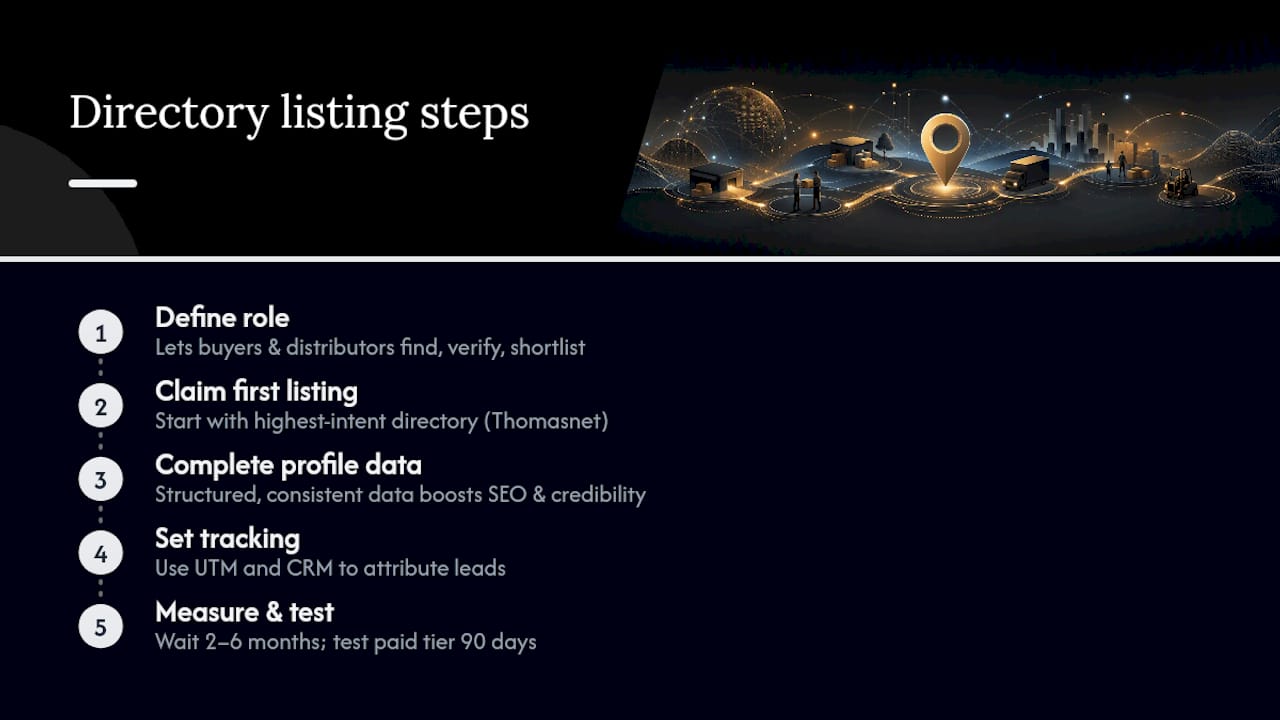
Is a paid listing tier worth the cost over a free profile? It depends on profile depth and traffic transparency. A subscription tier that unlocks certification fields, downloads, and better placement is often worth testing for 90 days against your cost per qualified lead before committing longer term.