
Local business marketing is the targeted process of attracting nearby customers through optimized search presence, reputation signals, and location-based advertising. Known in the industry as local marketing or proximity marketing, this discipline differs from broad digital marketing because it prioritizes relevance, proximity, and familiarity over reach. For a nail salon in Austin or a plumbing company in Denver, the goal is not to go viral. The goal is to appear when someone two miles away searches for exactly what you offer, and to give them enough trust signals to call you instead of a competitor.
What are the core components of local business marketing?
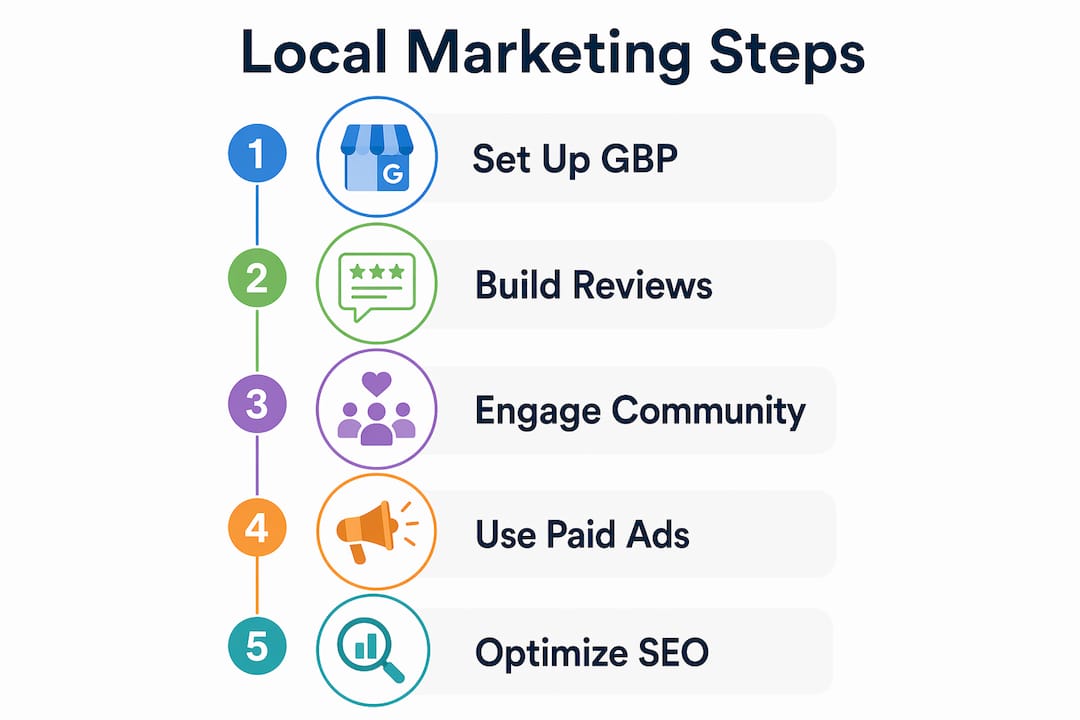
Local business marketing explained at its most practical level comes down to four interconnected pillars. Each one builds on the previous, and skipping ahead creates expensive gaps. Local business marketing focuses on attracting nearby customers via local search, reviews, location-based ads, and social presence. That means every tactic you run should serve at least one of these four areas:
- Google Business Profile and local SEO. Your Google Business Profile (GBP) is the single most visible asset you control in local search. It powers your appearance in Google Maps, the local 3-pack, and voice search results. Without a complete, accurate, and regularly updated profile, every other tactic underperforms.
- Review management. Reviews are both a trust signal for customers and a ranking signal for Google. Volume, recency, and response rate all factor into how prominently your business appears in local results.
- Local partnerships and referrals. Relationships with complementary businesses, neighborhood associations, and community groups create compounding word-of-mouth that no ad budget can replicate. A florist partnering with a wedding venue, or a gym cross-promoting with a nutrition store, generates warm leads at near-zero cost.
- Paid advertising. Google Local Services Ads (LSAs) and hyperlocal social campaigns amplify your organic foundation. They work best after the first three pillars are in place, not before.
The sequence matters. Building GBP, reviews, and partnerships first reduces paid advertising friction and lowers your cost per lead over time. Think of paid ads as fuel, not the engine.
How does Google Business Profile and local SEO drive local visibility?
Google Business Profile is the foundation of effective local advertising because it directly controls your placement in the local 3-pack, the three-business cluster that appears above organic results for most local searches. Businesses in the 3-pack capture the majority of clicks for high-intent queries like "electrician near me" or "best coffee shop in [neighborhood]." Getting there requires more than just claiming your profile.
Here is a practical sequence for optimizing your GBP and local SEO:
- Complete every profile field. Business name, address, phone number, website, hours, and service areas must be accurate and consistent across every platform. Inconsistencies confuse Google and reduce your ranking confidence.
- Select precise categories. Your primary category is the most influential ranking factor in GBP. A general contractor who also does roofing should list "General Contractor" as primary and "Roofing Contractor" as secondary, not the reverse.
- Add services and products. Google uses this data to match your profile to specific search queries. A salon that lists "gel manicure," "acrylic nails," and "eyebrow waxing" as services will rank for those terms independently.
- Publish weekly posts. GBP posts signal active management and give Google fresh content to index. Promotions, events, and new service announcements all qualify.
- Build local citations. Consistent listings on Yelp, Bing Places, Apple Maps, and industry directories reinforce your location signals and improve organic ranking.
Local marketing content should be location-aware and useful for local decisions rather than generic educational posts. A plumber in Chicago writing about "common pipe problems in older Lincoln Park homes" will outperform one writing about "how pipes work" every time.
Pro Tip: Add at least 10 high-quality photos to your GBP, including your storefront, interior, team, and finished work. Profiles with photos receive significantly more direction requests and website clicks than those without.

How reviews and reputation management build trust and increase conversions
Reviews are not just social proof. They are a direct ranking input for Google's local algorithm, and review volume, velocity, and recency all function as ranking signals. A business with 200 reviews averaging 4.6 stars will consistently outrank a competitor with 20 reviews averaging 4.9 stars. Recency matters too. A flood of reviews from two years ago carries less weight than a steady stream of new ones.
Practical strategies for building your review engine include:
- Ask at the right moment. The best time to request a review is immediately after a positive service interaction, before the customer leaves your location or closes the service call. Timing is everything.
- Use a direct link. Send customers a shortened Google review link via text or email. Removing friction from the process increases completion rates dramatically.
- Respond to every review. Responding to both positive and negative reviews signals active engagement to Google and shows prospective customers that you take feedback seriously. A thoughtful response to a 2-star review often converts skeptical readers more effectively than five 5-star reviews.
- Automate the follow-up. Review management platforms like Birdeye, Podium, and NiceJob automate review request sequences via SMS and email, removing the burden of manual outreach.
Pro Tip: When responding to negative reviews, acknowledge the issue specifically, offer a resolution, and invite the customer to contact you directly. Never argue publicly. Prospective customers read your response more carefully than the original complaint.
The connection between reviews and Google Local Services Ads performance is direct. Neglecting your GBP and review engine makes paid campaigns more expensive because weaker trust signals reduce your ad quality score and increase your cost per lead.
What role do paid ads play in local marketing?
Google Local Services Ads and hyperlocal social campaigns serve different functions, and understanding the distinction prevents wasted budget. The table below compares the two primary paid channels for local businesses.
| Feature | Google Local Services Ads | Hyperlocal Social Ads |
|---|---|---|
| Billing model | Pay per lead contacted | Pay per click or impression |
| Average cost | $60 per lead vs. $70 for traditional search | Varies by platform and targeting radius |
| Trust signal | Google Verified badge displayed | No platform verification badge |
| Best use case | High-intent service queries | Awareness and retargeting in a defined radius |
| Geographic targeting | Service area and zip code | GPS radius, neighborhood, or geofence |
| Conversion readiness | Requires fast lead response | Requires strong landing page or offer |
Google LSAs operate on a pay-per-lead model, meaning you pay only when a customer contacts you directly through the ad. The Google Verified badge displayed on LSAs functions as a trust signal that increases click-through rates for service businesses like HVAC companies, locksmiths, and law firms. LSA success depends heavily on operational readiness. Swift, accurate lead responses and proper geographic and service matching are part of effective ad management, not just placement.
Hyperlocal campaigns on platforms like Meta and Google Display use GPS data, social media geotags, and neighborhood-level audience filters to reach people within a specific radius. Hyperlocal marketing drives higher click-through rates, store visits, and conversions than broader campaigns because the message matches the immediate context of the viewer. A restaurant promoting a lunch special to people within a half-mile radius at 11:30 AM is a textbook hyperlocal execution. You can explore digital advertising examples that show how local businesses apply these tactics across different industries.
How to build a compounding local marketing system
A compounding local marketing system produces results that grow over time rather than stopping when your ad spend stops. The local marketing flywheel builds GBP, a review engine, and partnerships first, then layers paid ads on top for amplification. Here is how to execute that framework:
- Set one primary goal. Define whether you are focused on phone calls, bookings, walk-ins, or form submissions. Trying to optimize for all four simultaneously dilutes your measurement and your message.
- Map the local customer journey. Identify where your customers discover you (Google search, referral, social media), how they evaluate you (reviews, website, GBP photos), and what triggers their decision to contact you (offer, proximity, trust). Each stage needs a specific tactic.
- Establish your organic foundation first. Complete your GBP, build 20 or more reviews, and create locally optimized landing pages before running any paid campaigns. This sequence reduces your cost per lead significantly.
- Build a localized content calendar. Publish neighborhood-relevant posts on GBP, Instagram, and your blog on a consistent schedule. Content that answers specific local questions, such as "best time to service your HVAC in Phoenix summers," ranks for long-tail local queries and builds topical authority.
- Layer in paid ads. Once your organic foundation is solid, activate Google LSAs for high-intent service queries and run hyperlocal social ads for awareness and retargeting. Hyperlocal campaigns work best when GBP, location-based pages, reviews, and social geotags are synchronized.
- Track leads, not just traffic. Monitor call volume, booking completions, and form submissions. Web traffic is a vanity metric without conversion data attached. Use Google Business Profile Insights, call tracking tools like CallRail, and UTM parameters to attribute leads accurately.
For a broader view of how these tactics fit into a growth plan, the SMB marketing strategies guide covers additional frameworks relevant to local business owners in 2026.
Key takeaways
Local business marketing works because it aligns your digital presence, reputation, and advertising with the exact moment a nearby customer is ready to buy.
| Point | Details |
|---|---|
| GBP is the foundation | A complete, accurate Google Business Profile is the highest-leverage asset in local search. |
| Reviews compound over time | Consistent review volume and recency outperform a high rating with few recent reviews. |
| Sequence your investment | Build organic signals before paid ads to reduce cost per lead and improve ad performance. |
| Hyperlocal beats broad | GPS-targeted and neighborhood-level ads drive higher conversions than city-wide campaigns. |
| Track leads, not traffic | Measure calls, bookings, and form submissions to understand real marketing ROI. |
Why most local businesses are leaving money on the table
Most local businesses I work with have decent service and a loyal base. What they lack is visibility at the exact moment a new customer is searching. That gap is almost always traceable to the same three problems: an incomplete Google Business Profile, fewer than 15 reviews, and no consistent content presence.
The businesses that grow fastest are not the ones with the biggest ad budgets. They are the ones that built their organic foundation first and then used paid ads to accelerate what was already working. I have seen a salon go from 8 reviews to 140 in four months simply by texting a review link to every client after their appointment. Their Google Maps ranking moved from page two to the 3-pack without a single dollar in paid spend.
Voice search and "near me" queries are reshaping local search behavior in 2026. Queries like "best plumber open now near me" are answered by Google's local algorithm, which weighs GBP completeness, review recency, and proximity simultaneously. Businesses that build content around local neighborhood questions and service-area intent are the ones capturing those queries.
My honest advice: stop running ads until your GBP has at least 30 reviews and your website has a locally optimized service page. The ads will cost less and convert better once that foundation is in place. Monitoring leads rather than impressions is what separates businesses that grow from those that just spend.
— Tran
How Sourcesnova helps you build local visibility that lasts
Sourcesnova was built specifically for local and small-to-mid-size businesses that want real growth without the jargon. If you have read this far and recognize the gaps in your current local marketing, the next step is straightforward.
Sourcesnova provides hands-on support for Google Business Profile optimization, review management, local SEO, and paid ad strategy. The team handles execution so you can focus on running your business. No bloated retainers, no vanity reports. Just clear strategy and measurable results. Whether you are a service business, a retail shop, or a salon, Sourcesnova builds the compounding local marketing system that keeps your phone ringing. Start building your local presence with a team that treats your business like their own.
FAQ
What is local business marketing?
Local business marketing is the practice of promoting a business to attract customers within a specific geographic area through local search, reviews, location-based ads, and community presence. It prioritizes proximity and relevance over broad reach.
How does Google Business Profile help local businesses?
Google Business Profile controls your placement in Google Maps and the local 3-pack, which captures the majority of clicks for high-intent local searches. A complete, accurate profile with regular posts and steady reviews is the highest-leverage asset in local search.
What are Google Local Services Ads?
Google Local Services Ads are a pay-per-lead ad format that charges businesses only when a customer contacts them directly through the ad. They display a Google Verified badge and average about $60 per lead, making them cost-efficient for service businesses.
How many reviews does a local business need to rank well?
Review volume, recency, and response rate all influence local rankings. A business with consistent new reviews each month will outperform one with a higher average rating but stagnant review activity.
What is hyperlocal marketing?
Hyperlocal marketing targets customers within a very small geographic area using GPS data, geo-targeted ads, and social media location filters. It drives higher conversion rates than broader campaigns because the message matches the viewer's immediate location and intent.