
1688.com is Alibaba Group's Chinese domestic B2B wholesale marketplace, built for buyers inside mainland China. U.S. importers can access it, but only by working around a Mandarin-only interface, CNY pricing, local payment methods, and the absence of built-in international shipping.
Here is what that means in practice:
- What it is: A domestic wholesale platform owned by Alibaba Group, founded in 1999, with over one million paying members as of fiscal year 2024 — not an export marketplace.
- Why U.S. buyers care: Factory-level prices that commonly run 30–50% lower than comparable Alibaba.com listings because export overheads are stripped out.
- What you need to work around: Alipay and domestic bank transfers as the default payment methods, no official English interface, and suppliers who typically do not handle export documentation.
- Your realistic routes: Hire a China-based sourcing agent, use a freight forwarder for consolidation, or work with a multi-currency payment service like WorldFirst.
- Who benefits most: Small businesses and importers ordering at moderate-to-high volume who can manage logistics complexity or delegate it to a qualified partner like Sourcesnova.
Table of Contents
- What is 1688 and how does it fit into China's sourcing ecosystem?
- How does 1688 compare to Alibaba.com and Taobao?
- Can a U.S. buyer actually order from 1688 and ship to the United States?
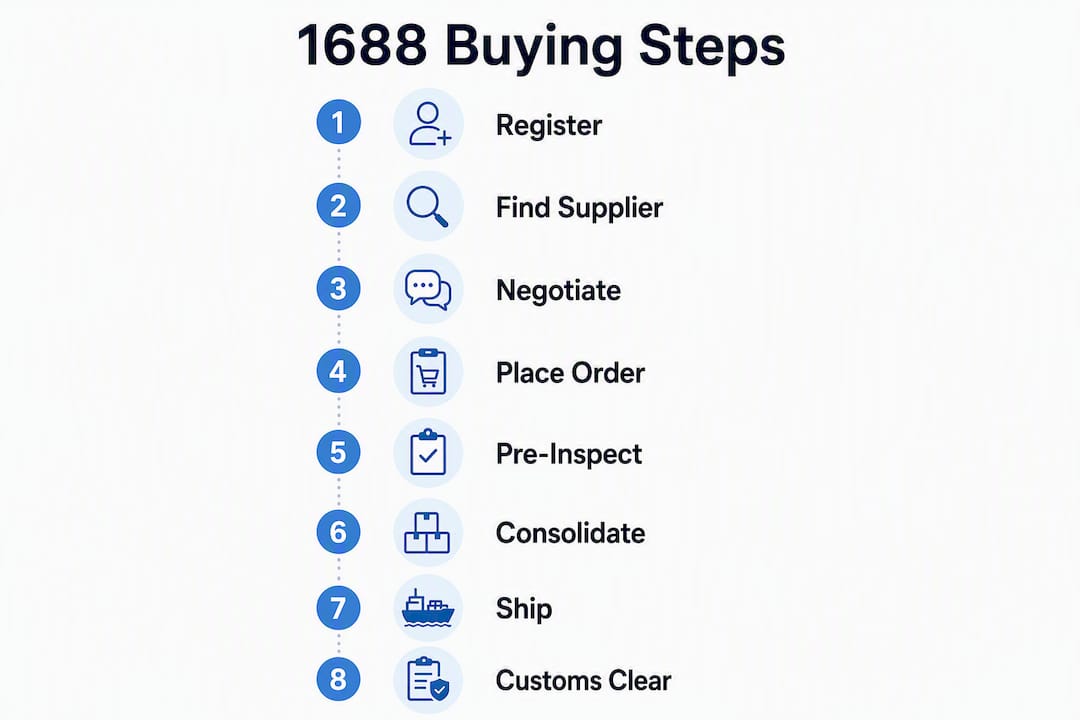
- How to buy from 1688 step by step as a U.S. importer
- What to expect on price, MOQs, and lead times
- Common risks when sourcing from 1688 and how to reduce them
- Tools and intermediaries U.S. importers should consider
- How Sourcesnova advises U.S. small businesses on sourcing from 1688
- Key Takeaways
- The real opportunity on 1688 is in the preparation, not the platform
- Sourcesnova helps U.S. importers source smarter from China
- Authoritative resources to learn more
What is 1688 and how does it fit into China's sourcing ecosystem?
1688.com is Alibaba Group's domestic wholesale platform, founded in 1999 with a single purpose: connecting Chinese manufacturers, factories, and distributors with domestic resellers and retailers. It was never designed for cross-border trade. That origin explains almost everything about how it works and why it looks the way it does.
Sellers on 1688 are primarily Chinese manufacturers and trading companies pricing for local buyers. Because they are not building in English support, export compliance, or international logistics, their unit prices reflect actual factory economics. That is the core reason prices tend to be lower than on export-facing platforms.
The platform spans over 1,700 product categories. For U.S. importers, the most commercially relevant include:
- Electronics components and accessories (cables, PCBs, LED modules, phone accessories)
- Textiles and apparel (fabrics, cut-and-sew garments, accessories)
- Packaging materials (custom boxes, poly bags, labels, tape)
- Consumer goods and home products (kitchenware, storage, décor)
- Beauty accessories (brushes, tools, salon supplies)
- Industrial and hardware supplies (fasteners, tools, safety equipment)
Many products sold on Amazon, regional e-commerce platforms, and local marketplaces worldwide originate from 1688 listings. Resellers in South Asia, Southeast Asia, and increasingly North America use 1688 as their primary sourcing origin, then sell through export-ready channels. Understanding that supply chain dynamic is what makes 1688 worth the operational complexity for a U.S. small business.
How does 1688 compare to Alibaba.com and Taobao?
The three platforms share Alibaba Group ownership but serve fundamentally different buyers. Choosing the wrong one costs money and time.
| Dimension | 1688.com | Alibaba.com | Taobao |
|---|---|---|---|
| Target market | Chinese domestic wholesale | Global export buyers | Chinese domestic retail |
| Language/interface | Simplified Chinese only | English + multilingual | Simplified Chinese |
| Typical pricing | Factory-level; 30–50% lower than Alibaba.com for comparable items | Export-priced; includes service and compliance overhead | Retail/consumer pricing |
| Payment methods | Alipay, domestic bank transfer | Credit card, wire transfer, Trade Assurance | Alipay |
| Export/logistics support | None built in; buyer arranges | Integrated; many suppliers ship internationally | None; domestic delivery only |
| Typical MOQ | Wholesale minimums; varies by category | Negotiable; often lower for export buyers | Single unit to small quantities |
| Buyer protections | Domestic Chinese dispute process | Trade Assurance with cross-border coverage | Alipay escrow (domestic) |
The decision rule is straightforward. Use 1688 when your priority is the lowest possible unit cost and you can manage payment and logistics through an agent or forwarder. Use Alibaba.com when you need export-ready suppliers, English communication, and Trade Assurance coverage. Use Taobao for small-quantity consumer purchases or product research.
One nuance worth knowing: many suppliers list on both 1688 and Alibaba.com simultaneously, but at different prices and with different service levels. The same factory may quote $4.20 per unit on Alibaba.com and the equivalent of $2.80 on 1688 for the same SKU, because the Alibaba.com price absorbs export support costs. Alibaba.com is export-focused with English support and integrated cross-border logistics, while 1688 is optimized for domestic cost-efficiency — that gap is structural, not negotiable.
Can a U.S. buyer actually order from 1688 and ship to the United States?
Yes, but not directly. 1688 runs entirely in Simplified Chinese, prices in CNY, and defaults to Alipay and domestic bank transfers — none of which a U.S. buyer can access without workarounds. Most sellers also do not offer export services or international shipping, so the buyer must arrange export documentation and freight independently.
Three routes work in practice:
- Hire a China-based sourcing agent. The agent buys on your behalf using their Alipay account and Chinese banking, inspects goods, consolidates shipments, and arranges export. This is the most common and lowest-risk route for first-time 1688 buyers.
- Use a freight forwarder with a China warehouse. You identify the supplier and negotiate terms, the forwarder receives goods at their China address, handles export documentation, and ships internationally. This works well when you have a supplier willing to communicate in basic English and accept payment via wire transfer.
- Work with a third-party buying/shopping service. Platforms designed for international buyers act as intermediaries, purchasing from 1688 on your behalf and consolidating multiple orders before shipping. Fees vary; inspect their terms carefully.
Payment workarounds are the most common friction point. Multi-currency business accounts from services like WorldFirst let you hold CNY and make local payments, which some suppliers will accept. Alternatively, paying your sourcing agent in USD and letting them handle the CNY transaction is the simplest path for most small businesses.
Registration hurdles are real but manageable. A Chinese phone number is required for standard registration, though some buyers log in using a linked Taobao or Alibaba account. The interface offers no official English translation, so browser-based auto-translation (Google Chrome's built-in tool) is the practical workaround for navigation.
Pro Tip: Before committing to a supplier, run a reverse-image search on their product photos. This quickly reveals whether the images are original factory shots or recycled from other listings, which is one of the fastest ways to identify trading companies posing as manufacturers.
Logistics reality: expect to coordinate customs, export declarations, and international freight yourself or through your agent. Most 1688 sellers will not handle export documentation, and assuming otherwise is one of the most common and costly mistakes first-time importers make.
How to buy from 1688 step by step as a U.S. importer
The process below assumes you are working with a sourcing agent or freight forwarder, which is the practical standard for U.S. small businesses.

Step 1: Search and supplier discovery. Use Chinese keywords rather than English search terms — Google Translate can generate the Mandarin equivalent of your product description. Combine keyword search with reverse-image search to trace whether a listing originates from a factory or a reseller. Cross-check the same supplier on Alibaba.com to compare pricing and verify they are a real manufacturer.
Step 2: Qualify the supplier. Before placing any order, request the following in writing (your agent can send this in Mandarin):
- Business license number and years in operation
- Factory photos (production floor, not just product shots)
- MOQ and unit price at your target quantity
- Lead time from order confirmation to ready-to-ship
- Export history, if any
A short message template your agent can adapt: "您好,我们是美国进口商,对贵公司的产品感兴趣。请提供营业执照、工厂照片、最小起订量和报价单。谢谢。" (Hello, we are a U.S. importer interested in your products. Please provide your business license, factory photos, minimum order quantity, and price list. Thank you.)
Step 3: Order samples. Always sample before committing to a production run. Define your acceptance criteria in writing before the sample ships: dimensions, materials, color tolerances, and packaging. Pay the sample fee and domestic China shipping via your agent.
Step 4: Negotiate terms and confirm the pro forma invoice. Request a pro forma invoice in CNY with itemized unit cost, tooling fees if applicable, and payment terms. Confirm bank details through a second channel (phone or video call) before transferring any funds to avoid payment fraud.
Sourcing professionals consistently flag payment fraud as the highest-risk moment in a 1688 transaction. Always verify bank account details through a second, independent channel before any wire transfer. A single confirmation email is not enough.
Step 5: Arrange pre-shipment inspection. For orders above a threshold your business can define (many importers use $1,500–$2,000 as a floor), hire a third-party inspection service to check goods before they leave the factory. This is your last practical opportunity to reject substandard product before it ships internationally.
Step 6: Consolidate and book international freight. Your agent or freight forwarder collects goods, handles export documentation, and books the international shipment. Compare FOB (you control freight from the Chinese port) and CIF (supplier or agent includes freight and insurance) arrangements based on your volume and risk preference.
Step 7: Clear U.S. customs. File an ISF (Importer Security Filing) at least 24 hours before vessel departure. Work with a licensed U.S. customs broker for commercial shipments. Confirm HS codes and applicable duty rates before the goods ship, not after.
What to expect on price, MOQs, and lead times
Understanding your full landed cost before placing an order is the difference between a profitable import and a costly lesson.
Price structure. 1688 lists prices in CNY. Convert to USD using the current exchange rate and add your FX service fee (typically 0.5–1.5% for a business account like WorldFirst). The factory unit price on 1688 is your starting point, not your total cost.
MOQ patterns. Most 1688 listings carry wholesale MOQs calibrated for domestic resellers. In practice:
| Category | Typical MOQ range | Sample order availability |
|---|---|---|
| Apparel/textiles | 50–200 pieces per style | Usually yes, at a premium |
| Electronics accessories | — | Sometimes; depends on tooling |
| Packaging materials | 500–1,000 units | Rarely; minimums are high |
| Consumer goods/home | 50 units | Often yes |
| Beauty accessories | — | Usually yes |
Lead time components. A realistic timeline for a small-batch order (under 500 units):
| Stage | Typical duration |
|---|---|
| Supplier confirmation and production | 7–15 business days |
| Domestic China transit to forwarder | 2–5 business days |
| Consolidation and export documentation | 3–7 business days |
| International ocean freight (China to U.S. West Coast) | 14–20 days |
| U.S. customs clearance and final delivery | 3–7 business days |
| Total estimated timeline | 29–45 business days |
Landed cost example. For a sample scenario: 200 units of a consumer accessory at CNY 35/unit ($4.80 USD at current rates), plus a $50 sample fee, $120 third-party inspection, $80 domestic China freight, $350 international ocean freight, and 7.5% import duty on a $960 declared value ($72). Estimated total landed cost: approximately $1,672, or roughly $8.36 per unit. That compares to a hypothetical Alibaba.com listing of $7.50 per unit with no inspection and no agent fee — but with Trade Assurance and English support included. The math shifts significantly at higher volumes.
Common risks when sourcing from 1688 and how to reduce them
1688 is a legitimate platform used daily by millions of Chinese businesses. Legitimacy does not eliminate risk for foreign buyers; it just means the platform itself is real. The risks are operational and structural.
Top supplier risks:
- Inaccurate or misleading product listings (photos from other factories, incorrect specifications)
- Counterfeit or substandard goods, particularly in electronics and branded-adjacent categories
- Suppliers with no export experience who cannot provide compliant documentation
- Fake or expired business licenses
Red flags to watch for:
- Unit prices significantly below every comparable listing without a verifiable factory explanation
- Refusal to provide a business license number or years in operation
- Pressure to pay outside the platform or via personal accounts
- Inconsistent lead times across different conversations
- Product photos that reverse-image search traces back to multiple unrelated sellers
Mitigation checklist:
- Verify the supplier's business license on China's National Enterprise Credit Information Publicity System (gsxt.gov.cn) — the official government registry.
- Request on-site factory photos and a short video of the production floor.
- Order and physically inspect samples before any production run.
- Use a third-party pre-shipment inspection service for all orders above your risk threshold.
- Confirm bank details through a second channel before every payment.
- Prefer suppliers with documented export history, even on 1688.
Buyer protection gap. 1688 does not offer an international Trade Assurance equivalent. Dispute resolution is conducted in Chinese and oriented toward domestic business norms. Because 1688 lacks international trade guardrails, experts recommend an intermediary for overseas buyers who don't have in-market sourcing capability. Escrow through your sourcing agent, payment via a reputable FX service, and pre-shipment inspection are the practical substitutes for the protections you lose compared with Alibaba.com's Trade Assurance.
Tools and intermediaries U.S. importers should consider
Getting 1688 to work for a U.S. business is largely a question of assembling the right support structure. No single tool solves everything; the combination matters.
China-based sourcing agents
A qualified sourcing agent handles supplier communication in Mandarin, verifies business licenses, negotiates pricing, pays via Alipay, and coordinates domestic logistics. Look for agents with transparent fee structures (flat fee or percentage of order value, clearly stated), English-language reporting, and verifiable references from U.S. clients. Common practical workarounds for international buyers include hiring China-based sourcing agents and using freight forwarders for consolidation..
Freight forwarders with China consolidation
A freight forwarder with a China warehouse address receives goods from multiple 1688 suppliers, consolidates them into a single international shipment, and handles export documentation. For product sourcing strategies that involve multiple SKUs or suppliers, consolidation typically reduces per-unit shipping costs substantially.
Payment and FX services
WorldFirst is a multi-currency business account that lets you hold CNY and make local payments to Chinese suppliers, reducing FX friction and transaction costs compared with standard international wire transfers. This is particularly useful when working directly with a supplier rather than through an agent.
Pre-shipment inspection services
Third-party inspection firms send inspectors to the factory before goods ship. For regulated categories (children's products, electronics, personal care items), combine inspection with laboratory testing against applicable U.S. standards (CPSC, FCC, FDA depending on category).
Browser and software tools
Sourcing professionals recommend browser auto-translation and reverse-image searches as baseline tools for navigating 1688. Google Chrome's built-in translation handles the interface adequately for navigation. For supplier verification, gsxt.gov.cn provides official Chinese business registry data. Landed-cost calculators (spreadsheet-based or purpose-built) are worth building before your first order to model total cost at different volumes.
When to use paid help vs. DIY: If your order value is below $1,000 and the product category is low-risk (non-regulated, non-electrical), a DIY approach with browser translation and a freight forwarder is feasible. Above $2,000, or for any regulated category, the cost of an agent and inspection is almost always recovered in avoided mistakes.
How Sourcesnova advises U.S. small businesses on sourcing from 1688
Sourcesnova works with U.S. small businesses and Asian manufacturers entering the North American market, and 1688 sourcing sits at the intersection of both. The practical checklist Sourcesnova applies when helping clients source from 1688:
- Supplier verification: Cross-reference business license on gsxt.gov.cn, confirm years in operation, and request factory documentation before any commercial discussion.
- Sample program: Define acceptance criteria in writing, order samples through a qualified agent, and document results before approving production.
- Inspection plan: Set an order-value threshold for mandatory pre-shipment inspection and identify a qualified third-party inspector for the relevant product category.
- Freight and customs plan: Confirm HS codes, applicable duty rates, and ISF filing requirements before goods ship.
- Landed-cost modeling: Build a per-unit cost model that includes FX, agent fees, inspection, freight, duties, and last-mile delivery before committing to a production order.
- U.S. go-to-market support: Once goods arrive, Sourcesnova supports B2B lead generation and market entry so the sourcing investment translates into actual revenue.
Sourcesnova is a full-service digital growth agency focused on helping local and small-to-mid-size businesses improve their online presence and grow. The firm was founded to address frustrations with ineffective marketing agencies by providing clear strategy and hands-on execution without bloated retainers or vanity reports. Sourcesnova serves clients across diverse industries including beauty and nail salons, lighting, retail, e-commerce, and service businesses, emphasizing treating each client's business like their own.
For a client who wants help buying from 1688, a typical Sourcesnova engagement covers vendor discovery and qualification, negotiation support, inspection and consolidation management, U.S. customs preparation, and go-to-market execution once goods land.
Key Takeaways
1688 is Alibaba Group's domestic Chinese wholesale marketplace where U.S. importers can access factory-level prices, but only by using sourcing agents, freight forwarders, and payment workarounds to bridge the language, currency, and logistics gaps.
| Point | Details |
|---|---|
| What 1688 is | Alibaba Group's domestic B2B wholesale platform, founded 1999, with over one million paying members as of fiscal year 2024. |
| Price advantage | Factory-level prices commonly run 30–50% lower than comparable Alibaba.com listings because export overheads are excluded. |
| How U.S. buyers access it | Via China-based sourcing agents, freight forwarders, or multi-currency payment services like WorldFirst. |
| Top risk to manage | No international Trade Assurance equivalent; mitigate with pre-shipment inspection, business license verification, and escrow through a trusted agent. |
| Sourcesnova's role | Sourcesnova provides end-to-end sourcing support, from supplier qualification and inspection to landed-cost modeling and U.S. market entry. |
The real opportunity on 1688 is in the preparation, not the platform
Most articles about 1688 frame it as a discovery problem: find the platform, figure out the interface, and the savings follow. That framing misses the actual challenge. The platform is accessible. The preparation is where most U.S. importers fall short.
The businesses that benefit most from 1688 are not necessarily the ones with the most sourcing experience. They are the ones who treat the first order as a structured test: defined acceptance criteria, a sample before production, an inspection before shipment, and a landed-cost model built before any money moves. The price gap between 1688 and export-facing platforms is real, but it evaporates quickly when a shipment fails inspection, a supplier disappears after payment, or a product arrives non-compliant with U.S. standards.
There is also a strategic point worth making directly. 1688 is most valuable as a price benchmark and a factory-identification tool, even for buyers who ultimately place production orders through Alibaba.com or a direct factory relationship. Knowing what a product costs at the domestic Chinese wholesale level gives you a negotiating reference point that most importers never have.
The caution worth stating plainly: 1688 is not a shortcut. It is a lower-cost channel that requires more operational discipline, not less. For businesses with the volume to justify the complexity, the savings are genuine. For businesses ordering below a few thousand dollars per SKU, the agent fees, inspection costs, and logistics overhead may narrow the advantage considerably. The math is worth doing before the first order, not after.
Sourcesnova helps U.S. importers source smarter from China
Sourcing from 1688 delivers real cost advantages, but the operational complexity is where most small businesses lose time and money. Sourcesnova offers a direct alternative to figuring it out alone.
Sourcesnova's B2B sourcing services cover the full process: supplier discovery and qualification, sample and inspection management, freight forwarding coordination, landed-cost modeling, and U.S. go-to-market support. Whether you need a one-off sourcing evaluation for a new product category, a monthly retainer for ongoing supplier management, or a full market entry package for a brand scaling to North America, Sourcesnova structures the engagement around your actual scope, not a bloated retainer.
No vanity reports, no jargon. Clear strategy and hands-on execution from a team that treats your sourcing budget like their own. To discuss your sourcing needs or request a consultation, visit sourcesnova.com.
Authoritative resources to learn more
The sources below are organized by what they are most useful for:
Platform facts (ownership, scale, structure):
- Alibaba Group: 1688 business overview — official ownership and platform history from Alibaba Group directly.
Practical how-to (agents, payments, buying process):
- WorldFirst: Buying from 1688 without knowing Chinese — practical guide covering payment workarounds and navigation for non-Chinese speakers.
- WorldFirst: The complete guide to buying from 1688 outside China — covers supplier categories, payment options, and international buyer strategies.
- MuleBuy: What is 1688 — a complete guide — explains logistics limitations and why export documentation must be arranged independently.
Safety checks (inspections, legitimacy, dispute notes):
- ChineseCheck: Is 1688 legit? The complete guide for international buyers — covers buyer protection gaps, red flags, and legitimacy assessment for foreign buyers.
Sourcing strategy and market entry support:
- Sourcesnova B2B sourcing services — end-to-end sourcing support for U.S. importers, from supplier qualification to U.S. market entry.