
If you are an Asian manufacturer or consumer brand preparing to sell through U.S. distributors and wholesale buyers, a custom website is the right infrastructure choice — provided you have distributor traction to validate or are ready to scale beyond initial conversations. A custom build gives you precise control over Core Web Vitals performance, buyer-specific UX flows, and security architecture aligned with OWASP Top 10 standards, all of which directly affect whether a U.S. procurement team trusts you enough to place a first order. Sourcesnova recommends custom builds for brands at the scale-ready stage; if you are still validating product-market fit, a well-configured template is the smarter first step.
At a glance:
- Custom websites deliver 20–40% higher conversion rates compared with template-based sites
- Clean code enables Core Web Vitals scores that improve search visibility and buyer trust
- Direct API integrations with ERP, CRM, and tax engines are critical for accurate RFQ management
- Security is easier to design in from the start than to retrofit through plugins
- Sourcesnova provides audits, scoped builds, and North American market entry support
Table of Contents
- Why custom websites outperform templates for wholesale buyers
- Must-have features for a B2B wholesale custom site
- What does a custom wholesale site actually cost?
- Custom website vs. template: how to decide right now
- How to plan and run your custom website build
- Technical integrations, security, and compliance you need to plan for
- How to measure ROI from your custom wholesale site
- Common mistakes and red flags to avoid
- Key Takeaways
- The case for a staged, ROI-first approach
- Sourcesnova can scope and build your wholesale platform
- Useful sources
Why custom websites outperform templates for wholesale buyers
The benefits of custom websites are most visible where wholesale conversion actually happens: on the RFQ form, the product catalog page, and the buyer account portal. Custom builds commonly show 20–40% higher conversion rates and measurable Core Web Vitals improvements compared with templates, and that gap compounds when your buyers are U.S. procurement managers who will leave a slow or confusing site without requesting a quote.
Speed matters more than most manufacturers expect. Industry studies connect a 0.1-second mobile speed gain with double-digit percentage lifts in conversions in retail-like categories — and wholesale product pages behave similarly when buyers are comparing suppliers.
Brand differentiation is the second lever. A distributor evaluating five overseas suppliers in one afternoon will remember the one whose site showed tiered pricing, net terms, and a clean RFQ path. A template cannot replicate that without visible workarounds that undercut credibility.
Two practical examples:
- RFQ automation: A lighting manufacturer configures a custom quote request flow that pre-populates SKU quantities, MOQs, and lead times. The buyer submits in under two minutes; the sales team receives a structured lead rather than a vague inquiry email.
- Distributor onboarding: A consumer brand builds a buyer account portal where approved distributors log in to see their contracted pricing, download compliance documents, and reorder without calling a sales rep.
Custom code also makes implementing Schema.org markup, clean URL structures, and server-side rendering straightforward — advantages that template platforms routinely block or require paid plugins to approximate.
Must-have features for a B2B wholesale custom site
Scope your MVP around features that directly affect whether a buyer completes a transaction or submits an RFQ.
Must-have:
- Product catalog with configurable SKUs, variant attributes, and downloadable spec sheets
- Buyer accounts with net terms display, account-specific pricing, and order history
- RFQ/quote request flows with structured input fields (quantity, delivery date, destination)
- Purchase order upload and reference number support
- Tiered pricing logic (volume breaks, distributor tiers, private label pricing)
- Bulk order UI with CSV upload or quick-entry grid
Nice-to-have (Phase 2):
- Intelligent search with synonym handling and attribute filtering
- Personalized price visibility (logged-in buyers see their contracted rate)
- In-platform sample ordering with separate checkout logic
- Multi-currency display for Canadian buyers alongside USD pricing
UX patterns matter as much as features. Buyers expect a visible "Request a Quote" button on every product page, a one-click reorder from order history, and a checkout path that accepts purchase orders without forcing credit card entry.

What does a custom wholesale site actually cost?
| Build type | Typical cost range | Typical timeline |
|---|---|---|
| Standard custom B2B site (catalog + RFQ + buyer accounts) | — | 8–12 weeks |
| Mid-complexity with ERP/CRM integration | — | 12–20 weeks |
| Enterprise platform (multi-brand, multi-region) | $80,000+ | 20+ weeks |
| Ongoing maintenance and security monitoring | $500–$2,000/month | Ongoing |
AI-assisted development workflows have lowered delivery times and costs; a well-scoped standard project is often deliverable in 6–10 weeks at the lower price bands. What drives costs up: ERP or inventory management system integrations, PCI-DSS compliance for payment flows, WCAG 2.2 accessibility requirements, complex catalog logic with thousands of SKUs, and internationalization for Canadian French or Spanish-language buyers.
Custom builds cost more up front but remove recurring plugin fees and forced rebuild cycles, improving total cost of ownership over a 3–5 year horizon. For a brand processing $500K+ in annual wholesale orders, that math usually favors custom within two years.
Custom website vs. template: how to decide right now
Work through this decision in order:
- Business stage: Are you validating your first U.S. distributor relationships, or do you have confirmed accounts and growing order volume?
- Revenue threshold: Are annual wholesale revenues approaching or exceeding $250,000–$500,000 USD?
- Feature needs: Do you require ERP sync, buyer-specific pricing, or structured RFQ flows that a hosted platform cannot support cleanly?
- Timeline: Do you need a site live in under six weeks to support a trade show or distributor meeting?
Choose custom when:
- You are processing complex RFQs with multiple SKUs and custom terms
- You need real-time inventory or pricing sync with an ERP or inventory management system
- Distributor trust and brand credibility are active sales blockers
- You expect significant traffic growth within 12 months
Stay with a template when you are still validating product-market fit, need a site in weeks, or have limited traffic. A well-configured template is the smarter first step at that stage.
A practical example: a Taiwanese consumer electronics brand with two U.S. distributor conversations and no confirmed purchase orders should build a clean Shopify or WooCommerce store first. Once those distributors place repeat orders and referrals start arriving, the business case for a custom build with buyer portals and ERP integration becomes clear and fundable.
How to plan and run your custom website build
Follow this checklist from discovery to launch:
- Discovery and scope (weeks 1–2): Define buyer personas, map RFQ and order flows, document integration requirements, and agree on a feature priority list.
- Content and catalog preparation (weeks 2–3): Compile product data, SKU taxonomy, spec sheets, and compliance documents. This step is the most common source of delays.
- API mapping (weeks 3–4): Document all integration endpoints — ERP, CRM, payment gateway, tax engine, shipping provider.
- Design and development (weeks 4–8): Build to agreed specs with weekly milestone reviews.
- Compliance review (week 8): Audit for WCAG 2.2 accessibility, PCI scope, and data handling requirements.
- Staging and UAT (weeks 9–10): Buyer-flow testing, integration validation, and load testing.
- Launch and initial optimization (weeks 11–12): Go live, monitor Core Web Vitals, and address post-launch issues.
| Role | Responsibility |
|---|---|
| Internal owner (founder/ops) | Approves scope, provides product data, signs off on UAT |
| Project manager | Tracks milestones, manages agency communication |
| Developer/agency | Builds and integrates |
| QA specialist | Tests buyer flows, integrations, and edge cases |
| Marketing owner | Prepares copy, SEO structure, and launch plan |
Pro Tip: Prepare your full SKU taxonomy, product attributes, and pricing tiers in a structured spreadsheet before the build starts. Agencies that receive clean, complete product data consistently deliver faster and with fewer integration errors.
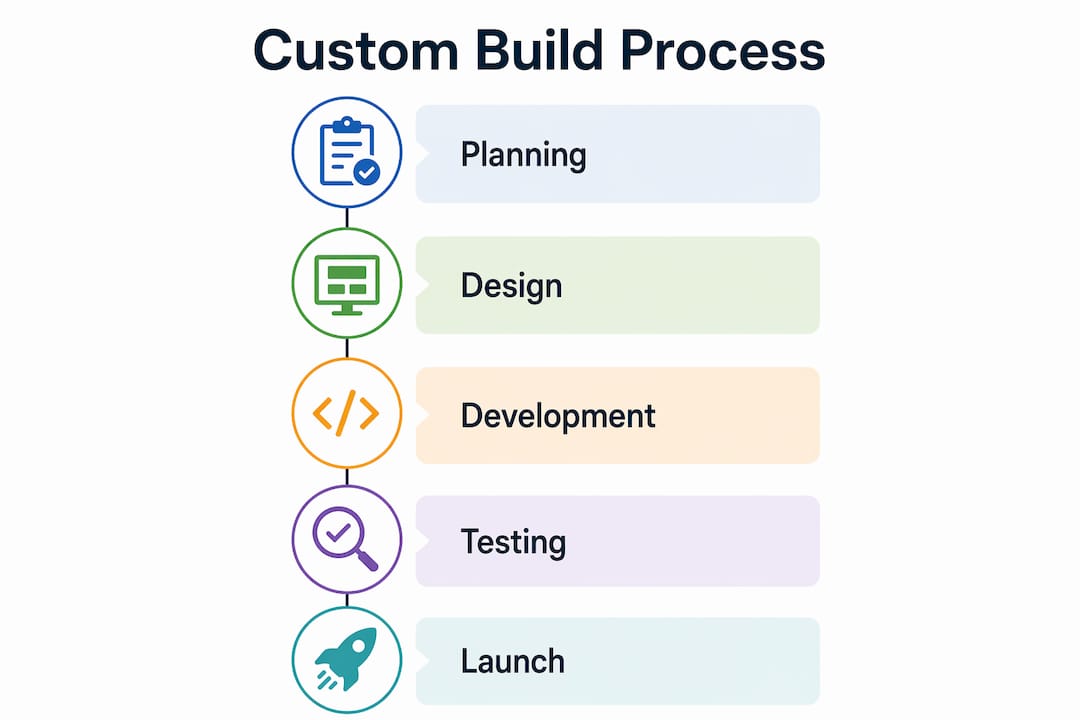
The website design process for a wholesale build follows this same logic: clarity up front reduces expensive rework later.
Technical integrations, security, and compliance you need to plan for
Core integrations to scope:
- ERP or inventory management system (real-time stock and pricing)
- CRM (lead capture from RFQ forms, closed-won attribution)
- Payment gateways supporting card and ACH (common for U.S. wholesale)
- Shipping and fulfillment providers with rate calculation
- Tax engine (Avalara or TaxJar for U.S. sales tax compliance)
- PIM or headless CMS for catalog management at scale
Custom architecture reduces exposure to abandoned third-party plugins and makes it easier to design against the OWASP Top 10 and meet PCI or accessibility requirements from the start. Retrofitting security onto a plugin-heavy template is consistently more expensive than building it in.
For SEO and AI discoverability, custom code allows clean implementation of Schema.org product and organization markup, structured URLs, and server-side rendering — all of which improve how search engines and AI citation tools index your catalog pages.
WCAG 2.2 accessibility compliance is increasingly expected by U.S. enterprise buyers and is a legal consideration under the Americans with Disabilities Act for public-facing sites. Budget it into the initial scope, not as an afterthought.
How to measure ROI from your custom wholesale site
Primary KPIs to track:
- Qualified RFQs per month (volume and quality)
- Quote-to-order conversion rate
- Average order value (AOV) by buyer segment
- Buyer acquisition cost (paid and organic channels)
- Lifetime value of distributor accounts
A straightforward payback calculation: if your current site generates 10 qualified RFQs per month at a 20% close rate and $8,000 AOV, that is $16,000 in monthly revenue. A conservative conversion lift from a custom build — say, moving from 20% to 25% close rate — adds $4,000 per month. Against a $30,000 build cost, payback arrives in roughly 7–8 months.
| Metric | Baseline (template) | Post-custom target | Impact |
|---|---|---|---|
| Monthly qualified RFQs | 10 | 16 | More pipeline |
| Quote-to-order rate | 20% | 25–30% | Higher close rate |
| Average order value | $8,000 | — | Larger orders |
| Payback period | — | 7–12 months | Justified investment |
Instrument your measurements with event tracking on RFQ form submissions, server logs for page performance, and CRM integration to track closed-won revenue back to specific traffic sources. Website design's effect on growth is measurable when you set up attribution correctly from day one.
Common mistakes and red flags to avoid
Frequent project mistakes:
- Vague scope: starting development without a documented feature list and integration map
- Missing product data: beginning the build before SKU taxonomy and pricing tiers are finalized
- Late integration discovery: treating ERP or tax engine connections as an afterthought
- Choosing speed over maintainability: accepting undocumented code to hit a deadline
Red-flag vendor behaviors:
- No documented build process or milestone schedule
- Inability to explain their API integration experience in concrete terms
- Unclear warranty, bug-fix, and post-launch maintenance terms
- Quoting a fixed price without a discovery phase
Questions to ask any vendor before signing:
- Can you show a previous B2B or wholesale site with buyer account functionality?
- How do you handle ERP or inventory system integrations — direct API or middleware?
- What is included in your post-launch warranty, and what triggers additional fees?
- Who owns the code and hosting infrastructure after delivery?
Ongoing maintenance costs are a common trap. Budget $500–$2,000 per month for hosting, security monitoring, and incremental feature work. Brands that skip this budget routinely face expensive emergency fixes 12–18 months after launch.
Key Takeaways
A custom website is the right investment for Asian manufacturers entering U.S. wholesale when annual revenues are approaching $250,000–$500,000, distributor trust is a sales blocker, and RFQ flows require ERP-level accuracy.
| Point | Details |
|---|---|
| Conversion advantage | Custom sites show 20–40% higher conversion rates than templates, directly affecting RFQ volume. |
| Cost and payback | Standard custom builds typically cost a mid-range amount; payback usually arrives within months with a conservative conversion lift. |
| Build readiness | Prepare your full SKU taxonomy and pricing tiers before development starts to reduce integration delays. |
| Template first | If you are still validating distributor relationships, a well-configured template is the smarter first step. |
| Sourcesnova | Sourcesnova provides scoped custom B2B builds, ERP/CRM integrations, and North American market entry support for manufacturers at the scale-ready stage. |
The case for a staged, ROI-first approach
Most manufacturers entering the U.S. wholesale market underestimate how much a website functions as a sales tool rather than a brochure. The brands that get the most from a custom build are not the ones with the largest budgets — they are the ones that arrive with clean product data, a clear picture of their buyer journey, and a willingness to build in phases.
The typical client profile Sourcesnova works with is a manufacturer that has had early distributor conversations, received informal interest, and now needs a platform that can handle structured RFQs, show account-specific pricing, and integrate with their existing inventory system. They do not need every feature on day one. They need an MVP that converts the buyers already in their pipeline, then a roadmap to add complexity as revenue justifies it.
The staged approach — MVP first, then iterate — reduces financial risk and produces faster payback. A $20,000 build that closes three additional distributor accounts in year one is a better outcome than an $80,000 platform that launches six months late and misses the trade show cycle. The goal is a site that earns its cost, not one that impresses at a board presentation.
Sourcesnova can scope and build your wholesale platform
Asian manufacturers entering the U.S. wholesale market need more than a website — they need a platform that converts distributor conversations into purchase orders. Sourcesnova builds custom B2B sites with RFQ flows, buyer account portals, and ERP/CRM integrations, and pairs each build with North American market entry support including distributor matching and wholesale SEO.
The process starts with a 90-minute site audit that maps your current digital presence against U.S. buyer expectations, identifies the highest-priority gaps, and produces a scoped feature list with ballpark costs. There are no long-term commitments required to get the audit. For brands ready to move faster, Sourcesnova offers fixed-scope build packages starting at the standard complexity tier, with transparent timelines and milestone-based delivery.
Request a site audit or scoped estimate to get a clear picture of what your wholesale platform needs and what it will cost to build it right.
Useful sources
- Bespoke Web Design: Why Custom Websites Outperform Templates in 2026 – Remery Blog: Covers conversion rate comparisons, Core Web Vitals evidence, speed-to-conversion correlations, and SEO/schema implementation advantages of custom builds. Check this source for the performance benchmarks cited in the benefits and ROI sections.
- Benefits Of Custom Web Design: 7 Reasons It Beats Templates – Boomdevs: Covers total cost of ownership over 3–5 years, ERP/CRM integration depth, security architecture, and when templates remain the right choice. Use this to validate cost assumptions and the decision framework.
- The Website Design Process for Business Owners – Sourcesnova Blog: Step-by-step process guidance aligned with the planning checklist in this article.
- How Website Design Drives Small Business Growth – Sourcesnova Blog: Connects design investment to measurable conversion and revenue outcomes — useful for building the internal business case.
- Why Custom Die-Cut Bags Elevate Brand Impact – Gatherpackaging: Packaging partner resource illustrating how custom physical branding reinforces the digital brand experience wholesale buyers encounter on your site.