
You can browse and buy from 1688.com in English, but not through an official English version of the site. Sourcesnova works with clients who source directly from Chinese factories, and the honest answer is that 1688 remains a Simplified Chinese platform with no native English interface. There is no official English interface for 1688.com, so international buyers rely on workarounds instead of a built-in toggle.
The fastest paths are:
- Browser translation (Chrome or Edge) for reading listings, messages, and supplier pages on the fly.
- Browser extensions like AIBUY that add English search, translated product cards, and simplified checkout flows on top of the Chinese site.
- A buying agent or World Account payment solution that removes the language barrier entirely by handling communication, payment, and logistics on your behalf.
None of these solves everything. Payment, receiving goods inside China, quality inspection, and export shipping still require either a China-side partner or a service built specifically to manage that chain.
Key Takeaways
Buying from 1688 in English is possible today through translation tools and agents, but payment, inspection, and export shipping still require dedicated support.
| Point | Details |
|---|---|
| No official English version | Use Chrome/Edge translate, AIBUY-style extensions, or an agent to browse and buy on 1688. |
| Factory pricing is the payoff | Prices on 1688 can run 10% to 40% below export-facing listings for the same products. |
| Payment needs a compliant path | World Account/World Pay lets eligible buyers pay in CNH without a mainland bank account. |
| Logistics is the real friction point | Most suppliers default to domestic delivery, so plan for a China-based forwarder or consolidator. |
| Agents fill the gap DIY can't | Sourcesnova supports sourcing, payment routing, and logistics for buyers scaling past their first order. |
Table of Contents
- Can I Use 1688.com in English? What the Platform Actually Is
- What Are the Best Ways to View 1688.com in English?
- How Do You Actually Buy on 1688 Step by Step?
- How Can International Buyers Pay 1688 Suppliers?
- How Does Shipping Work from 1688 to Your Country?
- How Do You Communicate with 1688 Suppliers?
- How Do You Vet 1688 Suppliers and Avoid Bad Ones?
- What Tools and Services Make 1688 Usable for English Speakers?
- When Is DIY Sourcing on 1688 Worth It?
- A Straight Answer on When to Hire Help
- Get Hands-On Help Sourcing from 1688
- Frequently Asked Questions
- Sources
Can I Use 1688.com in English? What the Platform Actually Is
1688.com is Alibaba Group's domestic wholesale marketplace, built for Chinese businesses buying from Chinese factories in bulk. It is not the export-facing sibling most Western buyers already know. Everything from the search algorithm to the customer service chat assumes the user reads Chinese and holds a mainland bank account.
That distinction matters for how you approach it. A domestic-focused marketplace like 1688 differs from an export-focused one on nearly every axis a buyer cares about:
- Language: 1688 runs entirely in Simplified Chinese; export platforms typically default to English.
- Currency: 1688 transactions settle in RMB; export marketplaces usually price and invoice in USD or other major currencies.
- Pricing: 1688 factory-direct prices can run 10% to 40% lower than the same products listed on export-facing sites, since there's no built-in export markup.
- MOQ: Minimums on 1688 often reflect domestic bulk-order norms, which can be lower per-unit but assume in-country pickup.
- Shipping model: 1688 sellers default to domestic delivery within China; export marketplaces build international shipping into the listing.
Experienced sourcing professionals use 1688 precisely because of that pricing gap and the sheer depth of factory selection. If you already know how to vet a supplier and you have a plan for payment and logistics, 1688 gives you access to inventory that never makes it onto Alibaba.com's international storefronts. If you're sourcing your first shipment and have zero infrastructure in China, the platform rewards patience more than speed.
What Are the Best Ways to View 1688.com in English?
Four methods cover almost every use case, and each solves a different piece of the puzzle.
Chrome and Edge built-in translate is the simplest starting point. Right-click any 1688 page and translate it to English instantly. It works well for reading product titles, descriptions, and basic supplier profiles, but it stumbles on specification tables, embedded text inside images, and technical terminology that doesn't translate cleanly. Search terms typed in English also return weaker results than searches typed in Chinese.
Browser extensions built for 1688, like AIBUY, go a step further. These tools overlay English search boxes, auto-translate product cards in the results feed, and sometimes streamline the checkout process. They're genuinely useful for browsing and shortlisting, though they rarely handle the actual payment or shipping steps. Treat them as a research layer, not a full buying solution.
Image search solves a different problem entirely. If you already have a photo of the product you want, uploading it to 1688's visual search tool is often faster than trying to translate a category tree that assumes fluency in Chinese product terminology. Buyer guides consistently point to image matching as the quicker first step when you know what you're looking for but not what to call it.
Buying agents remove the language question altogether. A China-based agent reads and writes in Chinese natively, negotiates directly with suppliers, and handles the parts of the process (payment, inspection, export) that translation tools can't touch.
Pro Tip: Combine methods instead of picking one. Use browser translation or an extension for discovery and shortlisting, then hand off communication, payment, and shipping to an agent or a World Account setup once you're ready to place a real order.
How Do You Actually Buy on 1688 Step by Step?
Once you've found a product worth pursuing, the buying process follows a predictable sequence. Here's the workflow that works whether you're doing it yourself or briefing an agent to do it for you.
- Translate your keywords into Chinese before searching. Direct English searches return thin, low-quality results; Chinese search terms unlock the full catalog.
- Run an image search if you have a reference photo, since it often beats keyword guessing for niche or highly specific products.
- Shortlist three to five suppliers based on transaction volume, product photos, and response speed rather than price alone.
- Make initial contact through AliWangWang chat, asking about MOQ, unit price at your target quantity, lead time, and whether they've shipped internationally before.
- Order a sample before committing to a bulk run, even if it costs more per unit and takes an extra week.
- Clarify MOQ and lead time in writing once you've approved the sample, including any changes to price or specs for the full order.
- Place the order and confirm a delivery address, since most suppliers default to domestic shipping and need explicit instructions if you're routing to a forwarder.
Before you commit to a full production run, run through this checklist:
- Confirm the supplier's business license or company registration is visible on their profile.
- Get written confirmation of unit price, MOQ, and lead time in one message thread.
- Approve a physical sample, not just photos, before paying for bulk.
- Ask specifically about packaging (retail-ready vs. bulk carton) if it affects your final sale.
- Confirm whether the supplier will deliver to a freight forwarder or only to a domestic address.
A short, direct sample request tends to get faster replies than a long one. Something close to this works well over WangWang chat:
Hello, I'm interested in [product name, with photo attached]. Could you send pricing for 1 sample and your MOQ and price per unit at 500 pieces? I'd also like to know your typical lead time and whether you can ship to a freight forwarder in [city].
Suppliers on 1688 respond fastest to specific, numbers-forward messages. Vague requests like "can you help me" often get ignored or answered days later. The post-purchase logistics chain is where most first-time buyers hit friction, not the ordering step itself, so treat sample approval and delivery instructions as the two moments that need the most precision.
How Can International Buyers Pay 1688 Suppliers?
Payment is where the language barrier turns into a real logistical question, because 1688 is built around RMB transactions and mainland Chinese bank accounts. You have four realistic paths, and they differ sharply in cost, compliance, and convenience.
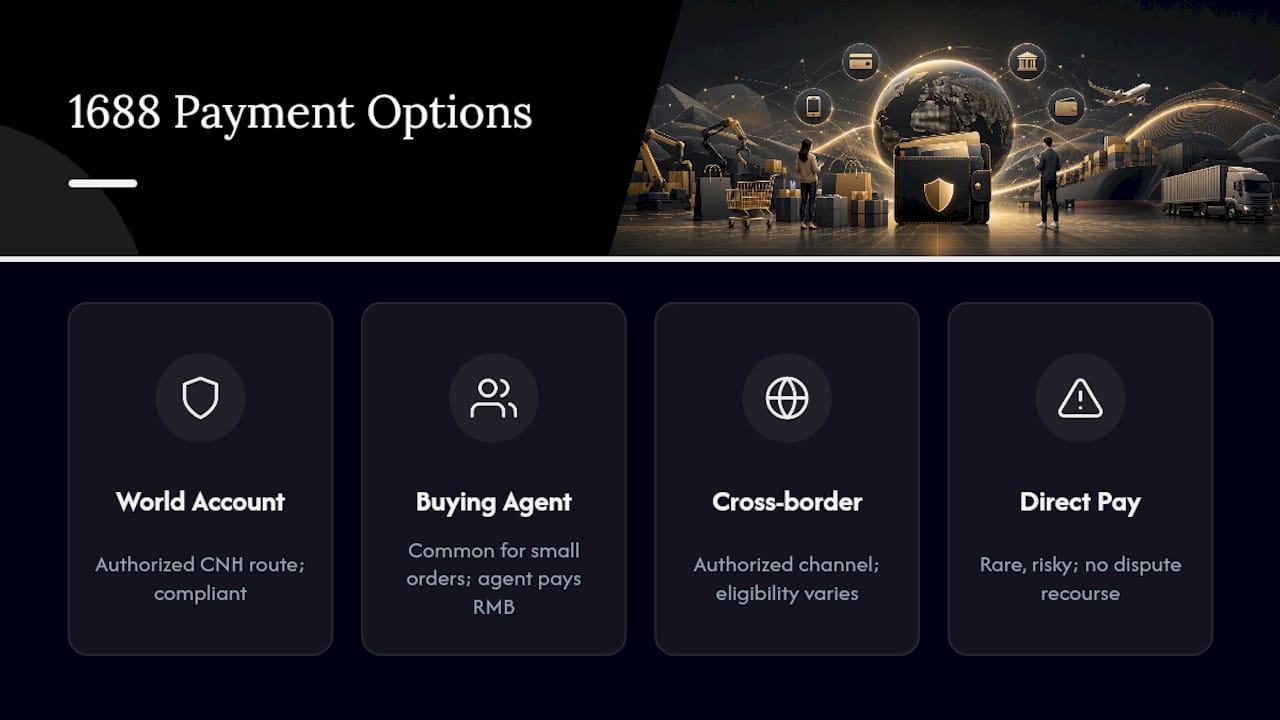
World Account (via World Pay) is the authorized international payment route built specifically for this gap. It lets eligible overseas businesses pay participating 1688 suppliers directly in CNH without needing a mainland bank account. This is the cleanest option for buyers who want to stay hands-on but need a compliant way to move money.
Paying through a buying agent who settles in RMB on your behalf is the most common route for smaller or first-time orders. The agent takes your payment in your home currency, converts it, and pays the supplier directly. You lose a bit on the agent's margin but gain someone who can catch payment discrepancies before they become disputes.
Cross-border payment platforms (sometimes bundled under services like Kuajingbao) offer another authorized channel, though eligibility and setup requirements vary and typically apply best to businesses with some existing China-facing infrastructure.
Direct supplier payment through informal channels is rare and risky. Some suppliers will accept international wire transfers directly, but without an authorized intermediary, you have no dispute resolution path if the goods don't arrive or don't match the sample.
The risk profile changes sharply depending on which path you pick. Escrow protections, refund rights, and chargeback options that exist on export-facing marketplaces largely don't apply on 1688 unless you're routing payment through an agent or an authorized cross-border service. A wire transfer sent directly to a supplier with no intermediary is, functionally, money you can't get back if something goes wrong.
Pro Tip: Always verify payment instructions through a second channel, like a phone call or a separate chat thread, before sending funds. Fraud attempts on B2B platforms often involve a hijacked account sending "updated" bank details mid-transaction.
How Does Shipping Work from 1688 to Your Country?
Most 1688 suppliers are set up for domestic delivery only. Some will handle export shipments occasionally, but the default assumption is that goods stay inside China, which means you need a plan for the leg between the factory and your door.
The standard approach is to have the supplier ship to a warehouse or freight forwarder inside China, who then consolidates your shipment with others and arranges international transport. Your freight options from there break down by shipment size:
- Courier (small parcels): Fastest option for samples or very small orders, typically arriving within a week but expensive per unit.
- Air freight: A middle ground for time-sensitive orders that are too large for courier but not yet worth a container.
- Sea freight, LCL (less than container load): Cost-effective for medium orders that don't fill a full container, usually taking four to six weeks door to door.
- Sea freight, FCL (full container load): The cheapest per-unit option for large, recurring orders once volume justifies a full container.
You'll also need to decide between DDP (delivered duty paid), where the forwarder handles customs and duties for a flat fee, and DDU (delivered duty unpaid), where you handle customs clearance and duties yourself on arrival. DDP costs more upfront but removes the guesswork for first-time importers.
Before you commit to a shipping plan, budget for every line in the landed-cost chain: product cost, sample fees, third-party inspection, domestic shipping to the forwarder, consolidation fees, international freight, customs clearance, duties, VAT or sales tax, and final-mile delivery to your address. Skipping any one of these in your cost estimate is how a "cheap" factory-direct order ends up costing more than expected once it clears customs.
How Do You Communicate with 1688 Suppliers?
AliWangWang, often just called WangWang, is 1688's built-in chat tool and the primary way you'll talk to suppliers before and during an order. Response quality varies a lot. Larger, export-experienced suppliers often have staff with functional English, while smaller factories may reply only in Chinese or use basic translation software themselves.
Short, specific messages get better results than long ones. A few templates worth adapting:
Initial contact: "Hello, I saw your product [name/link]. Can you confirm your MOQ and unit price at [quantity]?"
MOQ question: "Is your MOQ negotiable for a first order? I'd like to try a smaller batch before committing to [quantity]."
Sample request: "Can I order 1 to 3 samples before placing a bulk order? Please confirm sample cost and shipping time."
Pre-translating your message before sending it, rather than relying on the supplier to translate your English, tends to speed up replies. Always confirm numbers (price, quantity, dimensions) in digits rather than spelled-out words, since translation software handles numerals far more reliably than phrases.
Confirm measurements, packaging specs, and accepted payment currency in writing before you pay. A supplier who agrees verbally to something in chat but never confirms it in a follow-up message is a supplier whose word you can't rely on later if there's a dispute.
Pro Tip: Ask suppliers to send photos or a spec sheet for anything with dimensions, materials, or technical requirements. A photo of a printed spec sheet, even in Chinese, translates far more reliably than a supplier's typed description.
How Do You Vet 1688 Suppliers and Avoid Bad Ones?
Supplier quality on 1688 varies enormously, and the platform gives you real tools to check before you commit money. Run through this before contacting anyone seriously:
- Transaction history: Look for suppliers with a substantial volume of completed orders, not just a high star rating with few reviews.
- Product gallery: Consistent, high-quality photos across multiple angles suggest a real operation; stock photos or inconsistent lighting suggest a reseller, not a factory.
- Business license: Legitimate suppliers can usually provide a business license or company registration screenshot on request.
- Customer reviews: Read a sample of buyer feedback, particularly anything mentioning shipping delays or quality mismatches.
- MOQ and lead time consistency: A supplier whose stated MOQ changes every time you ask is a signal to slow down.
Red flags worth walking away from include MOQs that seem too low at prices that seem too good, product descriptions so vague you can't confirm materials or dimensions, a flat refusal to provide a business license, and photo sets that look copied from somewhere else.
For any order above sample size, a pre-shipment inspection or third-party quality control check is worth the cost. Build it into your timeline right after sample approval and before the supplier ships your bulk order to the forwarder, not after the goods have already left China. Catching a defect before international freight is far cheaper than catching it after.
What Tools and Services Make 1688 Usable for English Speakers?
Each stage of the buying process has a different tool that fits it best.
- Chrome or Edge built-in translate for reading listings and messages during initial browsing.
- AIBUY or similar 1688-focused extensions for English search and translated product cards when you're comparing options at scale.
- Image search for matching a reference photo to factory listings without needing to translate category names.
- AliWangWang for direct supplier communication once you've shortlisted candidates.
- World Account / World Pay for compliant cross-border payment once you're ready to transact.
- Freight forwarders and consolidators for the shipping leg, once your supplier has confirmed they'll deliver goods to a China-based address rather than only domestically.
Think of these as a relay, not a single tool that does everything. Translation and extensions get you through discovery. WangWang gets you through negotiation. World Pay or an agent gets you through payment. A forwarder gets your goods out of China. Trying to force one tool to cover two stages is usually where first-time buyers get stuck.
When Is DIY Sourcing on 1688 Worth It?
Order size is the first filter. If you're testing a product with a small batch and low financial exposure, doing it yourself with translation tools and patience makes sense, even if it takes longer. Once you're placing recurring orders at meaningful volume, the time you spend managing language, payment compliance, and freight coordination starts costing more than an agent's fee would.
Product complexity is the second filter. A simple, low-risk product with clear specs is forgiving of DIY mistakes. Anything requiring precise tolerances, safety certifications, or customs classification research benefits from someone who's done the paperwork before.
Run through this before deciding:
- Is your order large enough that a 10 to 40 percent factory-direct discount meaningfully outweighs the time cost of managing it yourself?
- Do you have a reliable way to pay in RMB or through World Pay without exposing yourself to fraud risk?
- Can you communicate clearly enough in writing to confirm specs, pricing, and shipping terms without a translator?
Pro Tip: If any single answer above is "no," a sourcing agent will likely save you money overall, even after their fee, by avoiding the mistakes that come from managing an unfamiliar process solo. Sourcesnova works with manufacturers and buyers navigating exactly this decision as part of broader market entry planning.
A Straight Answer on When to Hire Help
After walking through this workflow, my honest read is that the language barrier gets far more attention than it deserves. Translation tools and browser extensions solve browsing and basic communication reasonably well today. The real gap sits downstream: payment compliance, inspection timing, and the handoff from a domestic Chinese supplier to an international shipment. That's the part most first-time buyers underestimate, and it's the part no browser extension touches.
Sourcesnova works with manufacturers and buyers on exactly that downstream chain, including sourcing coordination, payment routing, and logistics planning for businesses moving from a single test order to a repeatable supply relationship. If you're weighing whether to manage 1688 yourself or bring in support, that's the piece worth pressure-testing first.
Get Hands-On Help Sourcing from 1688
Sourcesnova gives you a faster path than managing 1688 alone: a team that already speaks the language, knows which suppliers are worth trusting, and handles the payment and logistics chain that trips up most first-time buyers.
Instead of piecing together browser extensions, an agent's contact, and a freight forwarder separately, Sourcesnova's B2B sourcing support coordinates supplier vetting, payment handling, and quality control under one plan built around your product and volume. If you're preparing a first order or scaling past the point where DIY sourcing makes sense, Sourcesnova's broader service offerings cover the market entry work that follows sourcing, from logistics coordination to launch. Reach out through Sourcesnova's contact page to request a sourcing conversation and find out what a first order would actually cost, landed, before you commit to a supplier.
Frequently Asked Questions
Is there an official 1688.com English version? No. 1688.com operates entirely in Simplified Chinese with no native English toggle. Buyers use browser translation, extensions like AIBUY, or a buying agent to navigate it in English.
Can I pay 1688 suppliers without a Chinese bank account? Yes, through World Account and World Pay, which let eligible overseas businesses pay participating suppliers in CNH without holding a mainland account. Buying agents offer a similar workaround by settling payments in RMB on your behalf.
How long does shipping take from a 1688 supplier to my country? It depends on the freight lane: courier shipments can arrive within about a week, air freight typically takes one to two weeks, and sea freight (LCL or FCL) usually runs four to six weeks door to door once consolidated.
Do 1688 suppliers ship internationally themselves? Most don't by default. The standard workflow has the supplier deliver domestically to a warehouse or freight forwarder inside China, who then consolidates and ships internationally on your behalf.
Should I hire a sourcing agent instead of using 1688 myself? It depends on order size and complexity. Small test orders with simple products are reasonable to manage yourself with translation tools. Larger, recurring, or technically complex orders usually justify an agent's fee once you factor in the time cost of managing payment compliance and logistics alone.
Sources
- 1688 in English: How to Browse & Buy (2026 Guide)
- How to Buy from 1688 in English as a Foreigner (2026)
- How to Buy from 1688 as a Foreigner: Step-by-Step Guide 2026 | YiwuAgent
- 1688