
Business SEO is the practice of improving your website and online presence so search engines rank you higher and send qualified customers to your door. For small businesses, this is not optional. The first organic search result captures around 27.6% of all clicks. That means the businesses at the top of Google get a fundamentally different volume of traffic than everyone else. This guide to business SEO covers every core discipline you need: keyword targeting, content creation, local optimization, technical fixes, and ongoing maintenance. Each section gives you a clear action, not a theory.
What is a guide to business SEO, and why does it matter?
Search engine optimization (SEO) is the recognized industry term for the full set of practices that help your website appear in search results when customers look for what you sell. For small businesses, SEO is the most cost-effective channel available. Unlike paid ads, organic rankings keep delivering traffic after the work is done. Consistent monthly SEO effort outperforms competitors spending far more on sporadic campaigns. The return compounds over time because every page you rank is an asset, not an expense.
Small businesses also have a structural advantage most owners overlook. You can answer specific, local questions that large national brands ignore. A nail salon in Austin can rank for "gel nails near South Congress" faster than a national chain can. The key is knowing where to focus first.

How do you find the right keywords for your business?
Keyword research is the process of identifying the exact words and phrases your customers type into Google when they need your product or service. The goal is not to chase high-volume terms. The goal is to find terms with commercial intent, meaning the searcher is ready to buy or contact a business.
Start by writing down every question a new customer has asked you in person. Those questions are keywords. Then use free tools like Google Search Console or Google's autocomplete feature to see how people phrase those questions online. Use the language your customers use, not the language your industry uses internally.
When evaluating keywords, balance two factors:
- Search volume: How many people search this term each month?
- Competition: How many established sites already rank for it?
- Commercial intent: Does the searcher want to buy, or just learn?
- Local relevance: Does the term include your city, neighborhood, or service area?
- Long-tail specificity: Longer, more specific phrases convert better than broad terms.
Pro Tip: Target three to five primary keywords per page. Trying to rank one page for twenty terms dilutes your focus and confuses search engines about what the page is actually about.
Incorporate your chosen keywords naturally in your page title, the first H1 heading, at least one H2 subheading, and within the first 100 words of body text. Forced repetition hurts rankings. Write for the reader first, and the keyword placement will follow.
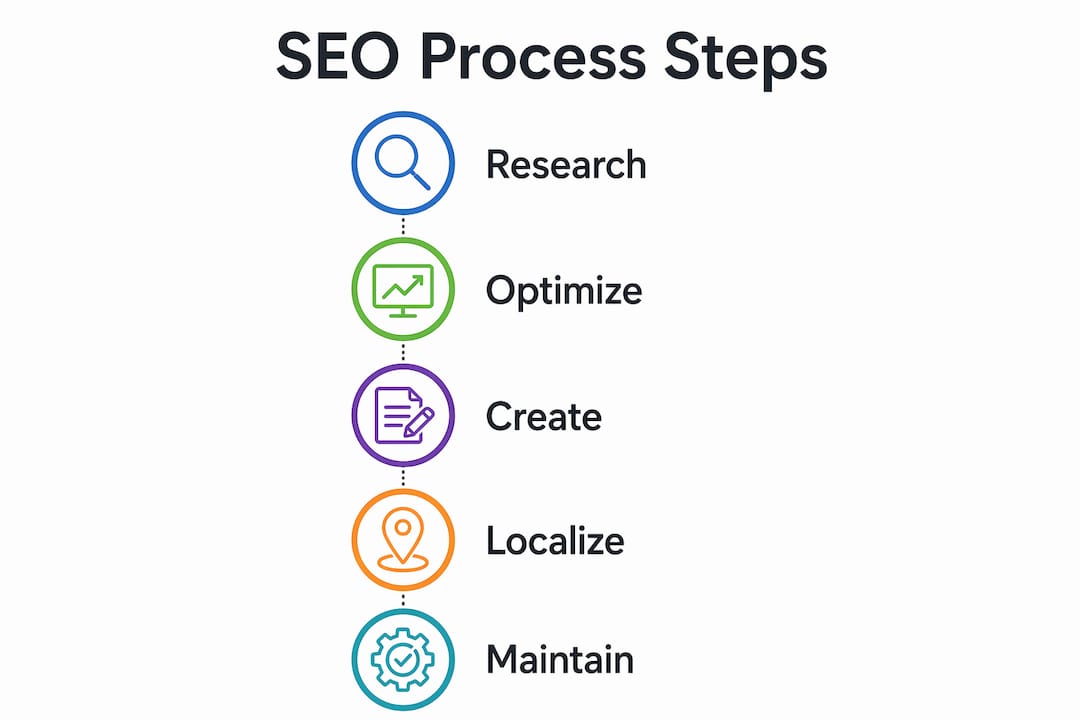
How do you create content that answers real customer questions?
Content is the vehicle that carries your keywords and signals your authority to search engines. Small businesses that use clear headers and answer specific customer questions outperform competitors using expensive tools and complex tactics. The formula is simple: answer the main question early, then support it with detail.
Follow this process for every page you publish:
- Identify the core question. What does a customer need to know before they buy from you?
- Answer it in the first paragraph. Do not bury the answer after three paragraphs of background.
- Use H2 and H3 headings to organize subtopics. Search engines read your heading structure to understand page content.
- Add an FAQ section at the bottom. FAQs capture long-tail searches and improve AI and search citations by giving explicit, labeled answers.
- Refresh existing pages before creating new ones. Updating high-value content consistently outperforms publishing many new pages.
The era of keyword stuffing is over. Authenticity and unique perspective now drive search rankings, especially as AI-powered search tools evaluate content quality more aggressively. Write as if you are explaining your service to a smart friend who has never heard of your business.
Pro Tip: Add a "Last Updated" date to your top pages. Search engines and readers both treat freshness as a quality signal, and it takes less than an hour to update a page with new facts or examples.
The role of content strategy in business growth is not just about volume. One well-structured, thoroughly answered page beats ten thin pages every time.
How does local SEO help your business get found nearby?
Local SEO is the set of practices that help your business appear when someone nearby searches for your product or service. For any business with a physical location or a defined service area, local SEO delivers the highest return of any SEO activity.
The foundation is your Google Business Profile (GBP). Claim it, complete every field, and keep it updated. Businesses that add photos to their GBP receive 42% more direction requests than those without photos. That single action costs nothing and takes thirty minutes.
Beyond GBP, local SEO requires:
- NAP consistency: Your Name, Address, and Phone number must be identical across every directory, including Yelp, Facebook, Apple Maps, and industry-specific listings. Inconsistent NAP data directly harms your local rankings.
- Local reviews: Ask satisfied customers to leave a Google review within 24 hours of their visit or service. Respond to every review, positive or negative.
- Local keywords: Use neighborhood names, city names, and nearby landmarks in your page content and GBP description.
- Local citations: Get listed in local business directories and chamber of commerce websites.
For more ideas on reaching nearby customers, the local marketing strategies that work for small businesses go well beyond GBP alone.
What technical SEO fixes does your website actually need?
Technical SEO covers the behind-the-scenes factors that determine whether search engines can find, read, and rank your pages. Most small business owners avoid this area because it sounds complex. The reality is that a short checklist covers 90% of what matters.
| Technical Factor | What to Do | Why It Matters |
|---|---|---|
| Site speed | Compress images, use a fast host | Slow pages lose rankings and visitors |
| Mobile friendliness | Use a responsive theme | Google indexes mobile versions first |
| SSL certificate | Install HTTPS on your domain | Google flags non-secure sites |
| XML sitemap | Submit to Google Search Console | Helps Google find all your pages |
| Schema markup | Add Organization and FAQPage schema | Improves how your site appears in results |
Schema markup deserves special attention. Only about 33% of sites implement structured data well. Adding Organization, LocalBusiness, and FAQPage schema gives your small business an immediate advantage in search results by enabling rich snippets, which are the expanded listings that show star ratings, addresses, and FAQ answers directly in Google.
URL structure also matters. Keep URLs short, descriptive, and free of random numbers or symbols. A URL like /services/nail-salon-austin tells both Google and the reader exactly what the page covers.
How do you maintain your SEO results over time?
SEO is not a one-time project. It is an ongoing discipline. Content updates deliver the highest ROI of any SEO activity in 2026, with top pages needing a fact and relevance check every 90 days. Most small businesses publish content and never return to it. That is where rankings quietly decay.
Build a simple maintenance routine:
- Monthly: Check Google Search Console for pages losing clicks or impressions.
- Quarterly: Refresh your top five pages with updated data, new examples, and expanded subtopics.
- Biannually: Audit your full site for broken links, outdated information, and pages that no longer serve a clear purpose.
- Ongoing: Monitor your GBP for new reviews and update your business hours, photos, and posts regularly.
When a page drops more than 50% of its traffic over a six-month period, treat it as a signal to rewrite, not delete. Add new data, restructure the headings, and expand thin sections. Deletion removes any residual authority the page has built.
Pro Tip: Set a recurring calendar reminder every 90 days labeled "SEO content audit." Assign each reminder to your three highest-traffic pages. Consistency over six months produces compounding results that no single campaign can match.
Tracking the right metrics keeps your effort focused. Measure organic traffic, keyword rankings for your target terms, and conversion actions like phone calls, form submissions, and direction requests from GBP. Vanity metrics like total page views tell you very little about whether your SEO is actually growing your business.
Key Takeaways
Effective business SEO requires consistent keyword targeting, structured content, local optimization, and regular maintenance rather than any single tactic or tool.
| Point | Details |
|---|---|
| Keywords drive qualified traffic | Target terms with commercial intent, not just high search volume. |
| Content structure wins rankings | Answer customer questions early and use clear H2/H3 headings throughout. |
| Google Business Profile is non-negotiable | Complete your profile and add photos to increase direction requests by 42%. |
| Technical SEO has a short checklist | Fix site speed, mobile display, HTTPS, and schema markup first. |
| Consistency beats big budgets | Monthly SEO maintenance outperforms sporadic, high-spend campaigns over time. |
What I've learned after watching small businesses get SEO wrong
Most small business owners I've worked with make the same mistake: they treat SEO as a launch task. They build a website, add some keywords, and expect results to hold. Six months later, they wonder why traffic has dropped and competitors have passed them.
The businesses that actually grow through SEO share one habit. They show up consistently. They update their Google Business Profile every week. They refresh a page every month. They answer one more customer question in writing. None of these actions is dramatic. All of them compound.
I've also watched owners get distracted by technical complexity when their real problem is simpler. A plumber in Phoenix does not need advanced schema markup before they have a complete GBP and ten Google reviews. Local SEO and clear content almost always move the needle faster than technical fixes for businesses under five years old.
The AI shift in search is real, but it does not change the fundamentals. Pages that answer questions clearly, use structured headings, and earn trust through reviews still win. What has changed is that thin, generic content gets filtered out faster. Authenticity and specificity are now competitive advantages, not nice-to-haves.
Start with one section of this guide. Do it well. Then move to the next. That approach beats a half-executed full strategy every time.
— Tran
How Sourcesnova helps small businesses grow through SEO
Sourcesnova was built specifically for small and mid-size businesses that want real search visibility without paying for reports that explain nothing. The team handles keyword research, content creation, local SEO setup, and technical audits as a connected system, not a menu of disconnected services.
Whether you run a salon, a retail shop, or a service business, Sourcesnova builds an SEO plan around your actual revenue goals. Clients get clear reporting, hands-on execution, and a team that treats their business as seriously as their own. Visit Sourcesnova to see how the approach works and what getting found online can look like for your business.
FAQ
What is business SEO in simple terms?
Business SEO is the process of improving your website and online profiles so search engines rank you higher when customers search for your products or services. Higher rankings bring more qualified traffic without paying for every click.
How long does SEO take to show results?
Most small businesses see measurable ranking improvements within three to six months of consistent effort. Local SEO through Google Business Profile often produces visible results faster, sometimes within weeks.
What is the most important local SEO step?
Claiming and fully completing your Google Business Profile is the single most impactful local SEO action. Businesses with photos on their profile receive 42% more direction requests than those without.
How often should small businesses update their SEO content?
Top pages need a fact and relevance check every 90 days. Pages that lose more than 50% of their traffic over six months need a full rewrite with updated data and expanded subtopics.
Does a small business need technical SEO?
Yes, but the priority list is short. Fix site speed, mobile display, HTTPS security, and submit an XML sitemap first. Adding schema markup like FAQPage and LocalBusiness gives an additional advantage that only about 33% of sites currently use.