
Most small business owners have tried selling online at some point. Some see results. Many don't. The difference rarely comes down to the product. What is e-commerce strategy, really? It's a structured plan that aligns your products, customers, and business operations to drive consistent online sales. Without it, you're making decisions reactively, spending on tactics that don't connect, and leaving revenue on the table. This guide breaks down the core components of a real e-commerce strategy, how to build one, and the specific mistakes that keep SMBs from growing online.
Table of Contents
- Understanding e-commerce strategy: core components
- Optimizing the customer journey to increase conversions
- Leveraging first-party data to personalize and reduce costs
- Measuring success with omnichannel analytics and KPIs
- Practical steps to build and apply your e-commerce strategy
- Why many SMBs struggle with e-commerce strategy success and how to break the cycle
- How SourcesNova helps SMBs build winning e-commerce strategies
- Frequently asked questions
Key Takeaways
| Point | Details |
|---|---|
| Definition of e-commerce strategy | It's a roadmap covering product, customer, and corporate plans that guides online business success. |
| Customer journey impact | Optimizing each stage from awareness to advocacy lowers cart abandonment and boosts sales. |
| First-party data value | Collecting and activating customer data improves personalization and lowers acquisition costs. |
| Omnichannel measurement | Tracking unified KPIs like CLTV and retention helps accurately assess and improve marketing impact. |
| Common SMB pitfalls | Premature spending without fixing foundational issues wastes budget and limits growth potential. |
Understanding e-commerce strategy: core components
An e-commerce strategy is not a marketing calendar or a social media plan. It is a complete roadmap covering how your business selects products, attracts and serves customers, and aligns internal operations to support sustained online growth. Think of it as the foundation everything else sits on.
The three pillars of e-commerce strategy are product, customer, and corporate strategy. Each one must be addressed before you start spending on traffic or ads. Experts recommend setting specific, measurable goals, such as a 20% quarterly traffic increase, before moving into tactics. Without those anchors, every decision becomes a guess.
Here is what each pillar covers:
- Product strategy: Selecting the right products, pricing them competitively, and aligning your catalog with real market demand and your brand positioning. Your product sourcing strategies need to support your margins and your delivery promises.
- Customer strategy: Identifying who your buyers are, what motivates them, and how to tailor their online experience from first visit to repeat purchase.
- Corporate strategy: Aligning your fulfillment, technology, staffing, and business goals so that online growth is actually sustainable. Growth that outpaces operations creates more problems than it solves.
Setting measurable goals is not optional. A goal like "increase sales" gives you nothing to work against. A goal like "reduce cart abandonment by 15% in Q2" gives your team a concrete target and a way to evaluate whether changes are working.
Optimizing the customer journey to increase conversions
With a clear understanding of the strategy's pillars, the next step is optimizing the customer journey to realize higher sales and retention.
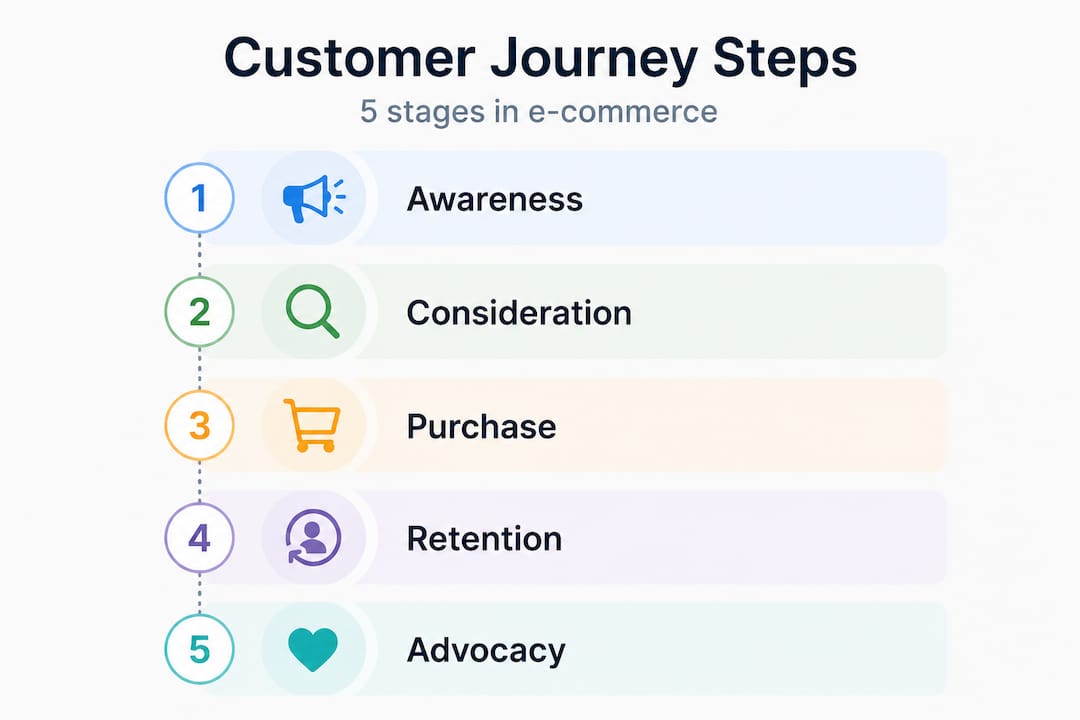
The customer journey follows five stages: awareness, consideration, purchase, retention, and advocacy. Most SMBs focus only on the purchase stage. That's where they lose the most ground.
The global cart abandonment rate sits at 70%, meaning seven out of ten shoppers who add items to a cart never complete the purchase. The reasons are often fixable: unexpected shipping costs, slow checkout, unclear return policies, and forced account creation.
Here are five stages to optimize for conversions:
- Awareness: Invest in SEO, paid search, and social content that targets buyer-intent keywords, not just general interest.
- Consideration: Use comparison content, customer reviews, and detailed product pages. Shoppers who feel informed convert at higher rates.
- Purchase: Simplify checkout. Offer guest checkout, one-tap payment options, and display all fees before the final step. No surprises.
- Retention: Deploy post-purchase emails, loyalty programs, and personalized reorder reminders. Keeping a customer costs far less than acquiring a new one.
- Advocacy: Make it easy to leave reviews and share purchases. Social proof at the awareness stage starts with satisfied customers at the advocacy stage.
"Transparent taxes, clear return policies, and personalized post-purchase experiences are not nice-to-haves. They are the difference between a one-time visitor and a repeat buyer."
Pro Tip: Gamified loyalty programs, where customers earn points, unlock badges, or access exclusive tiers, consistently outperform basic discount-based retention. The engagement mechanic keeps your brand top of mind between purchases.
For SMBs building out their full acquisition and retention approach, marketing strategies for growth cover how to connect these journey stages into a cohesive plan.
Leveraging first-party data to personalize and reduce costs
To deepen customer engagement and marketing efficiency, SMBs must leverage first-party data thoughtfully and systematically.

First-party data is information customers share directly with your business, through purchases, account signups, email subscriptions, and surveys. Unlike third-party cookie data, it is accurate, consent-based, and yours to use. As privacy regulations tighten and browser-based tracking disappears, first-party data is the only reliable foundation for personalized marketing.
Effective e-commerce strategies target email capture rates of 3 to 5% of site visitors and account creation at 20 to 30% of purchasers. These benchmarks exist because they directly enable personalization and reduce customer acquisition costs over time.
Here are the most effective capture mechanisms for SMBs:
- Email signups via pop-ups tied to exit intent or first-visit incentives (10% off, free shipping on first order)
- Account creation encouraged at checkout with a clear value exchange, such as order tracking and saved preferences
- Loyalty program enrollment that captures purchase history and preferences over time
- Post-purchase surveys that gather direct feedback and surface product or experience issues early
- Progressive profiling, which means collecting one or two data points at a time across multiple interactions rather than demanding a full profile upfront
Progressive profiling is underused by SMBs. Instead of a long signup form that drives abandonment, you ask for a birthday on the second email, preferred categories after the first purchase, and location data when a local promotion is relevant. The data builds naturally, and customers never feel interrogated.
Activating this data through Custom Audiences in paid platforms and value-based bidding improves ad efficiency significantly. You are no longer paying to reach cold prospects who share superficial characteristics with your buyers. You are reaching people who already have a relationship with your brand.
Pro Tip: Always explain the benefit when asking for data. "Get early access to new arrivals" outperforms a generic "sign up" prompt because it answers the customer's first question: what's in it for me?
Building your email marketing strategies around first-party data makes every campaign more targeted and every dollar spent more accountable.
Measuring success with omnichannel analytics and KPIs
Understanding how to measure and interpret omnichannel success enables SMBs to apply insights that multiply their strategy's impact.
Omnichannel e-commerce means your customer has a consistent, personalized experience whether they find you through Google, Instagram, email, or a physical store. Consistency is the operational goal. Measurement is how you know if you're achieving it.
Well-integrated omnichannel strategies can increase Customer Lifetime Value (CLTV) by 30% or more. That number moves significantly when businesses measure the right KPIs, not just revenue and sessions.
KPI comparison: last-click vs. multi-touch attribution
| Metric | Last-click attribution | Multi-touch attribution |
|---|---|---|
| Channel credit | 100% to final touchpoint | Distributed across all touchpoints |
| Budget decisions | Overvalues bottom-funnel ads | Reveals upper-funnel contribution |
| Blind spots | Ignores email, SEO, social assists | Requires unified data to implement |
| Best for | Short sales cycles | Complex, multi-session journeys |
Most SMBs default to last-click attribution because it's simple. But it systematically undervalues the SEO article that introduced the customer, the email that brought them back, and the retargeting ad that nudged them to buy. Budget decisions based on last-click data eventually defund the channels that start the journey.
Key KPIs every SMB should track:
- CLTV: Are customers returning and spending more over time?
- Customer retention rate: What percentage of buyers make a second purchase within 90 days?
- Cross-channel conversion rate: How do conversion rates compare across channels and devices?
- Engagement depth: Are users visiting multiple pages, watching videos, and engaging with emails?
- Attribution accuracy: Which channels are genuinely contributing to sales at each journey stage?
Growth marketing strategies built on these metrics allocate budget far more effectively than those relying on surface-level reporting.
Practical steps to build and apply your e-commerce strategy
Having explored key concepts and measurement, let's look at actionable steps SMBs can use to turn strategy into business results.
Experts recommend setting clear goals, choosing platforms that fit your product and customer base, and aligning all efforts around customer experience for sustainable success. Here is a framework you can apply immediately.
- Define measurable business goals. Tie every goal to a number and a timeline. Revenue target, conversion rate, email list size, repeat purchase rate. Vague goals produce vague results.
- Choose the right e-commerce platform. Your platform should match your catalog size, customer expectations, and integration needs. A handmade goods seller and a wholesale distributor have very different requirements.
- Develop product and customer strategies from data. Use search volume data, customer reviews, and sales history to guide product decisions. Survey existing customers to understand their buying motivations.
- Build and optimize your website. Page load speed, mobile checkout, clear navigation, and accessible product information are not optional. They directly affect both conversion rates and search rankings.
- Implement integrated multi-channel marketing. Connect SEO, paid search, email, and social into a single plan where each channel serves a role in the customer journey. Run them in isolation and you duplicate spend.
- Analyze performance regularly and adjust. Monthly reviews of your KPIs allow you to catch problems early. Weekly reviews of paid spend prevent budget waste.
- Keep customer experience central throughout. Technology and tactics change. The customer's desire for a fast, honest, and easy buying experience does not.
Pro Tip: Before you invest in any new essential marketing strategies, audit your current checkout flow from a mobile device. Most SMB owners never do this. What you find will almost certainly reshape your priorities.
Why many SMBs struggle with e-commerce strategy success and how to break the cycle
Here is the pattern we see repeatedly: a business owner invests in paid ads, drives traffic, and gets frustrated when sales don't follow. The instinct is to spend more on ads. The real problem is usually a broken checkout experience, unclear shipping costs, or a product page that doesn't answer the buyer's key questions.
Scaling ad spend before fixing a 70.22% average cart abandonment rate is one of the most common and expensive mistakes in e-commerce. Pouring more traffic into a leaky funnel does not fix the funnel. It just makes the leak more expensive.
The second pattern is siloed data. A business tracks email open rates in one platform, ad performance in another, and web analytics in a third, with no connection between them. Budget decisions get made on incomplete information. Channels that generate early awareness get cut because their last-click conversions look weak. Then the whole funnel suffers.
The businesses that build consistent revenue do three things before they scale spend. First, they audit their customer journey end to end, on mobile, on desktop, as a new visitor, and as a returning customer. They find the friction points before they pay to send more people through them. Second, they unify their data. That may mean a Customer Data Platform (CDP), or it may mean a simple spreadsheet that connects channel spend to revenue outcomes. Either way, decisions are based on the full picture. Third, they build an omnichannel demand approach: creating awareness, capturing purchase intent, recovering abandoned carts, and expanding with existing customers through targeted retention tactics.
That sequence, audit first, unify data, then scale, is not glamorous. But it is the difference between an e-commerce strategy that builds on itself and one that has to be rebuilt every quarter when the numbers don't improve.
How SourcesNova helps SMBs build winning e-commerce strategies
Building a sound e-commerce strategy takes more than a checklist. It takes a team that understands your business, your customers, and the specific levers that drive online growth.
SourcesNova works with small and mid-sized businesses across retail, e-commerce, and service industries to build strategies that connect product sourcing, web design, and integrated marketing into a single, results-driven plan. No jargon. No bloated retainers. Just clear direction and hands-on execution from a team that treats your business like their own. If you are ready to stop guessing and start growing, SourcesNova is the practical next step.
Frequently asked questions
What exactly does an e-commerce strategy involve?
An e-commerce strategy is a structured plan outlining how a business will sell products or services online, covering product selection, customer targeting, platform choice, marketing, and operational alignment to support sustainable growth.
How can SMBs reduce the high cart abandonment rate?
SMBs can reduce cart abandonment by optimizing checkout for speed and mobile, offering guest checkout, displaying all fees clearly before the final step, and stating return and shipping policies upfront to remove buyer hesitation.
Why is first-party data critical for e-commerce marketing today?
First-party data is accurate, privacy-compliant, and built on direct customer consent, making it your most dependable marketing asset as third-party cookies phase out and privacy regulations continue to tighten.
What key metrics should SMBs track to measure e-commerce success?
SMBs should prioritize Customer Lifetime Value, retention rate, cross-channel conversion rate, and engagement depth, since omnichannel KPIs like these reflect true strategy performance far better than surface-level traffic and revenue figures.
What common mistakes do SMBs make in e-commerce strategy?
The most costly mistakes are scaling ad spend before resolving high cart abandonment, operating with siloed data across platforms, and lacking clear measurable goals, all of which lead to misallocated budgets and inconsistent revenue.