
Brush a synthetic wig by starting at the ends, working upward in small sections, and using only wig-safe tools. Never pull from the root, never brush when soaking wet, and keep all heat tools away from synthetic fibers entirely.
Quick safety rules before you start:
- Do hold the hair above the area you're combing to relieve tension on the cap.
- Do finger-detangle major knots before reaching for any tool.
- Don't brush a soaking wet wig. Wait until it's damp or fully dry.
Warning: Using the wrong brush, applying heat, or yanking at the cap can permanently warp synthetic fibers. Once stretched or melted, they cannot be restored.
Table of Contents
- How to detangle curly or wavy synthetic wigs without losing the curl
- How often should you wash a synthetic wig?
- Storage and daily maintenance habits that prevent tangles
- Pro tips and expert cautions from experienced wig stylists
- Key Takeaways
- A note on wig care from Tran
How to detangle curly or wavy synthetic wigs without losing the curl
Curly synthetic wigs require a completely different approach. A brush that works on straight styles will pull apart curl clusters and leave the wig frizzy and undefined. The goal is to loosen tangles while keeping curl groups intact.
JenHair's curly wig detangling guide recommends misting with a water and conditioner mix, working in very small sections, and using fingers before any tool. ATM Wigs' texture-specific guidance confirms that straight styles tolerate gentle brushes more readily, while curly wigs need finger detangling and minimal combing to preserve the pattern.
Curly wig detangling routine:
- Lightly mist the section with a mix of water and a small amount of synthetic-wig conditioner.
- Use your fingers to loosen knots, working from the ends upward.
- Use a wide-tooth comb only where fingers can't fully clear the tangle. Short strokes, ends first.
- Never use a paddle brush on curly synthetic fibers.
Reforming curls after detangling:
Once detangled, scrunch the section upward with your palm to re-form the curl cluster. For tighter curls, roll small sections around your finger and let them air-dry in that shape. Non-heat roller sets also work well for resetting curl definition without brushing.
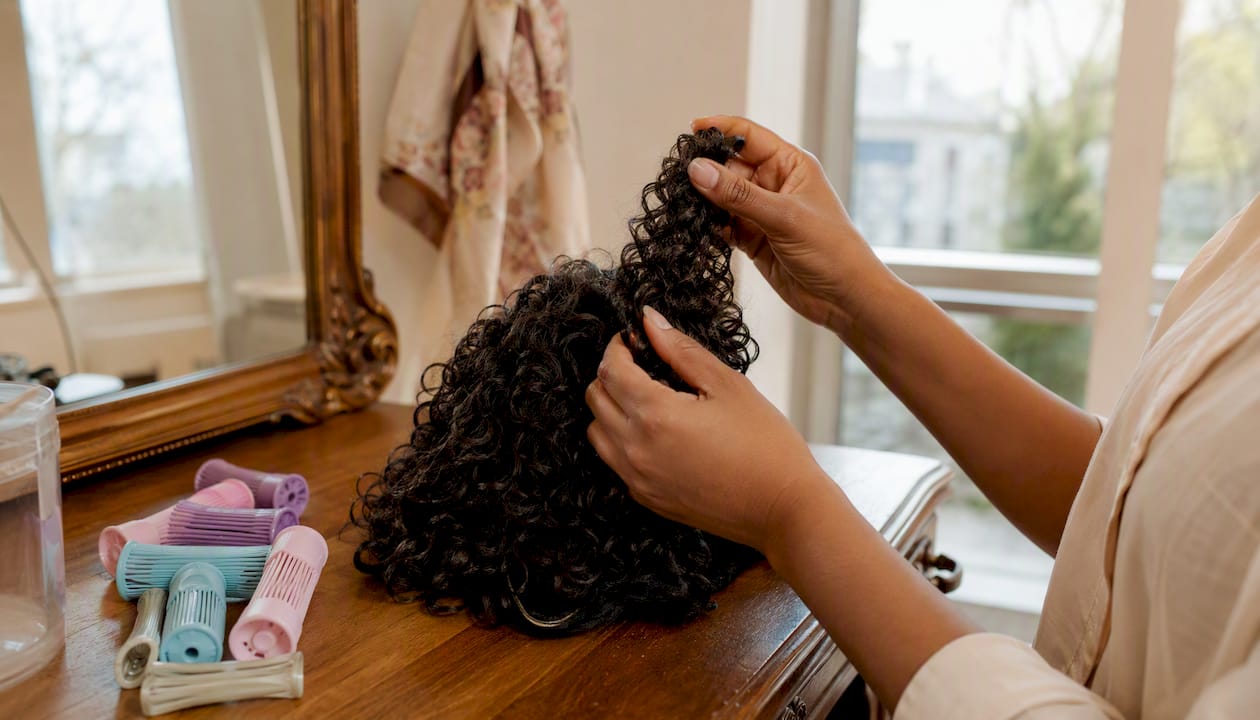
Pro Tip: If the ends of a curly wig look rough or frayed, a small trim is more effective than brushing. Trimming removes the damaged fiber rather than spreading the frizz further up the strand.
How often should you wash a synthetic wig?
Cleveland Clinic's wig care guidance recommends washing synthetic wigs at least once a month, using wig-specific shampoo and conditioner, and always air-drying on a stand. For daily wear, washing more frequently makes sense.
| Wear Frequency | Recommended Wash Cadence |
|---|---|
| Daily | Every 1–2 weeks |
| 3–4 times per week | Every 2–3 weeks |
| Occasional (1–2 times per week) | Once a month |
| Rarely (a few times per month) | At least once a month |
Safe washing routine:
- Pre-comb the wig while dry to remove tangles before water touches the fibers.
- Fill a basin with cool water and add a small amount of wig shampoo.
- Submerge the wig and swish gently. Do not scrub or twist.
- Rinse under cool running water, directing the flow from root to end.
- Apply a small amount of wig conditioner, leave for two minutes, then rinse.
- Blot with a microfiber towel and place on a wig stand to air-dry.
Pro Tip: Wash in the evening and let the wig dry overnight on a stand. Styling or storing a wig before it's fully dry causes the fibers to set in whatever shape they're in, which often means new tangles.
Storage and daily maintenance habits that prevent tangles
Good storage is the easiest maintenance step most people skip. A wig stored correctly needs far less detangling work before each wear.
Storage checklist:
- Store on a wig stand or in a breathable wig bag. Never in a sealed plastic bag.
- Keep away from direct sunlight and heat sources. Both degrade synthetic fibers over time.
- For travel, put the wig in a loose braid or a wig net before placing it in a bag. This prevents compression matting.
- Never stack wigs on top of each other.
Daily maintenance routine:
- Do a light detangle after every wear, even if the wig looks fine. Catching small tangles early prevents them from becoming mats.
- Spot-condition the ends weekly if the wig sees frequent use.
- Check the nape area every week. It's the first place matting develops and the easiest to address early.
For readers who transport wigs regularly, Sourcesnova's guide on wig packaging and transit handling covers practical steps for preventing matting and damage during shipping and travel.
Pro Tip: When packing a wig for travel, place it in a soft braid and wrap it in a silk or satin scarf before putting it in a bag. Cotton and synthetic fabrics create friction that causes tangling during transit.

Pro tips and expert cautions from experienced wig stylists
A few habits separate people who keep their wigs looking good for years from those who replace them every few months.
Non-negotiable cautions:
- No heat. Not a blow-dryer, not a flat iron, not a curling wand, unless the wig is explicitly labeled heat-resistant. Standard synthetic fibers melt at temperatures most styling tools reach.
- Test every new product on the inner weft before applying it to the full wig.
- Never stretch the cap when detangling. Hold the hair above the knot, not below it.
Practical expert tips:
- Keep a small emergency kit: a travel-size detangler spray, a wide-tooth comb, and two or three sectioning clips. This covers most situations you'll encounter away from home.
- Refresh curls with small non-heat rollers rather than brushing. Brushing re-styled curls is the fastest way to destroy curl definition.
- Trim sparingly and only at the ends. Trimming removes damaged fiber, but over-trimming shortens a wig that can't grow back.
For deeper guidance on safe styling methods, Sourcesnova has published a full step-by-step resource covering heat-free techniques and tool selection for synthetic wigs.
The most common mistake is treating a synthetic wig like natural hair. The fibers look similar, but they respond to tools, products, and moisture in completely different ways. Every technique that works on human hair needs to be re-evaluated before applying it to synthetic fibers.
Key Takeaways
Brushing a synthetic wig safely requires wig-specific tools, a section-by-section approach starting at the ends, and a firm rule against heat and aggressive wet combing.
| Point | Details |
|---|---|
| Start at the ends | Always comb from ends upward in short strokes; never pull from the root. |
| Use wig-safe tools | Wide-tooth comb and loop brush for most styles; fingers first for curly wigs. |
| Avoid heat entirely | No blow-dryers or styling tools unless the wig is explicitly heat-resistant. |
| Wash at least monthly | Use wig shampoo, cool water, and air-dry on a stand after every wash. |
| Store on a stand | Keep wigs on a stand or in a breathable bag, away from heat and sunlight. |
A note on wig care from Tran
Most wig care guides focus on what not to do. That's useful, but it leaves people without a clear routine to follow. The approach outlined here, starting at the ends, working in sections, and matching the technique to the texture, is the framework that consistently produces the best results with the least risk of damage.
Synthetic wigs are a significant investment, and the difference between a wig that lasts one year and one that lasts three often comes down to consistent, low-effort maintenance habits rather than any single technique. The routines here reflect that principle: small, regular actions that prevent the problems that are hardest to fix.
Sourcesnova publishes practical, research-grounded content for the beauty and consumer goods industries. If you're a manufacturer or brand looking to reach North American buyers, our team works directly on market entry, digital presence, and wholesale lead generation.