
A strong online presence means how easily potential customers can find, trust, and engage with your business across search engines, social media, and directories. For small business owners, building that presence is not optional. It is the difference between a full calendar and an empty one.
Here are the core components that work together to establish and grow your digital footprint:
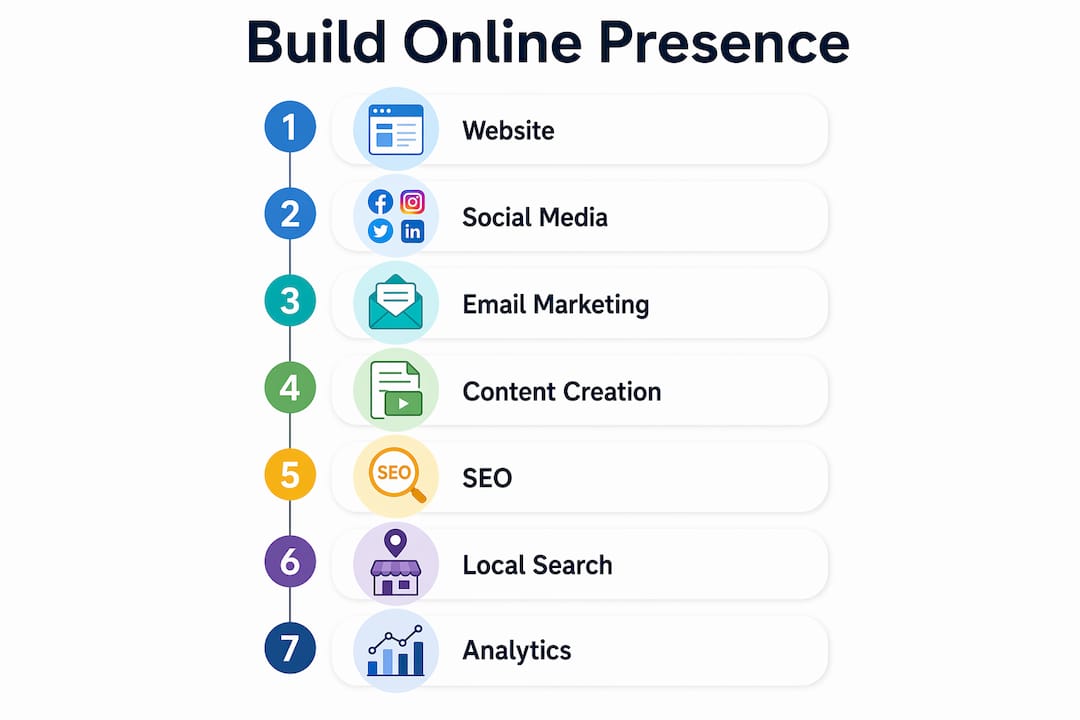
- A professional, mobile-friendly website that loads fast, looks credible, and converts visitors into leads
- Search engine optimization (SEO) to rank in Google and AI-driven search results for the queries your customers are already typing
- Social media presence on the two or three platforms where your audience actually spends time
- Content creation that educates, solves problems, and positions you as the go-to expert in your field
- Email marketing to stay in front of prospects and turn one-time buyers into repeat customers
- Customer reviews and reputation management to build the trust that closes deals
- Local search optimization so nearby customers find you before they find anyone else
- Community engagement and digital PR to extend your reach beyond owned channels
No single tactic carries the full load. The businesses that grow consistently online are the ones that execute across all of these channels in a coordinated, deliberate way. The sections below break down exactly how to do that.
1. How to build a website that works on every device
Your website is the only piece of digital real estate you fully own. Social platforms change their algorithms. Ad costs rise. But your website stays yours, and it should be the hub that every other channel points back to.
Mobile-first design is not a trend. It is the baseline. The majority of web traffic now comes from smartphones, and Google ranks the mobile version of your site before the desktop version. If your pages load slowly or your navigation breaks on a small screen, you lose visitors before they ever read a word.
Fast load times, clear navigation, and an SSL certificate (the padlock in the browser bar) are the three non-negotiables. SSL certificates signal security to both visitors and search engines, and sites without them rank lower and convert worse. Beyond security, your site needs:
- A clear headline on the homepage that tells visitors what you do and who you serve, within three seconds
- A visible contact method (phone number, form, or booking link) on every page
- Consistent branding: the same logo, colors, and tone you use everywhere else
- Updated content, especially your services, hours, and location details
Pro Tip: Resist the urge to make your website beautiful at the expense of being functional. A clean, fast site with a clear call to action will outperform a visually elaborate one that takes four seconds to load.
2. How to use social media and influencers to extend your reach
Social media is where your audience already is. The mistake most small business owners make is trying to be on every platform at once. That path leads to thin content, inconsistent posting, and burnout. Pick two or three platforms where your customers are active and commit to those.

A well-optimized profile is the starting point. Your bio, logo, contact details, and website link should be consistent across every platform you use. Inconsistency confuses potential customers and weakens your brand recognition. From there, a platform-specific content strategy matters more than posting volume.
Short-form video is the highest-engagement format on most platforms right now. Instagram Reels, TikTok, and YouTube Shorts reward businesses that show up authentically, whether that means a quick tutorial, a behind-the-scenes clip, or a direct answer to a common customer question. User-generated content, where your customers share their own experiences with your product or service, carries even more credibility than branded content.
Influencer collaborations do not require a celebrity budget. Micro-influencers with a few thousand engaged followers in your niche often drive more relevant traffic than accounts with millions of passive ones. Look for creators whose audience matches your customer profile, and focus on authentic partnerships over one-off sponsored posts.
- Schedule posts in advance using tools like Buffer or Later to maintain consistency without daily effort
- Engage with comments and messages promptly. Platforms reward accounts that generate conversation
- Repurpose content across channels: a blog post becomes a social caption, a video becomes a clip, a customer review becomes a graphic
For a deeper look at building a social strategy that actually converts, this social media guide covers the framework Sourcesnova uses with its own clients.
3. Why email marketing outperforms social media for direct engagement
Email marketing consistently outperforms social media in return on investment. That is not a new finding, and it holds up year after year because email gives you direct, unfiltered access to people who have already raised their hand and said they want to hear from you.

Building that list starts with giving people a reason to subscribe. Gated content works well here: a free checklist, a discount code, a short guide, or a resource that solves a specific problem your audience faces. Place sign-up prompts on your website's homepage, your blog posts, and your social media profiles. Growing an email list through gated content and clear calls to action is one of the most reliable ways to accelerate subscriber growth.
Once you have subscribers, the goal is to stay valuable without being pushy. A weekly or biweekly newsletter that shares a useful tip, a recent blog post, or a behind-the-scenes update keeps your brand top of mind. Heavy promotional emails sent too frequently will drive unsubscribes faster than anything else.
Segmentation and personalization lift open rates and click-through rates meaningfully. Sending a different message to new subscribers versus longtime customers, or to buyers of one product versus another, makes your emails feel relevant rather than generic. Most email platforms, including Mailchimp and Klaviyo, make basic segmentation straightforward even for small teams.
- Use a welcome sequence for new subscribers to introduce your brand and set expectations
- Test subject lines regularly. A small change in wording can shift open rates noticeably
- Integrate email with your other channels: promote your newsletter on social media and include social links in every email
4. How consistent content creation builds trust and search visibility
Content is how you demonstrate expertise before a prospect ever speaks to you. A business that publishes genuinely useful information, whether through blog posts, videos, or podcasts, builds credibility over time in a way that paid ads simply cannot replicate.
Start with your customers' most common questions and frustrations. Those are your content topics. A nail salon owner might write about how to make gel manicures last longer. A lighting retailer might publish a guide to choosing fixtures for small spaces. The goal is to answer real questions, not to write content that sounds impressive but helps no one.
Format variety matters because different people consume content differently. Blog posts serve readers who search Google. Short videos capture attention on social platforms. Podcasts reach commuters and multitaskers. You do not need all three at once. Start with one format you can sustain, then expand. Content strategy drives business growth most reliably when it is consistent rather than sporadic.
Guest posting on industry blogs and appearing on relevant podcasts as a guest are two of the fastest ways to reach new audiences without building them from scratch. Both also generate backlinks to your website, which strengthens your SEO. Partnerships with complementary businesses, where you co-create content or cross-promote to each other's audiences, follow the same logic.
- Publish on a schedule your team can actually maintain. Once a week beats three times a week for two weeks and then nothing
- Repurpose every piece of content: a blog post can become a social post, an email, and a short video
- Track which topics generate the most traffic and engagement, then create more of those
For practical guidance on content marketing for small businesses, Sourcesnova's blog covers topic research, format selection, and distribution in detail.
5. SEO basics that improve your organic search rankings
SEO in 2026 requires demonstrating E-E-A-T: Experience, Expertise, Authoritativeness, and Trustworthiness. Google's AI Overviews now surface at the top of many search results, pulling answers from content that directly and credibly addresses what users are asking. If your content does not meet that bar, it will not rank, regardless of how many keywords it contains.
On-site SEO covers the fundamentals: keyword research to understand what your customers search for, quality content that answers those queries thoroughly, descriptive meta titles and meta descriptions, and internal links that connect related pages on your site. These are table stakes. Every page on your site should serve a clear purpose and target a specific search intent.
Off-site SEO is about earning credibility signals from other websites. Backlinks from reputable sources, consistent business citations in directories, and mentions in industry publications all tell search engines that your site is trustworthy. You earn these by publishing content worth linking to and by building relationships with other creators and businesses in your space.
Technical health matters too. A site that loads slowly, has broken links, or is not indexed correctly will underperform regardless of content quality. Google Search Console is free and shows you exactly where technical issues exist. Mobile optimization, covered in the website section, feeds directly into your technical SEO score.
- Target long-tail keywords: specific phrases like "best nail salon in Austin" convert better than broad terms like "nail salon"
- Write content that answers questions completely, not just partially. AI Overviews reward depth and clarity
- Update older content regularly. A post from two years ago with outdated information can hurt your rankings
6. How local search optimization helps you win nearby customers
Local SEO is the most direct path to revenue for businesses that serve a specific geographic area. When someone searches "electrician near me" or "coffee shop in downtown Denver," Google surfaces results based on proximity, relevance, and the completeness of each business's online profile.
Claiming and optimizing your Google Business Profile is the single highest-leverage action for local visibility. Fill out every field: business category, hours, service area, photos, and a description that includes the keywords your customers use. Update it regularly, because Google treats active profiles as more relevant than neglected ones.
NAP consistency, meaning your business name, address, and phone number appear identically across every directory, matters more than most business owners realize. A mismatch between your Google listing and your Yelp listing creates confusion for both customers and search algorithms. Audit your listings on Google, Yelp, Facebook, and any industry-specific directories relevant to your category.
Responding to customer reviews increases the likelihood that a potential customer chooses your business by 41%, according to a 2024 BrightLocal survey. That figure alone makes review management one of the highest-return activities in local marketing. Ask satisfied customers to leave a review, make it easy by sending a direct link, and respond to every review, positive or negative, within a day or two.
- Use local keywords in your website content: city names, neighborhood names, and service-plus-location phrases
- Add schema markup to your website so search engines can read your business details accurately
- Consider location-based ads on Google or Meta to reach customers searching in your service area
For more local marketing tactics that go beyond the basics, local marketing ideas from Sourcesnova covers both organic and paid approaches.
7. How online communities and digital PR expand your brand's reach
Owned channels, your website, your email list, your social profiles, can only reach the audience you have already built. Online communities and digital PR get your brand in front of people who have never heard of you, through channels they already trust.
Engaging in forums, communities, and digital PR builds long-term brand awareness and referral traffic when done consistently and without overt selling. The key word is "without." Showing up in a Facebook group or a Reddit thread to pitch your services will get you ignored or removed. Showing up to answer a genuine question, share a useful resource, or offer a perspective that helps people will build your reputation over time.
Identify two or three communities where your ideal customers gather. That might be a LinkedIn group for your industry, a local business association forum, a niche subreddit, or a Facebook group organized around a topic your customers care about. Participate regularly. Answer questions. Share your content when it genuinely fits the conversation.
Digital PR extends this logic to media. A guest post on an industry blog, an interview on a relevant podcast, or a quote in a local news story all put your name in front of new audiences and generate backlinks that strengthen your SEO. Start with local media and niche publications before targeting national outlets.
- Monitor brand mentions using Google Alerts or a social listening tool so you can respond when people talk about your business
- Build relationships with journalists and bloggers in your niche before you need coverage
- Partnerships with complementary businesses, where you refer customers to each other, function as a form of community-based PR
8. How to use paid advertising to accelerate your online visibility
Organic strategies build lasting visibility, but they take time. Building an online presence typically takes 6 to 12 months of consistent effort before meaningful results appear. Paid advertising fills that gap by putting your business in front of the right audience immediately.
Google Ads places your business at the top of search results for the keywords you bid on. For local service businesses, search ads targeting high-intent queries, "emergency plumber in Chicago" or "wedding photographer near me," can generate leads within days of launching. The cost per click varies by industry and competition, but the targeting precision makes it one of the most measurable forms of advertising available.
Social media ads on Meta (Facebook and Instagram) and TikTok work differently. They interrupt people who are not actively searching for you, so the creative has to earn attention quickly. These platforms excel at building awareness and retargeting: showing ads to people who have already visited your website or engaged with your content. A small retargeting budget often delivers a strong return because you are reaching warm prospects, not cold ones.
The most effective paid advertising strategy integrates with your organic efforts. Run ads to your best-performing content, not just to a sales page. Use ad data to identify which messages resonate, then apply those insights to your organic content and email campaigns.
- Set a clear objective before launching any campaign: awareness, leads, or sales. Each requires a different approach
- Start with a modest daily budget and test two or three ad variations before scaling what works
- Track conversions, not just clicks. A high click-through rate that produces no leads is a signal to adjust your offer or landing page
9. How to define your brand identity and keep it consistent across channels
A clear brand identity is what makes your business recognizable and memorable across every channel a customer encounters. It is not just a logo. It is the combination of your visual style, your tone of voice, the values you communicate, and the experience you deliver consistently, whether someone finds you on Google, Instagram, or through a friend's referral.
Start with the basics: a professional logo, a defined color palette, and a consistent font set. These visual elements should appear identically on your website, your social profiles, your email templates, and any printed materials. Inconsistency in visuals signals a lack of professionalism, even when the underlying business is excellent.
Tone of voice matters just as much. Decide how your brand speaks: formal or conversational, technical or plain-language, warm or direct. Then apply that voice consistently across every piece of content you publish. A business that sounds authoritative on its website but casual and disjointed on social media creates confusion about who it actually is.
Building a strong digital brand presence requires documenting these decisions in a simple brand guide, even a one-page document, so that anyone creating content for your business follows the same standards. This becomes especially important when you bring on contractors, employees, or an agency.
10. How web analytics help you refine your online presence strategy
Data tells you what is actually working, not what you think is working. Without tracking, you are making decisions based on intuition alone, and that gets expensive quickly.
Google Analytics 4 (GA4) is free and gives you a clear picture of where your website traffic comes from, which pages visitors spend time on, and where they drop off. If most of your traffic comes from one blog post but that post has a high bounce rate and no conversions, that is a signal to improve the page's call to action or internal links. If a specific traffic source, say organic search or a referral from a partner site, consistently drives leads, that tells you where to invest more effort.
Social media platforms provide their own native analytics. Track engagement rate, reach, and click-through rate rather than just follower count. Follower count is a vanity metric. Engagement rate tells you whether your content is actually connecting with your audience.
Email platforms like Mailchimp and Klaviyo show open rates, click rates, and unsubscribe rates by campaign. A sudden drop in open rates usually means your subject lines have gone stale or your sending frequency has crept too high. A spike in unsubscribes after a specific email tells you that message missed the mark.
- Review your analytics monthly, not daily. Daily fluctuations are noise. Monthly trends are signal
- Set up goal tracking in GA4 so you can measure actual conversions, not just page views
- Use UTM parameters on links in your emails and social posts to track exactly which campaigns drive traffic and sales
11. How to prioritize your strategy without spreading yourself too thin
The single biggest mistake small business owners make when improving their online visibility is trying to do everything at once. The result is a thin presence on ten platforms instead of a strong presence on three. The hub-and-spoke model solves this: treat your website as the hub and limit your active social channels to two or three spokes that connect back to it.
Prioritization starts with knowing where your customers actually are. A B2B service business will find more traction on LinkedIn than on TikTok. A salon or retail shop will likely see better results on Instagram or Facebook. Spend your time where your audience already gathers, not where you feel you should be.
Consistency beats frequency. Publishing one well-crafted blog post per week and sending one useful email newsletter will outperform daily posting that lacks substance. Quality content, published on a schedule you can sustain, builds audience trust over time. Sporadic bursts of activity followed by silence do the opposite.
Pro Tip: Batch your content creation. Set aside two to three hours once a week to write, record, or design everything you need for the coming week. Scheduling tools like Buffer, Later, or Hootsuite then handle distribution automatically, so you are not making daily decisions about what to post.
Planning also prevents the burnout that causes most small business owners to abandon their online presence efforts entirely. Map out your content calendar a month in advance. Know what you are publishing, on which channel, and on which day. That structure removes the daily friction that makes consistency feel hard.
Key Takeaways
Building a strong online presence requires a coordinated approach across your website, search, social media, email, and reputation management, executed consistently over time.
| Point | Details |
|---|---|
| Website as central hub | Your site should be mobile-friendly, fast-loading, and SSL-secured, with every other channel pointing back to it. |
| SEO and E-E-A-T | Google's 2026 AI Overviews reward content that demonstrates Experience, Expertise, Authoritativeness, and Trustworthiness. |
| Email outperforms social | Email marketing consistently delivers higher ROI than social media; grow your list with gated content and segment for relevance. |
| Reviews drive local revenue | Responding to all reviews increases the likelihood a customer chooses your business by 41%, per a 2024 BrightLocal survey. |
| Sourcesnova for execution | Sourcesnova provides hands-on digital growth services for small businesses, covering SEO, content, social strategy, and website optimization with no bloated monthly commitments. |
The part most guides skip: value first, visibility second
The conventional advice on building an online presence focuses almost entirely on tactics: claim your Google Business Profile, post on Instagram, start a blog. That advice is not wrong. But it misses the underlying principle that determines whether any of those tactics actually work.
The businesses that build lasting online presence are the ones that lead with value. Not with sales pitches dressed up as content. Not with promotional posts disguised as engagement. Actual value: answers to real questions, solutions to genuine problems, information that makes someone's day or decision easier.
The reason this matters practically is that being overly salesy is the most common mistake that kills online presence efforts before they gain traction. Visitors can sense when every piece of content is angled toward a transaction. They leave, they unsubscribe, they stop following. But when a business consistently shows up with something genuinely useful, trust accumulates. And trust is what converts a visitor into a customer, and a customer into someone who refers others.
There is also a real risk in the omnipresence trap. Trying to maintain an active presence on every platform, publish content in every format, and run ads on every channel simultaneously is a recipe for mediocrity across the board. The businesses that win online are not the ones doing the most things. They are the ones doing the right things well, in the places their customers actually look.
AI tools like ChatGPT and Midjourney can accelerate content production meaningfully, but they do not replace the judgment required to know what your specific audience needs to hear. Use them to handle the mechanical work: drafting outlines, generating image concepts, writing first-pass captions. Then apply your own knowledge and voice to make the output genuinely useful. That combination, AI speed with human insight, is where small business owners have a real advantage over larger competitors who rely on templated, impersonal content at scale.
The timeline is also worth being honest about. Meaningful results typically take 6 to 12 months of consistent effort. That is not a reason to delay. It is a reason to start now and stay the course.
Sourcesnova helps small businesses get found and grow online
Too many small businesses invest in marketing that produces reports instead of results. Sourcesnova was built specifically to fix that. As a full-service digital growth agency focused on local and small-to-mid-size businesses, Sourcesnova handles the execution that most business owners do not have time to do themselves: website optimization, SEO, social media strategy, content creation, and reputation management, all under one roof with no bloated monthly commitments.
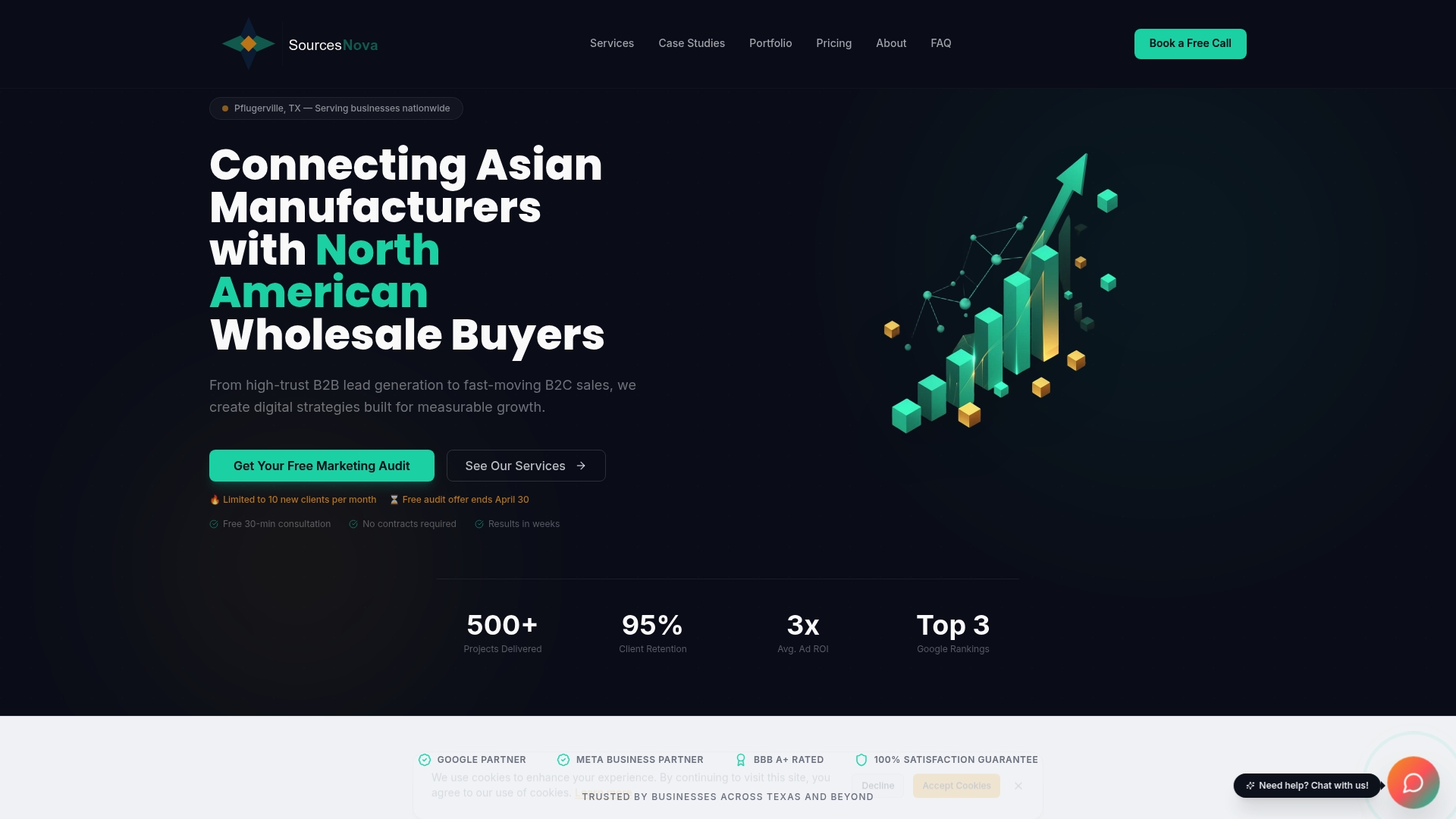
The clients Sourcesnova works with, from nail salons and retail shops to service businesses and e-commerce brands, share one priority: real, measurable growth. Not vanity metrics. Not jargon-filled strategy decks. If you are ready to build a digital presence that actually brings in customers, Sourcesnova is the partner that treats your business like its own.