
Digital presence is the strategic management of every online channel where your business is discovered, evaluated, and trusted. It goes far beyond owning a website. Your Google Business Profile, social media pages, customer reviews, blog content, and search rankings all form part of this identity. Businesses that treat these channels as a unified system attract more qualified visitors, build credibility faster, and convert at higher rates than those managing each channel in isolation. This guide covers digital presence explained in full, from core definitions to practical strategies you can act on today.
What is digital presence explained vs. digital footprint?
Digital presence and digital footprint are related but distinct concepts. Confusing them leads to poor management decisions and unnecessary risk.
Digital presence is the controlled, intentional management of brand perception online. You create it deliberately through your website, social profiles, published content, and review responses. Every element is a choice. The industry term for this practice is online brand management, and it describes the active curation of how your business appears across the web.

Digital footprint, by contrast, is the traceable record of your online activity, both active and passive. Active and passive trails include content you post yourself as well as data collected about you without your direct knowledge, such as cookies, third-party tracking, and data broker records. Your footprint is largely a byproduct of operating online.
The practical difference matters for two reasons: reputation and control.
- Reputation: Your digital presence shapes how customers perceive your brand. Your footprint shapes how data brokers, advertisers, and AI systems classify you.
- Control: You can build and refine your digital presence at any time. Your footprint accumulates whether you manage it or not.
- Risk: An unmanaged footprint can surface outdated information, negative press, or data privacy issues that undermine the presence you are working to build.
- Strategy: Focusing on presence management gives you a clear, actionable framework. Trying to manage every element of your footprint is reactive and rarely productive.
Pro Tip: Audit your business name in Google, Bing, and AI tools like ChatGPT or Perplexity every quarter. What surfaces in those results is your real-world digital presence, not just what you intended to publish.
Businesses that reduce privacy risks through a privacy-conscious digital architecture also protect their brand from data exposure that could erode customer trust.
What are the core components of a strong online presence?
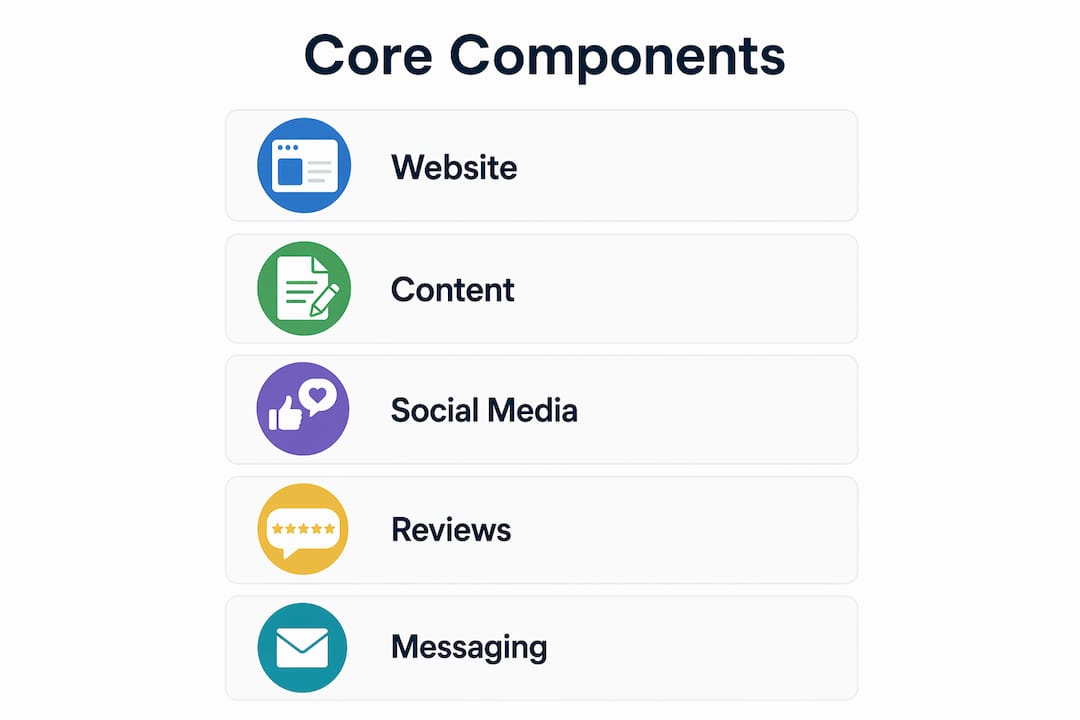
A strong online presence is built from several interconnected components. Each one serves a specific function. Together, they create a system that attracts visitors, builds trust, and drives conversions.
1. an optimized website
Your website is the foundation. Every other channel should drive traffic back to it. A site that loads in under two seconds improves conversion rates measurably. Speed is not a technical nicety. It is a direct revenue factor. Beyond speed, your site needs clear navigation, mobile responsiveness, and technical SEO fundamentals like proper metadata, structured data markup using Schema.org, and clean URL structures.
2. expert-driven content and blogging
Content is how you demonstrate authority and capture organic search traffic. Companies that publish consistent expert content generate 55% more website visitors than those that do not. That traffic compounds over time because well-ranked content continues attracting visitors months or years after publication. A content strategy for growth is not optional for businesses that want sustainable visibility.
3. social media profiles
Social platforms serve as discovery points, not just broadcasting channels. A potential customer might find your business on Instagram before they ever visit your website. Consistent branding, regular posting, and genuine engagement signal credibility to both users and search algorithms.
4. online reviews
Reviews are one of the most powerful conversion drivers available to any business. Businesses with 50+ five-star reviews convert visitors at significantly higher rates than businesses with no reviews. Google, Yelp, and industry-specific platforms like Houzz or Healthgrades each carry weight depending on your sector.
5. consistent messaging across all channels
Fragmentation kills trust. When your website says one thing and your Google Business Profile says another, customers notice. Search engines notice too. Consistent messaging across every channel reinforces your brand identity and prevents confusing signals that reduce your rankings.
Pro Tip: Use a brand style guide that covers your business name format, tagline, logo usage, and tone of voice. Apply it to every profile, listing, and content piece you publish.
| Channel | Primary Function | Key Success Metric |
|---|---|---|
| Website | Central hub and conversion point | Load speed, bounce rate, conversions |
| Blog / Content | Authority building and organic traffic | Organic sessions, keyword rankings |
| Social Media | Discovery and engagement | Reach, engagement rate |
| Online Reviews | Trust and conversion | Review volume, average rating |
| Google Business Profile | Local search visibility | Profile views, direction requests |
How does digital presence drive business growth?
The business case for investing in digital presence is grounded in compounding returns. Organic search via SEO and content is the most sustainable traffic source available because it builds on itself over time. Paid advertising stops the moment you stop paying. Organic rankings, earned reviews, and published content continue working indefinitely.
"Digital presence compounds in value only when multiple channels drive traffic to a unified hub with consistent messaging." — Wisetoast
The compounding effect works like this: a well-optimized blog post ranks on Google and drives traffic to your website. That traffic reads your content, sees your reviews, and converts into a customer. That customer leaves a review, which improves your local search ranking, which drives more traffic. Each channel feeds the others.
To put this into practice, follow a four-step audit process:
- Audit your current presence. Search your business name and primary service keywords. Document what appears in the first two pages of results. Identify gaps, outdated listings, and inconsistencies.
- Prioritize your channels. Not every business needs every platform. A local nail salon benefits most from Google Business Profile, Instagram, and review management. A B2B software company prioritizes LinkedIn and technical SEO.
- Set measurable KPIs. Track organic traffic, review volume, conversion rate, and local search impressions. Vanity metrics like follower counts tell you very little about business impact.
- Execute and iterate. Publish content consistently, respond to every review, and update your listings whenever your business information changes.
For businesses building their SMB marketing strategy, digital presence is the foundation that makes every other tactic more effective.
What are the biggest digital presence mistakes to avoid?
Most businesses do not fail at digital presence because of bad strategy. They fail because of preventable execution mistakes that quietly erode visibility and trust.
- Channel fragmentation: Managing your website, social profiles, and listings as separate projects creates inconsistent brand signals. Managing channels in silos causes lost trust with both customers and AI search engines that evaluate brand consistency.
- Chasing vanity metrics: Follower counts and post likes feel good but rarely correlate with revenue. Most businesses ignore technical SEO fundamentals in favor of surface metrics, which undermines long-term discoverability.
- Neglecting review management: Not responding to reviews, positive or negative, signals disengagement. Customers read your responses as much as they read the reviews themselves.
- Ignoring structured data: Schema.org markup helps search engines and AI tools understand your business accurately. Skipping it means missing out on rich search results and voice search visibility.
- Outdated business information: An old phone number or incorrect address on a listing costs you real customers. Audit every listing at least twice per year.
Pro Tip: Implement Schema.org structured data on your website's homepage, service pages, and blog posts. This markup directly improves how AI tools like Google's Search Generative Experience and Perplexity surface your business in answers.
Structured data and AI-optimized content are becoming core business competencies, not just technical extras. Businesses that adopt them now build a structural advantage that is difficult for competitors to close quickly.
Key takeaways
A strong digital presence requires consistent, integrated management of your website, content, reviews, and social channels as a unified system rather than isolated tactics.
| Point | Details |
|---|---|
| Digital presence vs. footprint | Presence is intentional and managed; footprint is a passive byproduct of online activity. |
| Website speed matters | Sites loading under two seconds convert visitors at measurably higher rates. |
| Content compounds over time | Consistent blogging generates 55% more visitors and builds authority that grows month over month. |
| Reviews drive conversions | Businesses with 50+ five-star reviews convert at significantly higher rates than those with none. |
| Avoid channel fragmentation | Inconsistent messaging across platforms confuses customers and weakens search engine trust signals. |
Why most businesses are building digital presence backwards
I have worked with dozens of small and mid-size businesses across retail, services, and e-commerce. The pattern I see most often is this: a business owner invests heavily in social media, builds a following, and then wonders why revenue is not growing. The answer is almost always the same. The foundation is missing.
Social media is a discovery channel. It is not a conversion engine on its own. When someone finds your business on Instagram or Facebook, the next thing they do is Google you. If your website is slow, your Google Business Profile is incomplete, or you have three reviews from 2021, you lose that customer. The social effort was wasted.
The businesses I have seen grow consistently are the ones that build from the inside out. They start with a fast, well-structured website. They publish content that answers real customer questions. They collect reviews systematically. Then they use social media to amplify what already works.
The other mistake I see is treating digital presence as a one-time project. You cannot build it in a sprint and walk away. The businesses that stay visible are the ones that treat it as an ongoing operational function, not a marketing campaign. That shift in thinking changes everything.
For businesses that want to understand how transparency in marketing connects to long-term digital credibility, the principle is the same. Consistency and honesty compound over time. Shortcuts do not.
— Tran
How Sourcesnova helps you build real digital visibility
Sourcesnova works with local and small-to-mid-size businesses that want to get found online, look credible, and turn visitors into paying customers. The approach is direct: audit what exists, fix what is broken, and build what is missing.
Services include website optimization, local SEO, content strategy, review management, and social media execution. Every engagement starts with a clear picture of where your business stands today and what it takes to grow. No bloated retainers, no reports full of numbers that do not connect to revenue. If you are ready to build a digital presence that actually works, start with Sourcesnova and get a clear plan from a team that treats your business like their own.
FAQ
What is digital presence in simple terms?
Digital presence is the sum of every way your business appears online, including your website, social profiles, reviews, and search rankings. It is the strategic management of how customers find and evaluate you across the web.
How is digital presence different from digital footprint?
Digital presence is actively managed and intentionally built. A digital footprint includes both active and passive online trails, many of which accumulate without your direct control or knowledge.
Why does digital presence matter for small businesses?
A strong digital presence directly affects how many customers find you, trust you, and choose you over competitors. Businesses with consistent content and strong reviews convert visitors at measurably higher rates.
How long does it take to build a strong digital presence?
Organic results from SEO and content typically take three to six months to gain traction, but the returns compound over time. Review volume and local search visibility can improve faster with consistent effort.
What is the first step to improving my digital presence?
Audit your current visibility by searching your business name and primary service keywords. Identify gaps in your listings, website speed issues, and review volume before investing in new channels.