
Brands that treat transparency as a legal checkbox are losing customers to competitors who treat it as a core business strategy. Understanding why transparency in marketing matters goes well beyond disclosure requirements. Trust-building advertising campaigns outperform average campaigns by 41%, a number that should get every marketing professional's attention. Consumer expectations have shifted. People now demand to know who they are buying from, how claims are substantiated, and whether a brand's values show up in actual behavior, not just ad copy.
Table of Contents
- Key Takeaways
- Why transparency in marketing is a growth driver
- The business case for being open with customers
- Transparency challenges and regulatory realities in 2026
- How to be transparent in marketing: practical steps
- My take on where most brands get transparency wrong
- How Sourcesnova helps you market with confidence
- FAQ
Key Takeaways
| Point | Details |
|---|---|
| Transparency drives measurable growth | Trust-building ad campaigns outperform average campaigns by 41% in business effects. |
| Consumers pay more for authenticity | 85% of consumers will pay a premium for brands they perceive as genuinely authentic. |
| Disclosure failures are widespread | Around a third of reviewed digital posts include no disclosure at all, creating real compliance risk. |
| Gen Z loyalty depends on transparency | 90% of Gen Z consumers would pay more for brands they trust, making clarity a competitive advantage. |
| Transparency needs a system, not a checklist | Effective marketing transparency requires workflow-level design, not individual ad-hoc disclosures. |
Why transparency in marketing is a growth driver
Most marketers define transparency as "being honest." That definition is too narrow to be useful. In practice, marketing transparency means being openly clear about your business practices, pricing, product claims, AI usage in content creation, data collection, and any material connection between an endorser and your brand. It covers what you say and what you choose not to say. Omissions mislead just as effectively as false claims.
Regulatory frameworks like those enforced by the ASA and CAP in the UK, and the FTC in the United States, require that all objective claims be substantiated with evidence before publication. You cannot claim your product is "the most effective" without data to back it up. You cannot imply clinical results from anecdotal testimonials. The standard is not whether you believe the claim. The standard is whether you can prove it if challenged.
Transparency also applies to format and labeling. When a post is sponsored, it must say so. When an image is AI-generated and carries persuasive or health-related content, that needs disclosure. When pricing includes fees not shown upfront, consumers consider that deceptive regardless of what the fine print says.
Pro Tip: Build a one-page transparency audit for your brand that covers claims, disclosures, data practices, and AI use. Review it quarterly, not just when a campaign launches.
The business case for being open with customers
Here is the data most marketing teams are not referencing when they budget for transparency efforts. 93% of trust-building ad campaigns in a major IPA study produced very large business effects. That is not a soft brand metric. That is revenue, market share, and growth.
Consumer research from Emplifi confirms the pattern from the demand side. 93% of consumers say authentic brand engagement builds trust. More concretely, 85% are willing to pay more for brands they trust. And more than half say they stop purchasing from a brand after a single inauthentic experience. That is not a loyalty problem. That is a revenue leak that transparency directly addresses.
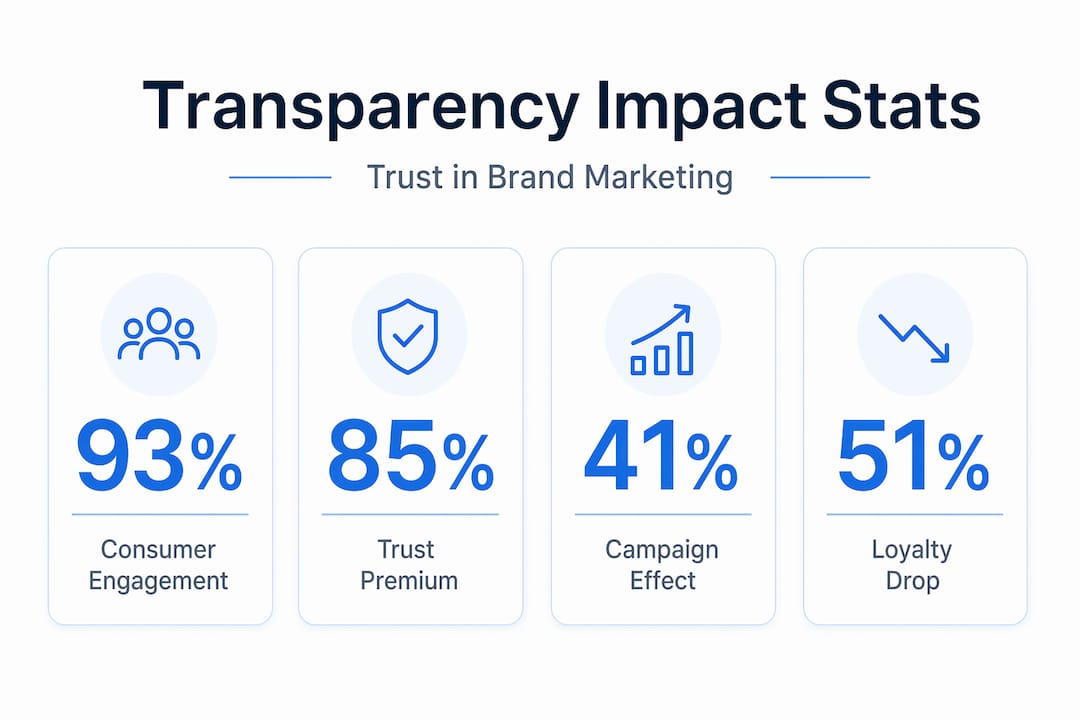
The generational dimension matters here too. According to a Queue-it survey, 90% of Gen Z consumers would pay more for brands they trust, with transparency and fair access practices being key trust drivers. This is the generation entering peak spending years. Getting their trust now is not just good ethics. It is smart long-term positioning.
The benefits of transparent marketing extend across the customer relationship:
- Pricing power. Trusted brands command higher prices without losing buyers.
- Reduced churn. Customers who trust a brand return and refer others more consistently.
- Shorter sales cycles. When claims are credible and verifiable, purchase hesitation drops.
- Stronger employee alignment. Internal teams believe in what they are marketing, which improves execution quality.
"Authentic brand engagement must be operational, not just messaging. Transparency should be consistent in communication and customer experience to build real trust." — Emplifi Survey, 2025
Transparency challenges and regulatory realities in 2026
Knowing the importance of marketing transparency and actually delivering it are two different problems. The gap between intention and execution is where most brands fail, and where regulators are increasingly active.
The ASA and CAP Annual Report for 2025 found that around a third of reviewed posts contained no disclosure at all. Another 9% used labels that were too vague to be understood by an average consumer. This is not a fringe problem among small content creators. These findings applied across professional digital advertising placements, including stories, short-form videos, and embedded promotions.
The regulatory landscape governing transparency in advertising now covers four core areas:
- Claim substantiation. Every objective claim about your product or service must be supported by documented evidence that can be produced on request.
- Clear and conspicuous disclosures. Labels like "Ad" or "Sponsored" must be prominent, placed upfront, and not buried in hashtag strings or end cards.
- AI content labeling. Medium-risk AI-generated content must be disclosed, while fabricated endorsements and deepfakes remain non-compliant regardless of any disclosure.
- Systemic disclosure design. Regulators now expect brands to prevent missing disclosures proactively through workflow-level controls rather than relying on platform auto-tags or individual creator judgment.
The critical shift in 2026 is that regulators are applying data-driven compliance enforcement, meaning they are auditing at scale using automated monitoring tools. The risk of being caught is no longer low just because your campaign is small.
Pro Tip: When running influencer campaigns or sponsored content, map every distribution format (story, reel, blog post, email) separately and assign a disclosure requirement to each format in your creative brief before production starts.
How to be transparent in marketing: practical steps
Implementing the importance of marketing transparency at the operational level requires more than good intentions. It requires systems that make transparency the default output of your workflow, not something layered on at the end.
The following practices move transparency from principle to execution:
- Maintain a claims evidence library. For every objective claim in active campaigns, link claims to supporting documentation in a centralized file. Update it whenever claims are revised or supporting data ages out.
- Design disclosures for comprehension, not compliance. A disclosure that technically satisfies a rule but confuses the average reader still damages trust. Test your labels with real people, not just legal reviewers.
- Map AI use to risk levels. If your team uses AI to generate testimonials, product images, or endorsements, assign each use case a risk tier and apply disclosure requirements accordingly.
- Build transparency into your creative brief. Disclosures, substantiation links, and labeling requirements should appear as mandatory fields in your brief template, not as an afterthought during legal review.
- Respond transparently to negative feedback. When customers post complaints publicly, a clear, honest response without deflection builds more trust than any marketing campaign could. Silence or corporate-speak does the opposite.
Transparency in brand communication also means being upfront about what you cannot do. Overpromising is one of the most common forms of marketing dishonesty, and customers remember it long after the campaign is over. For SMB digital advertising, this means setting realistic expectations in ad copy and landing pages rather than inflating outcomes to drive clicks.
Operationally, the brands that execute transparency best share one common trait. They treat it as a process that produces consistent output, not a value statement that produces occasional good behavior. You build that process by designing it into your production workflow from the start, the same way you design for accessibility or mobile responsiveness.

For businesses thinking about how to build this into their broader brand strategy, Sourcesnova's guide on building a strong digital brand covers how authenticity and consistent messaging work together to create long-term credibility.
My take on where most brands get transparency wrong
I have spent years working with small and mid-size businesses on their marketing, and the pattern I see most often is this: brands treat transparency as a communication problem when it is actually an operational one.
They write "honest and clear" into their brand values. Then they run a campaign with three undisclosed affiliate links, a headline claim with no substantiation, and an AI-generated review they forgot to label. The messaging says transparent. The system produces the opposite.
What I have found is that the businesses that genuinely win on trust are not necessarily saying more honest things than their competitors. They have built processes that make it structurally difficult to put something misleading into the world. Claim review is built into the content calendar. Disclosures are a required field in the creative brief. Evidence files are maintained by default, not scrambled together when a complaint arrives.
There is also a version of transparency that backfires. I have seen brands disclose every limitation of their product in the name of honesty and then wonder why conversions dropped. Transparency does not mean sharing every uncertainty. It means not creating false impressions. There is a real difference, and getting it wrong in either direction costs you.
The other thing I would push back on is the idea that Gen Z or any other cohort simply wants "more authentic content." What they actually want is brands that do not waste their time with manipulative tactics. That is a more specific and more useful framing. It means removing dark patterns, being direct about pricing, and making your claims defensible. That is transparency that actually builds trust.
— Tran
How Sourcesnova helps you market with confidence
Sourcesnova was built for businesses that are tired of paying for marketing that does not deliver and cannot explain why. Transparent marketing is not just an ethical stance. It is a growth strategy, and Sourcesnova helps you execute it with clarity. From setting honest campaign expectations to building content that substantiates your claims, Sourcesnova's approach covers the full picture. Explore service marketing strategies that prioritize real results, or see how Sourcesnova works with SMBs to turn trust into measurable growth. Ready to build marketing that works and earns trust at the same time? Contact Sourcesnova to get started.
FAQ
Why does transparency in marketing matter for business growth?
Trust-building ad campaigns outperform average campaigns by 41% in business effects, showing that transparency is directly linked to stronger revenue and market growth, not just brand goodwill.
What are the core elements of transparent marketing?
Transparent marketing includes substantiated claims, clear ad disclosures, honest pricing, and visible labeling for AI-generated content. It applies consistently across every channel and format your brand uses.
How does transparency affect customer loyalty?
85% of consumers are willing to pay more for brands they trust, and over half stop purchasing after a single inauthentic experience. Loyalty is directly tied to whether customers believe what you say.
What are the main regulatory requirements for transparency in advertising?
Advertising regulations require that all objective claims be substantiated, disclosures be clear and prominent, and AI-generated content carrying persuasive or health-related messaging be labeled. Regulators now use automated tools to audit compliance at scale.
How do small businesses implement transparent marketing practices?
Start with a claims evidence library, build disclosure requirements into your creative brief, and design labels for comprehension rather than just legal minimums. Sourcesnova's resources on SMB marketing strategies offer practical frameworks for getting this right from the start.