
Many small business owners assume digital branding means having a logo and a website. That assumption is costing them customers. Local marketing benchmarking shows that a significant share of SMBs still miss the core fundamentals of being found, being chosen, and building loyalty online. The result is invisible businesses with solid products and zero traction. This guide breaks down exactly what digital branding is, where most local businesses fall short, and the specific steps you can take to build an online presence that actually drives growth.
Table of Contents
- What is digital branding and why does it matter?
- Build your digital branding foundation: Step-by-step essentials
- Operationalize brand consistency across channels
- Fixing common digital branding gaps: Data-driven local impact
- Brand guidelines for ads: Navigating legal names and logo quality
- Why most guides miss the real leverage in digital branding
- Take your digital branding further with expert support
- Frequently asked questions
Key Takeaways
| Point | Details |
|---|---|
| Branding is more than design | Digital branding covers every online touchpoint, not just logos or websites. |
| Build foundations first | Start with Google Business Profile, SEO, and reviews before paid ads. |
| Consistency drives growth | Operational brand consistency across channels increases trust and conversion. |
| Fix core gaps fast | Claim listings, add CTAs, and engage reviews to outperform local competitors. |
| Brand guidelines in ads | Ad campaigns require logo quality and verified business names for approval and relevance. |
What is digital branding and why does it matter?
Digital branding is not your logo or your website color palette. It is the full picture of how your business presents itself and interacts with customers across every online touchpoint. That includes your Google Business Profile, your social media tone, your email signature, how fast you respond to reviews, and even the wording on your checkout page.
According to digital brand management best practices, small businesses get the most value when they treat digital branding as creating a consistent identity and customer experience across every online channel, not just a design project. This is a critical distinction. Design is a deliverable. Branding is an ongoing process.
Digital branding is what makes a stranger trust you enough to become a customer before they ever meet you in person.
Here is why this distinction matters for local businesses. Marketing generates attention. Branding determines whether that attention converts. If your paid ad drives 500 people to your website but your site looks inconsistent, your reviews are unanswered, and your contact information is wrong on three different platforms, you are paying for attention you cannot capture.
The benefits of getting this right include:
- Stronger trust signals. Consistent visuals and messaging tell customers you are professional and reliable.
- Higher conversion rates. Customers who recognize your brand across channels are more likely to act.
- Better word of mouth. A clear brand identity makes it easier for satisfied customers to describe and refer your business.
- Lower paid ad costs over time. Strong organic brand equity reduces dependency on constant ad spend.
You can read more about how these pieces connect in our overview of digital marketing for small businesses. Branding and marketing work best when they are paired intentionally, not managed as separate departments.
Build your digital branding foundation: Step-by-step essentials
Now that you understand digital branding's importance, here is how to start building it from the ground up. Many local business owners make the mistake of jumping straight to paid advertising before the foundation is in place. Starting with fundamentals like your Google Business Profile and basic SEO, before scaling into paid ads, is the smarter sequence that actually produces results.
Here is a practical starting order:
- Claim and fully complete your Google Business Profile. Add your business name, category, hours, phone number, website URL, service area, and photos. An incomplete profile signals neglect to potential customers and reduces your local search visibility significantly.
- Audit your name, address, and phone (NAP) consistency. Check every directory where your business is listed, including Yelp, Apple Maps, Facebook, and industry-specific platforms. Inconsistent information confuses search engines and customers alike.
- Establish a clean, mobile-optimized website. Your website is the single most controllable brand asset you own. Make sure it loads in under three seconds, communicates your core offer clearly, and includes a visible call to action on every page.
- Set up basic on-page SEO. This means using your target keywords in your page titles, meta descriptions, header tags, and image alt text. This does not require a technical background. It requires consistency and attention to detail.
- Create a review management habit. Ask every satisfied customer for a review. Respond to every review you receive, both positive and negative. This single habit compounds your trust signals over time faster than almost any other action.
- Align your brand visuals and tone across platforms. Use the same profile photo, cover image, logo version, and voice on your website, Google profile, Facebook page, and anywhere else you appear online.
You can explore more of these essential SMB marketing strategies that complement a strong brand foundation. For businesses that want to build credibility with media and local publications, digital PR for small business is another high-leverage move.
Pro Tip: Set a recurring monthly reminder to check your Google Business Profile, respond to any new reviews, and verify that your hours and contact information are still accurate. This 20-minute monthly task prevents the kind of trust erosion that sends customers straight to a competitor.
Operationalize brand consistency across channels
Once the basics are in place, you need to manage your brand consistently everywhere online. Most businesses set up their branding once and never revisit it. That approach leads to outdated logos on some platforms, different color shades across materials, and messaging that drifts over time as different team members handle different channels.

Brand consistency must be operationalized across channels with shared governance, including templates and asset rules, and it should be measured regularly, not treated as a one-time creative task. That sounds formal, but for a small business, it simply means having a shared folder with approved assets and a short checklist anyone on your team can follow.
Here is a practical comparison of three brand governance approaches most SMBs fall into:
| Governance level | What it looks like | Risk |
|---|---|---|
| Ad hoc | Brand assets stored in personal email or phone camera rolls, no documentation | High inconsistency, team confusion, off-brand materials |
| Basic | Shared Google Drive folder with approved logo files, one-page brand guide | Low inconsistency, easy to maintain |
| Advanced | Formal brand guidelines document, approval workflow, periodic brand audits | Minimal inconsistency, scalable as team grows |
Most local businesses only need the basic level to see a major improvement. A one-page brand guide covering your logo versions, color codes, approved fonts, and tone of voice is enough to bring real discipline to your brand management. You can make this document yourself in a few hours and share it with anyone who creates content or manages accounts for your business.
Key elements your basic brand guide should include:
- Logo files in full color, black, and white, in both PNG and SVG formats
- Primary and secondary color hex codes so there is no guessing
- Font names and sizing rules for headlines and body text
- Tone guidelines with three to five words that describe your brand voice (for example: professional, warm, direct)
- What not to do with your logo or messaging, including stretched versions or unapproved color combinations
Streamlining your digital marketing workflow makes it far easier to enforce brand consistency without adding hours to your workweek.
Pro Tip: Create a simple two-column checklist with "approved" and "not approved" examples for your logo and color use. Paste it into the top of your shared brand folder. Anyone creating marketing materials can review it in 60 seconds before publishing anything.
Fixing common digital branding gaps: Data-driven local impact
Even with systems, many local businesses still miss crucial steps. Here are the most common gaps and how to fix them.
Benchmarking research on local marketing maturity shows that a large portion of SMBs fail to execute the three most fundamental branding functions: getting found, being chosen, and building loyalty. These are not advanced tactics. They are basic steps that, when skipped, quietly drain revenue month after month.
Missing a local listing or ignoring a review is not a small oversight. It is a direct signal to your next potential customer that no one is minding the store.
Here is a breakdown of the most commonly missed branding fundamentals and their business impact:
| Branding gap | Prevalence among SMBs | Business impact |
|---|---|---|
| Incomplete or unclaimed local listings | Very high | Reduced local search visibility, lost foot traffic |
| Missing or weak calls to action | High | Lower website conversion rates |
| Unanswered customer reviews | High | Reduced trust, lower average star rating over time |
| Inconsistent NAP data across platforms | Moderate to high | Confusion for customers and search engines |
| No mobile-optimized website | Moderate | High bounce rates from mobile visitors |
Actionable fixes for each of these gaps:
- For local listings: Use a tool or manual audit to find every platform where your business appears or should appear. Claim each listing, verify accuracy, and add photos and a description.
- For weak CTAs: Every page of your website and every social media post should answer the question, "What do you want the reader to do next?" Make that action explicit, visible, and easy.
- For unanswered reviews: Set a weekly reminder to log in and respond. Even a two-sentence response to a positive review shows potential customers that you are active and engaged.
- For inconsistent NAP data: Create a master record of your exact business name, address, and phone number. Use that exact format everywhere. Even small differences like "St." versus "Street" can cause issues.
Connecting your brand presence to your broader social media growth strategy magnifies these fixes. A strong brand foundation also feeds into digital growth outcomes that go beyond visibility into actual revenue.
Brand guidelines for ads: Navigating legal names and logo quality
To truly scale, brand guidelines extend to advertising. This is where many small business owners get caught off guard.
When running digital ads, particularly through platforms like Google's Performance Max, your brand assets are not just creative choices. They are functional requirements. Performance Max brand guidelines specify that logo quality and accurate business name use can affect ad approval status and asset relevance scores. A blurry logo or an inconsistent business name in your ad assets creates credibility problems and operational friction.
Key considerations when applying brand guidelines to your ad campaigns:
- Use high-resolution logos only. Low-quality images can be rejected by ad platforms or appear unprofessional in display placements.
- Match your legal business name exactly. If your legal name is "Sunrise Nail Studio LLC," your ad assets should reflect the version customers recognize, but it must align with your registered name where required.
- Keep your brand voice consistent in ad copy. The tone of your ads should match your website and social channels. Inconsistency confuses potential customers who encounter your brand across multiple touchpoints.
- Avoid using off-brand stock photos. Images should match the look and feel of your other brand materials. A polished website paired with generic stock photos in your ads creates a disconnect.
Statistic to note: Approximately 70% of businesses are not actively tracking website conversions from their ad campaigns. That means the majority of SMBs spending money on ads have no way to measure whether their branding and ad investment is actually working. Setting up basic conversion tracking in Google Analytics and Google Ads is a non-negotiable step before scaling any paid campaign.
Getting your ads right requires the same brand discipline as your organic presence. Our SMB advertising guide covers how to build campaigns that align with your brand and actually convert.
Why most guides miss the real leverage in digital branding
Most branding guides for small businesses spend the majority of their content on design. Fonts, colors, logos, mood boards. Those elements matter, but they are not where most businesses lose or win.
The real leverage in digital branding comes from operational consistency and customer journey optimization. What that means in practice: a customer who finds your business on Google, visits your website, reads your reviews, and then gets a follow-up email after purchase should feel like they encountered one coherent business throughout. Not three different departments with different tones, visuals, and quality levels.
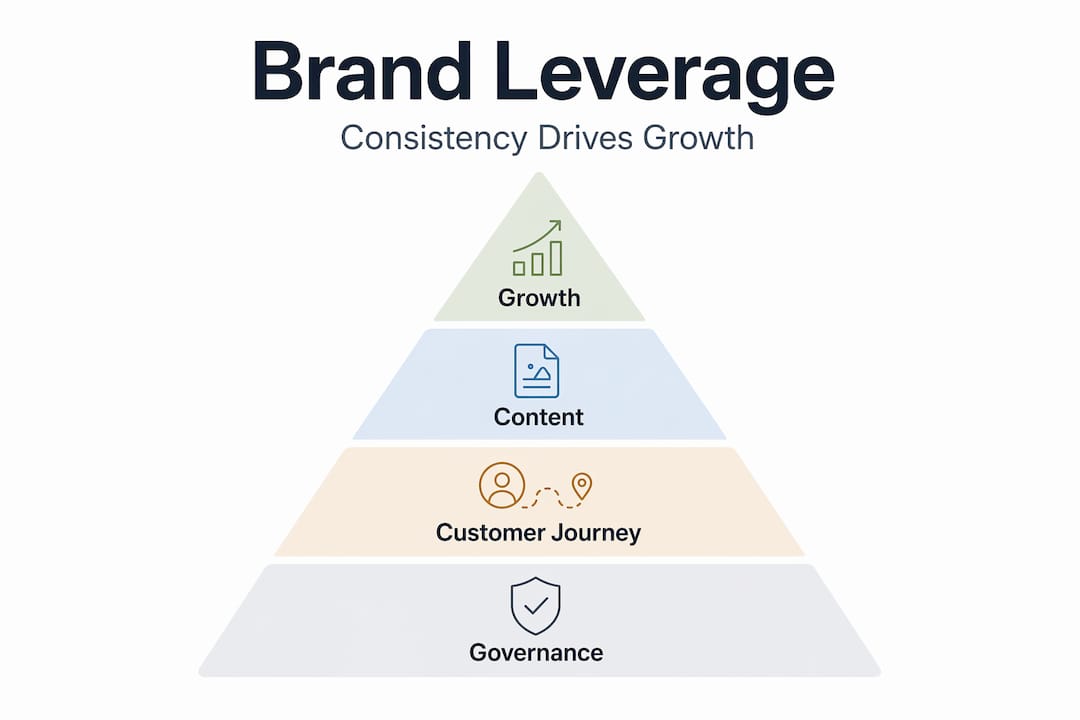
The businesses we see grow fastest are not always the ones with the best-looking logos. They are the ones that respond to reviews within 24 hours, keep their listings updated, make it easy for customers to take the next step, and measure what is working. That is operational branding. It is far less glamorous than a rebrand, and it delivers far more measurable return.
Most guides also treat branding and marketing as separate disciplines. That siloed thinking is a liability for small businesses with limited time and resources. When your marketing strategies for SMBs and your brand identity are built together, every campaign reinforces your credibility instead of starting from scratch. And when you pair that with smart digital PR for SMBs, your brand builds compounding authority over time.
The uncomfortable truth is that most small business owners do not need a more creative brand. They need a more consistent one. Consistency is a systems problem, not a design problem. Solve the systems, and the brand takes care of itself.
Take your digital branding further with expert support
Building a strong digital brand takes more than reading the right articles. It takes consistent execution, the right tools, and a clear strategy that connects every channel to your business goals.
At SourcesNova, we work directly with local and small-to-mid-size businesses to build brand presence that drives real growth. From Google Business Profile optimization and brand consistency audits to content strategy and ad campaign setup, our team handles the execution so you can focus on running your business. No jargon, no inflated retainers, and no vanity metrics. If you are ready to build a digital brand that actually converts, explore what digital branding support looks like with a team that treats your business like their own.
Frequently asked questions
How can small businesses quickly improve their digital branding?
Start by claiming your Google Business Profile and responding to customer reviews to build trust and local visibility. Building fundamentals first before investing in paid ads gives you a stronger foundation that makes every future marketing dollar more effective.
What's the most common mistake in SMB digital branding?
Most SMBs treat branding as a one-time task, but lasting success requires consistent updates and operational governance. Operationalizing brand consistency with shared templates and regular audits is what separates businesses that grow from those that stagnate.
Why do local listings and CTAs matter for digital branding?
They ensure your business is found and chosen online, driving customer action and loyalty at critical decision moments. Benchmarking data consistently shows these are among the most commonly missed fundamentals that directly affect local revenue.
How does logo quality influence SMB ad performance?
Logo clarity and name accuracy can impact ad approval and credibility, especially with platforms like Performance Max. Ad platform brand guidelines require high-resolution assets and accurate business names to maintain approval status and asset relevance scores.