
Most small and mid-sized businesses are invisible online, not because their products or services fall short, but because no one outside their existing customer base knows they exist. Earning media attention feels out of reach without a big budget or agency connections. Digital PR changes that equation. As digital PR strategy experts define it, the practice involves creating newsworthy content like original research, data studies, and expert commentary to earn media coverage, backlinks, and improved SEO visibility. This guide walks through every stage of building a campaign that works, from defining goals to measuring real returns.
Table of Contents
- Understand digital PR: What is it and why does it matter?
- Prepare your campaign: Tools, resources, and goal setting
- Build newsworthy content: Data, research, and expert insights
- Pitch and outreach: How to connect with journalists
- Measure success: Tracking ROI and troubleshooting
- What most digital PR guides overlook: Brand building beyond links
- Next steps: Powered digital PR support for your business
- Frequently asked questions
Key Takeaways
| Point | Details |
|---|---|
| Start with accessible tactics | Small businesses can use expert commentary and local press releases without big budgets. |
| Focus on newsworthy content | Original research and data studies are most likely to attract journalist attention. |
| Personalize outreach | Tailored, relevant pitches significantly increase media pickup rates. |
| Measure what matters | Track ROI through traffic and conversions, not just backlinks. |
| Aim for long-term brand building | Building a recognizable online entity pays off more than chasing individual links. |
Understand digital PR: What is it and why does it matter?
Digital PR is the practice of earning online media coverage through credible, newsworthy content rather than paying for ad placements. It bridges public relations and SEO, producing tangible benefits on both fronts. For a small business owner, that means articles about your brand appear in industry publications, blogs, and news sites, with links pointing back to your website.
Many people confuse digital PR with basic link building. They are not the same thing. Digital PR earns organically rather than through purchased placements, and in 2026 it has shifted toward building brand and entity signals rather than simply chasing backlinks. Entity building means establishing your brand as a recognized, trusted name across the web, the kind of recognition that matters to Google's systems and to AI-powered search experiences.
Traditional PR, by contrast, focuses on offline media like print newspapers, TV, and radio. It rarely prioritizes SEO outcomes. Digital PR combines the storytelling discipline of traditional PR with the strategic link acquisition and brand amplification that drives search performance.
Here is a clear comparison:
| Factor | Traditional PR | Digital PR |
|---|---|---|
| Primary channel | Print, broadcast, events | Online media, blogs, podcasts |
| SEO benefit | Minimal | High (backlinks, brand signals) |
| Cost model | Often paid placements | Earned coverage |
| Measurement | Reach and impressions | Backlinks, traffic, DR, conversions |
| Speed of results | Slow, episodic | Scalable and cumulative |
Key outcomes digital PR delivers for SMBs include:
- Improved domain authority through high-quality backlinks
- Increased organic search rankings for target keywords
- Referral traffic from reputable publications
- Stronger brand trust and credibility with new audiences
- Opportunities for journalists to quote your business as an expert source
"Digital PR is not about gaming an algorithm. It is about building a brand that publishers want to reference and readers want to trust."
Learning more about digital marketing for SMBs provides useful context for where digital PR fits within a broader growth strategy.
Prepare your campaign: Tools, resources, and goal setting
Before sending a single pitch or writing a press release, solid preparation separates campaigns that get traction from campaigns that go nowhere. The right tools and clearly defined goals make execution far more efficient.
Essential tools for SMB digital PR campaigns:
- Press release templates: Use tools like Prowly or a simple Google Docs template to standardize your announcements
- Outreach platforms: HARO (now Connectively), Muck Rack, and Cision help identify journalists covering your industry
- Analytics platforms: Google Analytics 4 tracks referral traffic and conversions from earned media
- Backlink tracking: Ahrefs and SEMrush monitor new links, domain rating changes, and competitor coverage
Tracking the right numbers matters as much as the tools themselves. According to state of digital PR data, the metrics that signal real campaign impact include backlink quality measured by domain rating (DR), referral traffic volume, media mentions, organic traffic growth, and overall domain authority improvement.
Here is a practical overview of key metrics and benchmarks:
| Metric | What it measures | Recommended tool |
|---|---|---|
| Domain rating (DR) | Authority of linking site | Ahrefs |
| Referral traffic | Visits from earned coverage | Google Analytics 4 |
| Media mentions | Brand name appearances online | Google Alerts, Mention |
| Organic traffic growth | SEO impact over time | SEMrush, Google Search Console |
| Conversion rate from referrals | Revenue tied to PR efforts | Google Analytics 4 |
Setting SMART goals, meaning specific, measurable, achievable, relevant, and time-bound goals, gives every campaign a clear direction. For example, a goal like "earn five backlinks from DR 50-plus publications within 90 days" is actionable. A goal like "get more press" is not.
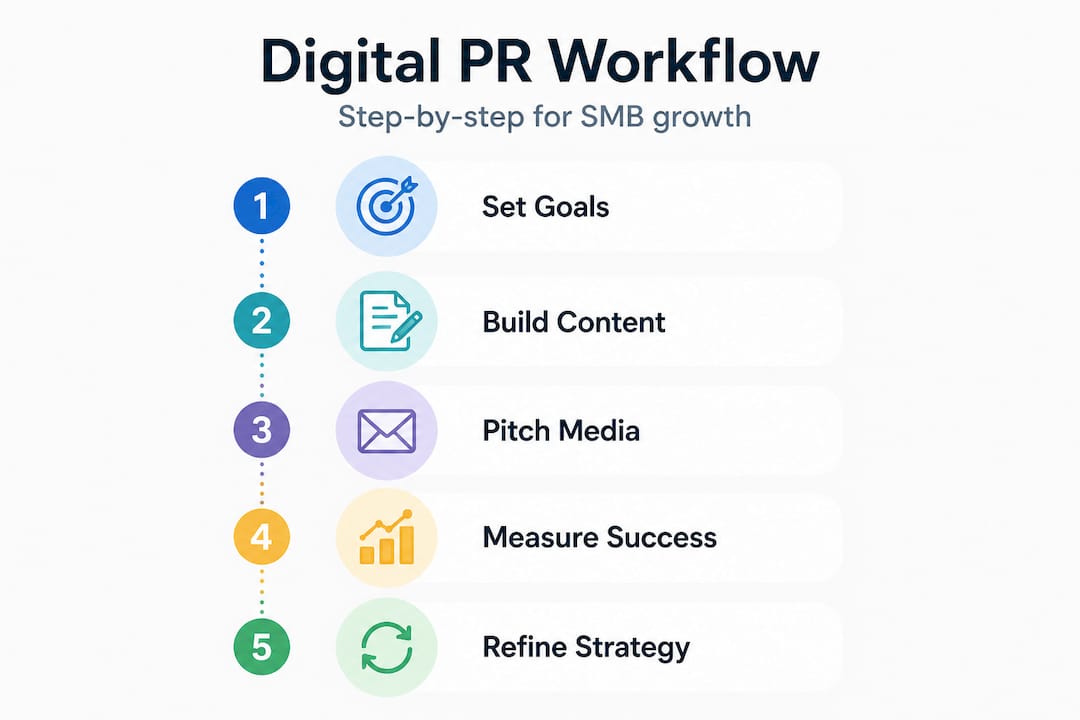
According to 2026 state of digital PR benchmarks, the two biggest challenges practitioners face are securing coverage at 26.4% and measuring results accurately at 14.9%. Both challenges become manageable when you establish a consistent content calendar and align your PR activity with hybrid SEO and PR goals from the start. Monitoring digital growth measurement frameworks can also clarify how to interpret early campaign data.
Pro Tip: Start with Google Alerts for brand and competitor monitoring before investing in paid tools. Once you see initial coverage and need deeper backlink data, then upgrade to Ahrefs or SEMrush.
Build newsworthy content: Data, research, and expert insights
The quality of your content determines whether journalists respond to your pitch or ignore it. Generic thought leadership pieces rarely earn coverage. Original data and actionable insights do.
According to 2026 link building outreach research, the core methodologies that consistently attract journalist attention include conducting proprietary surveys with 500 or more respondents, producing index reports, performing trend analysis, and creating interactive tools like calculators. Each of these approaches gives a journalist something genuinely useful to reference or share.
Step-by-step process for generating original research as an SMB:
- Identify a relevant industry question. What does your target audience or customer base want answered? What do journalists covering your niche regularly write about?
- Choose your research method. For small budgets, use a Google Forms survey distributed through your email list, social media channels, or platforms like SurveyMonkey Audience for paid respondents.
- Collect at least 100 to 300 responses. Larger sample sizes increase credibility, but even modest surveys produce quotable data points if the question is relevant.
- Analyze findings and identify three to five headline-worthy statistics. Focus on surprising or counterintuitive results that challenge common assumptions.
- Package results into a shareable asset. A one-page PDF summary, an infographic, or a dedicated landing page all work well for journalist reference.
- Draft an expert commentary layer. Add your interpretation of the data. What does it mean for customers or your industry? This is what makes you quotable.
Pro Tip: Public data sources like the U.S. Census Bureau, Bureau of Labor Statistics, and industry association reports are free to access and can be reanalyzed to produce fresh angles. Combining two public datasets in a new way often produces coverage-worthy insights without survey costs.
Industry benchmark: According to 2026 benchmarks, the average domain rating (DR) of sites providing coverage for data-led PR campaigns is 61, meaning your content is earning links from highly authoritative publications when executed correctly.
Strong content also supports the broader marketing efforts outlined in marketing strategies for SMBs, reinforcing brand credibility across multiple channels simultaneously.
Pitch and outreach: How to connect with journalists
Creating excellent content is half the job. Getting it in front of the right journalists is the other half. Outreach is where many small businesses lose momentum because they treat it as a mass email exercise rather than a targeted communication effort.

Research on journalist preferences shows that 47% of journalists say they rarely receive pitches that are actually relevant to their beat. That number represents a significant opportunity for businesses willing to do the research.
Smart outreach tactics for SMBs:
- Research journalist beats before pitching. Read their last five to ten articles. Understand what topics, angles, and formats they favor. Reference a specific article in your pitch opening.
- Lead with the news hook, not your business. Journalists care about what their readers find valuable. Frame your pitch around the insight or data, not around promoting your brand.
- Keep pitches under 200 words. Busy journalists skim. State the story, explain why it matters now, and include a link to supporting materials.
- Use timely triggers. Link your story to a seasonal event, recent industry news, regulatory change, or trending topic to increase relevance.
- Follow up once. Send a polite follow-up email after five to seven business days if you receive no reply. Do not send multiple follow-ups.
"The best pitches feel like they were written by someone who has actually read the publication they are pitching, not like they were sent to a list of 500 contacts at once."
For small businesses, starting with expert commentary, public data analysis, local media relationships, and press releases does not require large budgets. Local newspapers, regional business journals, and niche industry blogs are often far easier to place stories with and still provide valuable backlinks and credibility signals.
Outreach channels to consider include email, social media platforms like LinkedIn and X, and tools like HARO (Connectively) that directly connect journalists seeking expert sources with business owners. Distributing content through a well-maintained B2B newsletter can also help seed stories before formal pitching begins. For amplification, a structured social media strategy ensures coverage gets shared beyond the original publication.
Pro Tip: Use AI tools like ChatGPT to draft initial pitch structures, then personalize them heavily before sending. AI accelerates the structural work; human judgment ensures the pitch feels authentic and targeted.
Measure success: Tracking ROI and troubleshooting
Once a campaign launches, measurement is not optional. Without clear tracking, it is impossible to know what is working, what needs adjustment, or how to justify continued investment.
Core measurement steps:
- Connect Google Analytics 4 to your website and set up referral traffic segments to isolate PR-sourced visits
- Use Ahrefs or SEMrush to track backlink quality including DR, anchor text, and linking page context
- Set up Google Alerts and Mention.com to capture brand name appearances in real time
- Monitor organic ranking changes for target keywords over 8 to 16 week windows
- Track goal completions in GA4, meaning form fills, purchases, or phone calls tied to referral traffic
Industry benchmarks from 2026 to guide your evaluation:
| Benchmark | Value |
|---|---|
| Campaigns using data-led content | 95.9% |
| Campaigns using press releases | 85.1% |
| Average DR of earned coverage | 61 |
| Typical cost per link | $300 to $500 |
| Practitioners avoiding paid links | 80% |
Troubleshooting common gaps:
- Coverage secured but no traffic increase: Check whether the linking page is indexed and whether the link is followed. A no-follow link still has brand value but less SEO impact.
- Pitches sent but no response: Revisit the relevance of your story angle and journalist fit. Consider testing a different hook or switching to local media first.
- Backlinks earned but rankings not moving: Allow more time, typically 12 weeks minimum, and confirm that on-page SEO basics on the target landing page are solid.
Connecting measuring growth success to your broader digital performance framework ensures PR results are evaluated in the full context of business impact, not just link counts.
What most digital PR guides overlook: Brand building beyond links
Most digital PR tutorials stop at backlinks. Count the links, celebrate the DR scores, move on to the next campaign. That approach misses the deeper value that digital PR creates for small businesses over time.
Digital PR in 2026 has fundamentally shifted from pure link acquisition toward entity and brand signal building. Google and AI-powered search systems increasingly recognize brands as trusted entities, meaning consistent mentions, citations, and references across authoritative publications build a form of trust that no single backlink delivers on its own.
Here is the uncomfortable truth: a business that earns 50 mentions across credible publications without always securing a followed link is often better positioned than a competitor chasing 10 high-DR links through transactional placements. Brand signals accumulate and compound. They tell search systems that your business is a real, recognized entity in your industry.
The duplication method offers a practical, sustainable framework. When a pitch structure performs well, analyze why. What angle worked? What data resonated? Then rebuild similar structures with fresh data and new timing for ongoing campaigns. This approach reduces guesswork and builds an institutional knowledge base that improves every subsequent campaign.
AI-driven search results, including Google's AI Overviews and tools like Perplexity, draw on brand signals and authoritative citations when generating answers. A business consistently cited in credible sources is more likely to appear in these AI responses than one with an isolated link profile.
Seasonal awareness also matters. PR timing tied to industry events, regulatory announcements, or annual reports consistently outperforms content pitched without a clear news hook. Planning a digital marketing workflow that incorporates seasonal PR moments throughout the year creates compounding visibility rather than isolated spikes.
The bottom line: chase brand recognition and journalist relationships. The links and rankings follow as a natural consequence of doing that well.
Next steps: Powered digital PR support for your business
Implementing a consistent digital PR strategy takes time, expertise, and the right partnerships. Many small business owners understand the framework but lack the bandwidth to execute campaigns alongside running daily operations.
SourcesNova works directly with local and small-to-mid-size businesses to build digital PR strategies that earn real coverage, generate quality backlinks, and drive measurable traffic growth. No jargon, no vanity metrics, no bloated retainers. From content ideation and journalist outreach to ROI tracking and ongoing optimization, the team treats every client's business with the same focus and care as their own. Explore how digital PR solutions at SourcesNova can help your business earn the visibility it deserves, starting with a clear, honest conversation about your goals.
Frequently asked questions
What is digital PR and how is it different from traditional PR?
Digital PR focuses on earning online media coverage and backlinks through newsworthy content, while traditional PR relies on offline channels and paid placements. As outlined in the digital PR strategy guide, digital PR specifically targets SEO visibility alongside brand recognition.
How much does a typical digital PR campaign cost for small businesses?
Small businesses can launch effective campaigns using expert commentary, public data, and press releases without large budgets. According to 2026 industry benchmarks, the average cost per earned link is $300 to $500, and simple tactics like local media pitching require minimal financial investment.
What are the best ways to measure digital PR success?
Track backlinks, referral traffic, media mentions, and organic growth using tools like Ahrefs, SEMrush, and Google Analytics. State of digital PR data confirms these are the primary indicators of genuine campaign impact.
How long does it take to see ROI from digital PR efforts?
SEO results typically take 8 to 16 weeks to register, but well-targeted campaigns often produce media coverage and referral traffic sooner. According to digital PR statistics, top Google results hold 3.8 times more backlinks, and average digital PR ROI reaches 6.1 times investment.
How can small businesses stand out when pitching to journalists?
Research journalist beats, personalize every pitch, provide timely hooks, and avoid generic outreach. Journalist research data shows that 47% of journalists rarely receive pitches relevant to their beat, making personalization the single most effective differentiator.