
Running a small business means every dollar and every hour counts. The wrong marketing strategies for small businesses don't just waste money. They waste momentum. With dozens of channels competing for your attention and budget, knowing where to focus is the real challenge. This article cuts through the noise with a practical, prioritized look at the strategies that actually move the needle in 2026. From email and social media to AI-powered automation, you'll find a clear path from confusion to consistent customer growth.
Table of Contents
- Key takeaways
- 1. How to choose marketing strategies for small businesses
- 2. Social media marketing
- 3. Email marketing
- 4. Content marketing for small businesses
- 5. AI and automation tools
- 6. Local marketing strategies
- 7. Paid advertising as an amplifier
- My take on small business marketing in 2026
- Ready to put these strategies to work?
- FAQ
Key takeaways
| Point | Details |
|---|---|
| Own your assets first | Build SEO content, email lists, and your Google Business Profile before spending on paid ads. |
| Social and email lead channels | 68% of small businesses rank social media as their most valuable channel, with email close behind. |
| Document your content plan | A written content strategy can boost business success by 313% compared to no plan. |
| Track business metrics, not vanity | Measure conversion rate and cost-per-lead, not followers and likes. |
| Integrate channels for impact | SEO, social, email, and paid ads work best when connected, not run in silos. |
1. How to choose marketing strategies for small businesses
Before picking any channel, you need a framework. Without one, you end up chasing trends and spreading your budget too thin.
The smartest approach focuses on four criteria: measurable results, scalability, low cost to start, and how well the channel connects with the others you already use. A channel that ticks all four is worth prioritizing. A channel that only checks one box is a maybe, not a must.
Here is what that looks like in practice:
- Start with owned and organic assets. Your website, email list, and Google Business Profile cost little to maintain and compound in value over time. Build these first before scaling paid advertising.
- Limit your focus. Integrated marketing across 3 to 5 channels consistently outperforms scattered efforts across ten.
- Track the right numbers. Most small business owners make the mistake of chasing vanity metrics like follower counts instead of tracking conversion rate, cost-per-lead, and monthly sales.
- Use AI to save time. Automation tools handle repetitive tasks so you can focus on decisions, not execution.
- Connect your channels. When your SEO content feeds your email list, and your email list drives social engagement, each channel makes the others stronger.
Pro Tip: Set a 90-day goal for each marketing channel you launch. Measure one primary metric. If it isn't trending in the right direction after 90 days, adjust the tactic before adding a new channel.
For a deeper look at digital marketing for small businesses, Sourcesnova has built a practical overview that aligns with these criteria.
2. Social media marketing
Social media is the top channel for small businesses heading into 2026, with 68% expecting it to deliver the most value. That number is not surprising. Social platforms let you reach new customers, build credibility, and run paid ads, all from one place.
The key is not to be everywhere. Pick two or three platforms where your audience actually spends time and commit to showing up consistently on those.
- Combine organic and paid efforts. Organic posts build trust. Paid social amplifies reach. Both together outperform either one alone.
- Prioritize community over broadcasting. Respond to comments. Ask questions. Share behind-the-scenes content. Engagement signals matter more than posting frequency.
- Drive traffic off-platform. Every post should have a purpose. Link to your website, your email signup, or a product page. Social media is the top of the funnel, not the finish line.
- Repurpose content. A blog post becomes a carousel. A customer testimonial becomes a graphic. One piece of content can live across three platforms with minor adjustments.
Pro Tip: Post three times per week on your primary platform before expanding to a second. Consistency on one channel beats inconsistency on five.
73% of marketers say social media is effective for reaching new audiences in 2026. That reach matters most when your content is worth sharing.
3. Email marketing
Email is the channel most small businesses underestimate until they actually use it. An email marketing ROI of $42 for every $1 spent is not a rounding error. It is the highest return of any digital channel available to small businesses today.
The reason is simple. You own your email list. No algorithm change can cut your reach overnight. No platform ban can take your audience away. That kind of stability is rare in digital marketing.
To get real results from email, structure matters:
- Segment your list. New subscribers, past customers, and cold leads should not receive the same message. Segmented lists produce 14.32% higher open rates and nearly 101% higher click-through rates.
- Automate three core sequences. A welcome email series, a re-engagement campaign for inactive subscribers, and a post-purchase follow-up cover the majority of your customer lifecycle.
- Balance content types. A good rule of thumb is two educational emails for every one promotional email. Value first, offer second.
- Use visuals and clear calls to action. One primary call to action per email performs better than multiple competing options.
Pro Tip: Your subject line determines whether your email gets opened. Write it last, after the body copy is done, so you know exactly what you are promising.
Sourcesnova has a dedicated resource on winning email strategies that goes deeper on segmentation and automation for small businesses.
4. Content marketing for small businesses
Content marketing rewards patience. Done right, it builds the kind of authority that makes customers trust you before they ever speak to you. A documented content plan increases the likelihood of business success by 313%. That alone should make it a non-negotiable part of your strategy.

The trap most small businesses fall into is creating content for its own sake. Volume does not drive results. Relevance does. Buyer-intent content that answers specific questions at the right stage of the buying process outperforms generic blogs every time.
Here is a content format comparison to help you prioritize:
| Content type | Best use | Time to produce | Longevity |
|---|---|---|---|
| Blog post | SEO, authority building | Medium | High |
| Short-form video | Social engagement, awareness | Low to medium | Low |
| Infographic | Data storytelling, shares | Medium | Medium |
| Email newsletter | Retention, nurture | Low | Medium |
| Case study | Trust, late-stage buyers | High | High |
- Use a content calendar. Publish on a schedule, even if that means one post per week. Consistency signals credibility to both audiences and search engines.
- Tell real stories. Customer outcomes, behind-the-scenes process, and founder perspective connect better than product feature lists.
- Promote what you create. Distribute every piece of content across your social channels and email list. Good content that nobody sees helps nobody.
Pro Tip: Start with a list of the ten most common questions your customers ask before they buy. Write one piece of content answering each question. That is ten months of focused, buyer-intent content right there.
5. AI and automation tools
Artificial intelligence has moved from a competitive advantage to a practical necessity for small business marketing. 54% of small businesses actively use AI for marketing as of 2026, with another 27% planning to start.
The appeal is straightforward. AI turns hours of content creation into roughly 10 minutes of editing. You generate a draft, refine it, and publish. What used to take a full afternoon now takes a lunch break.
Here is where AI adds the most value for small businesses:
- Content drafting and editing. AI writes first drafts of blog posts, social captions, and email copy. You provide the direction and the final voice.
- Trend and keyword analysis. AI tools surface what your audience is searching for, so your content stays relevant.
- Image generation. Branded visuals for social media and ads without the cost of a designer for every asset.
- Social media scheduling. Automation tools publish your content at optimal times without manual effort.
- Email workflow automation. Welcome sequences, abandoned cart reminders, and re-engagement campaigns run without you touching them after the initial setup.
The critical distinction is that AI handles execution. Strategy still requires a human. Use it as an assistant, not a replacement for thinking about your business.
Pro Tip: Set up one automated email sequence before you do anything else with AI. A three-email welcome series that runs on autopilot is more valuable than any amount of manually written content.
Automation tools that create marketing systems working autonomously improve efficiency without adding to your weekly workload.
6. Local marketing strategies
For businesses with a physical location or a defined service area, local marketing is one of the highest-ROI moves available. Most of your best customers are already nearby. The goal is to make sure they find you first.
Start with your Google Business Profile. Claim it, complete every section, and post updates weekly. Businesses with complete profiles receive significantly more calls and direction requests than those with incomplete listings. Reviews matter here too. A steady stream of genuine customer reviews builds trust faster than any ad.
Local SEO extends this further. Use location-specific keywords in your website content, your service pages, and your blog posts. "Best nail salon in Austin" will drive far more qualified traffic than "best nail salon," because the person searching is ready to book.
Community involvement also works as a small business promotion strategy. Sponsor a local event, partner with a neighboring business for a joint promotion, or show up in local Facebook groups with genuinely helpful advice. These actions build the kind of brand recognition that advertising alone cannot buy.
7. Paid advertising as an amplifier
Paid ads work. But they only work well when the foundation underneath them is solid. Scaling paid ads without an organic foundation wastes budget on traffic that has nowhere meaningful to go.
Think of paid advertising as an amplifier for what already converts. If your email capture page is converting at 3% organically, paid traffic to that page has a proven floor to build on. If your messaging is untested and your site is not converting, paid ads accelerate the loss, not the gain.
For small business advertising, Google Search ads and Meta ads are the two most practical starting points. Google captures demand that already exists. Meta creates demand by putting your offer in front of people who match your customer profile. Both have a role in a mature marketing mix, but neither should come first.
Start with a small daily budget, $10 to $20 per day, test two to three versions of your ad copy, and let the data tell you which message resonates. Effective messaging is discovered through testing and listening to real customer language, not invented in isolation.
My take on small business marketing in 2026
I've worked with enough small business owners to know the most common marketing mistake. It's not the wrong channel. It's doing too many things at once without a connecting logic between them.
I've seen businesses with a decent Instagram following, a dormant email list, a blog that hasn't been updated in eight months, and a paid ads campaign bleeding money. Every channel is technically active. None of them are working together.
What I've found actually works is sequencing. You build the organic foundation first, SEO content and a Google Business Profile that earns trust while you sleep. Then you add email capture to convert that traffic into a list you own. Then you use social media to amplify the content you are already creating. Then, and only then, you put paid budget behind the funnel you have already proven works.
The businesses I've seen grow consistently are not the ones with the biggest ad budgets. They are the ones with the clearest message, the most consistent publishing schedule, and the discipline to track real business metrics. Conversion rate and cost-per-lead tell you the truth. Likes and follower counts do not.
AI has genuinely changed the efficiency equation for small businesses. I've watched solo operators produce the content output of a full team by using AI drafts as a starting point. But I've also watched people use AI to produce more mediocre content faster. The tool only helps if the strategy behind it is sound.
— Tran
Ready to put these strategies to work?
Understanding the right marketing strategies for small businesses is one thing. Executing them consistently, across the right channels, with the right message, is where most businesses get stuck.
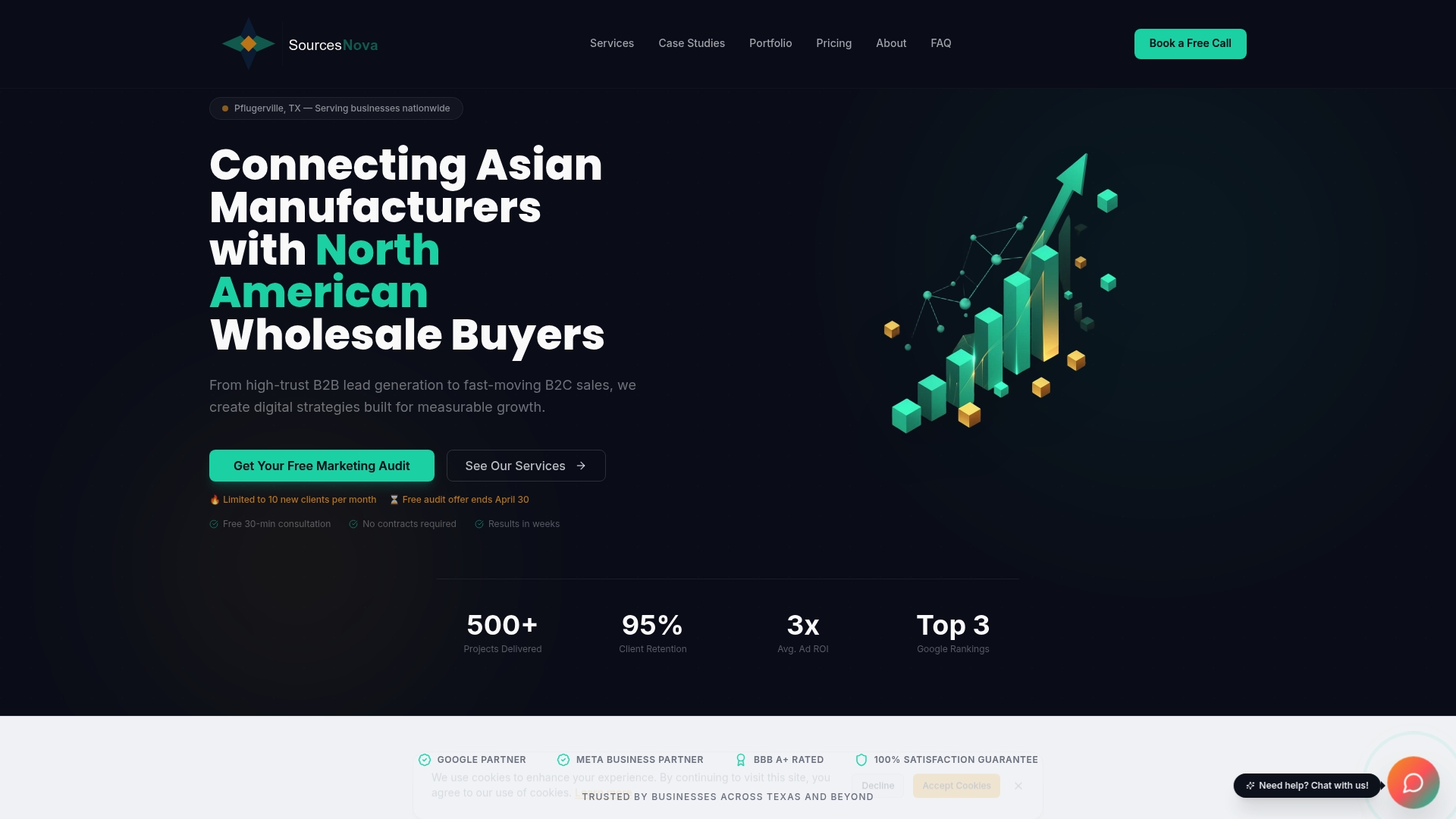
Sourcesnova is a full-service digital growth agency built specifically for small and local businesses. From SEO and content marketing to email campaigns and paid advertising, Sourcesnova handles the execution so you can focus on running your business. No bloated retainers, no jargon-filled reports. Just clear strategy and hands-on work that drives real growth. If you're ready to stop guessing and start seeing results, visit Sourcesnova to learn how the team can help you build a marketing system that actually works.
FAQ
What are the best marketing strategies for small businesses?
The most effective marketing strategies for small businesses in 2026 combine social media marketing, email marketing, and SEO-driven content, integrated across channels rather than run separately. Starting with owned assets like your email list and Google Business Profile before investing in paid ads produces the strongest long-term ROI.
How much should a small business spend on marketing?
Most small businesses should allocate 5% to 10% of gross revenue to marketing, with a heavier weight on organic and content channels early on. Paid advertising becomes more efficient once your organic funnel is converting.
Is email marketing still worth it for small businesses?
Email marketing delivers $42 for every $1 spent, making it the highest-ROI channel available to small businesses. Segmented, automated email campaigns consistently outperform broadcast-style newsletters.
How does AI help with small business marketing?
54% of small businesses use AI for tasks like content drafting, trend analysis, and image creation, reducing production time significantly. AI handles execution; the business owner still sets the strategy and provides the brand voice.
What is local marketing and why does it matter?
Local marketing focuses on reaching customers in a specific geographic area through tools like Google Business Profile, local SEO, and community partnerships. For businesses with a physical location, it is often the fastest path to qualified leads at the lowest cost.