
Most small businesses fail without a structured digital marketing plan. Not because they lack effort, but because their marketing looks like a pile of disconnected tactics with no thread connecting them to actual revenue goals. A digital marketing strategy explained properly is not a social media calendar or a list of tools. It is a deliberate, end-to-end process that connects what your business does to the customers who need it, and measures every step along the way. This guide walks you through exactly how to build one.
Table of Contents
- What is a digital marketing strategy and why does it matter?
- Setting marketing goals and choosing the right KPIs
- Choosing the right digital marketing platforms for your business
- Execution cycles and measurement: applying strategy with accountability
- Common digital marketing mistakes and how to avoid them
- Why most digital marketing strategies fail and how to truly succeed
- Get support building your digital marketing strategy and execution
- Frequently asked questions
Key Takeaways
| Point | Details |
|---|---|
| Strategic alignment | Align your digital marketing strategy with clear business goals before choosing tactics or tools. |
| Focused KPIs | Track 2-3 key performance indicators per goal to maintain focus and make informed decisions. |
| Tool selection | Choose marketing platforms that fit your operational needs to maximize efficiency and growth. |
| 90-day cycles | Implement digital marketing in 90-day execution cycles for accountability and agility. |
| Avoid metric overload | Use a formal measurement plan to prevent tracking excess data and ensure metrics drive actions. |
What is a digital marketing strategy and why does it matter?
A digital marketing strategy is a structured plan that coordinates all your online marketing activity around specific business goals. The key word is "structured." Disconnected tactics without a process are the most common mistake small businesses make, and they are expensive. Running paid ads, posting on Instagram, and sending occasional emails without a connecting framework means you have no way to know what is working or why.
One widely used model for structuring the customer journey is the RACE Framework, which stands for Reach, Act, Convert, and Engage. It maps four stages: attracting new audiences, prompting interaction with your content or offers, turning visitors into paying customers, and keeping those customers engaged long enough to generate repeat business and referrals. This framework is useful because it forces you to think about your entire customer journey, not just the top of the funnel.
Before any execution begins, you need to work upstream. That means defining your value proposition before touching any marketing tool. What do you do? Why does it matter to your specific customer? Why should someone choose you over the next option? These are not marketing questions. They are business clarity questions. Until they are answered, no amount of content or ad spend will produce consistent results.
Here is what a solid digital marketing strategy for SMB growth includes at its core:
- A clearly defined target audience and their specific problems
- A value proposition that separates you from alternatives
- A mapped customer journey from first contact to repeat purchase
- Defined goals, KPIs, and reporting cadence
- A selected set of channels and tools appropriate for your stage
- A structured execution and review cycle
With a clear definition of what a digital marketing strategy entails, let's explore how to set focused marketing goals that drive growth.
Setting marketing goals and choosing the right KPIs
Goal-setting sounds obvious until you see how most small businesses actually do it. Vague goals like "grow our social media presence" or "get more traffic" produce exactly that: more traffic, less revenue. Clear goal-setting starts with your business objectives first, then works backward to the marketing activity that supports them.
Follow this process to set goals that connect to results:
- Identify 3 to 5 business objectives for the next 90 days (examples: increase monthly new customers by 20%, grow email list to 1,000 subscribers, reduce cost per lead to under $30)
- For each objective, select 2 to 3 KPIs that are directly tied to that goal
- Set a baseline by pulling your current numbers before the campaign starts
- Define a specific target with a deadline
- Assign one person as accountable for each objective
The distinction between KPIs and generic metrics matters a great deal. A KPI is a number directly connected to a business outcome. Website visits is a metric. Conversion rate from landing page visits to leads is a KPI. Focus on 2 to 3 KPIs per objective to avoid data overload and maintain accountability.
Experts recommend one primary metric per initiative, supported by 2 to 3 leading indicators that tell you whether you are on track before the final number comes in. For example, if your primary metric is new customers acquired, your leading indicators might be qualified leads per week and sales call booking rate.
The most common goal-setting mistakes to avoid:
- Setting goals without baselines (you cannot measure progress from nowhere)
- Choosing metrics that are easy to report but hard to act on
- Treating social media follower counts as meaningful business KPIs
- Setting annual goals without breaking them into 90-day milestones
Pro Tip: Use a simple one-page document to capture each objective, its KPIs, current baseline, target, and owner. Review it weekly. This one habit separates businesses that grow from those that stay stuck.
Resources on setting marketing goals for small business growth and understanding digital marketing metrics and KPIs can help you go deeper on this step.
Now that you know how to set measurable goals, let's look at selecting the right digital marketing tools and platforms to support your strategy.
Choosing the right digital marketing platforms for your business
The market for digital marketing platforms in 2026 is crowded. Dozens of tools compete for your budget, and many overlap in features. The key question is not "what is the best tool?" but "what do I actually need right now, and what can my team realistically use?"
For most small businesses, email remains one of the highest-return channels available. Choosing the right platform depends on your goals and technical capacity.

| Platform | Best for | Price range | Standout feature |
|---|---|---|---|
| Mailchimp | Simple newsletters and basic automation | Free to $299/mo | Easy setup, low learning curve |
| Constant Contact | Local businesses and event-based marketing | $12 to $80/mo | Event tools, list management |
| ActiveCampaign | Automation-driven growth and segmentation | $15 to $145/mo | Advanced automation and CRM |
| GoHighLevel | Agencies and small businesses needing all-in-one | $97 to $297/mo | CRM, funnels, email, SMS combined |
For simple newsletters and email campaigns, Mailchimp and Constant Contact are solid entry points. ActiveCampaign is the right move when you need behavior-based automation, lead scoring, and tighter CRM integration. It excels when your email sequences need to respond to what contacts actually do, not just when they subscribed.
GoHighLevel is the leading all-in-one platform for agencies and small businesses that want to consolidate tools. At $97 per month, it combines CRM, sales funnels, email, SMS, appointment booking, and reputation management. For a business currently paying separately for five different tools, that consolidation alone can cut monthly software costs significantly.
Pro Tip: Before signing up for any platform, map out your actual workflow. If you need to capture leads, nurture them with email, and track which ones become customers, you need a platform with CRM capability built in. A standalone email tool will not be enough as you grow.
Explore proven email marketing strategies for SMBs to make the most of whichever platform you choose.
With tools in place, next we explore practical execution cycles and measurement to maintain agility and drive results.
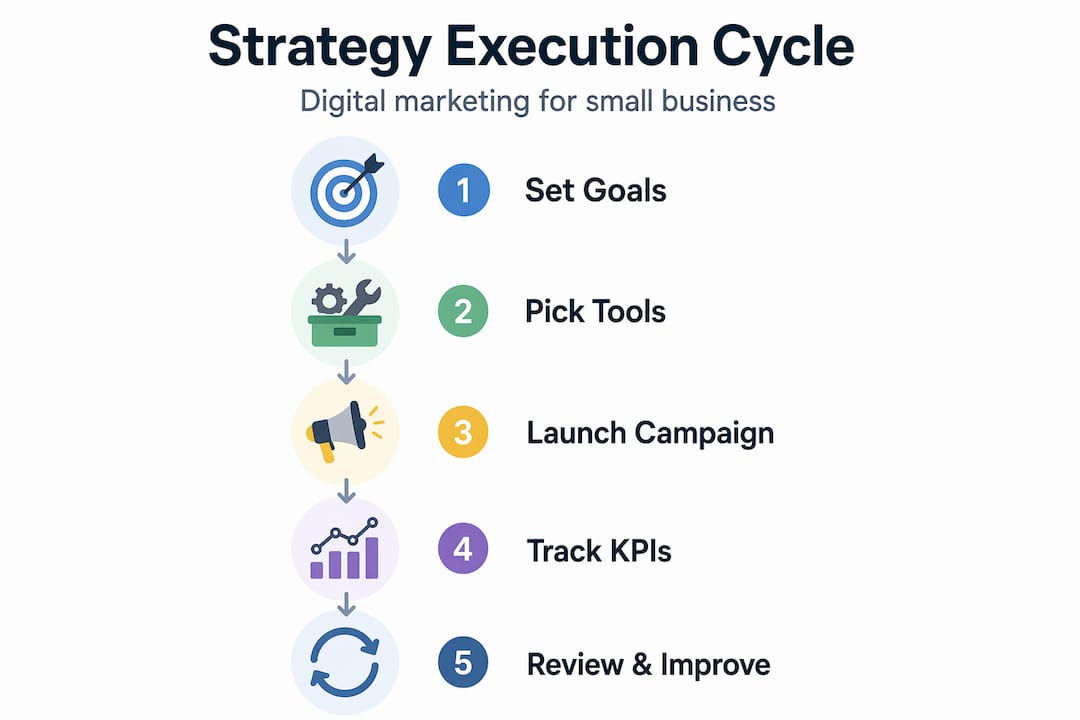
Execution cycles and measurement: applying strategy with accountability
Strategy without execution is a document. Execution without measurement is guesswork. Bringing both together inside a structured cycle is where most small business owners see real traction for the first time.
The 90-day execution cycle is the recommended standard. Here is why it works, and how to run one:
- Define your 90-day objective. One clear goal per team or initiative. Keep the scope narrow and the outcome specific.
- Build your campaign plan. Map each tactic to a goal, assign owners, and set weekly milestones.
- Create a formal measurement plan. Map goals to digital actions and tracking methods before you touch any analytics tool.
- Set your reporting cadence. Weekly pulse checks on leading indicators. Monthly full reviews comparing actuals to targets.
- Run a 90-day retrospective. What worked, what did not, what changes in the next cycle.
A 90-day execution cycle gives you enough time to see real impact from SEO, email, or paid campaigns, while keeping the feedback loop tight enough to change course before too much budget is wasted.
"Before using analytics tools, build a formal measurement plan mapping goals to digital actions and tracking methods." This step is the one most businesses skip entirely, and it is the reason their dashboards look busy but tell them nothing useful.
Pro Tip: When setting up your measurement plan, identify what data you will collect, where it will be stored, and who reviews it. Many small businesses collect data but never review it. The review habit is what converts data into decisions.
Explore practical tools for digital strategy execution for SMBs to support your 90-day process.
Having covered structured execution and measurement, let's examine common pitfalls and expert perspectives that most strategies miss.
Common digital marketing mistakes and how to avoid them
Knowing the right approach helps. Knowing the specific traps that derail small business marketing saves you months of wasted effort and budget.
The most common mistakes and how to avoid them:
- Starting with tactics, not narrative. Most companies focus on tactics before defining their story, causing buyers to lose interest quickly. If your messaging does not clearly state who you help, what problem you solve, and why you are the right choice, your tactics will underperform no matter how well they are executed.
- Disconnected channel activity. Running paid ads, email, and social media as separate efforts with no shared goal or measurement framework is a fast way to burn budget. Every channel should serve the same 90-day objective.
- Metric overload. Tracking too many metrics leads to reporting rather than managing. If your weekly review covers 20 numbers, you are not making decisions. You are producing a report. Cut it to the KPIs that directly reflect your commercial objectives.
- No review rhythm. Strategy that is not reviewed is not strategy. It is a plan that aged on a shelf. Weekly reviews take 20 minutes. They are the most valuable 20 minutes in your marketing week.
- Copying competitors without context. What works for a business with a six-person marketing team and $50,000 in monthly ad spend will not work the same way for a local business with a $1,500 budget.
Pro Tip: Before your next campaign, write a one-paragraph "campaign brief" that states the goal, the audience, the message, the channel, and how you will measure success. If you cannot fill it in clearly, the campaign is not ready to launch.
Read more on avoiding digital marketing pitfalls that commonly stall small business growth.
Why most digital marketing strategies fail and how to truly succeed
Here is the uncomfortable truth most marketing guides avoid: strategy does not fail because people choose the wrong tools or pick the wrong channels. It fails because of what happens after the plan is written, which is usually nothing.
The discipline of weekly review, 90-day cycles, and honest retrospectives is not glamorous. But most small business owners try to plan a full year, get overwhelmed by scope, and then operate without any plan at all after March. The 90-day model fixes this. Short enough to stay focused, long enough to see real data.
The second uncomfortable truth is about AI and marketing technology. Both are genuinely useful. But no automation platform makes bad positioning work. No AI tool compensates for a value proposition that no one understands. Technology is an enabler. The strategy has to come first, and it has to be grounded in business reality, not marketing theory.
One metric per initiative. Two or three leading indicators. Weekly review. Quarterly retrospective. This is not a sophisticated system. It is the effective digital marketing execution model that actually gets used, which makes it the only one that matters.
The businesses that grow are not the ones with the most tools or the largest ad budgets. They are the ones that commit to a clear goal, measure the right things, and iterate without ego. That is the real digital marketing strategy guide no one pins on the wall.
Get support building your digital marketing strategy and execution
Understanding the framework is the first step. Putting it into practice with limited time and resources is where most small business owners get stuck.
SourcesNova works directly with small and mid-size businesses to clarify goals, select the right platforms, and build measurable digital marketing strategies that produce real results. No bloated retainers, no jargon-heavy reports. Just clear direction and hands-on execution tailored to your industry, your budget, and your growth stage. Whether you need help selecting email marketing platforms for 2026, building a 90-day execution plan, or identifying the KPIs that actually matter for your business, the team at SourcesNova is built to support exactly that. Reach out and let's build something that works.
Frequently asked questions
What is the most important metric to track for small business digital marketing?
Choose one primary metric per initiative that directly reflects your business goal, such as conversion rate or customer acquisition cost. Experts recommend supporting that primary metric with two to three leading indicators that tell you whether you are on track before the final result arrives.
How often should I review my digital marketing performance?
Review key performance indicators weekly and conduct a full performance analysis monthly. KPIs reviewed weekly with a full monthly analysis create the accountability loop that keeps strategy on track and decisions data-driven.
Which digital marketing platform is best for small businesses?
For simple newsletters, Mailchimp or Constant Contact work well. ActiveCampaign is stronger for automation and segmentation. GoHighLevel is best for small businesses that want CRM, email, SMS, and funnels in one platform at a predictable monthly cost.
Why is a 90-day execution cycle effective?
A 90-day cycle provides enough time to see meaningful results from digital campaigns while keeping the feedback loop short enough for rapid pivots. Practitioners identify this cycle as the sweet spot between strategic focus and operational agility.
How can I avoid tracking too many marketing metrics?
Limit yourself to 2 to 3 KPIs per objective and connect every metric to a commercial outcome. Tracking too many metrics shifts your team from managing performance to producing reports, which is where accountability breaks down.