
Most small and mid-sized businesses make the same expensive mistake: they pour budget into paid ads before they've defined who they're selling to or built a single owned asset worth showing up for. The result is wasted spend, inconsistent leads, and a marketing strategy that stalls before it gains real traction. This guide breaks down B2B marketing fundamentals in plain terms, covering core concepts, the most effective channels, and the strategic frameworks that actually drive sustainable growth for SMBs. If you want clarity over complexity, start here.
Table of Contents
- What makes B2B marketing unique?
- Defining your ideal customer profile (ICP)
- Choosing the right B2B marketing channels
- Mapping your B2B content to the buyer journey
- Measuring success: Metrics that align with business growth
- What most SMBs miss about B2B marketing basics
- Take action: Build your B2B marketing foundation
- Frequently asked questions
Key Takeaways
| Point | Details |
|---|---|
| Start with ICP clarity | Defining your best-fit customer is the foundation for effective B2B marketing. |
| Prioritize owned channels | Invest in SEO, content, and email before scaling paid ads for lasting results. |
| Map content to the buyer journey | Deliver the right message and format at each decision stage to drive engagement. |
| Measure what counts | Track both engagement and revenue to ensure your marketing supports business growth. |
| Avoid big-company traps | Focus on simple, scalable basics that fit your SMB’s needs—not enterprise complexity. |
What makes B2B marketing unique?
B2B marketing operates on entirely different rules than selling directly to consumers. When a business buys a product or service, the decision rarely belongs to one person. You're typically dealing with multiple stakeholders, including decision-makers, influencers, and end users, each with their own priorities and objections. This alone changes everything about how you communicate.
Sales cycles in B2B are longer. A deal that takes a consumer two minutes to complete can take a B2B prospect six months to finalize. That time span requires consistent, credible communication at every stage of the buying process. Trust is not optional. It is the currency of B2B.
Because of this, the content you create must do heavy lifting. It needs to educate, address objections, and demonstrate authority across multiple formats and touchpoints. The content types for B2B visibility that perform best are those that map directly to buyer concerns, not just product features.
Key B2B marketing channels to understand:
- Website and blog (SEO): Consistently delivers the highest ROI for B2B companies across all channel types
- Email marketing: Offers a meaningful 2.4% conversion rate when properly segmented
- Paid social advertising: Effective for amplification, but only after owned assets are established
- Content marketing: Builds long-term authority and trust through educational assets
"B2B buyers complete a significant portion of their research before ever speaking to a sales rep. Your content is your first sales conversation."
This means your website, blog, and email list must be built before you spend significantly on paid channels. Owned channels compound in value over time. Paid channels stop the moment the budget runs out.
Defining your ideal customer profile (ICP)
With an understanding of B2B's unique dynamics, it's time to address your growth engine's foundation: the ideal customer profile.

Your ICP is a detailed description of the type of business most likely to buy from you, stay with you, and refer others to you. Without it, your messaging is vague, your channel choices are guesswork, and your sales team chases the wrong leads. For SMBs, ICP development strategies are especially critical because resources are limited and focus is everything.
According to demand generation guidance for B2B founders, SMBs should prioritize ICP definition before building out mid-funnel content like website messaging, long-form educational articles, LinkedIn presence, or event strategy. Skipping this step means building in the wrong direction.
Here is a practical step-by-step process to define your ICP:
- Analyze your best current customers. Pull a list of your top 20% of clients by revenue and retention. What industries are they in? What size are they?
- Identify common attributes. Look for patterns in company size, job titles of buyers, geographic region, and business model.
- Interview three to five of them. Ask what problem they were trying to solve, how they found you, and what made them choose you over others.
- Document your findings. Create a simple profile using the attributes you discovered.
- Stress test your ICP. Ask whether your current marketing speaks directly to that profile. If the answer is no, you have a messaging problem.
Here is an example ICP comparison table to illustrate how this works in practice:
| Attribute | Weak ICP | Strong ICP |
|---|---|---|
| Industry | "Any business" | Specialty retail, e-commerce |
| Company size | "Small businesses" | 10 to 50 employees |
| Buyer role | "The owner" | Operations manager or marketing director |
| Core pain | "Needs marketing" | Low online visibility, poor conversion rate |
| Revenue range | Not defined | $500K to $5M annual revenue |
| Location | Anywhere | Regional or national, English-speaking markets |
Pro Tip: Run a quick 80/20 analysis on your client list. The top 20% of clients likely generate 80% of revenue. Use them as the model for your ICP, not your average or lowest-value customers.
Choosing the right B2B marketing channels
After identifying your ICP, the next challenge is prioritizing effective marketing channels without spreading yourself too thin.
Not all channels deliver equal results for SMBs. The temptation is to be everywhere at once. The reality is that doing a few channels exceptionally well outperforms doing many channels poorly. Here is how the primary B2B channels compare for SMBs at an early or growth stage:
| Channel | Cost | Time to Results | ROI Potential | Best Use Case |
|---|---|---|---|---|
| SEO and blog content | Low to medium | 3 to 9 months | Very high | Long-term organic growth |
| Email marketing | Low | 30 to 60 days | High | Nurturing and conversions |
| LinkedIn organic | Free | 60 to 90 days | Medium to high | Thought leadership, outreach |
| Paid social (LinkedIn/Meta) | High | Immediate | Medium | Amplification only |
| Events and webinars | Medium | 60 to 90 days | Medium | Relationship building |
The data is clear: email and SEO deliver the best sustained ROI for B2B companies, with email marketing hitting a 2.4% conversion rate when properly targeted. These are owned channels. You control them. They grow with you.
For email strategies tailored to SMB sales, the focus should be on segmentation, relevance, and consistency rather than frequency. Sending fewer, better emails outperforms blasting your list weekly with generic content. A well-constructed B2B newsletter that genuinely educates your audience builds trust faster than most paid campaigns.
Your website is the anchor of everything. Without a credible, conversion-optimized site, no channel performs well. Website design for SMBs is not just about aesthetics. It is about clear messaging, fast load times, easy navigation, and calls to action that guide buyers to the next logical step.
Key pitfalls to avoid:
- Launching paid ads before SEO is in place. Paid traffic has no memory. Once you stop paying, the traffic stops.
- Publishing content without an ICP in mind. Content written for everyone converts no one.
- Treating LinkedIn as a sales channel from day one. Use it to educate and build credibility first.
- Ignoring your email list. It is the only audience you truly own.
According to B2B demand generation guidance, SMBs should avoid over-investing in paid channels until owned media like SEO and content is firmly established. Work in simple 90-day rhythms: set a goal, execute a focused plan, measure results, and adjust.
Pro Tip: If you are just starting out, commit to two channels only. Master SEO and email before adding LinkedIn or paid. Consistency in two channels beats scattered effort across six.
Mapping your B2B content to the buyer journey
With the strongest channels in mind, you will get the highest ROI by matching your content to where buyers are in their journey.
B2B buyers move through three broad stages: Awareness, Consideration, and Decision. Each stage requires different content formats and different messaging. Sending a pricing page to someone who just discovered your brand is as ineffective as sending an introductory blog post to someone ready to buy.
Here is how to map content across each stage:
Awareness stage: The buyer knows they have a problem but has not yet identified a solution.
- Best formats: Blog posts, LinkedIn articles, short educational videos, industry reports
- Messaging focus: Identify the problem, build credibility, do not pitch
- Distribution: SEO-optimized blog, organic LinkedIn, guest posts
Consideration stage: The buyer is actively evaluating options and comparing vendors.
- Best formats: Case studies, comparison guides, webinars, detailed how-to content
- Messaging focus: Show differentiation, address objections, demonstrate results
- Distribution: Email nurture sequences, LinkedIn direct outreach, retargeting
Decision stage: The buyer is close to choosing a vendor and needs final reassurance.
- Best formats: Testimonials, ROI calculators, one-pagers, free consultations, demos
- Messaging focus: Remove risk, build urgency, confirm fit
- Distribution: Sales enablement, email follow-up, direct outreach
The practical steps to build a simple content capsule for each stage:
- List the top three questions your ICP asks at each stage of the buying process.
- Assign one content format to each question.
- Build a 12-week calendar with two to three pieces per month across all three stages.
- Repurpose each piece across channels: a blog post becomes a LinkedIn article, an email summary, and a short video script.
For guidance on effective B2B content types at each stage, the focus should always be education first. Buyers trust brands that teach them something useful before asking for their business. That trust is what converts at the decision stage.
According to B2B demand generation research, long-form educational content combined with a strong LinkedIn presence is the highest-value combination for mid-funnel engagement. That is the consideration stage, where most SMBs produce the least content and lose the most deals.
Pro Tip: Build a simple one-page content map. Rows represent buying stages. Columns represent channels. Fill in one content format per cell. This becomes your editorial calendar with almost no extra planning required.
Measuring success: Metrics that align with business growth
Having built your foundation, the next step is ensuring your efforts produce measurable growth and knowing how to track it properly.
Most SMBs measure the wrong things. Tracking page views and social media likes feels productive, but neither tells you whether marketing is actually growing the business. These are vanity metrics. They look good in reports but have no direct connection to revenue.
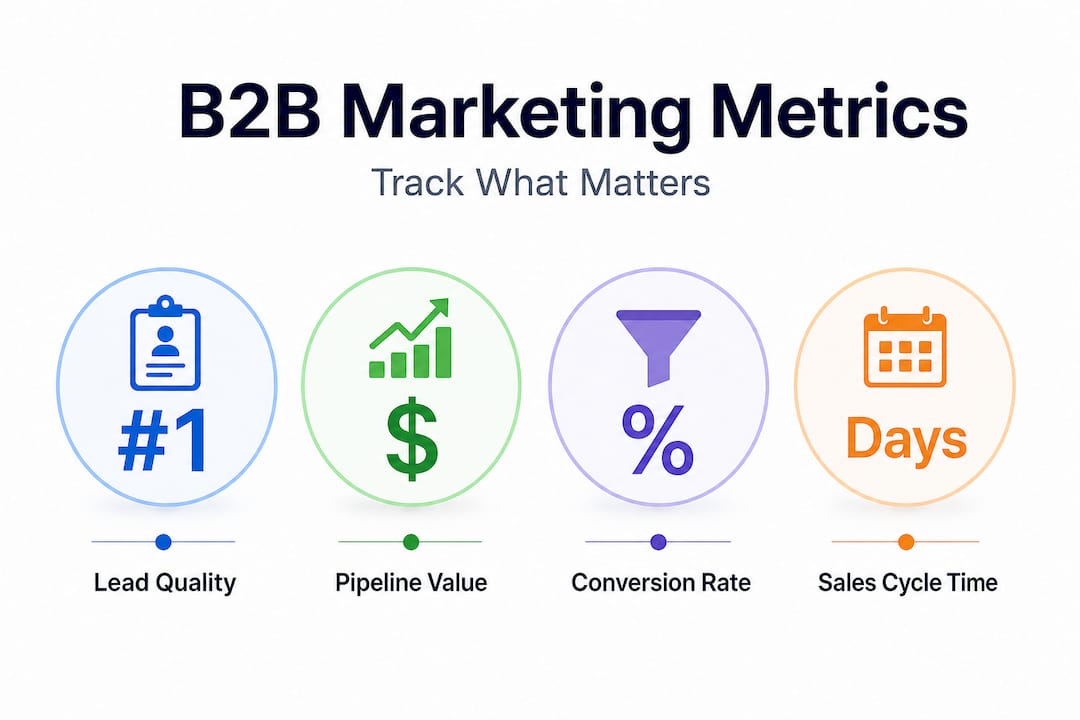
Instead, focus on blended metrics that connect engagement to pipeline and pipeline to revenue. According to HubSpot's B2B marketing data, SMBs that align marketing and sales on shared definitions of a qualified lead see significantly faster pipeline growth than those that don't. Start there.
A practical metrics checklist for busy SMB teams:
- Organic traffic growth: Is more of the right audience finding you through search?
- Email open and click rates: Are your subscribers engaging with what you send?
- Lead quality score: Are inbound leads matching your ICP, or are they off-target?
- Pipeline influence: How many active deals had contact with marketing content before closing?
- Cost per qualified lead: What does it actually cost to generate a lead worth pursuing?
- Revenue contribution from marketing: What percentage of closed revenue touched a marketing asset?
Tracking these metrics monthly, even in a simple spreadsheet, gives you a clear picture of what is working. For SMBs building a streamlined marketing workflow, the goal is not a complicated reporting dashboard. It is a handful of numbers reviewed consistently.
"The businesses that grow fastest are not those with the biggest budgets. They are the ones that know exactly what is working and put more into it."
Start simple. Pick three to four metrics that directly connect to your business goals. Review them monthly. Adjust your strategy based on what the data actually shows, not on what feels busy or productive.
What most SMBs miss about B2B marketing basics
Here is the uncomfortable reality after working with dozens of small and mid-sized businesses across industries: the companies that struggle with B2B marketing are almost never failing because of a bad product. They are failing because they skipped the basics.
They copied tactics from large enterprise brands with full marketing departments and six-figure budgets. They launched paid campaigns before writing a single useful piece of content. They posted on LinkedIn without knowing who they were posting for. And they measured success by the number of followers instead of the number of qualified conversations.
The discipline required to succeed in B2B marketing for an SMB is ruthless focus. Know your ICP cold. Understand their language, their frustrations, and the objections that keep them from buying. Build owned channels that compound over time. Measure only what connects to revenue.
The core SMB marketing strategies that consistently produce results share one trait: simplicity. Not laziness. Simplicity. A 90-day plan with two channels, one ICP, and three measurable goals will outperform a 12-channel strategy with vague objectives every single time.
The biggest mistake is not choosing the wrong channel. It is trying to master everything before mastering anything. Start with who you serve. Then build the content, channels, and measurement systems to serve them well. The results follow the focus.
Take action: Build your B2B marketing foundation
If you are ready to put these B2B marketing basics to work for your SMB, expert help and proven resources are just a click away. Building a sustainable marketing foundation does not have to be overwhelming, but it does require the right starting point.
SourcesNova works with small and mid-sized businesses that want real, measurable growth without the bloated retainers or confusing jargon. From ICP development and content strategy to email marketing and SEO, the team brings hands-on execution to every client engagement. Whether you are starting from scratch or looking to fix a strategy that has stalled, SourcesNova has the tools, frameworks, and experience to move your business forward. Visit sourcesnova.com to explore how focused B2B marketing strategy can become your most reliable growth driver.
Frequently asked questions
What is the first step in B2B marketing for SMBs?
The first step is defining your ideal customer profile (ICP) to focus your resources and sharpen your messaging before building any channel or content strategy. According to B2B demand generation guidance, ICP clarity is the prerequisite for every other effective marketing decision.
Which B2B marketing channels have the highest ROI?
Website SEO, content marketing, and email consistently show top ROI for B2B companies, with email delivering a 2.4% conversion rate when properly segmented and targeted.
How can I measure if my B2B marketing is working?
Track both engagement metrics and pipeline influence to see true effectiveness. According to HubSpot's B2B data, using blended metrics that connect engagement and revenue impact gives SMBs a much clearer picture than standalone vanity metrics.
How much should SMBs invest in paid channels early on?
SMBs should avoid major investments in paid channels until owned media like SEO and content is firmly established. Demand generation research consistently shows that over-investing in paid without an owned channel foundation leads to inconsistent and unsustainable results.