
SMS marketing is the high-intent, direct-response channel that converts time-sensitive behavioral signals into measurable leads and sales — and for Asian manufacturers and consumer brands entering the U.S. market, it fills a gap that email and paid ads simply cannot. According to SimpleTexting's 2026 report, 75.3% of businesses use SMS marketing, and 65.4% plan to increase their budgets. The U.S. regulatory framework requires compliance with TCPA and 10DLC carrier registration before you send a single message. The fastest pilot to run: an abandoned-cart recovery flow or a trade-show follow-up sequence.
- SMS delivers near-instant reach with open rates that far exceed email, per Salesforce
- TCPA and 10DLC registration are non-negotiable legal prerequisites in the United States
- Start with one focused flow (abandoned cart or trade-show follow-up) before scaling
Table of Contents
- What role does SMS marketing play in the B2B and DTC funnel?
- High-value SMS use cases for manufacturers and consumer brands entering the U.S.
- When is SMS a bad fit, and what risks should you avoid?
- Practical SMS best practices, timing rules, and message templates
- U.S. compliance and deliverability: TCPA, 10DLC, and consent language
- How do you measure SMS campaign performance and attribute revenue?
- How do you choose an SMS platform for U.S. market entry?
- A 90-day roadmap to pilot SMS for U.S. market entry
- Key Takeaways
- What most market-entry teams get wrong about SMS
- Sourcesnova's U.S. market-entry SMS services
- Useful sources and further reading
What role does SMS marketing play in the B2B and DTC funnel?
SMS, formally called short message service marketing, is permission-based direct mobile messaging used for urgent, high-intent prompts and two-way follow-up. It is not a replacement for email or paid ads. It is the channel you deploy when timing and intent converge.
Twilio's guidance frames it clearly: use email for long-form storytelling and nurturing; use SMS for high-intent, time-sensitive moments like abandoned carts or RFQ reminders. For market-entry teams, an SMS list is also an owned channel with lower platform risk than social media — a long-term asset for B2B relationship management.
- Awareness: limited role; better served by paid social or SEO
- Intent/consideration: SMS excels here — RFQ nudges, demo reminders, price-drop alerts
- Conversion: abandoned-cart recovery, time-limited launch offers, one-tap checkout links
- Retention: shipping updates, loyalty prompts, reorder reminders
eMarketer reports that 78% of consumers have made a purchase because of a brand's text message, and that consumers respond best when messages connect directly to wallet and checkout integrations. That frictionless path from message to purchase is where SMS earns its place in the funnel.
High-value SMS use cases for manufacturers and consumer brands entering the U.S.
The use cases split cleanly between B2B lead generation and DTC conversion. Both matter for a North American market-entry program.
B2B flows:
- Trade-show opt-in confirmation → meeting reminder → post-show demo link
- RFQ follow-up nudge sent 24–48 hours after a quote request
- Distributor outreach: new product availability or pricing update
- Demo scheduling confirmation and 1-hour pre-demo reminder
- Post-demo check-in with a direct link to a product catalog or spec sheet
DTC flows:
- Abandoned-cart recovery triggered by cart inactivity (typically 1–3 hours)
- Time-limited launch offer for a new SKU entering the U.S. market
- Shipping update with tracking link
- Loyalty prompt tied to a digital wallet pass or reorder discount
Two workflow examples:
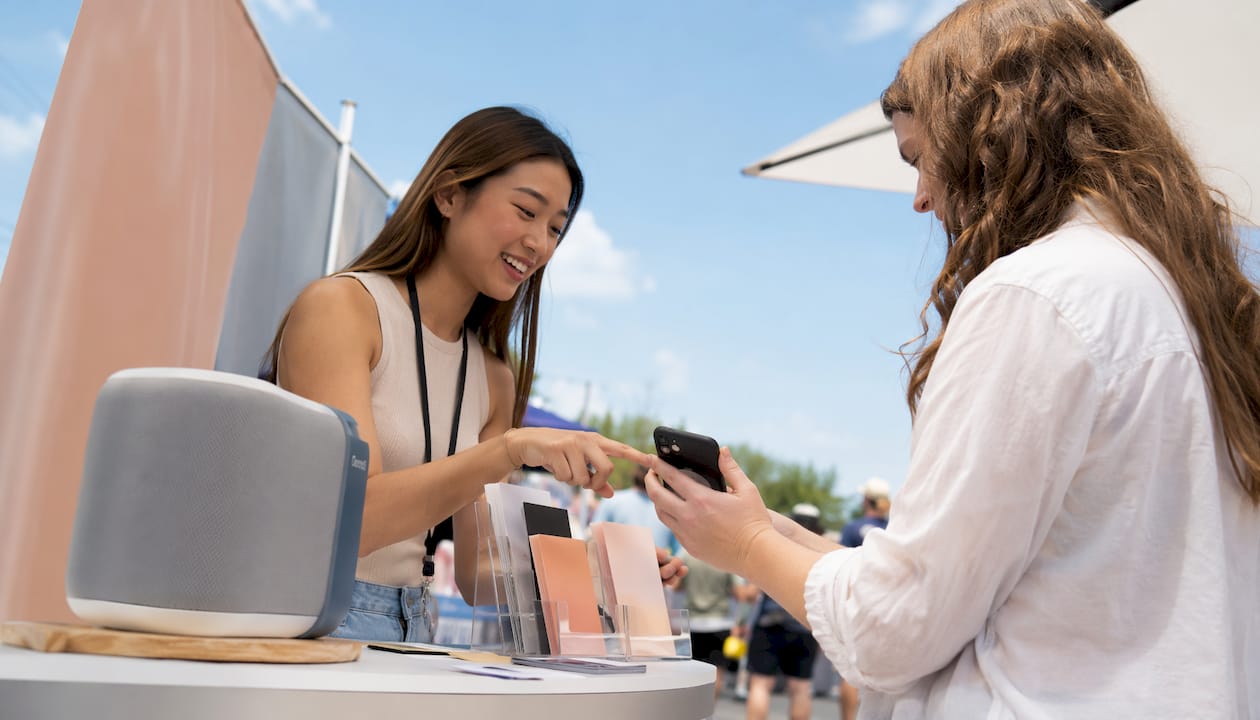
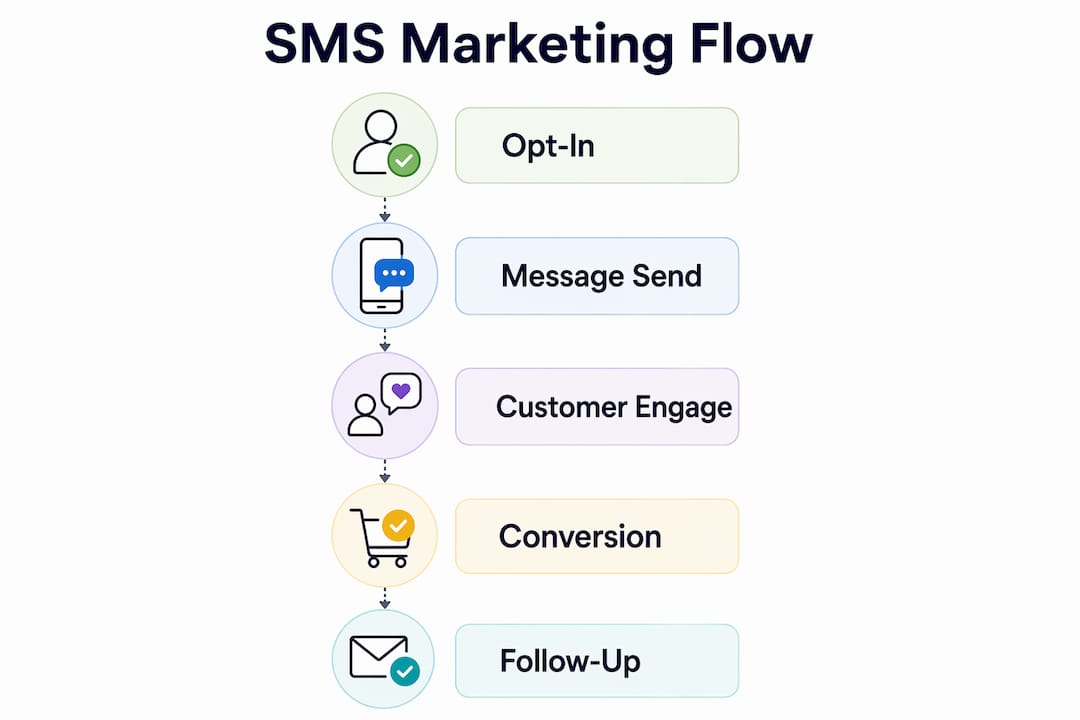
Trade-show sequence: Collect opt-ins at the booth via keyword text or QR code → send opt-in confirmation within minutes → send meeting reminder 2 hours before the scheduled slot → follow up with a demo link and spec sheet within 24 hours of the meeting.
Abandoned-cart sequence: Cart abandonment triggers a 1-hour delay → send SMS with product name, cart link, and a time-limited discount code → if no conversion in 24 hours, escalate to an email with full product details.
Yotpo's research confirms that SMS reduces abandonment and improves conversion rates compared with other channels, particularly for DTC lifecycle flows. Pairing SMS with B2B lead generation strategies gives manufacturers a structured pipeline from first contact to closed deal.
When is SMS a bad fit, and what risks should you avoid?
SMS fails when the fundamentals are missing: no explicit opt-in, no capacity to handle replies, or a message that delivers no clear value to the recipient.
- No opt-in = TCPA exposure. Sending marketing texts without documented consent in the U.S. carries statutory damages of $500–$1,500 per violation. This is not a gray area.
- High opt-out rates follow irrelevant messages or poor timing. Forbes Business Council notes that messages lacking genuine value drive immediate opt-outs and lasting brand damage.
- Intrusive timing — late-night sends or messages during U.S. holidays — signals cultural unfamiliarity and erodes trust with American buyers.
- Complex information belongs in email or a sales call, not a 160-character text. RFQ details, contract terms, and multi-step instructions are the wrong content for SMS.
EZTexting data shows U.S. consumers expect roughly a 15-minute response window for text-based service interactions. If your team cannot meet that SLA through staffing or an automated reply workflow, two-way SMS programs will damage your reputation faster than they build it.
Pro Tip: If you cannot guarantee a 15-minute reply window or an AI-driven conversational flow, limit SMS to one-way notifications (shipping updates, reminders) until your operations can support two-way messaging.
Practical SMS best practices, timing rules, and message templates
The rules are short. The execution is where most market-entry teams stumble.
Core rules:
- Obtain explicit opt-in before sending any marketing message
- Include a clear opt-out instruction (e.g., "Reply STOP to unsubscribe") in every marketing SMS
- Keep messages under 160 characters when possible; use MMS for richer content
- Use behavioral triggers (cart activity, purchase history) rather than broadcast blasts
- Cap frequency at 2–4 messages per month for most B2B and DTC flows
Timing for U.S. audiences: Send between 10 AM and 8 PM in the recipient's local time zone. Tuesday through Thursday performs consistently well for B2B. For DTC, Friday afternoon and Sunday evening tend to drive higher conversion on promotional messages.
Sample templates:
Trade-show opt-in confirmation: "Hi {{name}}, thanks for stopping by [Brand] at [Event]. You're confirmed for our 2 PM demo. Reply STOP to opt out."
RFQ nudge (24-hour follow-up): "Hi {{name}}, your quote request is ready. Review it here: {{cta_link}}. Questions? Reply to this message. Reply STOP to unsubscribe."
Abandoned-cart recovery: "{{name}}, you left something behind. Your cart expires in 24 hrs — complete your order: {{cta_link}}. Reply STOP to opt out."
Shipping update: "Your order {{order}} has shipped. Track it here: {{cta_link}}. Questions? Reply anytime."
Pro Tip: Test message timing with cohorts of 200–500 contacts before scaling. A 15-minute send-window shift can move CTR by several percentage points. Use purchase history and cart signals for personalization — broad demographic assumptions produce generic messages that get ignored. For deeper personalization frameworks, outreach personalization principles from B2B sales apply directly to SMS sequences.
U.S. compliance and deliverability: TCPA, 10DLC, and consent language
Compliance is not optional, and carrier deliverability depends on it. A non-compliant program will be filtered or blocked before it reaches inboxes.
Compliance checklist:
- Obtain written or digital opt-in consent before sending any marketing SMS
- Store consent records with timestamp, source, and opt-in language
- Include "Reply STOP to unsubscribe" in every marketing message
- Honor opt-out requests immediately and suppress the number from all future sends
- Do not send outside 8 AM–9 PM local time (TCPA requirement)
Number type guidance:
- 10DLC (10-digit long code): Best for most B2B and DTC programs. Requires brand and campaign registration with The Campaign Registry (TCR). Lower cost, higher carrier trust for ongoing messaging.
- Short codes: Higher throughput, faster delivery for large DTC campaigns. More expensive and require a longer approval process (4–12 weeks).
- Toll-free numbers: Faster to provision than short codes; suitable for mid-volume programs while 10DLC registration is pending.
Register your brand and campaign through TCR before launching. Twilio's platform supports sandbox testing so you can validate flows before live sends. Keep consent records for a minimum of four years to support audit readiness.
How do you measure SMS campaign performance and attribute revenue?
| KPI | Definition | Target benchmark |
|---|---|---|
| Deliverability rate | Messages delivered / messages sent | far exceed email |
| Open rate | Messages opened / delivered | >90% (SMS baseline) |
| CTR | Link clicks / delivered | ~10% for triggered flows |
| Response rate | Replies / delivered | 5–15% for two-way flows |
| Opt-out rate | Opt-outs / delivered | <2% per send |
| Conversion rate | Purchases or RFQs / delivered | 1–5% depending on flow |
| Revenue per message | Total revenue attributed / messages sent | Varies by AOV and flow |
| Cost per lead | Total SMS spend / leads generated | Set against channel benchmarks |
For attribution, use UTM parameters on every link, CRM lead-source flags for RFQ submissions, and one-click checkout tokens for DTC flows. Tie SMS events to your existing CRM or ecommerce conversion path so revenue is attributed at the message level, not just the session.
Tracking checklist:
- UTM links on every CTA in every message
- CRM lead source = "SMS" for all RFQ and demo-request submissions
- Webhook or API event logging from SMS platform to analytics
- Weekly opt-out rate review to catch content or frequency problems early
How do you choose an SMS platform for U.S. market entry?
Choose based on use-case fit first. B2B lead workflows need CRM-first platforms; DTC ecommerce programs need tight Shopify or WooCommerce integration. Both require 10DLC support.
Selection checklist:
- 10DLC brand and campaign registration support
- Native integrations with HubSpot, Salesforce, Shopify, or WooCommerce
- Automation triggers: abandoned cart, RFQ follow-up, event-based sequences
- Segmentation and personalization by behavior, purchase history, and list source
- Sandbox or trial account for pre-launch testing
- Pricing model that fits your volume (per-message vs. monthly subscription)
- Reporting: deliverability, CTR, opt-out rate, and revenue attribution
Platforms to evaluate:
- Twilio: Developer-first, highly flexible, strong API for custom B2B workflows and CRM integrations. Sandbox available.
- Klaviyo: Strong DTC ecommerce fit with deep Shopify integration, behavioral triggers, and cross-channel (SMS + email) automation.
- Attentive: DTC-focused with advanced segmentation, two-tap mobile opt-in, and strong compliance tooling.
- Postscript: Built specifically for Shopify merchants; straightforward abandoned-cart and promotional flows with per-message pricing.
For marketing automation architecture, connect your SMS provider to your ecommerce or CRM platform via native integration or API, then route events to your analytics layer for full-funnel attribution.
A 90-day roadmap to pilot SMS for U.S. market entry
Days 1–30: Setup and list build
- Select platform and complete 10DLC brand and campaign registration
- Draft opt-in consent language and configure opt-out workflows
- Build opt-in entry points: trade-show QR codes, website pop-ups, checkout checkboxes
- Integrate SMS platform with CRM or ecommerce system
- Set up UTM tracking and CRM lead-source flags
- Target: 200–500 opted-in contacts before first send
Days 31–60: Pilot flows and A/B testing
- Launch one B2B flow (trade-show follow-up or RFQ nudge) and one DTC flow (abandoned cart)
- A/B test message timing (morning vs. afternoon) and CTA copy
- Monitor deliverability, CTR, opt-out rate, and response time daily
- Review reply SLA compliance; adjust staffing or automation if response times exceed 15 minutes
- Target: baseline CTR and conversion data for go/no-go decision
Days 61–90: Scale decision and optimization
- Analyze pilot metrics against benchmarks in the KPI table above
- Expand winning flows to full list; pause or revise underperforming ones
- Add segmentation layers (purchase history, RFQ status, distributor tier)
- Integrate SMS data into full-funnel attribution reporting
- Decision gate: if cost per lead is within target and opt-out rate is below 2%, scale budget
Responsibility matrix:
- Marketing: message copy, templates, A/B test design, campaign calendar
- Legal/compliance: opt-in language review, consent record policy, TCPA audit
- Engineering/IT: platform integration, UTM setup, webhook configuration
- Sales: RFQ follow-up SLA, reply handling, demo scheduling coordination
Key Takeaways
SMS marketing drives measurable leads and sales for U.S. market entry when it is built on explicit consent, behavioral triggers, and 10DLC-compliant infrastructure from day one.
| Point | Details |
|---|---|
| Start with compliance | Register for 10DLC, document consent, and include opt-out language in every marketing message before your first send. |
| Pick one pilot flow | Launch either a trade-show follow-up or abandoned-cart sequence first; measure CTR and opt-out rate before scaling. |
| SMS complements email | Use SMS for high-intent, time-sensitive moments; reserve email for long-form nurturing and detailed RFQ content. |
| Adoption is high | 75.3% of businesses use SMS marketing, and 65.4% plan to increase their budgets, signaling strong channel maturity. |
| Sourcesnova handles the setup | Sourcesnova manages 10DLC registration, CRM integration, and SMS flow implementation as part of a U.S. market-entry package. |
What most market-entry teams get wrong about SMS
The instinct for many Asian manufacturers entering the U.S. is to treat SMS the way they treat WeChat broadcasts: high frequency, rich content, relationship-first. That approach fails in the American market. U.S. consumers have legal protections (TCPA), carrier-level filtering (10DLC), and a low tolerance for messages that don't deliver immediate value.
The teams that see real results treat SMS as a precision instrument, not a broadcast channel. They build small, high-intent lists rather than large, low-quality ones. They send fewer messages with sharper triggers. And they staff or automate replies before they send a single outbound text.
The 90-day roadmap in this article is not a formality. It is the minimum viable compliance and testing structure for a U.S. SMS program that won't get filtered, fined, or ignored. Skipping the pilot phase to move faster is the single most common mistake Sourcesnova sees from brands in their first 90 days in the North American market.
Sourcesnova's U.S. market-entry SMS services
Asian manufacturers and consumer brands entering North America face a specific challenge: building a compliant, integrated SMS program from scratch in a market with unfamiliar carrier rules, legal requirements, and buyer expectations. Sourcesnova handles the full setup, including 10DLC brand and campaign registration, CRM and ecommerce integration (HubSpot, Salesforce, Shopify, WooCommerce), consent workflow design, and SMS flow implementation for both B2B lead generation and DTC conversion.
The agency's market-entry packages combine SMS with North American SEO, paid social lead generation, and localized ecommerce builds so that SMS works as part of a connected channel strategy, not a standalone experiment. If you are planning a trade-show presence, a wholesale outreach campaign, or a DTC product launch in the U.S., start with a discovery call to map out the right pilot for your product and audience.
Useful sources and further reading
- SimpleTexting SMS Marketing Statistics 2026 — Business adoption rates, budget trends, and ROI signals for SMS in the U.S.
- eMarketer: SMS as a high-impact, low-clutter channel — Consumer purchase behavior and wallet/checkout integration data
- Twilio SMS Marketing for Beginners — Channel complementarity, behavioral triggers, and owned-list strategy
- Salesforce SMS Marketing Guide — Opt-in workflows, open rate benchmarks, and operational best practices
- Forbes Business Council: Why Strategic SMS Marketing Matters — Timing, value, and opt-out risk analysis
- Yotpo: 11 Benefits of SMS Marketing for Brands — DTC conversion, loyalty flows, and abandonment reduction
- EZTexting: Benefits of SMS Marketing — U.S. consumer reply-time expectations and service SLA guidance
This article provides general marketing and operational guidance. For binding compliance decisions on TCPA, 10DLC registration, or carrier policies, consult the FCC, The Campaign Registry, your SMS platform's legal documentation, or qualified legal counsel for your specific situation.