
Marketing automation is defined as the use of software and AI technologies to automate multichannel campaign delivery, lead nurturing, and customer profiling to drive measurable return on investment. The role of automation in marketing has expanded well beyond scheduled email blasts. Platforms like Adobe Journey Optimizer and Salesforce AI marketing now enable personalized, real-time customer journeys that adapt based on behavior, lifecycle stage, and predictive signals. For marketing professionals and business owners, understanding this shift from rule-based execution to intelligent orchestration is the difference between a cost center and a genuine growth engine.
How does the role of automation in marketing work?
Marketing automation automates routine tasks across email, social media, websites, and SMS while simultaneously managing lead scoring, segmentation, and visitor tracking. The result is a system that delivers stage-relevant messages without requiring a human to trigger each one. This is the foundational value: consistency at scale, without proportional headcount growth.
The core functions of traditional marketing automation platforms include:
- Multichannel campaign delivery: Coordinating messages across email, paid ads, SMS, and web in a single workflow
- Lead scoring and segmentation: Assigning scores based on behavior and demographic data to prioritize sales outreach
- CRM integration: Sharing pipeline data between marketing and sales for unified visibility
- Visitor tracking: Monitoring site behavior to trigger personalized follow-up sequences
- ROMI measurement: Attributing revenue back to specific campaigns and channels
Pro Tip: Before selecting an automation platform, map every manual handoff in your current marketing workflow. The tools that eliminate the most friction points, not the ones with the longest feature lists, will deliver the fastest ROI.
The marketing automation benefits extend directly to sales alignment. When both teams operate from a shared CRM with automated lead scoring, sales reps receive higher-quality leads and marketing gets clearer feedback on which campaigns convert. This cross-functional alignment, linking marketing, sales, and management under unified automation systems, enhances pipeline visibility and revenue attribution in ways that manual coordination simply cannot replicate.

| Function | Business impact |
|---|---|
| Automated lead scoring | Sales focuses on prospects most likely to convert |
| Behavioral segmentation | Messages match buyer intent, improving open and click rates |
| CRM data sync | Marketing and sales share a single source of truth |
| Campaign ROMI tracking | Budget allocation decisions are grounded in revenue data |
What advancements does AI-powered automation bring beyond traditional methods?
Traditional automation follows fixed rules: if a contact opens an email, send a follow-up in three days. AI-powered automation replaces that static logic with machine learning models that continuously update based on new data. AI marketing automation moves beyond rule-based systems to include intelligence layers that personalize messaging and optimize delivery timing, reducing manual tasks like list cleaning and A/B testing.
The practical advancements AI introduces over traditional methods include:
- Segments of one: Instead of grouping contacts into broad personas, AI models build individual profiles and serve next-best-action recommendations unique to each contact.
- Predictive send-time optimization: Machine learning identifies the exact time each subscriber is most likely to engage, rather than applying a single send time to an entire list.
- Generative content creation: AI drafts subject lines, ad copy, and landing page variants at scale, cutting creative production time significantly.
- Continuous A/B testing: Automated systems run and evaluate multivariate tests without waiting for human review cycles.
- Agentic AI execution: The most advanced systems can autonomously diagnose underperforming campaigns, generate new creative, and relaunch without human prompting.
"AI marketing turns marketing into a continuous data-to-decision-to-execution loop rather than static campaign plans, embedding intelligence at every automation step to enable continuous optimization." — IBM
This shift matters because it changes where bottlenecks form. In rule-based automation, the bottleneck is execution speed. In AI-driven automation, the bottleneck moves to the quality of briefs, governance structures, and documented data sources. Teams that recognize this early build the right internal capabilities before the tools outpace their processes.
Pro Tip: When deploying generative AI for content, assign a senior brand reviewer to audit a random 10% sample of AI-produced copy each week. This catches tone drift before it reaches your audience at scale.
How does automation impact customer lifecycle and journey management?
Lifecycle marketing automation triggers personalized, stage-relevant messages automatically when customers change lifecycle stages in CRM systems. Event-driven enrollment enables onboarding sequences, upsell campaigns, and retention flows to launch without manual intervention, which eliminates the timing errors that plague manually managed programs.
The practical applications across the customer lifecycle include:
- Onboarding sequences: New customers receive a structured welcome series tied to their product usage signals, not a generic drip campaign
- Upsell triggers: Contacts who reach a usage threshold or engagement milestone automatically enter a targeted upgrade workflow
- Re-engagement campaigns: Contacts who go dormant for a defined period receive a win-back sequence before being removed from active lists
- Retention alerts: CRM data flags at-risk accounts based on declining engagement, triggering proactive outreach from the sales team
The hidden dependency in all of this is data quality. Clean, structured CRM data is a prerequisite for effective lifecycle automation. If lifecycle stage definitions are inconsistent or contact records are incomplete, automated triggers fire at the wrong time and send the wrong message. This is not a technology problem. It is a data governance problem that no platform can solve on its own.
Pro Tip: Conduct a CRM audit before activating lifecycle automation. Define each lifecycle stage in writing, assign ownership for stage transitions, and establish a data hygiene schedule. Automation built on clean data performs; automation built on dirty data damages customer relationships.
For businesses working on lead generation strategies, lifecycle automation is the mechanism that converts initial interest into long-term customer value.
What are the practical operational benefits and challenges of marketing automation?
The operational impact of automation in digital marketing is measurable and significant. Adobe's own marketing team, using Adobe Journey Optimizer, reduced campaign testing time from 17 hours to 2 and tripled lead nurturing effectiveness by acting on real-time behavioral signals. That is not a marginal efficiency gain. It is a structural change in how fast a marketing team can respond to market signals.
The operational benefits extend across the organization:
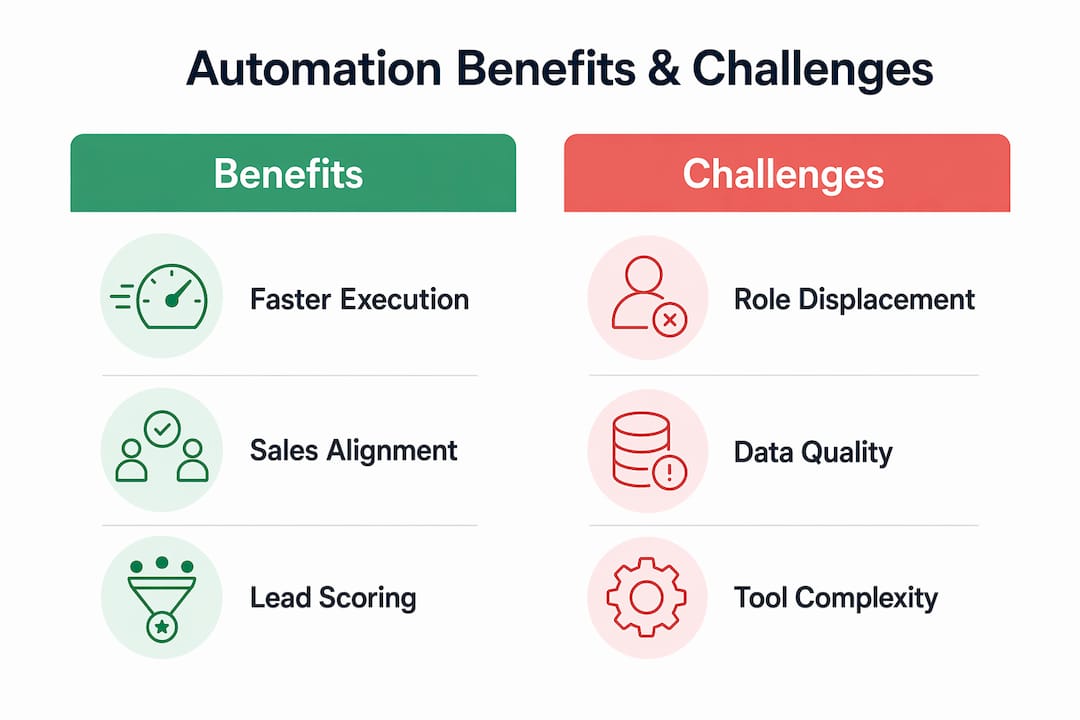
- Faster execution: Campaigns that previously required days of manual setup launch in hours
- Reduced errors: Automated workflows remove the human error risk in segmentation, scheduling, and personalization
- Cross-functional visibility: Sales and management access the same pipeline data as marketing, improving forecasting accuracy
- Scalable personalization: One marketer can manage personalized journeys for thousands of contacts simultaneously
The challenges are equally real. 47% of B2B companies reduced marketing roles due to AI, with junior copywriting and creative execution positions most at risk. This creates pressure on team structure and requires deliberate investment in upskilling. Automation also creates a measurement trap: teams that deploy tools without tracking outcomes mistake activity for results.
| Operational benefit | Operational challenge |
|---|---|
| Faster campaign execution | Junior role displacement requiring upskilling |
| Consistent customer journeys | Data quality dependencies |
| Improved sales-marketing alignment | Measurement gaps masking poor ROI |
| Scalable personalization | Governance complexity with AI systems |
Disconnected marketing tools increase operational complexity. Automation works best when it replaces manual coordination across integrated systems, not when it simply schedules messages within isolated platforms.
How can marketing professionals implement automation to maximize ROI?
Treating automation as a tool installation is the most common reason implementations underperform. Marketers must treat automation as an operating model change, coordinating AI agents with clear measurement frameworks and documented data sources. The technology is the easy part. The operating model is where most teams struggle.
A structured implementation approach follows this sequence:
- Audit current workflows: Identify every manual task, handoff, and decision point in your marketing and sales process before selecting a platform.
- Define lifecycle stages in writing: Document what qualifies a contact for each stage and who owns each transition in the CRM.
- Establish a measurement framework: Track both efficiency metrics (time saved, cost per lead) and effectiveness metrics (conversion rate, revenue attributed). Without measurement investment, automation becomes a cost center rather than a growth driver.
- Build human-in-the-loop governance: Assign reviewers for AI-generated content and automated decisions that affect brand voice or customer experience.
- Upskill the team: Train marketers to manage automation workflows, interpret AI outputs, and write effective briefs for generative tools.
Compliance is a non-negotiable element of any automated email program. The CAN-SPAM Act requires automated marketing emails to include clear opt-out mechanisms and honor unsubscribe requests within 10 business days. Violations carry per-email penalties that can accumulate quickly at automation scale.
Pro Tip: Build your measurement dashboard before you launch your first automated campaign, not after. Retroactively attributing revenue to automation is far harder than tracking it from day one.
For teams building their data-driven marketing foundation, these governance steps are the difference between automation that compounds results over time and automation that creates technical debt.
Key takeaways
Marketing automation delivers measurable ROI only when it operates on clean data, tracks both efficiency and effectiveness metrics, and is governed as an operating model change rather than a software deployment.
| Point | Details |
|---|---|
| Automation scope | Covers email, SMS, social, CRM, and lead scoring across the full customer lifecycle. |
| AI advancement | AI-driven systems adapt in real time, replacing fixed rules with predictive personalization. |
| Data dependency | Clean, structured CRM data is required for lifecycle automation to trigger correctly. |
| Measurement discipline | Track time saved and revenue attributed from day one to prove and protect automation ROI. |
| Governance requirement | Human oversight of AI-generated content and agentic decisions protects brand consistency. |
Why automation strategy matters more than automation tools
Most conversations about marketing automation focus on platform selection. After working with businesses across retail, e-commerce, and service industries, the pattern is consistent: the teams that get the most from automation are not the ones with the most sophisticated tools. They are the ones with the clearest processes before the tools are turned on.
The shift from rule-based automation to AI-driven agentic systems is real and accelerating. But the bottleneck has not moved to the technology. It has moved to the quality of the brief, the cleanliness of the data, and the clarity of the measurement framework. A business that cannot define its own customer lifecycle stages in writing will not benefit from an AI system that automates transitions between those stages.
The other underappreciated factor is cross-functional buy-in. Automation that lives only inside the marketing team creates reporting silos. When sales and management operate from the same automated pipeline data, the entire organization makes faster, better-informed decisions. That is where the strategic value of automation compounds beyond efficiency gains into genuine competitive advantage.
My recommendation for any team starting this process: resist the urge to automate everything at once. Pick the one workflow that costs the most manual time, automate it well, measure the outcome, and use that proof point to build internal confidence for the next phase. Sustainable automation adoption is incremental, not wholesale.
— Tran
Put automation to work for your business
Understanding how automation improves marketing is one thing. Implementing it in a way that actually drives revenue for your specific business is another. Sourcesnova works with small and mid-size businesses across retail, e-commerce, and service industries to build marketing systems that generate real growth, not just activity reports. From CRM setup and lifecycle automation to campaign management and performance tracking, Sourcesnova provides the strategy and hands-on execution that turns automation potential into measurable results. If you are ready to move from manual marketing to a system that works while you focus on running your business, explore Sourcesnova's services and see what a clear, accountable approach looks like.
FAQ
What is the role of automation in marketing?
Marketing automation handles multichannel campaign delivery, lead nurturing, and customer segmentation automatically, freeing marketing teams to focus on strategy and creative decisions rather than manual execution.
How does AI differ from traditional marketing automation?
Traditional automation follows fixed rules set by marketers, while AI-powered automation uses machine learning to adapt messaging, timing, and content in real time based on individual customer behavior and predictive signals.
What are the biggest risks of marketing automation?
The two primary risks are poor data quality, which causes incorrect triggers and wrong-stage messaging, and insufficient measurement, which makes it impossible to distinguish automation that drives revenue from automation that only drives activity.
How long does it take to see results from marketing automation?
Most businesses see efficiency gains within the first 30 to 60 days of deployment. Revenue impact typically becomes measurable within one full sales cycle, provided measurement frameworks are in place from launch.
Does marketing automation replace marketing jobs?
Automation shifts roles rather than eliminating them entirely. Research shows 47% of B2B companies reduced marketing headcount due to AI, with junior execution roles most affected, while demand for strategists, data analysts, and automation managers has grown.