
Most businesses lose customers not because their product is weak, but because they try to explain marketing funnels in ways that skip the real work: matching the right message to the right person at the right stage. A funnel is not a trick or a buzzword. It is a structured model of how strangers become customers, and understanding it correctly is the difference between a marketing budget that builds revenue and one that quietly drains it. This article covers the core stages, the metrics that actually matter, and the practical steps to build a funnel that converts.
Table of Contents
- Key takeaways
- Defining marketing funnels and core stages
- Key metrics for measuring funnel performance
- Common funnel mistakes that cost businesses revenue
- Modern funnel trends reshaping strategy in 2026
- How to create and optimize your marketing funnel
- My take on what funnels really require
- Ready to put your funnel to work?
- FAQ
Key takeaways
| Point | Details |
|---|---|
| Funnels have three core zones | TOFU, MOFU, and BOFU each require distinct content, messaging, and success metrics. |
| Stage-specific metrics matter | Applying bottom-of-funnel metrics to top-of-funnel activity leads to wasted budget and false conclusions. |
| One bottleneck fix drives outsized results | Improving a single drop-off point compounds through every downstream stage of the funnel. |
| Modern funnels are not linear | AI-driven discovery and multi-touch buyer journeys require updated measurement and content strategies. |
| Build fast, then improve | Launching a minimum viable funnel and iterating on real data beats waiting for a perfect build. |
Defining marketing funnels and core stages
The funnel metaphor exists for a reason. You start with a large audience at the top, and through a series of interactions, a smaller, more qualified group moves toward a purchase at the bottom. Understanding marketing funnels means recognizing that this narrowing is intentional. Every stage filters out people who are not ready or not the right fit, so your energy concentrates where it produces results.
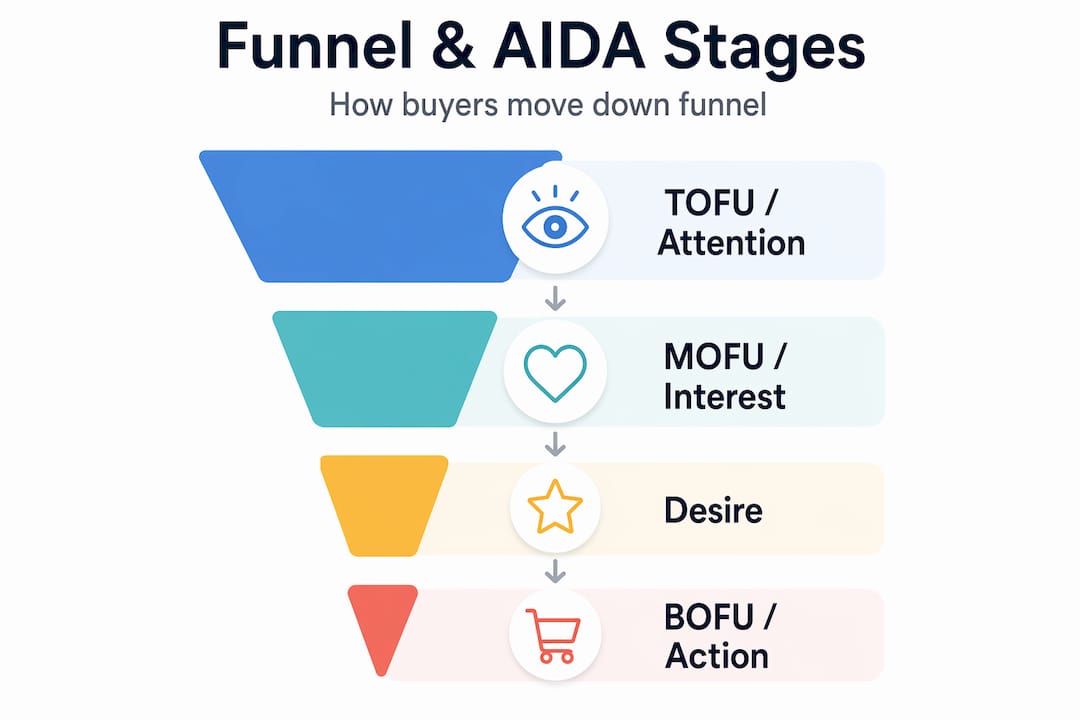
The three foundational zones are TOFU (top of funnel), MOFU (middle of funnel), and BOFU (bottom of funnel). Each represents a different level of buyer awareness and intent.
TOFU is where strangers encounter your brand for the first time. They are not looking to buy. They are researching a problem or browsing for information. Content here serves to educate and attract: blog posts, social media content, short videos, and informational guides. Your goal is not to sell. It is to earn attention and trust.
MOFU is where interested prospects evaluate their options. They know their problem, and they are weighing solutions. This is where comparison content, case studies, webinars, and email sequences do their best work. Stage-specific content types include blog posts and explainers at TOFU, comparisons and demos at MOFU, and proof-based content like case studies and FAQs at BOFU.
BOFU is where the decision happens. Prospects are ready to commit, and your job is to reduce risk and make the next step obvious. Offers, free trials, consultations, and testimonials belong here.
The AIDA model maps neatly onto this structure. Attention corresponds to TOFU, Interest and Desire align with MOFU, and Action sits at BOFU. 78% of digital marketers still use the AIDA framework in 2026 to structure their funnels, which reflects how well this model holds up across industries.
| Stage | Buyer State | Content Types | Primary Goal |
|---|---|---|---|
| TOFU | Unaware or curious | Blog posts, social content, videos | Build awareness and attract traffic |
| MOFU | Evaluating options | Case studies, webinars, email sequences | Build trust and educate |
| BOFU | Ready to decide | Demos, offers, testimonials, consultations | Convert and close |
For B2B content strategies that align with these stages, the principle is the same: content must match where the buyer is mentally, not where you want them to be.
Key metrics for measuring funnel performance
Tracking funnel performance is not about measuring everything. It is about measuring the right things at the right stage. Standard funnel benchmarks show overall funnel conversion rates between 1% and 3%, with TOFU converting at 5% to 15% for cold traffic and 20% to 40% for targeted audiences. MOFU engagement typically runs 15% to 25%, while BOFU conversion varies significantly: e-commerce sits at 2% to 5%, SaaS trials at 5% to 15%, and high-touch B2B at 10% to 30%.

These ranges give you a baseline for setting realistic targets. The gap between where you are and where the benchmark sits tells you where to focus.
The distinction between leading and lagging indicators matters here. A lagging indicator is a result, like closed revenue or total customers acquired. A leading indicator is a behavior that predicts that result, like email open rates, demo requests, or content downloads. Effective funnel metric frameworks recommend maintaining at least two leading indicators per lagging indicator, with 15 to 25 active metrics and 40 to 60 diagnostic metrics for companies in the $5M to $50M ARR range.
For most small and mid-size businesses, that level of instrumentation is overkill. What matters is having at least one leading indicator per funnel stage so you can diagnose problems before they show up in your revenue numbers.
Pro Tip: Find the stage where you lose the most prospects and fix that first. Improving a single bottleneck compounds through every stage below it. A TOFU-to-MOFU improvement from 3% to 5% increases total customers by 62%, without touching anything else in the funnel.
One additional nuance worth knowing: marketing and sales metrics should be tracked separately. Marketing funnels measure aggregate audience behavior. Sales funnels measure individual opportunity qualification. Mixing them muddies accountability and makes it harder to diagnose where problems actually originate.
Common funnel mistakes that cost businesses revenue
Most funnel failures are not technical. They are structural. The same errors appear repeatedly across businesses of every size, and they are avoidable once you know what to look for.
- Pitching to TOFU prospects. Treating top-of-funnel strangers like ready-to-buy customers is the most common funnel failure. Cold audiences need education first, not a sales pitch.
- Skipping MOFU entirely. Many businesses build an awareness campaign and a sales page with nothing in between. The middle of funnel is where trust is built, and without it, most prospects simply leave.
- Applying BOFU metrics to TOFU activities. Measuring a blog post by its direct conversion rate is like grading a first date on whether it led to a marriage proposal. TOFU should be evaluated by visitor progression to MOFU actions within a 30-day window, not by immediate sales.
- No defined stage transitions. If your team cannot agree on when a lead moves from TOFU to MOFU, your data will be inconsistent, and your optimization efforts will target the wrong problems.
- Chasing last-touch attribution. Only crediting the final touchpoint before purchase ignores all the TOFU and MOFU content that made the sale possible. This systematically underfunds the top of your funnel over time.
Pro Tip: Do not build the perfect funnel before launching. Set up a minimum viable funnel with a lead magnet, a landing page, a short email sequence, and a clear offer. Run it, measure the drop-offs, and improve from there. Real data beats theoretical planning every time.
Explore proven SMB growth strategies to see how these principles apply across different business types and industries.
Modern funnel trends reshaping strategy in 2026
The core logic of marketing funnels has not changed. What has changed is how buyers move through them, and where they encounter your brand at all.
AI tools like ChatGPT are now handling early funnel stages for a significant share of buyers. Instead of running a Google search, a prospective customer asks an AI assistant for recommendations. Traditional search volume is predicted to drop 25% by the end of 2026. This means your TOFU visibility strategy needs to account for Generative Engine Optimization (GEO), which means structuring your content so it appears in AI-generated responses, not just search engine results pages.
Buyers no longer move in a straight line from awareness to purchase. They jump between stages, revisit content multiple times, and often research through AI tools before a brand even knows they exist. Funnels that assume a predictable sequence will miss a growing share of the market.
Multi-touch attribution is the measurement answer to this non-linear reality. Rather than assigning full credit to the last touchpoint, multi-touch models distribute credit across every interaction that contributed to a conversion. This gives TOFU activities the credit they deserve and prevents marketers from defunding the content that starts the relationship.
Generative AI reshaping discovery means businesses that rely entirely on paid search for TOFU traffic are increasingly vulnerable. Building organic content authority, earning mentions in trusted sources, and structuring content for AI readability are now early-funnel priorities, not optional extras.
The compound effect of focused funnel optimization still holds. Improving one stage lifts every stage beneath it. The difference in 2026 is that you need to map where your buyers actually enter the funnel, not where your analytics assumed they would.
How to create and optimize your marketing funnel
Building a funnel that works does not require a complicated technology stack or a large team. It requires clarity on what you are offering, who you are targeting, and what action you want people to take at each stage.
Step 1: Build your minimum viable funnel. Start with four components.
- A lead magnet: a piece of content that delivers real value in exchange for an email address. A checklist, a short guide, or a free audit works well.
- A landing page: a focused page with one offer, one call to action, and no distractions.
- A nurture email sequence: three to five emails that educate, build trust, and move prospects toward a decision. Email nurture for MOFU is one of the highest-return investments in the funnel.
- A sales page or offer page: a clear presentation of your product or service with social proof and a direct way to buy or book.
Step 2: Create stage-specific content.
- TOFU: blog posts answering common questions in your industry, short social videos explaining a concept, and social media content that generates awareness.
- MOFU: case studies, comparison guides, webinars, and email sequences that address objections.
- BOFU: testimonials, free trials, demos, limited-time offers, and direct consultation booking.
Step 3: Set up tracking for each stage transition. Use a CRM or analytics platform to monitor how many visitors enter TOFU, what percentage engage with MOFU content, and what percentage convert at BOFU. Track these numbers weekly. When a stage shows unusual drop-off, investigate the content, offer, or messaging at that specific point.
Step 4: Improve one thing at a time. Change one variable per test. If your TOFU-to-MOFU conversion is low, test a different lead magnet before rewriting your landing page. Isolating variables makes it possible to know what actually caused an improvement.
My take on what funnels really require
I have worked with businesses that spent months mapping out elaborate funnel diagrams before sending a single email. And I have seen businesses with a single landing page and a five-email sequence outperform companies with sophisticated CRM setups and dedicated marketing teams. The difference is almost always discipline around stage separation.
What transforms client outcomes, in my experience, is not a better tool or a more complex strategy. It is the decision to stop treating every prospect the same. The moment a business starts creating TOFU content that does not mention the product at all, and MOFU content that genuinely helps rather than sells, the numbers shift. Prospects engage longer. Drop-off rates fall. Conversions improve without touching BOFU at all.
The mistake I see most consistently is applying the wrong success metric to the wrong stage. A founder sees low conversion on their blog traffic and decides the blog is failing. They cut it. They were measuring a TOFU asset by BOFU standards, and they just eliminated the thing feeding the rest of their funnel.
On the AI and GEO front, I think the businesses that will struggle most are those waiting for certainty before adapting. The shift is already happening. Structuring content for AI readability and earning brand mentions in authoritative sources is not a future consideration. It is a present-tense funnel requirement.
Keep your funnel simple, measure it honestly, and fix one thing at a time. That approach produces more growth than any sophisticated system built on assumptions.
— Tran
Ready to put your funnel to work?
Understanding the theory behind marketing funnels is a strong starting point. Turning that understanding into a system that reliably acquires and converts customers is where the real work begins.
Sourcesnova works with small and mid-size businesses to build clear, practical marketing strategies grounded in data and designed for real growth. From content creation to full-funnel execution, the team at Sourcesnova helps business owners stop guessing and start growing. Explore the blog for additional guidance on B2B growth foundations and content strategy, or reach out directly to discuss where your funnel needs the most attention.
FAQ
What does "marketing funnel" mean?
A marketing funnel is a model that represents the stages a prospect moves through from first discovering your brand to making a purchase. The stages are typically grouped into awareness, consideration, and decision, mapped to TOFU, MOFU, and BOFU zones.
What are the main marketing funnel stages?
The three core stages are top of funnel (TOFU) for awareness, middle of funnel (MOFU) for evaluation, and bottom of funnel (BOFU) for conversion. Six granular sub-stages include awareness, interest, consideration, intent, decision, and purchase.
How do I know if my marketing funnel is working?
Track conversion rates at each stage transition and identify where the largest drop-off occurs. Benchmark your numbers: TOFU should convert 5% to 15% of cold traffic to MOFU engagement, and a healthy overall funnel converts 1% to 3% from first touch to purchase.
What is the biggest mistake in marketing funnel management?
Applying bottom-of-funnel conversion metrics to top-of-funnel activities is the most damaging error. It leads to cutting high-value awareness content because it does not produce immediate sales, which starves the entire funnel over time.
How does AI affect marketing funnels in 2026?
AI tools are handling early funnel research for a growing share of buyers, with traditional search volume projected to fall 25% by end of 2026. Marketers need to prioritize Generative Engine Optimization to maintain visibility at the top of the funnel.