
Most small business owners assume a digital strategy means buying the right tools. Install a CRM, set up Google Ads, launch a social profile, and call it done. That assumption is costing businesses real money. A genuine SMB digital strategy is a business-led transformation plan that connects technology investments to measurable outcomes, not a shopping list of software. What follows is a structured, phased approach to building a digital strategy that actually drives growth. You'll leave with a clear framework, specific tactics, and the confidence to execute without wasting budget on disconnected tools.
Table of Contents
- Key Takeaways
- What an effective SMB digital strategy actually is
- A 90-day roadmap for small business digital growth
- Aligning your digital marketing with business outcomes
- Common execution mistakes and how to avoid them
- My honest take on why most SMBs get this wrong
- Ready to build your digital strategy with expert support
- FAQ
Key Takeaways
| Point | Details |
|---|---|
| Strategy over tools | Digital transformation means connecting technology to business goals, not purchasing more software. |
| Phase your execution | A 90-day roadmap with assess, automate, and optimize phases prevents overwhelm and delivers early wins. |
| Fix conversion first | Optimize landing pages and lead flows before scaling ad spend to reduce cost per lead. |
| People drive adoption | 70% of transformation success depends on team buy-in and process adoption, not the technology itself. |
| Measure one workflow end-to-end | Instrument a single key process, like lead to sale, early to prove ROI and build momentum. |
What an effective SMB digital strategy actually is
The phrase "digital strategy" gets applied to everything from a new website to a full enterprise overhaul. For small and mid-sized businesses, the standard industry term is digital transformation, which means fundamentally changing how value is created and delivered through technology. The key distinction is that transformation is a business initiative, not an IT project.
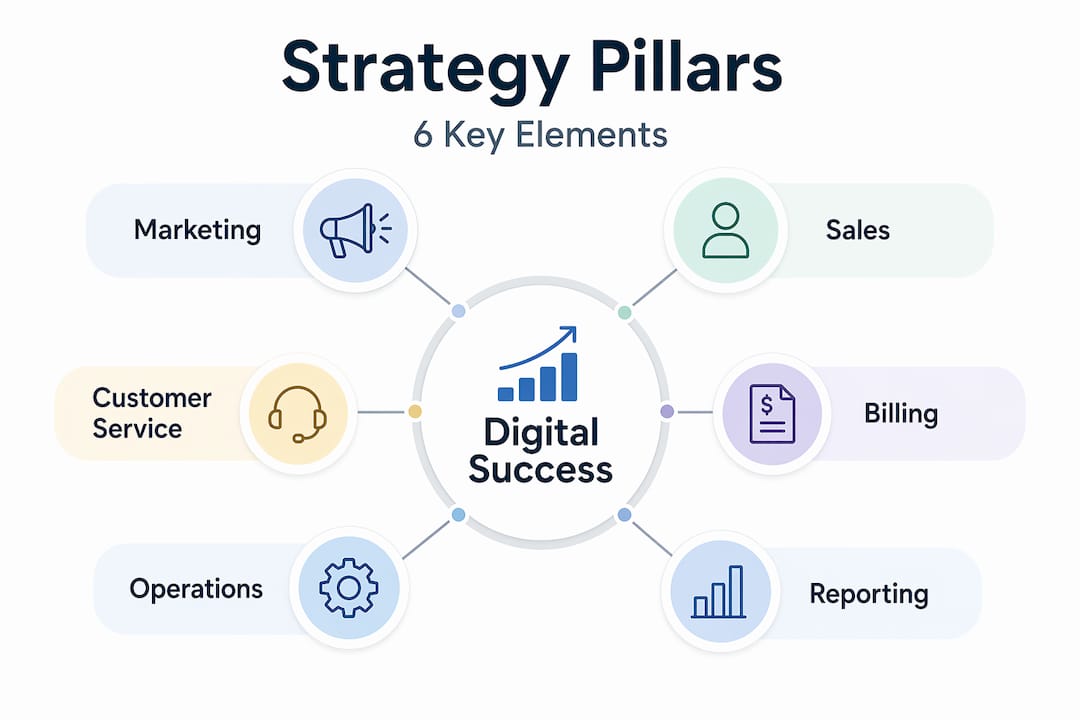
A well-built strategy spans six interconnected pillars:
- Cloud infrastructure: The foundation everything else runs on. Cloud-based tools give you access, flexibility, and data sharing across your team without expensive hardware.
- Process automation: Replacing repetitive manual tasks, from invoice processing to appointment reminders, with workflows that run themselves.
- Data and analytics: Collecting the right data at each customer touchpoint and turning it into decisions, not just reports.
- AI and machine learning: Applying AI for customer data analysis and campaign optimization without needing a data science team.
- Cybersecurity: Protecting customer data and business continuity, which is non-negotiable as you digitize more operations.
- Customer experience: Designing every digital interaction to be consistent, fast, and aligned with what your customers actually expect.
These pillars fail in isolation. A business that buys a CRM but never connects it to marketing, billing, or customer service ends up with an expensive contact list. The 7-step SMB approach that experts recommend sequences these investments deliberately to avoid exactly that trap.
Pro Tip: Before purchasing any new software, ask yourself which of the six pillars it belongs to and how it connects to at least one other pillar in your current stack. If you cannot answer that, wait.

A 90-day roadmap for small business digital growth
A phased approach prevents the most common failure mode in small business online strategy: doing too much at once, seeing no clear results, and abandoning the effort entirely. This 90-day structure is drawn from a practical transformation plan designed specifically for SMBs.
-
Days 1 to 30: Assess your current state. Conduct a digital maturity assessment to document your existing tech stack, data quality, and workflows. Map one core process end-to-end, ideally lead to sale or order to fulfillment. Identify your top three pain points: where is time being wasted, where is data falling through the cracks, and where are customers dropping off? Create a prioritized backlog based on impact and ease, not on what sounds exciting.
-
Days 31 to 60: Automate and integrate. Tackle your top two priorities from the backlog. This phase typically involves deploying a CRM if you do not have one, connecting your marketing tools to it, and automating at least one repetitive workflow such as lead follow-up emails or appointment confirmations. The goal is tangible time savings that your team feels immediately, because those early wins build the momentum and leadership support you will need for phase three.
-
Days 61 to 90: Optimize and measure. Set up reporting dashboards that track the metrics tied to your business goals, not vanity numbers. Review what the automation and integration work delivered. Test improvements, adjust based on data, and document what you learned. By the end of this phase, you should have a continuous improvement process in place, not just a project that is "done."
The insight here that most guides skip is this: measuring a single key workflow end-to-end in the first 30 days is more valuable than deploying five new tools. When you can see the whole picture, you know exactly where to intervene.
Pro Tip: Pick one pilot with a clear before-and-after metric, like hours spent on manual follow-up per week. Proving ROI on that single process funds and justifies every next investment.
Aligning your digital marketing with business outcomes
Once your operational foundation is in place, digital marketing for SMBs becomes a much more precise exercise. Too many businesses run ads before fixing where the ads send people. The result is paying for traffic that does not convert, which is a budget drain that compounds quickly.
Start with market research and competitive analysis before committing to any channel. Understand where your customers actually spend time online, what language they use when searching for what you offer, and what your competitors are doing well or poorly. This intelligence shapes every channel and message decision downstream.
The core digital marketing elements worth your budget are:
- SEO and content: Organic search delivers compounding returns over time. A focused marketing strategy for 2026 prioritizes content that answers real customer questions at each stage of the buying process.
- Paid search and social: Google Ads average cost per lead sits at $79.14, while Facebook averages $26.43. Knowing your industry benchmark tells you whether your campaigns are efficient or broken.
- Social media: Choose two platforms your customers actually use rather than trying to be everywhere. A focused social media growth strategy consistently outperforms a scattered presence.
- Email and CRM automation: This is your highest-ROI channel once your list is properly segmented and your sequences are set up correctly.
Here is what the data shows on conversion optimization versus ad spend:
| Lever | Impact on Cost Per Lead | Effort Level |
|---|---|---|
| Reduce form fields from 7 to 3 | 25 to 40% lift in form completions | Low |
| Improve page speed by 1 second | 7% more conversions retained | Medium |
| Add personalization to landing pages | Up to 40% conversion lift | Medium |
| Increase ad spend by 20% | Marginal without page fixes | High cost |
The takeaway is clear: fixing your landing page mechanics delivers far more CPL improvement than raising your bids. Before scaling any channel, validate that your conversion path works. Otherwise, you are paying more to waste more.
Common execution mistakes and how to avoid them
Knowing what to do is only half the work. Understanding where SMBs typically break down in execution is what separates businesses that sustain digital growth from those that stall after the first quarter.
The most expensive mistake is treating technology as a checklist. Buying a marketing automation platform does not mean you have a marketing strategy. Executive commitment with clear governance and a named owner for the digital initiative is what separates transformations that stick from those that quietly die after six months.
A closely related trap is automating broken processes. If your lead follow-up process is slow and inconsistent manually, automating it just makes it consistently bad and faster. Fix the process logic first, then automate it.
Other patterns worth watching for:
- Expanding to new marketing channels before the existing ones convert well
- Investing in reporting tools without first defining which metrics drive your business decisions
- Skipping change management, which is the training, communication, and adoption support that gets your team actually using the new systems
"70% of transformation success comes from people and process adoption, not from the technology itself."
That finding should shift how you budget. If you are spending 90% of your digital investment on software and 10% on training and change management, your ratios are backwards. The tools are relatively easy. Getting your team to trust, use, and improve them is the real work.
The businesses that sustain SMB digital transformation are the ones that treat it as an ongoing discipline. They review metrics monthly, run small experiments, and make incremental improvements rather than waiting for a major overhaul cycle.
My honest take on why most SMBs get this wrong
I have worked with enough small business owners to know that the conversation almost always starts in the wrong place. Someone pitches them a tool, and suddenly that tool becomes the strategy. I have seen businesses spend thousands on platforms they never fully use because no one paused to ask what problem they were actually trying to solve.
The real issue is framing. When you treat digital strategy as a project with a finish line, you underfund the follow-through. What actually works is treating it as an operating rhythm. Review, test, adjust, repeat. The businesses I have seen succeed are not the ones with the most sophisticated stacks. They are the ones with the clearest picture of one or two core metrics and the discipline to move them month over month.
My advice is to start smaller than feels comfortable. Pick one workflow to measure, one process to automate, one channel to optimize. Prove it works. Then expand. That approach builds real competence inside your organization, which is an asset no outside agency can give you.
The cost-benefit reality for most SMBs is that you do not need a massive budget to see meaningful digital results. You need clarity on what you are solving, a realistic sequence to solve it, and the patience to measure before you scale.
— Tran
Ready to build your digital strategy with expert support
If this framework makes sense but you are unsure where to start with your own business, that is exactly the problem Sourcesnova was built to solve. Sourcesnova works with local and mid-sized businesses across retail, services, e-commerce, and more. The team delivers clear digital growth strategy with hands-on execution, not bloated retainers or reports full of metrics that do not connect to revenue.
There are no overpromises here. Sourcesnova does an honest assessment of where your business stands digitally, identifies your highest-impact priorities, and builds a plan your team can actually execute. Whether you need a full digital transformation roadmap or help fixing a conversion problem that is costing you leads right now, the process starts with a straightforward conversation. Schedule a digital health check with Sourcesnova and get a clear picture of what is working, what is not, and what to do about it.
FAQ
What is an SMB digital strategy?
An SMB digital strategy is a business-led plan that connects technology investments to specific, measurable goals. It covers operations, marketing, data, and customer experience as an integrated system, not a collection of separate tools.
How long does it take to see results from digital transformation?
A phased 90-day plan can deliver measurable early wins within the first 30 days by automating one workflow and tracking it end-to-end. Broader results compound over 3 to 6 months as optimizations layer.
What is the biggest mistake SMBs make with digital strategy?
The most common mistake is buying tools without a defined strategy. Success depends 70% on people and process adoption, so neglecting change management and team training is what causes most digital initiatives to stall.
How do I reduce my cost per lead without increasing ad spend?
Fix your conversion mechanics first. Reducing form fields from 7 to 3 can lift completions by 25 to 40%, and every one-second improvement in page speed retains 7% more conversions. Those changes cost less than a single week of increased ad budget.
Do I need a big budget to start a digital strategy?
No. The most effective approach for small businesses is to pick one core workflow, measure it, automate it, and prove ROI before expanding. A clear process with modest tools consistently outperforms a bloated tech stack with no defined owner or goals.