
Social media marketing steps are a set of deliberate actions designed to help small businesses engage audiences, build brand awareness, and drive measurable results through platforms like Instagram, Facebook, and LinkedIn. Most marketing managers treat these steps as a one-time checklist. That is the wrong approach. Buffer and Sprout Social both confirm that the most effective social media programs treat this as a continuous improvement cycle, not a launch-and-forget plan. This guide walks you through each step with the rationale, tools, and workflows you need to build a social media presence that produces real business results.
What are the essential social media marketing steps every small business should follow?
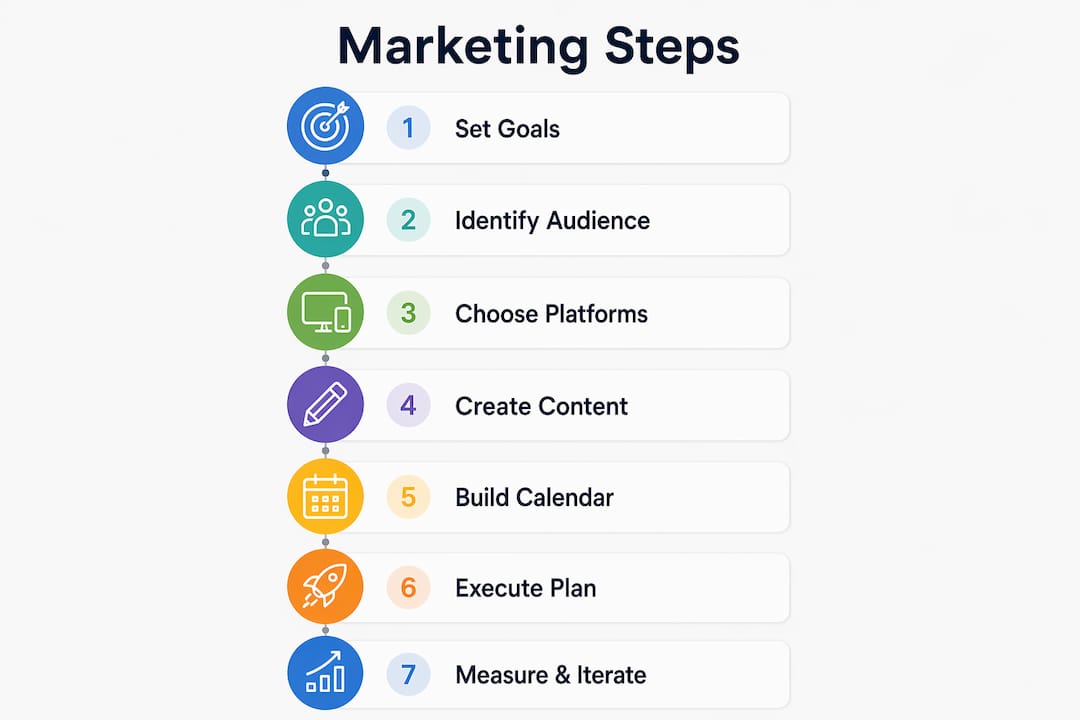
The social media marketing steps that consistently produce results follow a logical sequence. Each step builds on the previous one, and the cycle repeats as you gather data and refine your approach.
- Set SMART goals tied to specific business outcomes such as revenue, leads, or customer retention.
- Define your target audience using demographic data, platform behavior, and buyer personas.
- Select the right platforms based on where your audience spends time and what your team can realistically produce.
- Establish content pillars that organize your messaging into 3 to 5 consistent themes.
- Build a content calendar that maps posts to launches, promotions, and key dates.
- Publish and engage by responding to comments, monitoring mentions, and participating in conversations.
- Analyze performance using platform analytics and third-party tools like Buffer or HubSpot.
- Iterate your strategy based on what the data tells you every 30 to 90 days.
HubSpot documents a 10-step strategy process that most social media teams complete within 2 to 4 weeks. That timeline is realistic for small businesses starting from scratch. The cyclical nature of these steps is what separates businesses that grow their social presence from those that plateau after the first few months.
Pro Tip: Set a calendar reminder every 90 days to review your strategy from step one. Markets shift, platforms update their algorithms, and your business priorities change. Treating the cycle as a living process prevents your social media from going stale.
How to set and align social media marketing goals with your business objectives
Goal-setting is the foundation of every effective social media strategy. Without clear goals, you cannot measure success, defend your budget, or make informed decisions about content and platforms.
The SMART framework transforms vague aspirations into measurable social media targets that connect directly to revenue and sales objectives. SMART stands for Specific, Measurable, Achievable, Relevant, and Time-bound. A goal like "grow our Instagram following" is not SMART. A goal like "increase Instagram followers by 20% in 90 days to support our spring product launch" is.
Common goal categories for small businesses include:
- Brand awareness: Reach, impressions, and follower growth on platforms like Instagram and Facebook.
- Lead generation: Form submissions, email sign-ups, and link clicks driven from LinkedIn or Meta ads.
- Sales: Direct revenue attributed to social campaigns through UTM tracking and conversion pixels.
- Customer care: Response time, resolution rate, and customer satisfaction scores on social channels.
Each goal category maps to specific key performance indicators. Tracking KPIs against your goals is what converts social media activity into business intelligence. Sourcesnova recommends linking every social goal to at least one revenue or pipeline metric so that marketing spend can be justified and adjusted with confidence. For more detail on building this foundation, the marketing goals guide on the Sourcesnova blog covers the full process for small businesses.
How to identify and understand your audience for effective social media
Audience research is where most small businesses underinvest. Knowing your audience at a surface level, such as "women aged 25 to 45," is not enough to drive content decisions. You need to understand platform-specific behavior, language preferences, and the problems your audience is actively trying to solve.

Building buyer personas with digital behavior and platform-specific insights produces more effective targeting and higher content relevance. A buyer persona for a nail salon owner looks very different from one for a B2B lighting distributor, even if their age and income are identical. The platforms they use, the content formats they respond to, and the language they trust are all distinct.
Practical methods for audience research include:
- Native analytics: Instagram Insights, Facebook Audience Insights, and LinkedIn Analytics reveal who is already engaging with your content.
- Social listening tools: Platforms like Sprout Social allow you to monitor brand mentions, competitor conversations, and trending topics in your niche.
- Competitor analysis: Study the top-performing posts of direct competitors to identify content gaps and audience preferences.
- Customer interviews: Direct conversations with existing customers surface language patterns and pain points that no analytics tool captures.
Pro Tip: Export your top 20 performing posts from the last six months and look for patterns in format, topic, and posting time. Your existing audience is already telling you what they want. Most businesses ignore this data and keep guessing.
How to choose the right platforms and create content pillars
Platform selection is one of the highest-leverage decisions in the entire social media campaign process. Choosing the wrong platforms wastes production resources and produces weak results regardless of content quality.
Pressure-testing platform choices against realistic production capacity prevents spreading resources too thin. A small business with one marketing manager cannot maintain a high-quality presence on five platforms simultaneously. Sprout Social recommends assigning each platform a distinct role aligned with specific business goals rather than treating all channels as interchangeable broadcast tools.
| Platform | Primary audience | Best content format | Strongest use case |
|---|---|---|---|
| 18 to 34, visual consumers | Reels, Stories, carousels | Brand awareness, product showcase | |
| 25 to 54, broad demographics | Video, events, groups | Community building, local ads | |
| B2B professionals, decision-makers | Articles, thought leadership | Lead generation, recruiting | |
| TikTok | 18 to 30, entertainment-first | Short-form video | Viral reach, brand personality |
| 25 to 44, purchase-intent users | Infographics, product pins | E-commerce, inspiration content |
Content pillars organize your messaging into 3 to 5 recurring themes that reflect your brand's expertise and your audience's interests. For a retail business, pillars might include product education, behind-the-scenes content, customer stories, and promotional offers. Pillars prevent the common trap of posting randomly and ensure every piece of content serves a defined purpose. For a deeper look at building your brand's digital presence around these pillars, the digital brand presence guide on the Sourcesnova blog is a practical starting point.
What steps are involved in building a content calendar and executing your plan?
A content calendar converts your strategy into a production schedule. Without one, even well-defined goals and content pillars collapse under the daily pressure of running a business.
Structured workflows and centralized calendars increase output predictability and quality without requiring a larger team. The key is batching content creation, which means producing multiple posts in a single session rather than creating content day by day.
Recommended tools and scheduling practices:
- Calendar tools: monday.com, Notion, or Google Sheets for planning. Buffer, Hootsuite, or Later for scheduling and publishing.
- Batching cadence: Block two to four hours per week for content creation. Produce one to two weeks of content in each session.
- Approval workflows: For teams with more than one person, use a simple review step before publishing to catch errors and maintain brand consistency.
- Key date alignment: Map your calendar to product launches, seasonal promotions, and industry events at least four weeks in advance.
| Calendar element | Recommended tool | Frequency |
|---|---|---|
| Content planning | monday.com or Notion | Weekly |
| Post scheduling | Buffer or Later | Weekly batch |
| Performance review | Native analytics or HubSpot | Monthly |
| Strategy audit | Sprout Social or manual review | Quarterly |
Consistency matters more than volume. Publishing three well-crafted posts per week on two platforms outperforms posting daily on five platforms with inconsistent quality. The calendar is the operational backbone that makes consistency achievable without burning out your team.
How to monitor performance and iterate your social media strategy
Measurement closes the loop on every other step. Without it, you are making decisions based on assumptions rather than evidence.
Effective ROI measurement focuses on engagement, conversions, and revenue impact. These three metrics separate meaningful performance data from vanity metrics like raw follower counts. Engagement tells you whether your content resonates. Conversions tell you whether social activity drives business outcomes. Revenue impact tells you whether the investment is justified.
Key metrics to track by category:
- Reach and awareness: Impressions, follower growth, share of voice.
- Engagement: Likes, comments, shares, saves, and click-through rate.
- Conversions: Link clicks, form submissions, and purchases attributed to social.
- Customer care: Response time and resolution rate on social channels.
Integrating social analytics within your broader marketing tech stack, such as connecting HubSpot or Google Analytics to your social platforms, produces credible ROI analysis that goes beyond platform-level data. This integration is what allows you to connect a Facebook ad click to a closed sale in your CRM.
Pro Tip: Run a social media audit every quarter. Review your profile completeness, content performance by pillar, and platform engagement rates. Audits surface drift early, before a slow decline becomes a serious problem.
Key takeaways
Effective social media marketing requires a repeating cycle of goal-setting, audience research, platform selection, content planning, execution, and data-driven iteration to produce consistent business results.
| Point | Details |
|---|---|
| Start with SMART goals | Connect every social media goal to a specific business metric like revenue or leads. |
| Research your audience deeply | Use native analytics, social listening, and competitor analysis to build accurate buyer personas. |
| Assign each platform a distinct role | Match platforms to audience behavior and production capacity to avoid overcommitment. |
| Build and maintain a content calendar | Batch content creation and use scheduling tools like Buffer or Later for consistent publishing. |
| Measure what matters | Track engagement, conversions, and revenue impact. Integrate social data with your CRM or analytics platform. |
What I have learned from working through these steps with real businesses
The most common mistake I see small business owners make is treating social media marketing as a setup task. They spend two weeks building a strategy, launch it, and then expect it to run on autopilot. Six months later, they wonder why results have plateaued.
The businesses that grow consistently are the ones that treat the social media growth strategy as a living system. They review their goals every quarter, audit their content performance, and make deliberate adjustments. That discipline is not glamorous, but it is what separates businesses with 15% year-over-year growth from those spinning their wheels.
Resource constraints are real for small businesses. You cannot do everything at once. The answer is not to try harder. It is to do less, better. Two platforms executed with discipline and a clear content calendar will outperform five platforms managed reactively every single time. Sprout Social's guidance on assigning channel roles reflects exactly this principle, and it is advice I give to every client who comes to Sourcesnova overwhelmed by platform choices.
The other thing I would push back on is the obsession with follower counts. Follower growth is a lagging indicator of content quality, not a leading indicator of business results. Focus on engagement rate and conversion rate first. When those metrics are healthy, follower growth follows naturally.
— Tran
How Sourcesnova helps small businesses execute social media marketing
Sourcesnova was built specifically for small and mid-size businesses that want real marketing results without the bloated agency model. The social media marketing steps covered in this guide are exactly the kind of work Sourcesnova executes for clients across retail, e-commerce, beauty, and service industries.

If you are ready to move from strategy to execution, Sourcesnova provides clear, hands-on support at every stage of the process. From goal-setting and audience research to content calendar management and performance reporting, the team handles the operational complexity so you can focus on running your business. Visit Sourcesnova to learn how the team can build and manage a social media program that drives measurable growth for your business.
FAQ
What are the first social media marketing steps for a small business?
The first steps are setting SMART goals tied to business outcomes and defining your target audience using platform analytics and buyer personas. Without these two foundations, platform selection and content planning have no direction.
How many social media platforms should a small business use?
Most small businesses with limited marketing resources perform best on two to three platforms. Sprout Social recommends assigning each platform a distinct role rather than posting the same content everywhere.
How do you measure social media marketing success?
Effective measurement tracks engagement, conversions, and revenue impact as the three core metrics. Connecting social analytics to tools like HubSpot or Google Analytics provides a clearer picture of ROI than platform-level data alone.
How often should you update your social media strategy?
A full strategy review every 90 days is the standard recommended by Buffer and HubSpot. Monthly performance reviews on key metrics allow for smaller adjustments between major strategy cycles.
What is a content pillar in social media marketing?
A content pillar is a recurring theme that organizes your social media messaging into 3 to 5 consistent categories. Pillars prevent random posting and ensure every piece of content serves a defined audience need or business goal.