
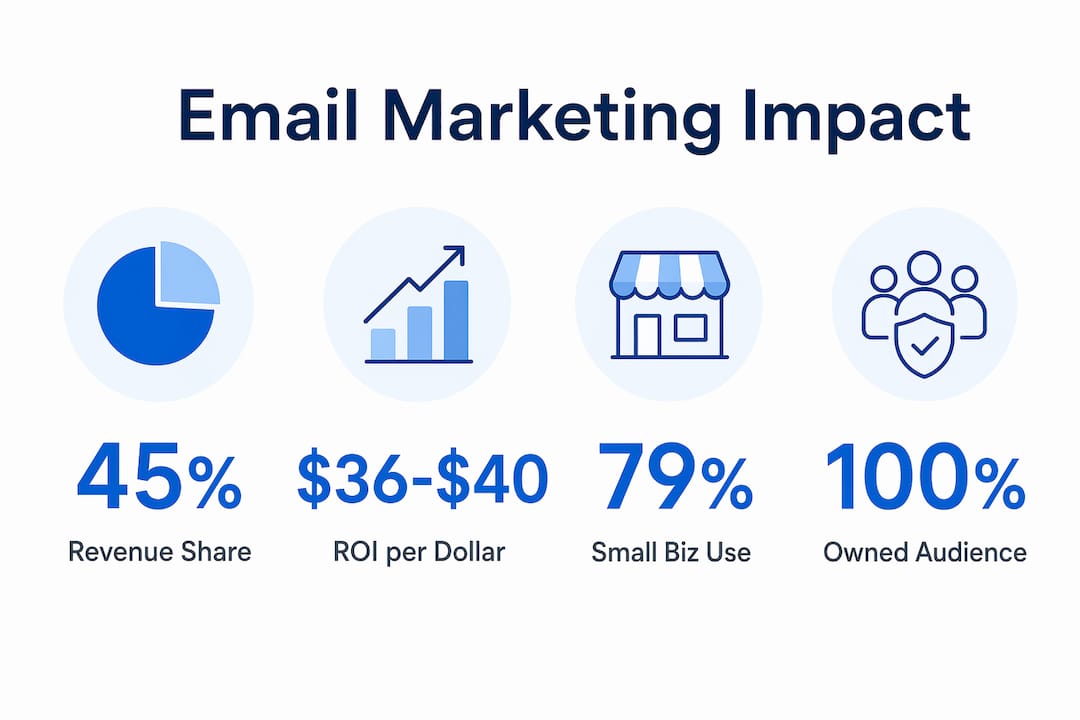
Email marketing is defined as a permission-based, direct communication channel that delivers targeted messages to subscribers who have opted in to receive them, making it the highest-ROI channel in digital marketing. Businesses that treat email as a core revenue system rather than a broadcast tool consistently outperform those that rely on social media or paid ads alone. According to HubSpot, email marketing delivers an average ROI of $36 to $40 for every $1 spent, a figure no other digital channel matches at scale. Apollo confirms that behavior-triggered automation can drive up to 76% more revenue than static broadcast campaigns. For business owners and marketers, understanding the role of email marketing means recognizing it as owned infrastructure, not just a campaign tool.
What is the role of email marketing in a modern strategy?
The role of email marketing in any modern marketing plan is to serve as the primary owned channel connecting your business directly to customers and prospects. Unlike social media platforms, where algorithm changes can cut your organic reach overnight, email gives you a direct line to 100% of your subscriber list every time you send. Twilio describes this as the defining advantage of email over rented channels. That ownership is the foundation everything else is built on.
Effective email marketing strategies start with clear business goals tied to specific outcomes: revenue per campaign, customer retention rates, or pipeline influence. Audience segmentation follows immediately. Sending the same message to every subscriber is the fastest way to erode engagement and damage your sender reputation. A retail business, for example, should segment by purchase history, product category interest, and recency of last purchase before sending a single promotional email.

The technical foundation matters just as much as the content. SPF, DKIM, and DMARC authentication protocols are non-negotiable for inbox placement. Without them, your emails land in spam regardless of how well-written they are. Twilio identifies these protocols as critical to any deliverability strategy. Think of authentication as the infrastructure layer that makes everything else possible.
Measurement must go beyond open rates. Revenue attribution, click-through rates, and pipeline influence give you a real picture of what your email program is actually doing for the business. The strategic components that define a high-performing email program include:
- Goal alignment: Every campaign maps to a specific business objective, whether that is a product launch, re-engagement, or upsell.
- Segmentation: Lists divided by behavior, demographics, or purchase stage receive relevant content and convert at higher rates.
- Authentication: SPF, DKIM, and DMARC protect sender reputation and guarantee inbox placement.
- Automation: Behavior-triggered sequences replace manual batch sends and generate more revenue with less effort.
- Revenue metrics: Click-through rate, conversion rate, and revenue per recipient replace vanity metrics like open rate.
Pro Tip: Set up your email authentication records before you send your first campaign. Retroactively fixing deliverability issues after your sender reputation is damaged takes months, not days.
How does email compare with other digital marketing channels?
Email marketing's effectiveness becomes clearest when measured against the alternatives. Paid search and social media advertising deliver reach, but that reach disappears the moment you stop paying. Organic social media reach on platforms like Instagram or Facebook averages in the low single digits as a percentage of followers. Email, by contrast, reaches your entire opted-in list on every send.
ClickMinded reports that email drives 45% of revenue in some organizations, surpassing both paid ads and SEO. That figure reflects what happens when email is treated as a revenue system with proper segmentation and automation in place. SMS marketing offers high open rates but limited content depth and higher per-message costs. Content marketing builds authority over time but converts slowly. Email sits at the intersection of reach, cost efficiency, and measurable conversion.
| Channel | Audience ownership | Average ROI | Content depth | Cost per send |
|---|---|---|---|---|
| Email marketing | Owned | $36 to $40 per $1 | High | Very low |
| Paid social ads | Rented | Variable | Medium | High |
| Organic social | Rented | Low/variable | Low to medium | Low (time cost) |
| Paid search (PPC) | Rented | Variable | Low | High |
| SMS marketing | Owned | High open rates | Very low | Medium |
The table above makes the ownership distinction concrete. Social media and paid search audiences belong to the platform, not to you. When Meta changes its algorithm or Google adjusts its bidding model, your results change with no input from you. Your email list belongs to your business permanently.
Pro Tip: Build your email list in parallel with every other channel you run. Every paid ad campaign, social post, and blog article should have a clear path to an email opt-in. The list compounds in value over time in a way that ad spend never does.
What best practices are shaping email marketing effectiveness in 2026?
The shift defining email marketing in 2026 is the move from volume to relevance. Sending more emails to more people no longer produces better results. Inbox providers like Google and Microsoft now use engagement signals, specifically whether recipients open, click, or delete without reading, to determine where future emails land. Sender reputation, built on subscriber engagement rates, now affects inbox placement more than sending volume alone.
AI adoption is accelerating across email programs. Mailjet reports that 79% of marketers use or plan to use AI for email copy generation and personalization. The highest-impact applications are subject line testing, send-time optimization, and dynamic content personalization at scale. AI does not replace strategy, but it significantly reduces the manual work required to execute personalized campaigns across large lists.
The following practices define high-performing email programs in 2026:
- Prioritize list health over list size. Remove inactive subscribers every 90 days. A smaller, engaged list outperforms a large, disengaged one in both deliverability and revenue.
- Build behavior-triggered flows first. Welcome sequences, abandoned cart emails, and post-purchase follow-ups generate revenue automatically once configured.
- Use AI for testing and personalization. Subject line A/B testing and dynamic content blocks improve engagement without requiring manual effort per send.
- Shift your primary KPI to revenue per recipient (RPR). ClickMinded identifies RPR as the most telling KPI for measuring monetization efficiency across campaigns and automated flows.
- Treat open rates as directional only. Apple's Mail Privacy Protection inflates open rate data. Apollo confirms that open rates are unreliable for accurate measurement since Apple MPP launched.
Beyond these five, the technical foundation deserves ongoing attention. New email programs should spend their first 90 days building an active subscriber base before scaling send volume. Sender reputation is earned gradually and lost quickly. Scaling too fast on a new domain or IP address triggers spam filters before your program has a chance to prove itself.
How can business owners practically apply email marketing for sales growth?
Practical application starts with mapping your email program to the customer journey. A prospect who just signed up for your list has different needs than a customer who purchased three months ago. Designing campaigns around these stages, rather than sending the same newsletter to everyone, is what separates email programs that generate revenue from those that generate unsubscribes.
The marketing funnel framework gives you a clear structure for this. Top-of-funnel emails educate and build trust. Mid-funnel emails address objections and present offers. Bottom-of-funnel emails close with urgency, social proof, or incentives. Each stage requires different content, different frequency, and different calls to action.
For small and mid-size businesses, the highest-return automations to build first are:
- Welcome sequence (3 to 5 emails): Introduces your brand, sets expectations, and delivers immediate value to new subscribers. This sequence runs automatically and converts new leads while you focus elsewhere.
- Abandoned cart flow: Recovers revenue from shoppers who did not complete a purchase. A three-email sequence sent over 24 to 72 hours recovers a meaningful percentage of lost sales.
- Post-purchase follow-up: Requests reviews, introduces complementary products, and builds loyalty. This flow costs nothing to run after setup and generates repeat purchases.
- Re-engagement campaign: Targets subscribers who have not opened or clicked in 90 days. Winning some back is worth the effort. Removing those who do not respond protects your sender reputation.
Choosing the right email service provider (ESP) matters for execution. Platforms like Mailchimp, Klaviyo, and ActiveCampaign each serve different business types and budget levels. Klaviyo is purpose-built for e-commerce with deep Shopify integration. ActiveCampaign suits service businesses that need CRM-connected automation. The right ESP depends on your business model, not on which platform has the most features.
List maintenance is not optional. AWeber data shows that 79% of small business owners consider email marketing important, yet only 60% believe their efforts are effective. That gap exists largely because of poor list hygiene and weak segmentation, not because email does not work. For winning email strategies tailored to SMBs, the fundamentals of list management and automation setup are where the gap closes.
Key takeaways
Email marketing works because it combines owned audience access, behavior-triggered automation, and measurable revenue attribution in a single channel that no algorithm can take away from you.
| Point | Details |
|---|---|
| Owned audience advantage | Email reaches 100% of your subscriber list on every send, unlike social media platforms. |
| ROI outperforms all channels | Email delivers $36 to $40 for every $1 spent, the highest ROI in digital marketing. |
| Automation drives revenue | Behavior-triggered flows generate up to 76% more revenue than broadcast campaigns. |
| Measure what matters | Revenue per recipient and click-through rate are more reliable KPIs than open rates. |
| Technical setup is non-negotiable | SPF, DKIM, and DMARC authentication determine inbox placement before content is ever read. |
Why email marketing deserves the infrastructure treatment
Most businesses I work with think about email marketing as a campaign activity. They plan a promotion, write some copy, hit send, and check the open rate. That mindset produces mediocre results and leads to the conclusion that email does not work. The real problem is that they are running campaigns on top of a broken foundation.
The businesses generating 40% or more of their revenue from email are not sending more emails. They are running cleaner lists, tighter segmentation, and automated flows that work around the clock. They have authentication set up correctly, so their emails actually arrive. They measure RPR and conversion, not opens. They treat email as a system, not a series of one-off sends.
Privacy changes like Apple's Mail Privacy Protection and Google's inbox filtering updates have actually strengthened email's position relative to other channels. Social media reach continues to shrink organically. Paid ad costs continue to rise. Email, when built correctly, gets more valuable as the alternatives get more expensive.
The uncomfortable truth is that most small businesses are not getting poor results because email is ineffective. They are getting poor results because they skipped the infrastructure. Fix the foundation first. Segmentation, authentication, automation, and list hygiene are not advanced tactics. They are the baseline. Once that baseline is in place, the ROI data from HubSpot and ClickMinded stops looking like an industry average and starts looking like your own results.
— Tran
How Sourcesnova can help you build a high-performing email program
Sourcesnova works with small and mid-size businesses that want email marketing to actually generate revenue, not just fill inboxes. The team handles everything from ESP selection and authentication setup to segmentation strategy, automation builds, and performance reporting. No jargon, no vanity metrics, and no retainers that outlast results.
If your email program is underperforming or you are starting from scratch, Sourcesnova provides the strategy and hands-on execution to close the gap between what email marketing should deliver and what yours is delivering right now. Visit Sourcesnova's digital marketing services to learn how the team can build or rebuild your email program with the technical foundation and automation flows that drive real growth.
FAQ
What is the role of email marketing in a business strategy?
Email marketing serves as the primary owned communication channel between a business and its customers, delivering targeted messages that drive engagement, retention, and revenue. Unlike paid channels, email lists are owned assets that generate returns without ongoing ad spend.
How does email marketing work for small businesses?
Email marketing works by collecting subscriber opt-ins, segmenting those subscribers by behavior or profile, and sending targeted campaigns or automated flows that move recipients toward a purchase or re-engagement. Small businesses see the highest returns from welcome sequences, abandoned cart flows, and post-purchase automations.
What is a realistic ROI for email marketing campaigns?
HubSpot reports an average ROI of $36 to $40 for every $1 spent on email marketing, making it the highest-returning digital channel. Businesses with strong segmentation and automation in place often exceed this average.
Why are open rates no longer a reliable email marketing metric?
Apple's Mail Privacy Protection automatically pre-loads email content, which registers as an open even when the recipient never viewed the message. Apollo confirms this makes open rates directional at best. Click-through rate, conversion rate, and revenue per recipient are more accurate performance indicators.
How often should a business send marketing emails?
Send frequency depends on your audience, industry, and content quality, but most small businesses perform best with one to three emails per week. Consistency matters more than volume. Sending relevant content on a predictable schedule builds subscriber trust and protects sender reputation over time.