
Pricing strategy is defined as the method a business uses to set optimal prices for its products or services, balancing production costs, customer value perception, and competitive positioning to drive profitability. The role of pricing strategy extends far beyond simply covering costs. It functions as a core lever in both marketing and finance, shaping how customers perceive your brand, which market segments you attract, and how sustainable your margins are over time. Strategies like cost-plus, value-based, and competitive pricing each serve distinct business goals. Selecting and continuously refining the right approach is what separates businesses that grow from those that stagnate.
What are the main types of pricing strategies and their business roles?
Pricing strategy is the foundation for what you charge, balancing break-even costs and profit margins within a competitive context. Each strategy type serves a specific function, and understanding those functions is the first step toward selecting the right model for your business.
The six most widely applied pricing strategies are:
- Cost-plus pricing: Adds a fixed markup to production costs. Straightforward to calculate, but it ignores what customers are actually willing to pay.
- Competitive pricing: Sets prices relative to competitors. Useful in commoditized markets, but treating competitor prices as a goal rather than context leads to margin erosion.
- Price skimming: Launches at a high price and reduces it over time. Apple uses this with iPhone releases to capture early adopters before broadening reach.
- Penetration pricing: Enters the market at a low price to gain share quickly, then raises prices as brand loyalty builds. Streaming services like Spotify used this to displace legacy music distribution.
- Value-based pricing: Sets price according to the perceived value delivered to the customer, not the cost to produce. Value-based models consistently outperform cost-plus in profitability potential.
- Dynamic pricing: Adjusts prices in real time based on demand, competition, and customer behavior. Airlines and e-commerce platforms rely on this to maximize revenue per transaction.
| Strategy | Primary goal | Best for | Risk | Profitability potential |
|---|---|---|---|---|
| Cost-plus | Cost recovery | Manufacturers, contractors | Ignores market demand | Moderate |
| Competitive | Market parity | Commoditized markets | Price wars, margin squeeze | Low to moderate |
| Price skimming | Revenue maximization | New, differentiated products | Alienates price-sensitive buyers | High (short-term) |
| Penetration | Market share growth | New entrants, SaaS | Margin pressure at launch | Low (long-term gain) |
| Value-based | Profit optimization | B2B services, premium brands | Requires deep customer insight | High |
| Dynamic | Real-time optimization | E-commerce, travel, hospitality | Complexity, customer distrust | High (if managed well) |
Pro Tip: No single strategy needs to be permanent. Many businesses start with penetration pricing to build market share, then transition to value-based pricing once brand equity is established. Reviewing your model annually keeps you aligned with market conditions.
How does pricing strategy influence brand perception and customer segmentation?
Pricing shapes customer attraction and brand perception directly. A price point is not just a number. It is a signal. Customers use price to infer quality, exclusivity, and trustworthiness before they ever experience your product.

Premium pricing creates a perception of exclusivity. Brands like Rolex and McKinsey do not compete on affordability. Their high prices are the message. Conversely, pricing too low in a market where customers expect quality signals risk, not value. A consultant charging $50 per hour in a market where peers charge $300 signals inexperience, not generosity.
Pricing tiers allow businesses to segment customers by willingness to pay and value perception. SaaS companies like HubSpot use tiered pricing (Starter, Professional, Enterprise) to serve small businesses and large corporations from the same product. Each tier communicates a different value proposition to a different buyer. This architecture is a marketing decision as much as a financial one.
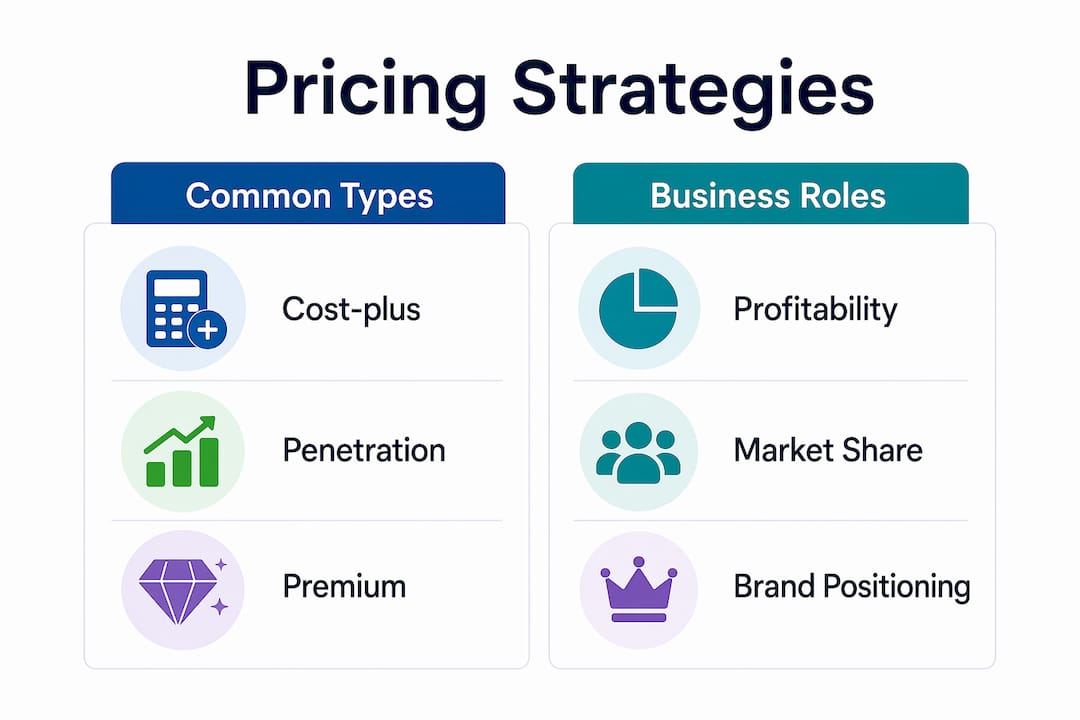
Marketing owns pricing as a key lever to set positioning and target customer segments through tier and price architecture. When pricing decisions are made exclusively by finance teams without marketing input, the result is often a price that covers costs but fails to communicate value. The two functions must work together.
The risks of misaligned pricing are concrete. Wrong pricing attracts the wrong customers, which increases churn, support costs, and brand dilution. A discount-driven customer base is harder to retain and less likely to refer others. Aligning your marketing and pricing decisions from the start prevents this misalignment.
Pro Tip: Conduct willingness-to-pay studies before finalizing price tiers. Tools like conjoint analysis surveys or Van Westendorp price sensitivity meters give you customer data that replaces guesswork with precision.
What data and analyses underpin effective pricing strategy decisions?
Effective pricing strategy analysis requires four distinct inputs: cost data, demand data, competitive context, and customer value perception. Treating any one of these as sufficient on its own produces a price that optimizes for one variable while ignoring the others.
Follow these steps to build a data-grounded pricing decision:
- Calculate your cost floor. Run a full break-even analysis that includes direct production costs, overhead, and desired margin. This is your minimum viable price, not your target price.
- Assess market demand. Survey customers or analyze purchase behavior to understand how demand shifts at different price points. Price elasticity data tells you how sensitive your buyers are to changes.
- Reference competitor pricing as context. Pricing initiatives underperform when competitor prices are treated as goals instead of context. Know what competitors charge, but price based on your own value delivery.
- Measure customer value perception. Qualitative interviews, customer advisory boards, and Net Promoter Score data reveal what customers believe your product is worth. This is the most underused input in pricing decisions.
- Apply segmentation data. Different customer segments have different willingness to pay. Segmentation and predictive analytics allow you to price differently for different segments without triggering fairness concerns.
- Align with business goals. A business prioritizing market share sets a different price than one prioritizing margin. Your pricing decision must reflect which goal is primary at this stage of growth.
| Data input | What it tells you | Tool or method |
|---|---|---|
| Break-even analysis | Minimum viable price | Cost accounting software |
| Price elasticity | Demand sensitivity to price changes | A/B testing, historical sales data |
| Competitive benchmarking | Market price range and positioning | Manual research, pricing intelligence tools |
| Willingness-to-pay studies | Customer-perceived value ceiling | Conjoint analysis, Van Westendorp surveys |
| Segmentation data | Optimal price by customer type | CRM data, behavioral analytics |
Success in pricing depends on market research, customer exploration, competitive analysis, and internal alignment. Pricing is an enterprise decision, not a spreadsheet exercise.
Why must pricing strategy be continuously reviewed and optimized?
Prices must be constantly reviewed using sales outcomes and consumer feedback. Pricing is not a one-time decision. Markets shift, competitors adjust, and customer expectations evolve. A price that was optimal at launch can become a liability within 12 months.
The consequences of pricing neglect are measurable. Businesses that fail to review pricing regularly experience margin leakage, which occurs when discounting, exceptions, and informal price reductions erode profitability without appearing in headline metrics. Pricing governance prevents this by establishing clear rules for when and how prices can be adjusted, and by whom.
Ongoing pricing optimization requires these practices:
- Sales feedback loops: Review which deals closed at full price and which required discounting. Patterns in discount requests reveal where your price-to-value alignment is weak.
- Elasticity testing: Run controlled price tests across customer segments or geographies to measure how demand responds to price changes before committing to a market-wide adjustment.
- Consumer sentiment monitoring: Consumer sentiment and psychology distort pricing perceptions. Track reviews, social media, and customer service data for signals that your price is creating friction or eroding trust.
- Competitive price tracking: Set a quarterly cadence for reviewing competitor pricing. Markets move faster than annual planning cycles.
- Margin analysis by product line: Not all products carry equal margin. Regular analysis identifies which lines to protect, which to reprice, and which to discontinue.
Dynamic pricing in volatile markets is one of the most effective tools for continuous optimization. Businesses in e-commerce, hospitality, and logistics that implement real-time pricing adjustments consistently outperform those using static price lists. The key is pairing automation with governance so that price changes align with brand positioning, not just demand signals.
Pro Tip: Set a formal pricing review calendar: monthly for high-volume SKUs, quarterly for service lines, and annually for your overall pricing architecture. Treat it with the same rigor as a financial audit.
Key takeaways
Pricing strategy is the single highest-leverage decision a business makes, and it requires continuous data input, cross-functional ownership, and disciplined governance to deliver sustained profitability.
| Point | Details |
|---|---|
| Pricing signals brand value | Price is a positioning tool. Set it to reflect the value you deliver, not just the cost you incur. |
| Strategy type must match market context | Value-based pricing outperforms cost-plus in profitability; choose based on your product, market, and growth stage. |
| Data drives accurate pricing | Break-even analysis, willingness-to-pay studies, and segmentation data together produce defensible price points. |
| Marketing must co-own pricing | Pricing decisions made without marketing input produce prices that cover costs but fail to communicate value. |
| Continuous review prevents margin leakage | Quarterly pricing reviews and sales feedback loops protect margins and keep prices aligned with market conditions. |
Pricing strategy is a leadership decision, not a finance task
Most organizations treat pricing as a finance function. That is the wrong frame. Pricing determines who buys from you, what they believe about your brand, and how much margin you have to reinvest in growth. Those are marketing and leadership decisions.
In my experience working with small and mid-size businesses, the most common pricing failure is not setting the wrong number. It is setting a number and never revisiting it. A business launches with a competitive price, gains traction, and then watches margins compress as costs rise while prices stay flat. The team is too busy executing to stop and analyze. By the time the problem is visible in the financials, the fix requires a price increase that customers resist because the value story was never built.
The businesses that get pricing right treat it as a design variable within their product and market strategy. They integrate pricing with product development, sales training, and marketing messaging from the start. They run willingness-to-pay research before launch, not after. They build pricing governance into their quarterly rhythm so that margin leakage is caught early.
Product and pricing strategy must be integrated to maximize competitiveness and reduce ineffective discounting. That integration does not happen by accident. It requires a leader who owns it. If your organization does not have a clear answer to "who owns pricing," that is the first problem to solve.
Pricing is also where the gap between strategy and execution is most costly. A well-researched price communicated poorly is as damaging as a wrong price. Sales teams need to be trained on the value narrative that justifies your price. Marketing needs to build content that reinforces that narrative. Finance needs to track the right metrics to catch leakage. Pricing is cross-functional by nature, and it performs best when treated that way.
— Tran
How Sourcesnova can support your pricing and growth strategy
Sourcesnova works with small and mid-size businesses that want real growth, not vanity metrics. Pricing strategy is one of the highest-impact areas where clear thinking and market data produce measurable results.
Sourcesnova helps businesses align their pricing with their positioning, their marketing with their value story, and their digital presence with their growth goals. Whether you are entering a new market, repositioning an existing product line, or building a pricing architecture from scratch, the team at Sourcesnova brings the strategic clarity and hands-on execution that small businesses rarely get from traditional agencies. No bloated retainers. No jargon. Just a clear plan and a team that treats your business like their own. Explore how Sourcesnova can support your next stage of growth.
FAQ
What is the role of pricing strategy in business?
Pricing strategy determines the optimal price point for a product or service by balancing production costs, customer value perception, and competitive positioning. It directly influences profitability, brand perception, and which customer segments a business attracts.
What are the most effective pricing strategy best practices?
The most effective practices include conducting willingness-to-pay research before launch, aligning pricing decisions across marketing and finance, and reviewing prices on a formal quarterly or annual cadence. Treating competitor prices as context rather than targets consistently improves margin outcomes.
How does pricing strategy impact brand perception?
Price signals quality and positioning before a customer experiences the product. Premium pricing creates exclusivity, while underpricing in a quality-sensitive market signals risk and erodes trust.
How do you develop a pricing strategy for new products?
Start with a break-even analysis to establish your cost floor, then conduct customer value perception research to identify willingness to pay. Use competitive benchmarking as context, select the strategy type that matches your market entry goal, and build in a formal review cycle post-launch.
Why is continuous pricing optimization important?
Markets shift, costs change, and customer expectations evolve. Businesses that do not review pricing regularly experience margin leakage through informal discounting and price exceptions that compound over time without appearing in headline revenue figures.