
Strategic partnerships are defined as mutually beneficial business collaborations where two or more organizations align goals, share resources, and pursue outcomes neither could achieve alone. The role of strategic partnerships has expanded well beyond simple vendor agreements. Strategic alliances have grown 25% annually in recent decades, driven by the need to pool capital, skills, and market access. A 2025 KPMG survey of 258 senior leaders confirms that outcome-oriented partner ecosystems are now critical to accelerating progress and building capabilities that individual organizations cannot develop fast enough on their own. For business leaders and entrepreneurs, understanding how to build and manage these relationships is no longer optional. It is a core competency.
What are the primary benefits of strategic alliances?
Strategic alliances deliver four core advantages: growth acceleration, cost reduction, risk mitigation, and access to new markets. Each benefit compounds the others when the partnership is structured with clear intent. That compounding effect is why well-designed alliances outperform standalone operations in nearly every measurable category.
Shared R&D costs represent one of the most direct financial benefits. Pharmaceutical companies routinely co-develop drug candidates to split clinical trial costs, which can reach hundreds of millions of dollars per compound. Aerospace manufacturers share component development across borders for the same reason. Neither party could absorb the full cost alone, but together they reach the market faster and with less capital at risk.

Market access is the second major driver. A domestic brand entering Southeast Asia through a local distribution partner cuts years off its timeline. The local partner brings regulatory knowledge, customer relationships, and logistics infrastructure. The entering brand brings product, capital, and brand equity. Both sides gain something they could not build quickly on their own.
| Benefit | Standalone operation | Partnership model |
|---|---|---|
| R&D cost | Fully absorbed internally | Shared across partners |
| Market entry speed | Slow, high upfront cost | Faster with local expertise |
| Risk exposure | Concentrated in one entity | Distributed across partners |
| Capability gaps | Must hire or build internally | Filled by partner strengths |
| Innovation pace | Limited by internal bandwidth | Accelerated through co-creation |
Pro Tip: Align each partnership benefit directly to a specific business objective before signing any agreement. If you cannot name the objective, the benefit is theoretical, not real.
How do effective partnership negotiations build long-term value?
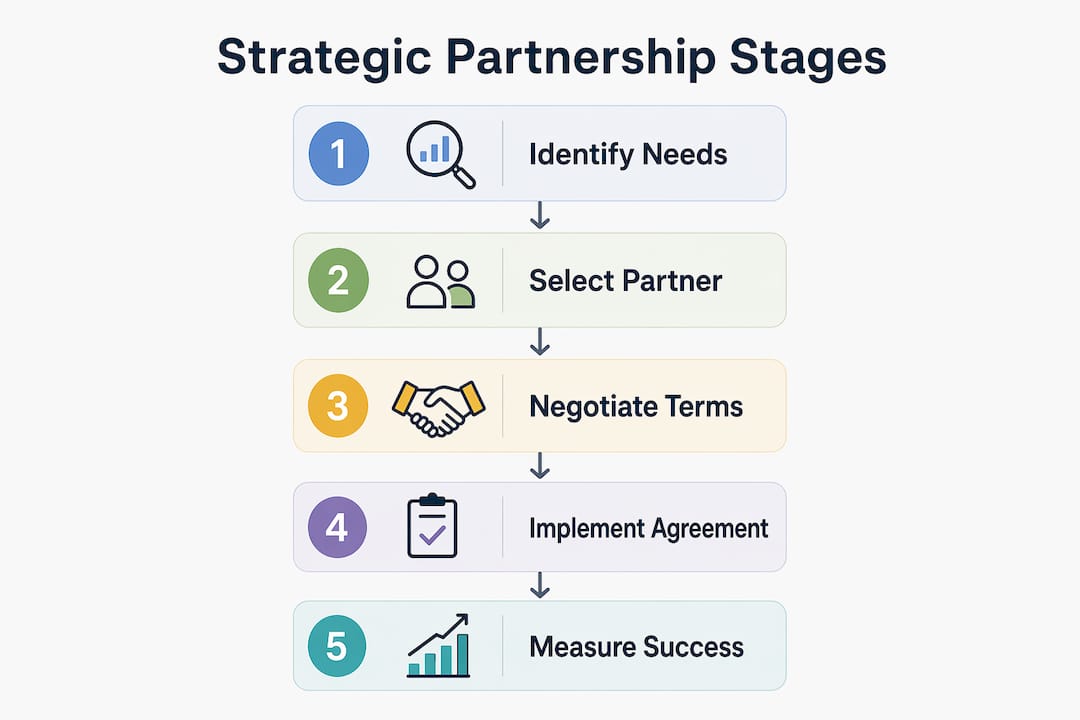
Many partnerships fail from a lack of strategic clarity at the negotiation outset. The goals, risks, and constraints of each party must be visible before any term sheet is drafted. Harvard Business School research on partnership negotiation identifies five steps that separate durable deals from ones that collapse within two years.
- Define your internal objectives first. Know what your organization needs from the partnership before the first meeting. Vague goals produce vague agreements.
- Build personal trust early. Personal trust in negotiation expands the Zone of Possible Agreement (ZOPA), revealing constraints and priorities that formal proposals never surface.
- Map all stakeholders. Both internal champions and external decision-makers shape the deal. Ignoring either group creates surprises late in the process.
- Pace each negotiation phase deliberately. Rushing through legal or technical review to close faster destroys the trust built in earlier stages. Deliberate pacing preserves relationships and produces better terms.
- Document trade-offs transparently. Every concession made by either party should be recorded with its rationale. This record becomes the foundation for resolving disputes after the deal closes.
The ZOPA concept deserves more attention than most negotiators give it. When both parties share their real constraints openly, the range of mutually acceptable outcomes widens. A partner who knows your budget ceiling can propose creative structures. A partner who hides their constraints forces you to guess, and guessing produces suboptimal deals.
Pro Tip: Slow down the negotiation when you feel pressure to speed up. Urgency is usually a signal that something important has not been resolved. Resolving it now costs less than resolving it after the contract is signed.
What governance models support successful partnerships?
Governance is the operational backbone of any partnership. Without it, even well-negotiated agreements drift into conflict, ambiguity, and underperformance. Successful partnerships require formal governance, transparency, and performance-based incentives to manage shared liability and keep both parties accountable.
The partner ecosystem model, which KPMG's 2025 research highlights, shifts the focus from bilateral contracts to multi-party collaboration. In this model, partners are managed as a cohesive team rather than a collection of separate vendors. Each partner has defined roles, decision rights, and performance metrics. The ecosystem as a whole is measured on both financial and non-financial outcomes, including revenue, reputation, and innovation velocity.
Performance-based gainsharing is one of the most effective governance tools available. Rather than paying a fixed fee, one partner shares a percentage of the value created. This aligns incentives beyond what a traditional contract can achieve. When both parties benefit directly from the outcome, they invest more effort in making it succeed.
Key governance practices that protect partnership value:
- Define decision rights in writing. Specify who approves what, at what threshold, and within what timeframe.
- Set shared performance metrics. Both financial and non-financial KPIs should be agreed upon before operations begin.
- Schedule regular transparency reviews. Quarterly data-sharing sessions prevent small misalignments from becoming large disputes.
- Establish an escalation path. When disagreements arise, both parties need a pre-agreed process for resolution.
- Audit third-party risk jointly. Shared liability means shared responsibility for vetting subcontractors and suppliers.
For businesses managing logistics partnerships in e-commerce, these governance principles apply directly. Delivery performance, inventory accuracy, and returns handling all require clear ownership and shared data to function at scale.
How do you select partners that drive innovation?
Partner selection is where most businesses make their first and most costly mistake. They choose partners based on convenience or existing relationships rather than strategic fit. Moving from ad hoc to intentional partnerships requires measuring both financial and non-financial value from the start of the selection process.
The right partner fills a capability gap you cannot close internally within your required timeline. That gap might be technical, geographic, regulatory, or relational. Identifying it precisely before you begin outreach separates intentional partner selection from accidental collaboration.
Cultural alignment matters as much as capability. A partner with the right technology but a mismatched decision-making culture will slow every joint initiative. Assess how the candidate organization makes decisions, handles conflict, and measures success. These factors predict collaboration quality better than any capability checklist.
| Selection criterion | What to evaluate |
|---|---|
| Strategic fit | Does their growth direction align with yours over 3–5 years? |
| Capability complement | Do they fill a gap you cannot close internally in time? |
| Cultural alignment | Do decision-making styles and risk tolerance match? |
| Financial stability | Can they sustain the partnership through market downturns? |
| Innovation capacity | Do they invest in new capabilities, or maintain existing ones? |
| Interoperability | Can their systems and teams integrate with yours practically? |
Multi-sector and AI-focused partners are increasingly valuable in current ecosystems. A manufacturing business that partners with a data analytics firm gains predictive maintenance capabilities without building a data science team. The market entry strategies enabled by such partnerships reduce both cost and time to value significantly. For businesses considering digital consulting support, a structured partner evaluation process is the first deliverable worth investing in.
Key Takeaways
Strategic partnerships create durable competitive advantages when built on clear objectives, personal trust, formal governance, and deliberate partner selection rather than convenience or habit.
| Point | Details |
|---|---|
| Define objectives first | Know exactly what your business needs before approaching any potential partner. |
| Trust expands deal quality | Personal trust widens the Zone of Possible Agreement and surfaces hidden constraints. |
| Governance prevents drift | Formal decision rights, shared KPIs, and transparency reviews keep partnerships on track. |
| Selection beats convenience | Choose partners based on strategic fit and capability gaps, not existing relationships. |
| Measure non-financial value | Track reputation and innovation outcomes alongside revenue to capture full partnership value. |
What I've learned about partnerships that most guides won't tell you
The analytical frameworks in this article are real and they work. But the part that most business guides skip is this: the quality of a partnership is determined in the first three conversations, not in the contract.
I have watched well-structured deals fall apart because the two founding champions never built genuine trust with each other. The governance model was sound. The financial incentives were aligned. But when the first real conflict arose, neither side had the relational capital to work through it. They defaulted to legal language instead of conversation, and the partnership dissolved within 18 months.
The lesson is not to skip the legal work. The lesson is to invest equally in the relational work. That means sharing your real constraints early, even when it feels risky. It means slowing down when the other side is pushing to close. It means treating the negotiation itself as a test of how the partnership will function under pressure.
The businesses that build the most durable alliances treat partner selection as a long-term hiring decision, not a procurement exercise. They ask: "Can we work through a hard problem with this team?" If the answer is uncertain, no contract term fixes that uncertainty.
Strategic partnerships are now a key competitive differentiator for handling global market volatility and technological disruption. The organizations that master them will not just grow faster. They will be harder to displace.
— Tran
How Sourcesnova helps you build partnerships that deliver
Building the right partnerships requires more than good intentions. It requires a clear process, the right connections, and execution discipline that most internal teams do not have bandwidth to maintain.

Sourcesnova works with local and small-to-mid-size businesses to identify partnership opportunities, structure agreements that protect your interests, and manage the ongoing collaboration so it stays productive. Whether you are entering a new market, filling a capability gap, or building a distribution network, Sourcesnova brings the cross-border expertise and hands-on execution that turns partnership strategy into measurable growth. Visit Sourcesnova's growth services to see how the right partner relationships can accelerate your business.
FAQ
What is the role of strategic partnerships in business growth?
Strategic partnerships accelerate growth by giving businesses access to resources, markets, and capabilities they cannot build alone. Strategic alliances have grown 25% annually because they reduce cost and risk while expanding competitive reach.
Why do so many strategic partnerships fail?
Most partnerships fail from a lack of strategic clarity and goal alignment at the outset. Defining objectives and risks before negotiations begin is the single most effective way to prevent early dissolution.
What is the Zone of Possible Agreement (ZOPA) in partnership negotiations?
ZOPA is the range of outcomes both parties can accept in a negotiation. Personal trust expands this range by encouraging both sides to share real constraints, which opens up deal structures that formal proposals never surface.
How should businesses measure partnership success?
Effective partnerships measure both financial outcomes, such as revenue and cost savings, and non-financial outcomes, including reputation and innovation velocity. Outcome-oriented ecosystems track all three categories to capture full partnership value.
What governance structure works best for long-term partnerships?
Formal governance with defined decision rights, shared KPIs, and regular transparency reviews produces the most durable partnerships. Performance-based gainsharing aligns incentives beyond what standard contracts achieve and keeps both parties invested in shared outcomes.