
Agencies are defined as specialized external partners that deliver execution, strategy, and multi-channel marketing capabilities to accelerate business growth. The role of agencies in growth goes far beyond running ads or posting on social media. A well-matched agency compresses months of internal ramp-up into weeks, brings senior-level judgment across paid media, SEO, analytics, and brand strategy, and operates as an integrated part of your growth system. For business owners who want real results without building a full internal team from scratch, understanding how agencies drive growth is one of the most valuable decisions you can make.
What core functions do agencies perform to drive growth?
Agencies deliver execution bandwidth that most small and mid-size businesses cannot build internally at the same speed or cost. A capable agency covers paid media, organic search, creative production, analytics, and lifecycle marketing simultaneously. That breadth means you are not waiting six months to hire five specialists before seeing results.
The most direct agency advantage is speed. Agencies typically deliver initial strategic plans within 7–14 days, compressing 6–12 months of in-house ramp-up into a single quarter. That timeline difference is the gap between a business that captures market share now and one that is still onboarding its first hire.

Beyond speed, agencies bring structured decision intelligence. They connect channel-level data to business goals, identify where pipeline is leaking, and use AI-driven analytics to prioritize spend. This is not guesswork. It is the kind of cross-channel judgment that only comes from working across dozens of accounts and industries simultaneously.
Here are the core functions a growth-focused agency performs:
- Paid media management across Google Ads, Meta, and programmatic channels
- SEO and content strategy tied to pipeline and revenue targets
- Analytics and reporting that connect marketing activity to ARR and customer lifetime value
- Creative production for ads, landing pages, and email sequences
- CRM and lifecycle marketing to improve retention and reduce churn
- AI and automation integration for faster testing and decision-making
Pro Tip: Identify agencies that transfer retained knowledge to your team through documented playbooks and shared dashboards. If the agency leaves, you should keep the system.
Specialized agency partnerships range from $3,000 to $15,000 per month in 2026, avoiding the fixed costs of full-time in-house hires. For a business that needs senior strategy and multi-channel execution, that cost model is often more efficient than building the equivalent team internally.
How have agencies evolved from vendors to growth infrastructure partners?
The agency model has changed fundamentally over the past decade. Agencies have evolved from campaign vendors to business growth infrastructure partners, integrating brand strategy, AI, CRM, and performance marketing into continuous operating systems. That shift matters because episodic campaigns no longer produce compounding results.
Modern agencies do not just run campaigns. They design the systems that connect your brand, your data, and your commercial objectives. Think of them as translators between your business goals and the technical execution required to reach them. A retail business scaling from $2M to $10M in revenue needs a partner who understands how brand positioning affects paid media efficiency, how CRM segmentation affects email revenue, and how SEO compounds over 12–18 months.
The metrics have changed too. Agencies that operate as growth infrastructure partners focus on pipeline velocity, customer retention, and lifetime value rather than impressions and click-through rates. Vanity metrics are easy to report. Revenue impact is harder to fake.
Key shifts in the modern agency role include:
- Moving from one-off campaigns to continuous growth systems
- Integrating CRM data with paid and organic channels for unified targeting
- Aligning brand narrative with commercial objectives across departments
- Reporting on metrics tied to retention, pipeline, and revenue growth
- Using AI tools to accelerate testing cycles and reduce wasted spend
Pro Tip: Look for agencies that align their reporting to your internal KPIs, not just their own channel metrics. Shared dashboards with your sales and finance teams signal a true growth partner.
Firms that specialize and evolve their service mix while securing larger engagements are 55% more likely to be fast-growing agencies. That structural discipline in the agency itself correlates directly with better outcomes for their clients.
Agency vs. in-house: what are the real tradeoffs?
The decision between an agency and an in-house growth team is not binary. Each model has clear strengths, and the best-performing businesses in the $5M–$50M revenue range typically use both. Understanding the tradeoffs helps you allocate resources where they produce the most return.
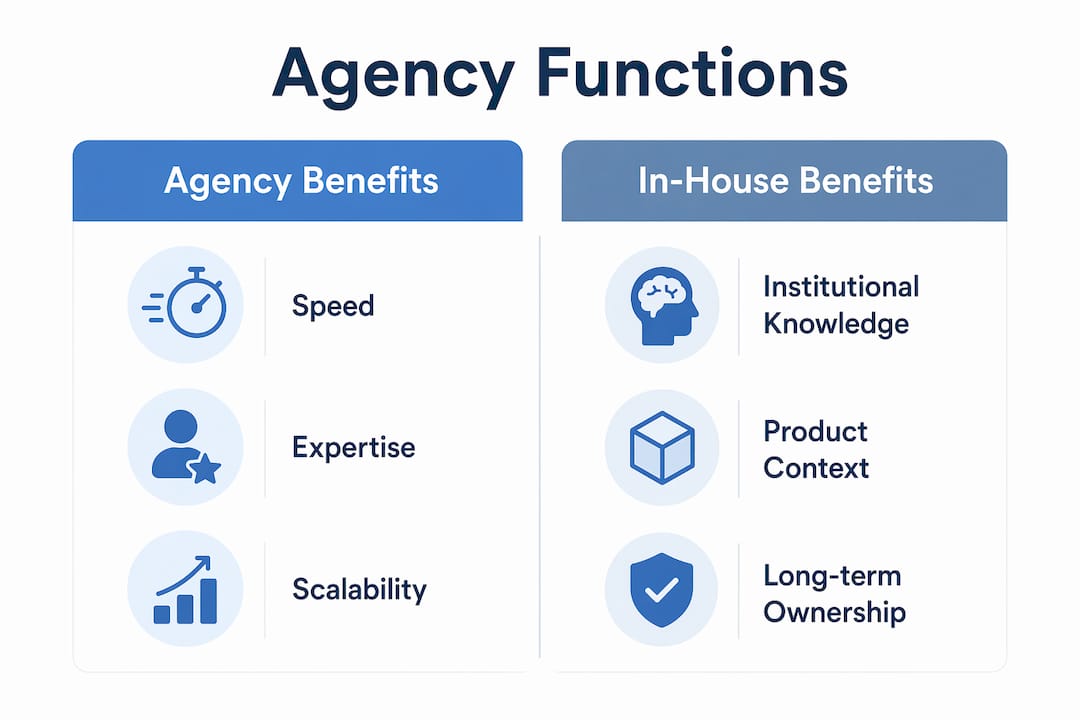
Hybrid models combining an internal senior growth lead with an agency execution engine are stable and effective long-term. The internal lead owns strategy, customer insights, and institutional knowledge. The agency provides execution speed, channel breadth, and senior judgment across multiple disciplines simultaneously.
| Attribute | Agency | In-house team |
|---|---|---|
| Speed to capability | 7–14 days for initial deliverables | 6–12 months to hire and onboard |
| Channel breadth | Multi-channel across SEO, paid, CRM, creative | Typically one or two specialists |
| Cost structure | $3,000–$15,000 per month, variable | Fixed salaries, benefits, and overhead |
| Institutional knowledge | Stays with the agency unless documented | Builds internally over time |
| Strategic authority | Executes within client-defined strategy | Owns strategy and long-term direction |
| Accountability | Contractual deliverables and KPIs | Direct management and culture alignment |
The most common failure point is not choosing the wrong model. Absence of an internal owner who can absorb, direct, and compound agency output causes the most common failures in agency relationships. Without someone internally who understands the strategy and can make decisions, agencies fill the vacuum with activity that does not connect to your goals.
Execution bandwidth, multi-channel judgment, and speed to capability are the core agency advantages. Institutional knowledge and product context favor in-house teams. The practical answer is to use each where it is strongest.
Pro Tip: Assign one accountable internal stakeholder to every agency engagement. That person approves strategy, reviews reports, and makes decisions. Without this role, agency output degrades within 90 days.
For businesses exploring what a full-service agency actually covers, the scope is broader than most owners expect. Paid media, SEO, email, CRM, and creative can all sit under one agency relationship when the partnership is structured correctly.
How can businesses get the most out of an agency partnership?
Getting real value from an agency requires more than signing a contract. The businesses that see the strongest results treat the agency relationship as a managed partnership, not a hands-off outsource.
-
Define scope and KPIs before the engagement starts. Agree on what success looks like in 90 days, 6 months, and 12 months. Tie metrics to pipeline, revenue, or customer acquisition cost, not just traffic or impressions.
-
Assign a single internal point of contact. This person owns the relationship, approves deliverables, and connects agency work to internal priorities. A digital marketing agency can produce measurable SEO and pipeline improvements within 90 days when there is proper KPI alignment and a single internal stakeholder.
-
Prioritize agencies with senior strategy and analytics capabilities. Junior execution teams can run campaigns. Senior strategists connect campaigns to revenue. Ask who will actually work on your account before signing.
-
Retain all playbooks, datasets, and creative assets. Your agency should document what they build. If the relationship ends, you keep the system. This protects your investment and builds internal capability over time.
-
Review performance monthly, not quarterly. Monthly reviews catch misalignment early. Quarterly reviews often surface problems too late to correct without losing budget.
Agencies are most effective when companies have defined strategies. Without internal leadership authority, agency execution drifts from commercial priorities. The agency executes. You own the direction.
For service businesses specifically, a service business marketing guide covers how to structure agency relationships around lead generation, local SEO, and retention, which are the three channels that move the needle fastest for most service-based companies.
Retail businesses face a different set of priorities. Understanding how wholesale supplies power retail growth alongside marketing execution shows why agencies that integrate commercial strategy with channel tactics outperform those that focus on media alone.
Key Takeaways
Agencies deliver the fastest path to multi-channel growth execution, but only when paired with clear internal ownership, defined KPIs, and a structured knowledge-transfer process.
| Point | Details |
|---|---|
| Speed advantage | Agencies compress 6–12 months of ramp-up into a single quarter through immediate deployment. |
| Hybrid model wins | Combining an internal growth lead with an agency execution team produces the most stable, long-term results. |
| Internal ownership is critical | Without one accountable internal stakeholder, agency output loses direction and commercial alignment. |
| Retain all assets | Require documented playbooks and shared dashboards so institutional knowledge stays with your business. |
| Choose specialists | Agencies that specialize and evolve their service mix are 55% more likely to be fast-growing, which benefits their clients directly. |
What I've learned about agency partnerships after years of watching them succeed and fail
The businesses I see struggle most with agencies are not the ones that chose the wrong partner. They are the ones that hired an agency as a substitute for internal leadership. An agency cannot own your growth strategy. It can execute it brilliantly, but someone inside your business has to know where you are going and why.
The hybrid model works. I have seen it work consistently for businesses in the $5M–$50M revenue range. An internal growth lead who owns strategy and customer insights, paired with an agency that brings execution speed and channel breadth, produces results that neither could achieve alone. The internal lead keeps the agency grounded in commercial reality. The agency keeps the internal lead from getting buried in execution details.
The other thing I have learned is that agency selection based on specialization matters more than most owners realize. A generalist agency that does everything adequately will not move the needle as fast as a specialist agency that dominates two or three channels relevant to your business. Ask for case studies from your specific industry. Ask who owns your account day to day. Ask what happens to your data and playbooks if the relationship ends.
The agencies worth working with answer those questions directly. The ones that deflect or get vague are telling you something important.
— Tran
How Sourcesnova supports your growth with real agency partnership
Sourcesnova was built specifically for small and mid-size businesses that want real growth without bloated retainers or vanity reports. The team covers paid media, SEO, creative, and lifecycle marketing with a focus on measurable outcomes tied to revenue, not just traffic.
For business owners ready to move from scattered marketing activity to a connected growth system, Sourcesnova provides the execution bandwidth and senior strategy that most small businesses cannot build internally at the same speed or cost. Every engagement includes clear KPIs, documented playbooks, and direct access to the team doing the work. Visit Sourcesnova to see how the agency model works in practice and whether it fits your current growth stage.
FAQ
What is the role of agencies in business growth?
Agencies accelerate growth by delivering specialized execution across paid media, SEO, analytics, and brand strategy faster than most businesses can build internally. They function as integrated growth partners, not just campaign vendors.
How quickly can an agency produce results?
Agencies typically deliver initial strategic plans within 7–14 days and can produce measurable pipeline improvements within 90 days when KPIs and internal stakeholders are clearly defined.
When does an in-house team outperform an agency?
In-house teams outperform agencies when deep institutional knowledge, product context, and long-term strategic ownership are the primary requirements. For execution speed and multi-channel breadth, agencies hold the advantage.
What causes agency partnerships to fail?
The most common cause of failure is the absence of an internal owner who can absorb, direct, and act on agency output. Without internal accountability, agency work loses commercial alignment quickly.
How much do growth agency partnerships cost in 2026?
Specialized growth agency partnerships range from $3,000 to $15,000 per month in 2026, depending on scope and channel coverage. That cost avoids the fixed overhead of full-time senior hires across multiple disciplines.