
Retail marketing, defined as the coordinated process of attracting, converting, and retaining customers through targeted channels and campaigns, is the engine behind consistent store revenue. Following retail marketing step by step separates businesses that grow predictably from those that run disconnected promotions and wonder why sales stall. This guide covers every stage of the process: customer analysis, channel selection, budget allocation, campaign execution, and ongoing optimization. Tools like Google Business Profile, Salesforce, and AI platforms including ChatGPT and Gemini now play a direct role in how retail marketers reach buyers and measure results.
What does retail marketing step by step actually involve?
Retail marketing is not a single tactic. It is a system built from five coordinated disciplines: SEO, AI optimization, paid advertising, email and loyalty programs, and influencer and social commerce. Successful retail marketing teams balance all five, and over-focusing on any one of them is the most common mistake store owners make.
The step-by-step retail guide starts with analysis, moves through planning and execution, and ends with measurement and iteration. Skipping the analysis phase is where most retail marketing strategies break down. Without knowing who your buyers are, which channels they use, and what your current digital presence looks like, every dollar you spend is a guess.

Retail marketing also connects four pillars into one system: omnichannel execution, paid media with proven outcomes, owned digital experiences, and in-store digital utility. Each pillar supports the others. A strong paid media campaign that drives traffic to a slow, broken website produces no return.
How to analyze and prepare before launching a retail marketing strategy
Preparation is not optional. Retailers should audit their customer personas, Google Business Profile status, and website performance within 12 months before any major campaign launch. That window keeps your data current and your assumptions grounded in actual buyer behavior.
Start with your customer personas. Pull recent purchase data from your point-of-sale system and cross-reference it with demographic data from Google Analytics 4 or Meta Ads Manager. Your personas from two years ago are likely outdated. Buyers' channel preferences, price sensitivity, and product interests shift faster than most store owners realize.
Next, audit your digital storefront. Check that your Google Business Profile is claimed, verified, and populated with current hours, photos, and product categories. Confirm your website loads in under three seconds. Pages that load slowly lose conversions before a visitor even reads your offer.
- Update customer personas using recent purchase and demographic data
- Verify and optimize your Google Business Profile listing
- Run a technical SEO audit covering metadata, broken links, and page speed
- Check for overlapping paid keywords that waste ad spend
- Confirm analytics tracking is firing correctly on all key pages
Pro Tip: Fix broken metadata and overlapping paid keywords first. These are low-effort repairs that produce measurable performance gains before you spend a dollar on new campaigns. Regular auditing of digital assets like structured data and ad creative is one of the fastest ways to lift results.
How do you build and execute a retail marketing plan?
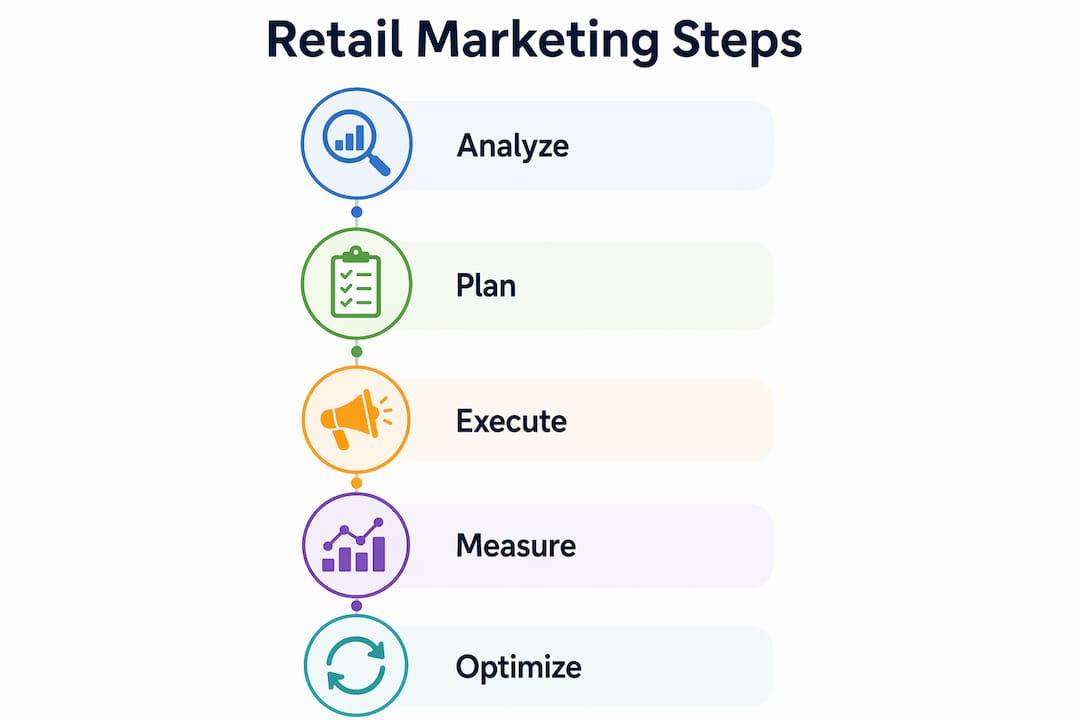
Set SMART goals before selecting any channel. A SMART goal for retail looks like this: increase repeat purchase rate by 15% in Q2 by launching a tiered loyalty program for customers who have bought twice in the past six months. Vague goals like "grow sales" produce vague results.
Channel selection follows goal setting. Focusing on two or three high-impact channels and mastering them outperforms spreading budget across every available platform. Choose channels based on where your buyers actually spend time, not where your competitors appear to be active.
Budget allocation for mid-size retailers follows a clear pattern in 2026. Industry standards place 35%–55% of the retail marketing budget in paid advertising, 10%–18% in SEO, 10%–18% in email and loyalty programs, 8%–15% in influencer and social commerce, and 3%–8% in AI optimization. These ranges reflect the relative return each channel delivers at scale.
| Channel | Typical budget share | Primary impact |
|---|---|---|
| Paid advertising | 35%–55% | Fast traffic and immediate sales lift |
| SEO | 10%–18% | Long-term organic visibility and lower cost per click |
| Email and loyalty | 10%–18% | Retention, repeat purchase, and lifetime value |
| Influencer and social commerce | 8%–15% | Brand awareness and new audience reach |
| AI optimization | 3%–8% | Personalization, efficiency, and predictive targeting |
Execution runs on a quarterly cadence. A structured 12-month cycle dedicates Q1 to data preparation and product feed audits, Q2 to creative content production and influencer outreach, Q3 to campaign experiments and testing, and Q4 to harvest campaigns and next-year strategy planning. This rhythm prevents the reactive, last-minute scramble that kills campaign quality.
- Q1: Clean data, update product feeds, refresh personas
- Q2: Produce creative assets, brief influencers, launch spring campaigns
- Q3: Run A/B tests, experiment with new ad formats, measure lift
- Q4: Execute peak-season campaigns, document learnings, plan next year
Pro Tip: Build your creative production pipeline in Q2, not Q4. Retailers who brief influencers and produce video assets in the spring enter the holiday season with tested content rather than rushed work.
For small business marketing strategies that apply directly to retail, the same channel-first, budget-second logic holds. Know your audience before you spend.
What are the best ways to measure and optimize retail marketing?
Great retail marketing runs on evidence. Optimization requires proving what causes sales lift and reallocating budget accordingly, using predictive analytics to accelerate learning cycles. Gut instinct is not a measurement strategy.
Track these core KPIs from day one:
- Repeat purchase rate: the percentage of customers who buy more than once in a 90-day window
- Channel ROI: revenue generated per dollar spent on each marketing channel
- Incremental sales lift: the additional revenue directly attributable to a specific campaign
- Customer acquisition cost: total marketing spend divided by new customers acquired
- Email open and click rates: indicators of list health and message relevance
A/B testing is the most reliable way to improve performance. Test one variable at a time: subject lines in email campaigns, headline copy in paid ads, or hero images on landing pages. Running multiple simultaneous tests produces results you cannot interpret cleanly.
AI-assisted personalization doubles the likelihood of customer purchase compared to non-personalized campaigns. That is not a marginal improvement. Retailers using tools like Salesforce Marketing Cloud or Klaviyo to deliver personalized product recommendations see measurable lifts in average order value and repeat purchase frequency.
The role of automation in marketing extends this further. Automated triggers, such as a cart abandonment email sent 30 minutes after a session ends, outperform manually scheduled batch campaigns in both open rates and conversion.
Pro Tip: Clean POS data is the foundation of effective personalization. Without organized, accurate point-of-sale records, segmentation and targeting become unreliable. Audit your POS data before building any personalization workflow.
How to build a retail marketing checklist before every campaign
A retail marketing checklist prevents the most expensive mistakes: launching a campaign to a broken landing page, running ads without conversion tracking, or missing a seasonal peak because the creative was not ready. Use this checklist before every major campaign launch.
| Checklist area | Key action |
|---|---|
| Customer personas | Validated with purchase data from the past 12 months |
| Google Business Profile | Claimed, verified, and updated with current information |
| Website performance | Load time under three seconds, no broken links |
| Metadata and SEO | Title tags, meta descriptions, and structured data reviewed |
| Budget allocation | Confirmed across all active channels with clear caps |
| Campaign calendar | Synced with seasonal peaks, holidays, and product launches |
| Staff training | In-store team briefed on promotions and messaging |
| Analytics tracking | Confirmed firing on all conversion events |
| Customer journey map | Offline and online touchpoints aligned and consistent |
| Creative assets | Produced, approved, and uploaded before launch date |
Staff training belongs on this list for a reason. A paid campaign that drives foot traffic to a store where employees do not know the promotion is running destroys the customer experience. Offline and online marketing must tell the same story. Local marketing execution depends on this alignment more than most store owners expect.
Key Takeaways
Retail marketing works when analysis, channel selection, budget discipline, and continuous measurement operate as one connected system rather than separate activities.
| Point | Details |
|---|---|
| Start with analysis | Audit personas, Google Business Profile, and website speed before spending on campaigns. |
| Prioritize two or three channels | Mastering a focused channel mix outperforms spreading budget across every platform. |
| Follow budget benchmarks | Allocate 35%–55% to paid ads and 10%–18% each to SEO and email for mid-size retailers. |
| Personalize with clean data | AI personalization doubles purchase likelihood only when POS data is accurate and organized. |
| Use a campaign checklist | Verify creative assets, tracking, staff training, and seasonal alignment before every launch. |
What I have learned from watching retail marketing plans succeed and fail
The most common failure pattern I see is not a bad channel choice or a weak creative. It is a store owner who spends 90% of their marketing budget chasing new customers while their existing buyers quietly stop returning. The top 20% of buyers generate 60%–80% of total revenue. Ignoring retention is not a conservative strategy. It is an expensive one.
The second pattern is complexity addiction. Retailers who try to run paid search, paid social, influencer campaigns, SEO, email, SMS, and TikTok simultaneously in their first year produce mediocre results everywhere. The stores that grow fastest pick two channels, build real competence in them, and add a third only after the first two are producing reliable returns.
What actually works is an integrated data system. When your POS, email platform, and ad accounts share the same customer data, your campaigns get sharper with every cycle. When they operate in silos, you are essentially starting over with each campaign. The technology to connect these systems, through platforms like Klaviyo, Salesforce, or even a well-configured Shopify store, exists and is accessible to businesses of any size.
My honest recommendation: treat your first 90 days as a learning phase, not a growth phase. Run small experiments, measure everything, and let the data tell you where to put real money. Retailers who do this consistently outperform those who launch big and optimize never.
— Tran
How Sourcesnova helps retail businesses grow with clear strategy
Retail marketing requires coordinated execution across analysis, channels, budgets, and measurement. Most store owners have the ambition but not the bandwidth to manage all of it at once.
Sourcesnova is a full-service digital growth agency built specifically for local and small-to-mid-size businesses. The team handles everything from Google Business Profile optimization and paid advertising to email program setup and analytics configuration. No bloated retainers, no vanity reports. Clients get clear strategy and hands-on execution from a team that treats each business like its own. If you are ready to build a retail marketing system that produces consistent results, visit Sourcesnova to see how the team works and what they deliver.
FAQ
What is retail marketing step by step?
Retail marketing step by step is a structured process covering customer analysis, channel selection, budget allocation, campaign execution, and performance optimization. Following each stage in sequence produces more consistent sales growth than running disconnected promotions.
How much should a retail store spend on marketing?
Mid-size retailers in 2026 allocate 35%–55% of their marketing budget to paid advertising, with 10%–18% each going to SEO and email and loyalty programs. The right split depends on your audience, goals, and current channel performance.
What are the most effective retail marketing channels?
The most effective channels for most retail businesses are paid advertising, email and loyalty programs, and SEO. Focusing on two or three channels and building real competence in them outperforms spreading budget across every available platform.
How does AI personalization improve retail marketing results?
AI-assisted personalization doubles the likelihood of customer purchase compared to non-personalized campaigns. Tools like Klaviyo and Salesforce Marketing Cloud deliver personalized product recommendations that lift both average order value and repeat purchase rates.
What should a retail marketing checklist include?
A retail marketing checklist should cover customer persona validation, Google Business Profile status, website load speed, metadata review, budget confirmation, campaign calendar alignment, staff training, analytics tracking, and creative asset readiness before every campaign launch.