
Omnichannel marketing is the practice of connecting every customer touchpoint — from your website and email to physical stores and social media — into one unified, data-driven experience. The industry term is omnichannel marketing, and defining omni channel marketing correctly matters because most businesses confuse it with simply being present on multiple platforms. Omnichannel customers spend 30% more and shop 70% more often than single-channel customers. That gap exists because omnichannel treats every interaction as part of one continuous journey, not a series of disconnected events. Achieving that requires unified customer data platforms like Salesforce CRM or Segment CDP as the operational backbone.
How does omnichannel differ from multichannel marketing?
Multichannel marketing means a brand maintains a presence on several channels, such as email, Instagram, and a physical store, but each channel operates independently. A customer who browses your website and then calls your support line starts from zero in both conversations. There is no shared data, no continuity, and no recognition of prior behavior.
Cross-channel marketing moves one step further. It coordinates two or three channels in limited ways, such as sending a follow-up email after a website visit. The coordination is partial. Customer identity is not fully unified across all touchpoints.
Omnichannel marketing integrates all channels with real-time coordination and a unified customer identity. When a customer adds an item to their cart on mobile, abandons it, and later walks into your store, the sales associate can see that behavior and respond accordingly. That is the defining difference.

| Approach | Channel Coordination | Customer Data | Customer Experience |
|---|---|---|---|
| Multichannel | None | Siloed per channel | Disconnected |
| Cross-channel | Partial | Shared between select channels | Partially consistent |
| Omnichannel | Full, real-time | Unified across all channels | Continuous and personalized |
The customer perspective makes this concrete. A shopper who receives a promotional email, clicks through to the website, and then visits a store expects the brand to know where they are in their decision. Multichannel cannot deliver that. Omnichannel can.
- Multichannel: Many channels, no connection between them
- Cross-channel: Some connection, limited to select touchpoints
- Omnichannel: All channels share data and respond in real time to customer behavior
What technology does an omnichannel strategy require?
A centralized CRM or Customer Data Platform is the single source of truth that makes cross-channel coordination possible. Without it, each channel operates on its own version of the customer, which produces inconsistent messaging and missed opportunities. Platforms like Salesforce, HubSpot, and Segment are built specifically to consolidate customer identity across touchpoints.
Beyond the CDP, a working omnichannel stack requires several interconnected components:
- Identity graph: Links a single customer's behavior across devices, browsers, and channels into one profile
- Data integration layer: Connects your e-commerce platform, CRM, email service provider, and ad platforms so data flows in real time
- Personalization engine: Uses behavioral data to serve relevant content, offers, and messages at the right moment
- Marketing automation platform: Tools like Klaviyo, Braze, or ActiveCampaign execute triggered communications across email, SMS, and push notifications
- Analytics and attribution model: Measures which channel combinations drive conversions, not just last-touch clicks
Organizational structure matters as much as technology. Siloed organizational structures with separate budgets and KPIs for each channel prevent data sharing and block the unified customer view that omnichannel requires. A brand where the email team, paid media team, and retail team each report to different executives with separate goals will struggle to coordinate, regardless of the tools in place.
Pro Tip: Start with one high-impact journey, such as abandoned cart recovery across email, SMS, and retargeting ads, before building out the full stack. This proves ROI quickly and builds internal support for broader investment.
The technology investment is real, but the organizational change is harder. Cross-functional alignment, shared KPIs, and a single owner for the customer experience are prerequisites that no software can replace.
What are the key omnichannel trends driving results in 2026?
The most significant shift in omnichannel strategy for 2026 is the move away from static audience segments toward real-time behavioral triggers. 55.2% of advanced marketing organizations now prioritize behavior-triggered communication over static segmentation. This means a customer who views a product page three times in 48 hours receives a different message than one who viewed it once six weeks ago, even if both fall into the same demographic segment.
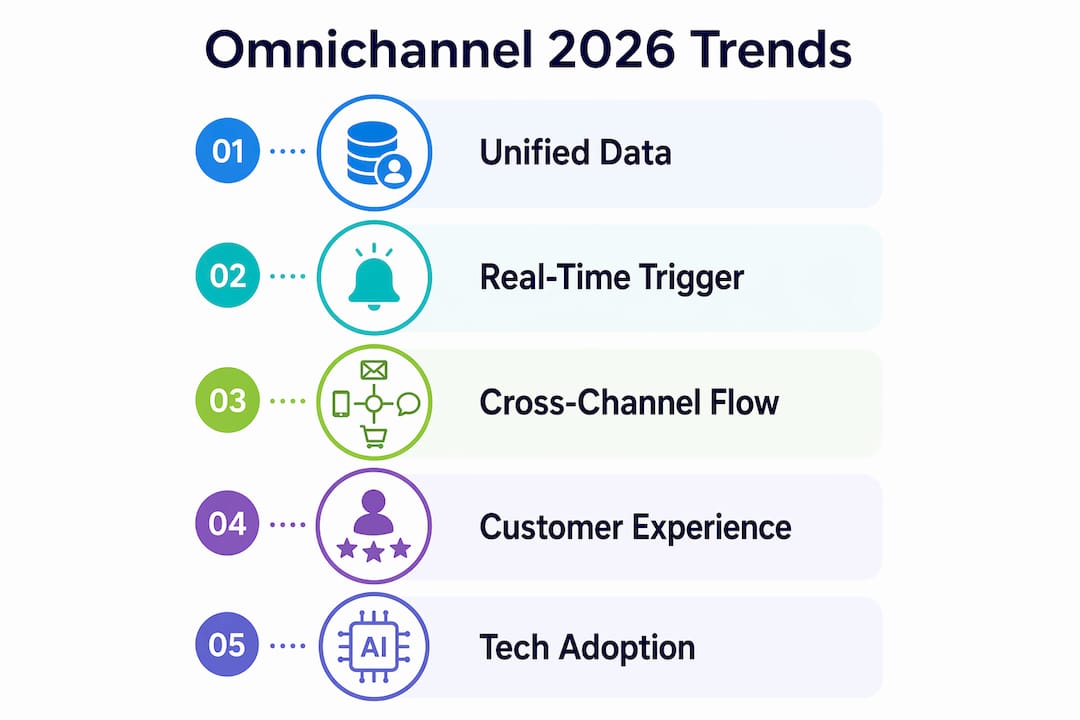
This shift produces measurable results. Behavior-triggered campaigns consistently outperform batch-and-blast emails because they respond to demonstrated intent rather than assumed interest. Platforms like Braze and Klaviyo make this execution accessible to mid-size businesses, not just enterprise brands.
Practical applications of this trend include:
- Browse abandonment sequences: Triggered when a user views a product but does not add it to their cart, delivered across email and SMS within hours
- Post-purchase cross-sell flows: Activated immediately after a transaction, personalized to the specific product purchased
- Loyalty tier notifications: Sent when a customer is close to reaching a reward threshold, timed to encourage one more purchase
- Reengagement campaigns: Triggered after 60 or 90 days of inactivity, with messaging calibrated to the customer's last known interest
Understanding marketing automation's role in these flows is critical for any team building out real-time omnichannel execution.
"The most common mistake is confusing channel presence with true omnichannel integration. Real integration requires real-time data sharing and a unified customer identity across every touchpoint." — Braze
The brands winning in 2026 are not the ones on the most channels. They are the ones whose channels talk to each other.
What are the biggest challenges in deploying omnichannel marketing?
The most common failure mode in omnichannel implementation is treating it as a technology project rather than an organizational one. Teams buy a CDP, connect a few channels, and expect results. When the results do not materialize, the technology gets blamed. The real issue is almost always process and alignment.
Haphazard omnichannel efforts without a clear roadmap destroy business value. The "crawl, walk, run" framework prevents this. In the crawl phase, you connect two or three channels around one customer journey and measure the impact. In the walk phase, you expand to additional journeys and channels with the data from phase one as your proof of concept. In the run phase, you operate a fully coordinated system with real-time triggers across all touchpoints.
Common pitfalls to avoid:
- Launching too many channels at once: Spreads resources thin and produces mediocre execution across the board
- Misaligned KPIs: When the email team optimizes for open rates and the paid media team optimizes for ROAS, neither is optimizing for the customer journey
- Ignoring data quality: A CDP is only as useful as the data fed into it. Duplicate records, missing identifiers, and inconsistent naming conventions corrupt the customer view
- Underestimating change management: Getting the retail team, digital team, and customer service team to share data and coordinate messaging requires leadership commitment, not just a software subscription
Starting with focused, high-impact journeys like abandoned cart recovery across channels is the proven method for building internal support and demonstrating ROI before asking for larger budget commitments.
Pro Tip: Before your first omnichannel build, audit your existing data. Identify where customer records are duplicated or incomplete. Clean data is the foundation everything else depends on.
For e-commerce businesses, understanding what an e-commerce strategy actually requires at the operational level helps set realistic expectations for omnichannel integration timelines.
Key takeaways
Omnichannel marketing works because unified customer data, real-time behavioral triggers, and cross-channel coordination together produce customers who spend more, buy more often, and stay longer.
| Point | Details |
|---|---|
| Omnichannel vs. multichannel | Omnichannel unifies data and coordinates channels in real time; multichannel does not. |
| CDP is non-negotiable | A centralized Customer Data Platform is the foundation for any true omnichannel strategy. |
| Behavioral triggers outperform segments | Over 55% of advanced marketers now use real-time behavior triggers instead of static audience lists. |
| Phased implementation reduces risk | Starting with one high-impact journey proves ROI before scaling to the full channel mix. |
| Organizational alignment is the hard part | Siloed teams and misaligned KPIs block omnichannel success more often than technology gaps do. |
Why most omnichannel strategies stall before they scale
I have seen this pattern repeat across businesses of every size. A marketing team invests in a CDP, connects their email and ad platforms, and calls it omnichannel. Six months later, the results look almost identical to what they had before. The technology worked. The strategy did not.
The issue is almost always that the organization never agreed on what "unified customer experience" actually means in practice. The email team still owns email. The paid media team still owns paid. Nobody owns the customer journey. That is not an omnichannel strategy. That is a multichannel strategy with better software.
What actually works is starting with one customer journey that everyone agrees matters. Abandoned cart is the obvious choice because the revenue impact is immediate and measurable. You connect email, SMS, and retargeting around that single journey. You measure the lift. You bring that data to leadership and use it to fund the next phase.
Data quality is the other underrated factor. I have watched teams spend months integrating platforms only to discover their customer records are a mess. Duplicate emails, missing phone numbers, inconsistent product identifiers. The CDP cannot fix bad data. You have to fix it before you build.
The businesses that succeed with omnichannel treat it as a long-term operating model, not a campaign. They invest in the organizational structure, the shared KPIs, and the data governance before they invest in the next platform. The technology is the easy part. The discipline is what separates the brands that see real results from the ones that just have a longer list of tools.
— Tran
How Sourcesnova helps you build an integrated marketing strategy
Sourcesnova works with small and mid-size businesses that want real growth from their marketing, not just more channels to manage. If you are working through the complexity of connecting your digital presence, your e-commerce operations, and your customer communications into a coordinated system, Sourcesnova provides the strategy and hands-on execution to make that happen.
From web design that anchors your digital experience to cross-channel ad campaigns that reach customers where they are, Sourcesnova builds the integrated marketing infrastructure that growing businesses need. No bloated retainers, no vanity reports. Visit sourcesnova.com to see how Sourcesnova approaches integrated digital growth for businesses ready to move beyond disconnected marketing.
FAQ
What is omnichannel marketing, exactly?
Omnichannel marketing is a customer-centric approach that connects all sales and communication channels into one unified experience using shared customer data. Every touchpoint, from email to in-store, reflects the same customer history and intent.
How is omnichannel different from multichannel?
Multichannel marketing uses many channels independently with no shared data. Omnichannel integrates all channels with real-time coordination so the customer experience is continuous across every touchpoint.
Why choose omnichannel over single-channel marketing?
Omnichannel customers spend 30% more and shop 70% more frequently than single-channel customers. The higher profitability comes from consistent, personalized engagement that builds loyalty over time.
What is the biggest risk in omnichannel implementation?
The biggest risk is launching without a clear roadmap, which leads to wasted resources and inconsistent customer experiences. A phased "crawl, walk, run" approach reduces this risk significantly.
Do small businesses need omnichannel marketing?
Small businesses benefit from omnichannel principles even at a modest scale. Starting with two or three connected channels, such as email, SMS, and a website, delivers measurable results without requiring enterprise-level technology investment.