
Many businesses spend years paying multiple agencies — one for SEO, another for social media, another for paid ads — only to find their brand messaging pulls in different directions and nobody owns the results. Understanding what is a full service agency, and whether it's the right model for your business, can change how effectively your marketing budget works. This guide breaks down the full service agency definition, what these agencies actually do, the real benefits and trade-offs, and how to evaluate if one is the right fit for where your business is headed.
Table of Contents
- Key takeaways
- What a full service agency is and does
- Benefits and challenges of a full service agency
- How to choose the right full service agency
- Full service agencies in action
- My take on agency integration and marketing ROI
- How Sourcesnova delivers integrated marketing for real growth
- FAQ
Key takeaways
| Point | Details |
|---|---|
| Full service agency definition | A full service agency provides strategy, creative, media, digital, and analytics under one roof from a single brief. |
| Integration drives ROI | Unified teams avoid siloed channel KPIs, which delivers better returns than managing disconnected specialists. |
| Not all labels are equal | Some agencies called "full service" rely on white-label partners behind the scenes, reducing true integration. |
| Readiness matters | Financial fluency, delegation infrastructure, and leadership buy-in are prerequisites before engaging a full service agency. |
| Match stage to model | Full service works best when your marketing spans multiple channels and coordination overhead is already a real cost. |
What a full service agency is and does
A full service marketing agency is an organization that handles the entire marketing function for a client. Strategy, brand identity, content creation, paid media, SEO, social media, public relations, and performance analytics all operate under a single contract and a single team. You submit one brief. Every discipline responds to it.
This is structurally different from hiring a specialist agency for each channel. A specialist SEO firm will optimize your search presence. A specialist paid media agency will manage your ad spend. Each team delivers on its own metrics. The problem is that no one connects those metrics to each other or to your actual business goals. You end up with a fragmented picture of performance and no single point of accountability.
Full-stack marketing combines brand strategy, creative, demand generation, paid media, and operations under one accountable team, removing the translation layers typical between separate agencies. That means when your paid media team launches a campaign, the creative team already built assets matched to the same messaging the SEO team is targeting. Nothing gets lost in handoffs.
Here is how the three agency models compare:
| Agency type | Scope | Best for | Risk |
|---|---|---|---|
| Full service agency | All marketing disciplines | Businesses managing multiple channels | Higher cost, requires strong partner selection |
| Specialist agency | Single channel (SEO, paid, etc.) | Businesses with one priority channel | Siloed results, coordination burden on you |
| Boutique agency | Niche expertise or industry | Brands needing deep craft in one area | Limited scalability across channels |
Pro Tip: Ask any agency you evaluate to show you a campaign brief template. A true full service agency will have one document that connects strategy, creative, media, and reporting. If they hand you three separate templates, their integration is likely more in name than in practice.
Benefits and challenges of a full service agency
The most immediate benefit is operational. Coordination overhead is eliminated when one team manages every discipline. You stop acting as the project manager between six different vendors and start focusing on your business.

The second benefit is speed. Integrated teams collapse the handoff delays that slow multi-agency campaigns. Speed gains come primarily from collapsing inter-agency handoffs into single-team workflows using shared briefs and communication platforms. A campaign that takes three months to coordinate across separate agencies can launch in weeks when one team executes the whole thing.
The third benefit is ROI. When your agency treats marketing as a unified system rather than a collection of channels, decisions get smarter. Full-service agencies serve as fiduciaries for CMOs and CFOs, tying marketing budgets directly to contribution margin and CAC:LTV metrics. That is a fundamentally different relationship than receiving a monthly report showing impressions and click-through rates.
The challenges are real too. Here is what to watch for:
- Verify true integration. Not all agencies labeled full service are fully integrated internally. Some outsource services to white-label partners, which means you get the coordination problems of multiple agencies while paying one retainer.
- Cultural fit affects execution. An agency that works well with enterprise clients may move too slowly for a fast-moving SMB. Match their operating tempo to yours.
- Budget thresholds are real. Full service agencies cost more upfront. If your marketing budget is thin, a single specialist may deliver more concentrated value at a lower price point.
- Dependency risk. The more disciplines you consolidate in one partner, the more exposed you are if the relationship deteriorates. Build in performance reviews and contract flexibility from the start.
"Clients should treat full-service agencies as strategic partners and fiduciaries, demanding financial accountability tied to growth metrics rather than vanity numbers." — Markacy
Pro Tip: Request a list of all services the agency delivers in-house versus through third-party partners. Document it before signing. This one question reveals more about their actual capabilities than any sales deck.
How to choose the right full service agency
Choosing the right partner starts with an honest internal assessment. Businesses adopting full-stack marketing should evaluate financial fluency, delegation infrastructure, and leadership readiness before committing. If your leadership team cannot clearly articulate your margins, customer acquisition costs, and growth targets, no agency can build a strategy around them.
Once you confirm internal readiness, use this evaluation framework with any agency you shortlist:
- Ask about integration methodology. How does the agency manage handoffs between strategy, creative, and media internally? A vague answer is a red flag.
- Request team structure documentation. Who are the actual people working on your account? Are they employees or contractors? How many clients does each account lead manage?
- Examine accountability structures. What KPIs does the agency measure itself against? If the answer is impressions, reach, or clicks alone, the agency is not operating at the level of a true growth partner.
- Review case studies by growth stage. An agency with strong results for early-stage startups may lack the infrastructure to support a mid-market brand scaling across multiple channels. Match their portfolio to your stage.
- Assess communication cadence. Weekly reporting, monthly strategy reviews, and a clear escalation path are baseline expectations. Any hesitation on these points suggests the relationship will be reactive rather than proactive.
- Evaluate technology stack. What platforms does the agency use for project management, reporting, and campaign tracking? Fragmented tools often indicate fragmented execution.
A full service digital agency is the right choice when your business is running campaigns across three or more channels, your team is spending significant time coordinating between vendors, or your brand messaging has become inconsistent across touchpoints. Reviewing your SMB marketing readiness before committing to a full service model can save you from an expensive mismatch.
When a specialist agency makes more sense: if you are a business with one primary acquisition channel that already converts well, consolidating into full service may not add enough value to justify the cost. Optimize what works before expanding scope.
Full service agencies in action
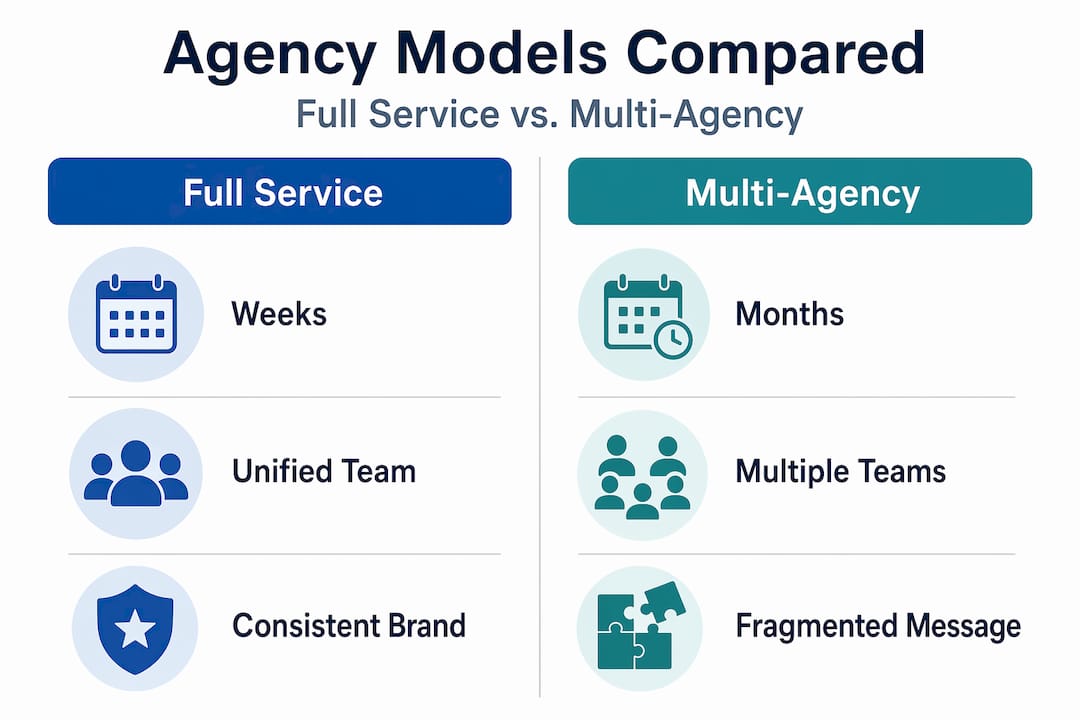
Consider how a full service agency runs a product launch campaign. The strategy team builds a go-to-market plan in week one. In week two, creative develops assets aligned to the target audience positioning. By week three, paid media configures campaigns using those exact assets, and the SEO team publishes supporting content targeting the same search intent. Performance data flows into a shared dashboard, and all three teams adjust in real time.
Compare that to a multi-agency setup. The strategy team hands off a document to the creative agency, which takes two weeks to interpret and brief internally. The creative assets arrive late to the paid media agency, which built its own ad structure in the meantime. The SEO content goes live on a different messaging angle because no one coordinated. The client spends the first month sorting out the misalignment rather than capturing market opportunity.
Managing multiple specialist agencies becomes inefficient as business scales. This is not a minor inconvenience. It is a compounding drag on marketing ROI as your channels multiply.
The table below summarizes the measurable differences between integrated and fragmented agency models:
| Factor | Full service agency | Multi-agency model |
|---|---|---|
| Campaign launch time | Weeks | Months |
| Brand messaging consistency | Unified across all channels | Varies by agency interpretation |
| Performance accountability | Single point of accountability | Distributed, often unclear |
| Cost of coordination | Built into agency workflow | Falls on internal team |
| KPI alignment | Tied to business metrics | Channel-specific metrics |
Understanding how marketing funnels connect to business KPIs like CAC and customer lifetime value is critical to getting the most from a full service relationship. When your agency measures the same metrics your CFO watches, the conversation about marketing investment becomes far more productive.
My take on agency integration and marketing ROI
I have worked with businesses at every stage, from early-growth service businesses to mid-market brands with substantial marketing budgets. The pattern I see most often is this: companies underinvest in integration and overinvest in individual channel performance. They celebrate a paid media team hitting a 3.5x ROAS while their SEO traffic is declining and their email list is disengaged. Each team delivered on its own metrics. The business still lost ground.
What I have found is that the value of a full service agency is not primarily about having more services available. It is about having one team that cares about your total outcome. When the paid media manager and the content strategist sit in the same weekly meeting, they solve problems together that fragmented teams never even see.
The caution I consistently give is this: scrutinize white-label delivery models carefully. I have seen businesses pay full-service retainers while receiving the same outsourced execution they could have purchased for a fraction of the cost. The label means nothing. The delivery model is everything.
My honest advice: treat the agency selection process like hiring a senior employee. Check references. Ask hard questions about methodology. Demand transparency on who does the work. The agencies that resist those questions are telling you everything you need to know.
— Tran
How Sourcesnova delivers integrated marketing for real growth
Sourcesnova was built specifically to solve the fragmentation problem that costs small and mid-size businesses marketing ROI every day. As a full service digital agency focused on local and SMB growth, Sourcesnova provides strategy, digital presence, content, paid media, and performance reporting under one accountable team. No bloated retainers. No vanity metrics. Just clear execution tied to the results that matter: more visibility, more qualified visitors, and more customers.
For businesses across retail, e-commerce, service industries, and beyond, Sourcesnova delivers integrated SMB marketing strategies that remove coordination overhead and build consistent brand presence across every channel. If your business is ready to stop managing disconnected vendors and start growing with a partner that treats your business like its own, Sourcesnova is built for exactly that.
FAQ
What is the full service agency definition?
A full service agency provides end-to-end marketing services including strategy, creative, media, digital, and analytics under one team and one contract. The defining characteristic is that all disciplines operate from a unified brief rather than independently.
What does a full service agency do differently from a specialist agency?
A full service marketing agency coordinates all marketing channels internally, which means brand messaging stays consistent and performance data connects across the entire customer journey. A specialist agency focuses on a single channel and delivers metrics only for that channel.
What are the main benefits of a full service agency?
The primary benefits of a full service agency are reduced coordination overhead, faster campaign deployment, consistent brand messaging, and marketing investment tied to business growth metrics rather than channel-level vanity numbers.
How do I know if a full service agency is truly integrated?
Ask the agency to document which services are delivered by in-house employees versus third-party or white-label partners. A genuinely integrated agency has internal teams across disciplines and a unified methodology connecting strategy, creative, and media.
When should a business choose a specialist agency instead?
If your business has one primary acquisition channel that already performs well and your marketing complexity is low, a specialist agency may deliver more concentrated value. Full service agencies provide the greatest return when you are running campaigns across multiple channels simultaneously.