
Video marketing is the strategic use of video content to promote brands, engage audiences, and drive measurable business outcomes. The role of video marketing in 2026 is no longer optional. 91% of businesses now use video as a marketing tool, and 82% of marketers report positive ROI from social media video alone. That adoption rate reflects a fundamental shift: video has moved from a creative add-on to a core business function. For marketing professionals and small business owners, understanding how video content works across the customer journey is the difference between a brand that gets noticed and one that gets ignored.
What is the role of video marketing in business growth?
Video marketing functions as a full-funnel business tool, not just a content format. It builds awareness at the top, educates prospects in the middle, and converts buyers at the bottom. Successful brands now treat video as a structured asset connected to specific customer journey stages rather than a series of one-off creative projects. That shift in thinking changes everything about how video gets planned, produced, and measured.
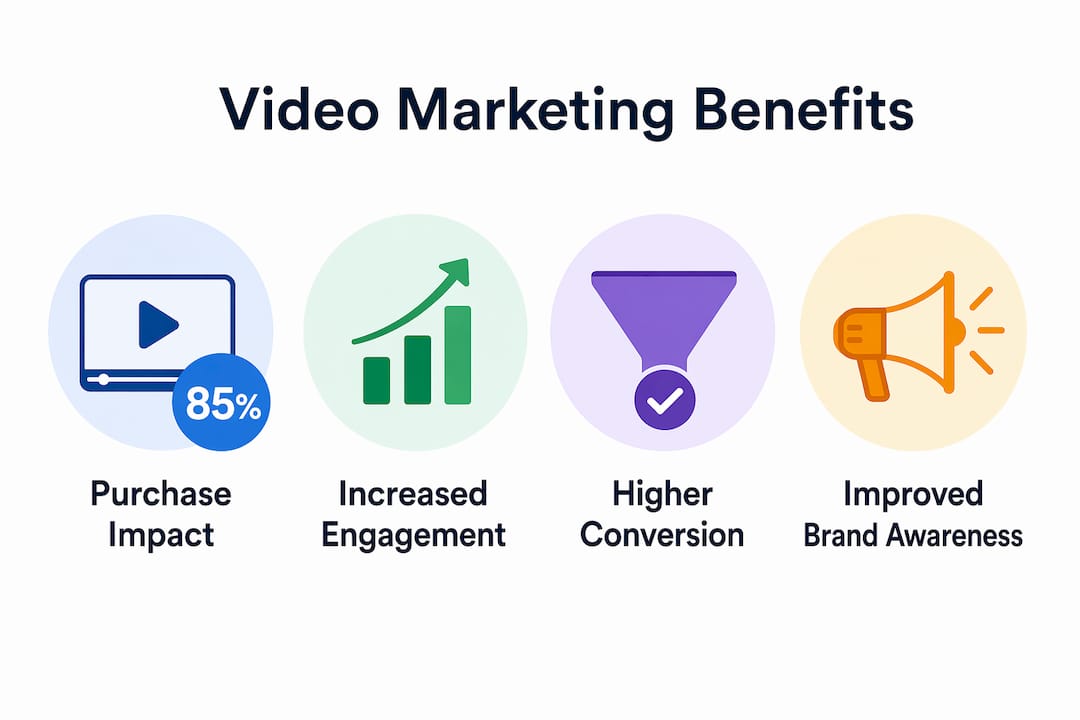
The impact shows up in buyer behavior. 85% of consumers say video has helped them make a purchase decision. That number means your product video is doing sales work around the clock. Video also improves product understanding for 93% of marketers, which directly reduces buyer hesitation and support costs.

For small businesses, the practical value is clear. A two-minute product walkthrough on your website answers the questions your sales team fields every day. A short brand story on Instagram builds the trust that a text bio never could. Video compresses the relationship-building timeline in a way no other format matches.
What are the key benefits of video content for marketers?
The benefits of video content span every major marketing objective, from search visibility to customer retention. Here is where video delivers the most measurable impact:
- SEO and organic traffic. Video ranks higher in search results and increases organic traffic. Search engines treat video as a signal of content quality, and pages with embedded video earn longer dwell times, which improves rankings.
- Engagement and reach. Social media video engagement is now the fastest-growing performance metric, surpassing raw view counts as the primary indicator of success. Engagement signals tell algorithms to push your content to more users.
- Platform-specific growth. LinkedIn video usage among marketers jumped from 61% to 81% year over year. That growth rate signals where B2B audiences are shifting their attention.
- Conversion and sales. Product videos reduce buyer hesitation at the decision stage. When a customer can see a product in use, their confidence in purchasing increases significantly.
- Brand trust. Authentic video content builds emotional connection faster than written content. Customers who feel they know your brand are more likely to return and refer others.
The importance of video marketing becomes most visible when you compare it to static content alternatives. A blog post explains. A video demonstrates. Demonstration closes more sales.
Pro Tip: Embed a short product or service video on your highest-traffic landing page and track the change in time-on-page and conversion rate over 30 days. The data will make the case for expanding your video investment.
Short-form vs. long-form: which format serves your strategy?
Video format selection is a strategic decision, not a creative preference. Short-form and long-form videos serve distinct roles in a complete marketing strategy, and using only one leaves part of your funnel unaddressed.
| Format | Best use case | Primary goal |
|---|---|---|
| Short-form (under 60 seconds) | Social discovery, ads, brand awareness | Top-of-funnel reach and algorithm favor |
| Long-form (5+ minutes) | Webinars, tutorials, product deep-dives | Authority building and lead nurturing |
| Mid-form (1–5 minutes) | Explainers, testimonials, case studies | Consideration and conversion |
Short-form videos under 60 seconds dominate discovery and algorithmic reach on platforms like TikTok, Instagram Reels, and YouTube Shorts. They are built for attention capture, not depth. Long-form video builds authority and facilitates the kind of detailed education that turns a prospect into a confident buyer.
The most effective video marketing strategies use both. A webinar or tutorial video provides deep value to an engaged audience. That same content can then be repurposed into multiple short clips to sustain engagement and traffic for months after the original recording. One long-form asset becomes ten short-form touchpoints across different platforms and audiences.
Balancing entertaining content with value-driven content matters at every length. Algorithms favor engagement signals over production polish. A clear, genuinely useful video filmed on a smartphone will outperform a high-budget production that says nothing worth remembering.
Pro Tip: When you record a webinar or long tutorial, immediately plan your short-form repurposing schedule. Identify three to five standalone moments before you even hit publish on the full version.
How do AI tools and modern production workflows change video output?
AI has fundamentally changed what a small marketing team can produce. 80% of marketing teams now use AI to support video production processes including scriptwriting, editing, captioning, and translation. The result is higher volume without proportional budget increases.
The production model itself is shifting. The in-house multimedia producer is now a standard role on modern marketing teams. One person handles scripting, on-camera hosting, and basic editing, supported by AI tools that handle the repetitive technical work. Outsourcing is reserved for specialized projects where production quality is a brand differentiator.
Here is how small teams can adopt this model effectively:
- Start with AI scriptwriting tools. Tools like ChatGPT or Jasper can generate first-draft scripts from a brief. You edit for voice and accuracy, cutting production prep time significantly.
- Use AI-powered editing platforms. Platforms like Descript allow you to edit video by editing the transcript. This removes the technical barrier for non-editors.
- Automate captions and accessibility. Auto-captioning tools built into platforms like YouTube Studio and CapCut make your content accessible and improve watch time on silent autoplay.
- Batch your production. Film multiple videos in one session. Changing your shirt between takes gives you variety without resetting your entire setup.
- Reserve outsourcing for brand-critical content. Your brand launch video or annual campaign deserves professional production. Your weekly educational content does not.
The role of automation in marketing extends directly into video workflows. Teams that adopt AI tools now are building a production capacity advantage that compounds over time.
How to integrate video into your customer journey and marketing strategy
Video works best when it is mapped to specific stages of the customer journey rather than produced in isolation. Each stage requires a different type of video with a different objective.
- Awareness stage. Short social videos, brand story content, and educational clips introduce your brand to new audiences. The goal is reach and recognition, not conversion.
- Consideration stage. Explainer videos, product demos, and customer testimonials address the questions buyers ask before making a decision. Place these on product pages, in email sequences, and on YouTube.
- Decision stage. Case studies, comparison videos, and detailed tutorials give buyers the final confidence to purchase. These videos work hardest on landing pages and in retargeting campaigns.
- Retention stage. Onboarding videos, how-to content, and community updates keep existing customers engaged and reduce churn. This is the most underused stage in most video strategies.
Aligning video production with your campaign calendar prevents the common problem of reactive content creation. Plan your video topics around product launches, seasonal demand, and recurring customer questions. YouTube and LinkedIn serve different audience behaviors. YouTube functions as a search engine, so long-form educational content compounds in value over time. LinkedIn rewards professional insight and B2B credibility. Understanding top B2B content types helps you match format to platform intent.
Measurement closes the loop. Track engagement rate, watch time, click-through rate, and conversion rate by video type. The data tells you which formats and topics earn the most business impact, so you can produce more of what works.
Key takeaways
Video marketing delivers the highest ROI when treated as a structured business tool mapped to the customer journey, not as a creative exercise.
| Point | Details |
|---|---|
| Video drives purchase decisions | 85% of consumers say video directly influenced a buying decision. |
| Format selection is strategic | Short-form builds reach; long-form builds authority. Use both to cover the full funnel. |
| AI expands production capacity | 80% of teams use AI for scripting and editing, producing more content without proportional budget growth. |
| Repurposing multiplies ROI | One long-form video can generate months of short-form content across multiple platforms. |
| Engagement beats views | Social media engagement rate has replaced view count as the primary video success metric. |
Why most businesses are still using video wrong
I have worked with enough small businesses to see the same pattern repeat. They produce a brand video, post it once, and wonder why nothing changed. The problem is not the video. The problem is treating video as an event instead of a system.
The businesses that get real results from video are the ones that build a repeatable production process. They film consistently, repurpose aggressively, and measure what actually moves the needle. They are not waiting for perfect production quality. They are shipping content that answers real customer questions, and they are doing it every week.
The AI tools available now remove most of the excuses. Descript, CapCut, and similar platforms have made editing accessible to anyone willing to spend an afternoon learning the basics. The gap between businesses that use video well and those that do not is no longer a budget gap. It is a commitment gap.
I also think most businesses underestimate the retention stage. Everyone wants to make videos that attract new customers. Almost nobody makes videos that keep existing customers engaged. A simple onboarding video series can reduce support requests and increase repeat purchases more reliably than any top-of-funnel campaign. Start there if you are not sure where to begin.
The role of content strategy in business growth applies directly to video. Without a plan, you produce content that feels busy but delivers nothing measurable. With a plan, every video has a job to do.
— Tran
Ready to build a video strategy that actually works?
Sourcesnova helps small and mid-size businesses turn marketing investment into real growth. If you are ready to move beyond guesswork and build a video marketing strategy tied to your actual business objectives, Sourcesnova provides the clear strategy and hands-on execution that most agencies skip.

From content planning to channel strategy, Sourcesnova works with businesses across retail, e-commerce, and service industries to build marketing systems that perform. No bloated retainers, no vanity metrics. Visit Sourcesnova to explore how a structured video marketing approach can strengthen your brand visibility and convert more of the right customers.
FAQ
What is the role of video marketing in 2026?
Video marketing serves as a full-funnel business tool that builds brand awareness, educates prospects, and drives conversions. With 91% of businesses using video as a marketing tool, it is now a baseline requirement for competitive brand visibility.
How does video marketing improve SEO?
Video increases dwell time on web pages and earns higher placement in search results. Search engines treat video as a quality signal, which improves organic rankings for pages that include relevant video content.
What video format works best for small businesses?
Short-form videos under 60 seconds work best for discovery and social reach, while mid-form explainer and testimonial videos drive conversions. A combination of both formats covers the full customer journey most effectively.
How can small teams produce video content consistently?
The in-house multimedia producer model, supported by AI tools like Descript and CapCut, allows small teams to handle scripting, filming, and editing without large budgets. Batching production sessions and repurposing long-form content into short clips extends output significantly.
How do you measure video marketing effectiveness?
Track engagement rate, watch time, click-through rate, and conversion rate by video type and placement. Engagement rate has replaced view count as the primary performance indicator, reflecting how well content resonates with its audience.