Yes, TikTok Shop is available in the United States, and it's worth testing if your products are visual, priced between $15 and $60, and suited to trend-driven discovery. TikTok Shop works best as a controlled acquisition channel, not a full storefront replacement. Statista tracks roughly $9 billion of TikTok Shop's $33 billion global 2024 sales coming from the U.S. market, confirming real scale here, not a niche experiment.
For most small businesses, the smart move is a small pilot, not a full migration off Shopify or your existing store. Two things you can do in the next 48 to 72 hours:
- Start Seller Center registration with your ID, bank details, and one hero SKU ready to list.
- Pull your current AOV and margin numbers so you can judge fit before committing ad spend.
Key Takeaways
TikTok Shop USA works best as a disciplined acquisition channel for visual, mid-to-low AOV products, not as a replacement for owned e-commerce infrastructure.
| Point | Details |
|---|---|
| Confirm U.S. availability and fit | TikTok Shop suits visual, trend-driven products in the $15 to $60 range with room to absorb fee volatility. |
| Register with clean documentation | Match your EIN, bank account, and business name exactly to avoid the most common verification delay. |
| Model fees conservatively | Commission rates have shifted before, so rebuild unit-economics assumptions quarterly, not annually. |
| Keep fulfillment flexible | Pair FBT for fast-moving SKUs with an independent 3PL to cover coverage gaps and late-shipment risk. |
| Capture value beyond the platform | Push TikTok buyers into email and SMS flows immediately so a single sale can become a repeat customer. |
| Get expert help for the technical build | Sourcesnova runs Shopify and TikTok integration, creator outreach, and fulfillment strategy for U.S. sellers piloting the channel. |
Table of Contents
- Getting Started With TikTok Shop USA: Registration And Requirements
- How Much Do TikTok Shop USA Seller Fees Actually Cost?
- Shopify Sync, 3PLs, And Fulfilled By TikTok: Which Fulfillment Setup Fits?
- Which Creators And Content Formats Actually Drive TikTok Shop Sales?
- What KPIs Matter Most When Piloting TikTok Shop?
- Legal And Tax Considerations For US Sellers On TikTok Shop
- What Customer Service Standards Should You Expect On TikTok Shop USA?
- When Did TikTok Shop Launch In The USA And How Big Is It Now?
- How Does TikTok Shop Compare To Other US Social Commerce Platforms?
- SourcesNova Perspective: What We Recommend For U.S. Merchants
- How SourcesNova Can Help With Your TikTok Shop USA Launch
- Sources
Getting Started With TikTok Shop USA: Registration And Requirements
Seller Center sorts U.S. applicants into three account types, and each one asks for different paperwork. Individual sellers need a government ID and either a Social Security number or an ITIN. Sole proprietors add a bank account under their name. Corporations and LLCs need an EIN, formation documents, and a business bank account that matches the legal entity name exactly, a mismatch here is the single most common reason applications stall.
Verification usually runs 24 to 48 hours, though the official Seller Center cites a window up to 72 hours during high application volume. The most common delay comes from mismatched business names between your EIN documentation and your bank statements.
Before you start the application, gather:
- A valid ID and SSN or ITIN, or an EIN for registered businesses.
- Bank account and routing numbers tied to the legal entity name on file.
- A completed W-9 form for tax reporting.
- Your warehouse or fulfillment address and a separate returns address if different.
- Product category documentation, required for regulated goods like supplements or cosmetics.
Pro Tip: Apply with your single best-selling SKU first rather than your full catalog. A narrow application with clean documentation clears review faster than a bulk upload with gaps.
How Much Do TikTok Shop USA Seller Fees Actually Cost?
Three cost layers hit every sale: a referral fee based on category, a payment processing fee, and optional promotional fees when you fund Shop Ads or affiliate commissions. None of these are fixed forever. The Ecommerce Times 2026 audit documents real commission rate instability across categories, meaning the referral percentage you model today can shift before your next inventory order lands.
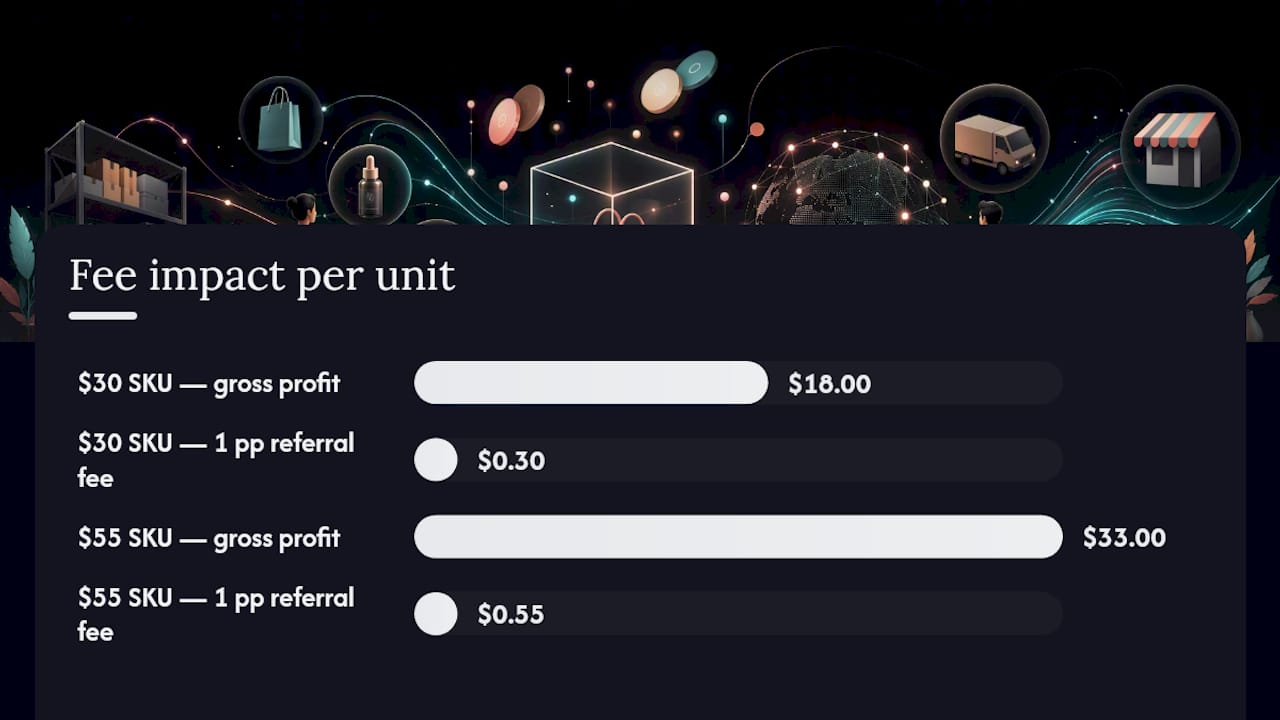
That volatility matters more on thin margins than fat ones. Consider two products:
- A $30 impulse SKU with 60% gross margin: a few points of fee movement can erase most of your contribution margin per unit.
- A $55 mid-AOV SKU with the same margin percentage: the same fee shift costs you real dollars but leaves more room to absorb it.
Fee sensitivity check: because the platform reported over $32 billion in H1 2026 GMV while still adjusting commission structures, treat any fee assumption as provisional and rebuild your unit economics model quarterly, not annually.
Run your own numbers before scaling spend. If a single percentage-point change in referral fees flips your contribution margin negative, the product is too fragile for this channel regardless of how well it performs creatively.
Shopify Sync, 3PLs, And Fulfilled By TikTok: Which Fulfillment Setup Fits?
The TikTok for Shopify integration syncs inventory, orders, and pricing automatically once connected, so a sale on TikTok Shop deducts stock from your Shopify count in near real time. That native sync removes the double-entry bookkeeping that used to make multichannel selling error-prone for small teams.
Fulfilled by TikTok (FBT) handles pick, pack, and ship for you, but the same 2026 audit documents late-shipment issues and coverage limits that leave some categories and regions underserved. Many sellers run a hybrid: FBT for fast-moving, low-complexity items, and an independent 3PL like ShipBob or ShipMonk for anything fragile, customized, or shipped outside FBT's current footprint.
Before you commit to either path, build this checklist:
- Confirm your 3PL's TikTok Shop integration handles order tagging correctly to avoid duplicate shipments.
- Set a returns SLA and communicate it in your product listings, TikTok Shop buyers expect Amazon-level speed.
- Track late-shipment rate weekly for the first 60 days, not monthly, since a bad streak can suppress your Shop visibility fast.
Pro Tip: Keep a backup 3PL contract signed even if you plan to use FBT exclusively. Switching fulfillment mid-crisis costs you more in lost Shop performance than the standby fee ever will.
Which Creators And Content Formats Actually Drive TikTok Shop Sales?
Creator-led content and live shopping consistently outperform brand-only posts, largely because the Open Collaboration and affiliate ecosystem lets dozens of creators test your product simultaneously at a pace a brand account alone can't replicate. This is the mechanism worth understanding before you spend a dollar on paid promotion.

A working creator brief needs four things: the product's single strongest hook, three do's and don'ts for demonstrating it on camera, your commission offer, and a sample fulfillment timeline. Post it through the Affiliate Marketplace or Open Collaboration tools inside Seller Center rather than cold-messaging creators individually, the built-in tools track commission payouts automatically.
For a first pilot, run this cadence over 30 to 60 days:
- Week one: recruit 10 to 15 micro-creators through Open Collaboration and ship samples.
- Weeks two through four: prioritize demo and POV-style videos, they convert better early than polished brand content.
- Weeks five and six: layer in one or two live shopping sessions once you have organic content proving demand.
- Throughout: reinvest commission budget toward whichever creator format is driving the lowest cost per order.
A platform like Money Plug can help structure creator payout systems if you're managing affiliate relationships across more than a handful of partners.
Pro Tip: Send samples to creators before you fund any ad spend. Organic creator content that already converts is the cheapest signal you'll get for which Shop Ads to scale.
What KPIs Matter Most When Piloting TikTok Shop?
Track ROAS, customer acquisition cost, average order value, return rate, and contribution margin from day one, then layer in lifetime-value signals once you have repeat-purchase data. A pilot that looks profitable on ROAS alone but ignores return rate is telling you half the story.
Attribution here isn't as clean as a direct Shopify checkout. Affiliate commission disputes can take weeks to resolve, and the platform audit flags this as a recurring friction point for sellers reconciling payouts. Build a weekly reconciliation habit rather than waiting for month-end totals to surprise you.
- Set up email and SMS flows that trigger the moment a TikTok Shop order syncs into your customer database.
- Enrich each new buyer's Shopify profile immediately so a one-time TikTok purchase has a path to become a repeat, owned-channel customer.
- Reconcile affiliate commission ledgers weekly, not monthly, to catch disputes while resolution is still practical.
The real value of a TikTok Shop buyer often shows up months later in your email list, not in the initial order.
Legal And Tax Considerations For US Sellers On TikTok Shop
Selling on TikTok Shop doesn't change your underlying tax obligations, it just adds a new sales channel to report. Every seller must complete a W-9, and TikTok issues 1099-K forms to sellers who cross the federal reporting threshold, so keep your gross sales records reconciled against what the platform reports at year-end.
Sales tax collection on TikTok Shop is handled through marketplace facilitator laws in most states, meaning the platform collects and remits sales tax on your behalf in states where those laws apply. That doesn't eliminate your own registration obligations if you also sell through other channels in the same states, consult a tax professional familiar with multichannel e-commerce before assuming TikTok's remittance covers everything.
Product compliance matters just as much as tax paperwork. Categories like cosmetics, supplements, and children's products carry FDA or CPSC labeling and safety requirements regardless of which platform you sell through. TikTok Shop's category application process asks for supporting documentation in these categories precisely because regulators hold the seller, not the platform, responsible for compliance.
Keep your business entity structure documented and consistent across your EIN, bank account, and Seller Center registration. A mismatch between your legal name and your operating name is a common source of both onboarding delays and tax filing headaches later. If you're new to registering a formal business entity for e-commerce, a short consultation with a small-business accountant before you scale spend costs far less than untangling a compliance issue after the fact.
What Customer Service Standards Should You Expect On TikTok Shop USA?
Buyers on TikTok Shop expect Amazon-level response speed, even from a small independent seller. That expectation is baked into the platform's seller performance scoring, which factors in response time, order defect rate, and shipping speed into your Shop's visibility in search and recommendations.
Set a response time target of a few hours for buyer messages during business hours, and staff at least a basic auto-response for after-hours inquiries. Slow responses don't just frustrate one buyer, they can quietly suppress how often your listings surface to new shoppers.
Returns and refunds need a clear, published policy inside your Shop settings, matched by fast internal handling once a return request comes in. Sellers using a hybrid fulfillment model, FBT for some SKUs and an independent 3PL for others, need consistent return windows across both so buyers don't get conflicting information depending on which product they ordered.
Live shopping sessions raise the bar further. Buyers who ask questions during a livestream expect real-time answers, which means either the seller or a trained creator partner needs product knowledge deep enough to handle objections on camera without hesitation. Treat your first few livestreams as a training exercise for whoever is hosting, scripted answers to common objections prevent dead air that kills conversion mid-stream.
When Did TikTok Shop Launch In The USA And How Big Is It Now?
TikTok Shop launched broadly in the U.S. in September 2023, following a smaller pilot phase earlier that year. What started as an experimental checkout feature inside the app has become a full commerce platform with its own seller tools, advertising products, and fulfillment infrastructure.
Growth since launch has been fast by any retail standard. TikTok Shop crossed over $32 billion in GMV in H1 2026 alone globally, and Statista's tracking shows the U.S. accounting for roughly $9 billion of the platform's $33 billion 2024 total, a meaningful share of a genuinely global business.
That growth hasn't been friction-free. Operational audits document commission instability and fulfillment reliability gaps as the platform matures its seller infrastructure. For U.S. small businesses, that combination means real opportunity paired with real operational risk, exactly why a measured pilot beats an all-in migration in year one.
How Does TikTok Shop Compare To Other US Social Commerce Platforms?
TikTok Shop's biggest structural advantage over other social commerce options is its discovery engine. The algorithm surfaces product videos to users who never searched for the product at all, closer to impulse retail than search-driven shopping. Other social platforms with shopping features tend to rely more heavily on existing follower relationships, which favors brands that already have an audience rather than ones trying to build one from scratch.
Average order values reflect that discovery-first model. Industry benchmarks put TikTok Shop's typical AOV around $38, compared with roughly $63 on Amazon, a gap that tells you a lot about buyer intent. TikTok Shop buyers are often making a lower-commitment, trend-driven purchase decision, while Amazon shoppers frequently arrive already intending to buy something specific.
That doesn't make one platform better than the other, it makes them suited to different jobs. Amazon still wins on high-intent search traffic and buyer trust for considered purchases. TikTok Shop wins on introducing a product to someone who wasn't looking for it yet. Most sellers with a Shopify store benefit from treating TikTok Shop as a top-of-funnel discovery layer that feeds their owned channels, rather than trying to replace either Amazon or their direct-to-consumer store with it entirely.
SourcesNova Perspective: What We Recommend For U.S. Merchants
Our take is simple: pilot one TikTok-friendly SKU, keep fulfillment independent rather than fully dependent on FBT, and instrument your post-purchase flows before you scale spend. The sellers who extract real margin treat TikTok Shop as an acquisition engine and let Shopify sync push buyers into owned retention channels.
We run this exact combination for clients, Shopify and TikTok integration work, creator outreach structuring, and 3PL strategy, because the operational pieces matter as much as the creative.
How SourcesNova Can Help With Your TikTok Shop USA Launch
Sourcesnova is the practical alternative to trial-and-error TikTok Shop setup for small businesses that don't have a full e-commerce team on staff. We handle the technical integration between Shopify and TikTok Shop, structure creator outreach so you're not cold-messaging affiliates one by one, and build the 3PL or hybrid fulfillment strategy that keeps your margins intact once orders start coming in.
A typical pilot engagement runs 30 to 60 days, matching the same content cadence recommended earlier in this guide, giving you enough data to decide whether to scale before committing further ad budget. We also set up Shop Ads and paid social campaigns alongside your organic creator content once you have proof of what converts.
If you're an Asian manufacturer or consumer brand evaluating U.S. market entry more broadly, TikTok Shop is often one piece of a larger direct-to-consumer launch strategy, not the whole plan. Book a consult at Sourcesnova and we'll map out whether a TikTok Shop pilot fits your product, margin structure, and current fulfillment setup before you spend a dollar on ads.
Sources
- TikTok Shop’s U.S. Merchant Program in 2026: A Full Audit – Ecommerce Times
- TikTok Shop in the United States – statistics & facts | Statista
- TikTok Shop | buy, sell and discover on TikTok